
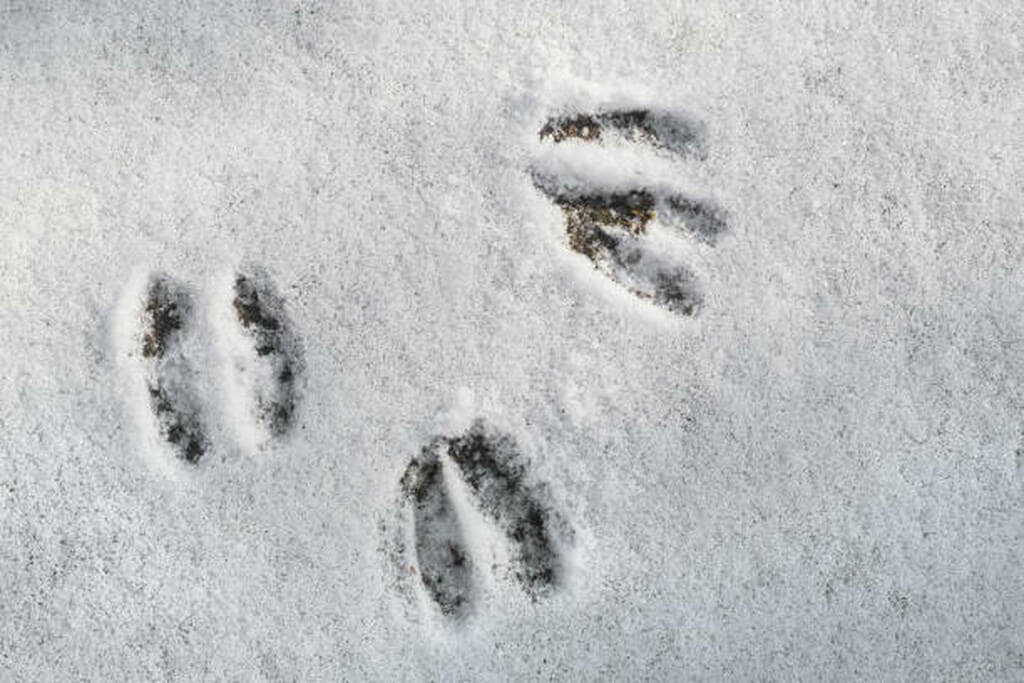
Deer tracks in the snow typically appear as two narrow, pointed hoof prints that form a heart-shaped or teardrop-shaped impression. In soft snow, the tracks often spread wider and may include two smaller dewclaw marks behind the main hooves. On firm or packed snow, the prints usually look sharper and more defined, making them easier to identify. However, snow depth, temperature, and the deer’s speed can all change the appearance of a track, which is why relying on a single footprint often leads to misidentification.
Learning to recognize deer tracks involves more than looking at hoof shape. Track size, stride length, gait pattern, travel direction, and the surrounding signs all provide important clues about the animal that left them behind. A series of tracks can reveal whether a deer was calmly walking toward a feeding area, running from a predator, or traveling between bedding sites during the early morning or evening.
This guide explains how deer tracks look in different snow conditions, how large they typically are, how to determine the direction of travel, and how to distinguish them from the tracks of animals such as moose, elk, coyotes, rabbits, and wild turkeys. You’ll also learn how to identify fresh tracks and avoid the most common mistakes when tracking deer in winter.
What do deer tracks look like in the snow?
Deer tracks in the snow consist of two elongated, pointed hoof prints that create a heart-shaped or teardrop-shaped outline. Each hoof is split into two toes, producing a clear gap down the center of the print. The pointed ends face the direction of travel, while the rounded ends remain at the rear.
On firm snow, individual hoof edges appear crisp and well-defined, making the split hoof easy to recognize. In powder snow, the hoof sinks deeper, causing the print to widen and lose some of its sharp edges. Wet or melting snow often enlarges the track as the surrounding snow collapses, making a deer track appear larger than it actually is.
Dewclaws are not visible in every track. These small secondary hooves usually register only when a deer runs, lands after a jump, travels through deep snow, or moves across muddy ground. When present, dewclaw marks appear slightly behind the main hoof print and indicate that more weight was placed on the foot during movement.
Track shape can also change depending on the deer’s behavior. A walking deer leaves compact, evenly spaced prints with minimal disturbance. A running deer creates longer gaps between tracks, deeper impressions, and more frequent dewclaw marks because each stride generates greater force. Recognizing both the hoof shape and the overall track pattern produces a much more reliable identification than examining a single footprint.
How big are deer tracks in the snow?
Most adult deer tracks measure about 2–3 inches (5–7.5 cm) long and 1.5–2.5 inches (4–6 cm) wide. Exact dimensions vary by species, sex, age, body weight, and snow conditions. Fresh, compact snow generally preserves the most accurate measurements, while melting snow can increase a track’s apparent size.
Buck tracks are typically larger, wider, and deeper than doe tracks because mature males weigh considerably more. During late autumn and winter, heavy-bodied bucks often leave broader hoof impressions with more visible dewclaws, especially in soft snow. However, track size alone cannot reliably determine sex because a large doe and a young buck may leave similarly sized prints.
Fawn tracks are noticeably smaller and narrower, usually measuring less than 2 inches (5 cm) in length. Their shorter stride and lighter body weight also produce shallower impressions, even in soft snow. Finding multiple track sizes together often indicates a doe traveling with one or more fawns.
Species also influence track dimensions. White-tailed deer generally leave smaller, narrower prints than mule deer, while both species produce substantially smaller tracks than elk or moose. Moose tracks frequently exceed 5 inches (13 cm) in length, making them easy to distinguish from deer once accurate measurements are taken.
When identifying a track, avoid relying on size alone. Compare hoof shape, stride pattern, track spacing, and nearby deer signs such as trails, droppings, or browsed vegetation. Evaluating multiple characteristics together greatly improves identification accuracy, especially after snowfall or partial melting has altered individual prints.
How are deer tracks arranged in the snow?
Deer tracks follow predictable movement patterns that reveal how the animal was traveling. While an individual hoof print confirms that a deer passed through an area, the arrangement of multiple tracks provides far more information about its speed, behavior, and destination.
A walking deer leaves a relatively straight trail with evenly spaced prints. The hind hoof often lands close to or directly on top of the front hoof print, creating a tidy, efficient pattern known as direct registration. Because deer conserve energy whenever possible, this walking gait is the pattern most commonly found near feeding areas, established trails, and bedding sites.
When a deer begins trotting or running, the spacing between tracks increases noticeably. Each hoof strikes the ground with greater force, producing deeper impressions. In soft snow, dewclaw marks become more common because the animal’s weight shifts farther backward as it accelerates. Running tracks also appear less symmetrical as the deer lengthens its stride to cover more ground.
A bounding pattern is common when a deer escapes danger or crosses deep snow. Instead of evenly spaced footprints, the tracks appear in grouped sets with long gaps between them. The hind feet often land ahead of the front feet during each leap, creating clusters that differ significantly from a normal walking trail. This pattern usually indicates that the deer was startled, avoiding an obstacle, or moving quickly through difficult terrain.
Stride length also offers valuable clues. An adult deer walking at a relaxed pace typically leaves shorter, consistent distances between each set of tracks, while faster movement creates progressively longer spacing. Although stride length varies with body size, terrain, and snow depth, sudden changes along the same trail often indicate a change in behavior, such as detecting a predator or approaching a food source.
How can you tell which direction a deer was traveling?
The pointed ends of the hoof prints indicate the direction the deer was moving. Because a deer’s hooves taper toward the front, the narrow tips always face forward, while the wider, rounded ends remain behind. This is the quickest and most reliable way to determine travel direction from a well-preserved track.
Looking at a single footprint is useful, but following several consecutive tracks provides much greater accuracy. A continuous trail reveals the natural flow of movement, making it easier to confirm direction even if individual prints have been partially covered by fresh snow, wind, or melting.
Stride alignment also helps identify the direction of travel. Walking deer typically place each foot in a smooth, consistent sequence that forms a narrow trail. As speed increases, the spacing between tracks grows longer while the trail maintains a clear forward progression. Observing this pattern over several yards often provides more confidence than relying on one isolated print.
Additional signs surrounding the tracks can confirm your interpretation. Disturbed snow kicked forward by the hooves, fresh browsed twigs, bedding depressions, droppings, or well-worn deer trails often appear along the direction of movement. These signs place the tracks within the deer’s natural behavior, helping distinguish whether the animal was traveling toward food, returning to cover, or moving between habitat areas.
When snow conditions have distorted the prints, avoid drawing conclusions from one footprint alone. Evaluate the entire trail, including hoof shape, track spacing, nearby deer sign, and the surrounding landscape. Combining multiple clues produces a far more accurate interpretation than relying on a single characteristic.
How can you tell if deer tracks are fresh?
Fresh deer tracks have sharp, well-defined edges and show little evidence of weathering. Shortly after a deer passes, the outline of each hoof print remains crisp, the bottom of the track looks clean, and loose snow displaced by the hooves is still visible around the edges. These characteristics make fresh tracks much easier to identify than older ones.
As time passes, weather gradually changes the appearance of a track. Wind blows loose snow into the print, softening the edges and reducing detail. Direct sunlight causes the snow to melt and refreeze, creating rounded borders that make the track appear larger than it originally was. Additional snowfall can partially or completely fill the impression, making it difficult to determine its true shape or size.
Temperature also affects track preservation. During freezing conditions, deer tracks may remain recognizable for several days if there is little wind or new snowfall. In contrast, temperatures near or above freezing can noticeably alter a track within a few hours as melting snow enlarges the print and obscures the split hoof pattern.
The most reliable way to judge freshness is to evaluate the track together with other nearby deer signs. Fresh droppings usually appear moist and glossy before drying over time. Recently browsed twigs expose light-colored wood where buds or stems were eaten. New bedding areas show clean depressions in the snow with little accumulation, while fresh trails often display multiple sharp hoof prints leading to feeding or resting locations. When several fresh signs occur together, they provide much stronger evidence than a single footprint alone.
Avoid estimating freshness based solely on track size or depth. Snow conditions, sunlight, wind, and repeated deer traffic can all alter a print after it is made. Examining the entire trail and the surrounding habitat produces a far more accurate assessment.
Why do deer tracks look different in different snow conditions?
Snow conditions significantly influence the appearance of deer tracks, even when the same deer leaves them. Snow depth, moisture content, temperature, and surface hardness all determine how much the hoof sinks and how well the print retains its shape.
In dry powder snow, a deer’s hooves sink deeply and push loose snow outward. The resulting tracks often appear wider, less defined, and slightly larger than the actual hoof. Fine details, such as the narrow gap between the split hooves, may become difficult to distinguish because the surrounding snow collapses into the impression.
Wet snow produces cleaner and more complete prints because it compacts under pressure. Individual hoof edges remain visible immediately after the track is made, making wet snow one of the easiest surfaces for identifying deer. However, if temperatures rise, these well-defined prints can quickly expand as melting softens the surrounding snow.
Crusted or frozen snow creates a different pattern. When the surface supports the deer’s weight, hoof prints may appear shallow and incomplete. If the crust breaks under pressure, the edges become jagged and irregular rather than smooth. This broken appearance can sometimes be mistaken for tracks left by a larger animal.
Melting snow is one of the most common causes of misidentification. As temperatures increase, the edges of a track gradually collapse outward, making the impression look both wider and longer than it originally was. A deer track that measured 2.5 inches when fresh may appear much larger after several hours of melting, leading people to mistake it for an elk or even a young moose.
Because snow continuously changes, experienced trackers avoid identifying an animal from a single footprint. Instead, they examine several tracks along the trail, compare their consistency, and consider current weather conditions. Combining hoof shape, gait pattern, track measurements, and snow conditions provides a much more reliable identification than relying on one enlarged or distorted print.
How do deer tracks compare with other animal tracks in the snow?
Deer tracks are distinguished by their two pointed, split hooves, but several other animals leave prints that can appear similar under certain snow conditions. Comparing hoof shape, track size, gait, and trail pattern is the most reliable way to avoid misidentification.
Moose tracks resemble deer tracks because both animals have cloven hooves. The difference is size. Adult moose tracks commonly measure 5–7 inches (13–18 cm) long, making them more than twice the size of most deer tracks. Moose prints also appear broader, rounder, and more widely spaced because of the animal’s larger body and longer stride.
Elk tracks are another common source of confusion. They have the same basic split-hoof shape but are noticeably larger than deer tracks, typically measuring 4–5 inches (10–13 cm) long. Elk also leave wider trail patterns and longer stride lengths, reflecting their greater height and weight.
Coyote tracks are easy to distinguish once you recognize that they belong to a canine rather than a hoofed animal. Instead of two hoof prints, a coyote track shows four toes surrounding a central paw pad, often with visible claw marks extending forward. Coyotes usually travel in a straight, narrow line, creating a trail that differs significantly from the alternating hoof pattern of a deer.
Rabbit tracks have a completely different arrangement. Their large hind feet land ahead of the smaller front feet, producing a repeated four-print pattern that often forms a “Y” shape. The grouped hopping pattern is unlike the evenly spaced hoof prints left by a walking deer.
Wild turkey tracks display three long forward-pointing toes and one shorter rear toe. Because there are no hooves, turkey prints are immediately recognizable once the individual toes become visible. Turkeys also leave scratch marks where they search for seeds, insects, and other food beneath the snow or leaf litter.
When snow has partially melted or drifted, individual prints may become distorted. In these situations, compare the entire trail instead of one footprint. Track size, gait, spacing, habitat, and nearby animal sign together provide a much more dependable identification than hoof shape alone.
What other signs help identify deer besides tracks?
Tracks provide strong evidence of deer activity, but additional field signs help confirm that deer recently used an area. Experienced trackers rarely rely on footprints alone. Instead, they evaluate multiple signs that reflect the animal’s feeding, resting, and movement patterns.
Deer droppings are one of the easiest signs to recognize. Fresh pellets are dark, moist, and glossy, while older pellets gradually dry, harden, and fade in color. Finding fresh droppings near a trail often indicates that deer have been feeding or traveling through the area within a relatively short period.
Browsed vegetation is another reliable indicator. Deer feed by clipping buds, twigs, leaves, and young shoots with their lower teeth and hard upper palate. The bitten ends usually appear rough and slightly torn, unlike the clean cuts left by rabbits or the larger breakage caused by moose. During winter, freshly browsed shrubs and saplings often stand out against the surrounding snow.
Bedding areas reveal where deer have rested. These locations appear as oval depressions pressed into the snow, frequently surrounded by multiple tracks leading in and out. Bedding sites are commonly found in sheltered locations such as dense conifer stands, brushy hillsides, or areas protected from strong winds.
Rubs and scrapes provide additional clues, especially during the breeding season. Bucks create rubs by scraping the velvet from their antlers or marking trees with scent glands, leaving patches of stripped bark on small trees. Scrapes are shallow areas of disturbed soil or snow where bucks paw the ground and deposit scent to communicate with other deer.
Well-established deer trails connect feeding areas, bedding sites, and water sources. These narrow paths often contain repeated hoof prints from multiple animals using the same route over days or weeks. Following these trails can reveal how deer move through a landscape and identify travel corridors that remain active throughout the winter.
The most accurate identification comes from combining several signs. A trail that includes fresh hoof prints, droppings, browsed vegetation, bedding depressions, and nearby rubs provides far stronger evidence of recent deer activity than any single clue viewed in isolation.
Read more: Tracking Wounded Deer: Complete Recovery Guide
What mistakes do people make when identifying deer tracks?
Most deer track identification errors occur because people evaluate a single footprint instead of the entire trail. Snow constantly changes after a track is made, so one distorted print rarely provides enough evidence for an accurate identification.
One of the most common mistakes is assuming a large track belongs to a large animal. As snow melts, the edges of a hoof print collapse outward, making the track appear significantly larger than when it was first created. A melted deer track can resemble an elk or even a young moose track if measurements are taken after several hours of thawing.
Another mistake is ignoring snow conditions. Powder snow, wet snow, crusted snow, and frozen surfaces each preserve tracks differently. A deer walking across soft powder leaves a much different impression than the same deer crossing packed or frozen snow. Without considering the surface conditions, it is easy to misinterpret both the size and shape of the print.
Many beginners also focus only on hoof shape while overlooking gait patterns. A deer’s movement creates a recognizable sequence of tracks that reflects whether it was walking, trotting, running, or bounding. Studying several consecutive prints often reveals more useful information than examining one isolated footprint.
Overlapping tracks can also cause confusion. In areas with frequent deer activity, multiple animals may use the same trail over several days. New prints crossing older ones create irregular shapes that no longer resemble a typical deer track. Following the trail in both directions usually reveals where individual track sets separate, making identification much easier.
Another common error is ignoring nearby evidence. Tracks should always be evaluated alongside other deer signs, including droppings, browsed vegetation, bedding areas, rubs, and established trails. These clues provide important context and help confirm that the tracks belong to a deer rather than another hoofed animal.
The most accurate approach combines multiple characteristics instead of relying on a single feature. Hoof shape, track size, stride length, gait, snow conditions, habitat, and surrounding deer sign together produce a much more reliable identification than any one clue alone.
Frequently Asked Questions About Deer Tracks in the Snow
Can deer tracks disappear overnight?
Yes. Fresh snowfall, strong winds, melting temperatures, or repeated freeze-thaw cycles can partially or completely erase deer tracks within a few hours. During cold, stable weather with little wind, tracks may remain visible for several days.
Are deer tracks always heart-shaped?
No. Fresh tracks on firm snow usually have a distinct heart-shaped appearance because of the split hooves. However, deep powder, melting snow, or broken crust can distort the print, making it appear wider, rounder, or less defined.
Can you tell how old a deer is from its tracks?
Not accurately. Larger tracks generally belong to larger deer, but track size alone cannot determine age. Body weight, sex, species, snow conditions, and melting all influence the size and depth of a footprint.
Do deer always travel in straight lines?
No. Deer often follow winding paths while feeding, browsing vegetation, or avoiding obstacles. Longer, straighter trails are more common when deer travel between bedding areas, feeding sites, or water sources.
What is the easiest way to identify deer tracks?
Look for the combination of two pointed split hooves, an alternating walking pattern, and supporting deer signs nearby. Evaluating several consecutive tracks, rather than a single footprint, provides the most dependable identification, especially when snow conditions have altered individual prints.