
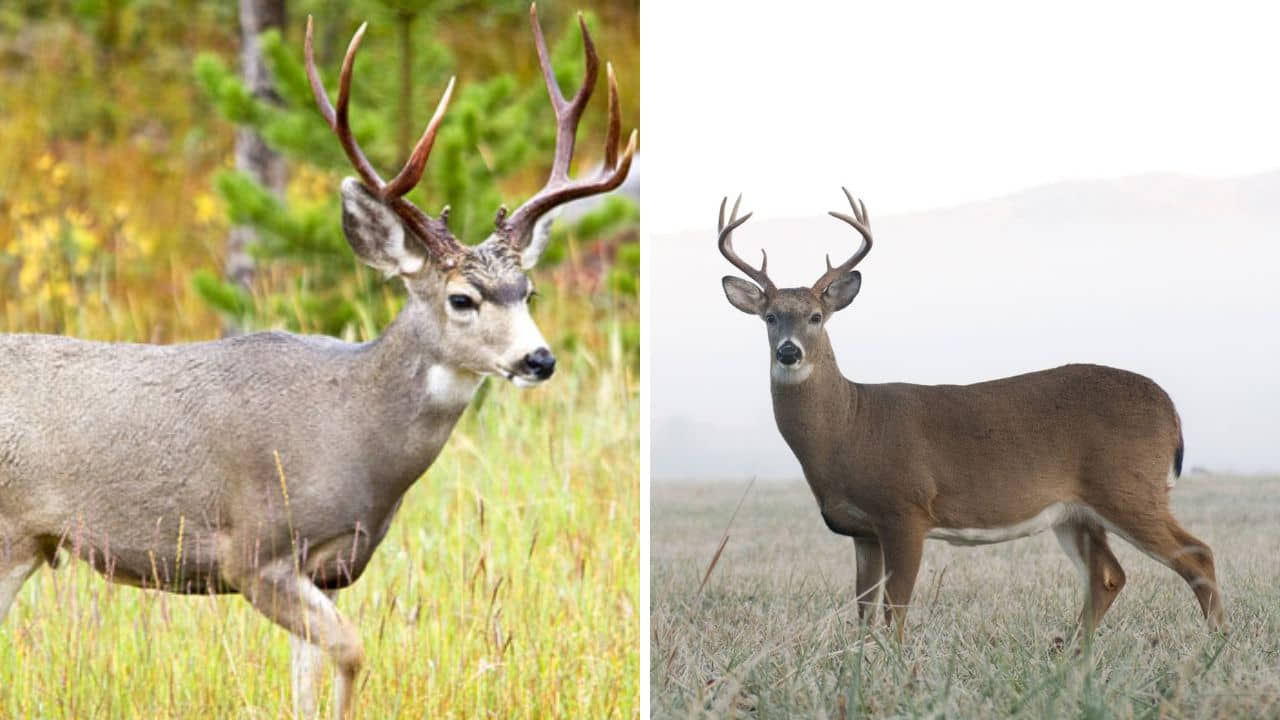
Mule deer and white-tailed deer differ in appearance, behavior, habitat, and movement, making accurate identification important for hunters, wildlife enthusiasts, and anyone exploring North American ecosystems. Although both species belong to the deer family (Cervidae) and often occupy neighboring ranges, they have distinct physical characteristics and survival strategies that make them relatively easy to distinguish once you know what to look for.
The fastest way to tell them apart is by examining their ears, tails, antlers, and escape behavior. Mule deer have oversized ears, black-tipped tails, forked antlers, and typically bound away with a stiff-legged gait called stotting. White-tailed deer have smaller ears, a broad white underside on the tail that is raised when alarmed, antlers with a single main beam, and a fast, agile running style through dense cover. These differences reflect how each species has adapted to different landscapes across North America.
This guide compares mule deer and white-tailed deer across the characteristics that matter most. You’ll learn how to identify each species in the field, where they live, how their behavior differs throughout the year, how to distinguish their tracks, whether they can hybridize, and which species presents a greater challenge for hunters. By the end of this article, you’ll have a clear understanding of the defining traits of both deer and know how to recognize them with confidence in almost any situation.
What are the biggest differences between mule deer and whitetail?
The biggest differences between mule deer and white-tailed deer are their ears, tails, antlers, movement, habitat, and behavior. While both species belong to the deer family, they evolved in different environments across North America, resulting in distinct physical features and survival strategies.
| Feature | Mule Deer | White-tailed Deer |
|---|---|---|
| Ears | Large, mule-like ears | Smaller, rounded ears |
| Tail | Thin with a black tip | Brown tail with a bright white underside |
| Antlers | Fork repeatedly as they grow | Grow from a single main beam with tines |
| Body Size | Generally larger and heavier | Slightly smaller and more compact |
| Habitat | Mountains, foothills, sagebrush, open country | Forests, farmland, river bottoms, suburban areas |
| Escape Style | Stots with stiff-legged jumps | Runs with long, fast bounds while raising its tail |
| Migration | Seasonal migrations are common | Usually maintains a smaller home range |
These characteristics provide the quickest way to distinguish the two species in the field. Hunters often identify mule deer from a distance by their large ears and bounding gait, while white-tailed deer are recognized by the flash of their raised white tail as they flee.
How can you tell a mule deer from a whitetail?
You can tell a mule deer from a whitetail by comparing six physical characteristics: ears, tail, antlers, face, body shape, and movement. Looking at several traits together is more reliable than relying on a single feature, especially in areas where both species share the same range.
Ears
Mule deer have noticeably larger ears than white-tailed deer. Their ears measure roughly three-quarters the length of the head and resemble those of a mule, which is the origin of the species’ common name. White-tailed deer have shorter, more rounded ears that appear proportional to the head.
Large ears also help mule deer detect predators across open landscapes where sound travels farther, while the smaller ears of white-tailed deer are well suited to forested environments.
Tail
The tail is the easiest feature to recognize when a deer is moving away. Mule deer have a narrow white tail with a distinct black tip and usually keep it lowered while running. White-tailed deer display a broad white underside that is raised like a flag whenever they are alarmed.
Because this behavior is highly consistent, the raised white tail is often the quickest field mark for identifying a white-tailed deer at long distance.
Antlers
Mule deer antlers fork repeatedly, whereas white-tailed deer antlers grow from a single main beam. As mule deer mature, each branch divides into two additional branches, creating a symmetrical forked appearance. White-tailed deer develop individual tines that project upward from one curved beam.
Although antler shape varies with age and genetics, this branching pattern remains one of the most reliable identification features for mature bucks.
Face and body shape
Mule deer typically have a broader face, darker forehead, and stockier frame than white-tailed deer. Their noses often appear darker, and their bodies are built for traveling long distances over rugged terrain. White-tailed deer have a slimmer head, longer neck, and a more streamlined body that allows quick acceleration through dense vegetation.
Movement
Mule deer and white-tailed deer escape predators using different running styles. Mule deer perform a high, stiff-legged leap known as stotting, with all four feet leaving and landing on the ground nearly together. This movement allows them to maintain balance and visibility while crossing rocky slopes and uneven terrain.
White-tailed deer rely on speed and agility instead. They sprint with long, low bounds, rapidly changing direction through forests and brush while keeping their white tail raised to alert other deer. Their running style is optimized for navigating dense cover rather than open landscapes.
How do mule deer and whitetail antlers differ?
Mule deer antlers grow by repeated forking, while white-tailed deer antlers develop from a single main beam with individual tines. This branching pattern is the most reliable way to distinguish mature bucks when body features are difficult to see.
Mule deer antlers split into two branches near the base, and each branch forks again as the buck ages. Mature animals often develop a balanced, symmetrical rack with multiple forks instead of a single dominant beam. The number of points depends on age, nutrition, and genetics, but the repeated bifurcation remains consistent across the species.
White-tailed deer follow a different growth pattern. Each antler develops from one curved main beam that extends forward before individual tines project upward. As bucks mature, they generally add more points along the beam rather than creating additional forks. This structure gives whitetail antlers a more sweeping appearance compared with the compact, forked frame of mule deer.
Although antlers are highly useful for identification, they should not be used alone. Young bucks may have simple spikes or small forks, and injuries during growth can produce abnormal antlers in either species. Hunters and wildlife observers should confirm identification by combining antler structure with ear size, tail markings, facial characteristics, and body shape.
Where do mule deer and whitetail live?
Mule deer and white-tailed deer occupy different habitats, although their ranges overlap in parts of western and central North America. Habitat preference is one of the primary reasons the two species developed different physical adaptations and behaviors.
Mule deer are most common in open landscapes, including mountains, foothills, sagebrush flats, desert shrublands, and high-elevation forests. They thrive in areas with broad visibility where they can detect predators at long distances. Many western populations migrate seasonally between higher summer ranges and lower winter ranges, sometimes traveling more than 100 miles along established migration corridors.
White-tailed deer prefer habitats that provide abundant cover. Deciduous forests, agricultural fields, river bottoms, wetlands, and suburban woodlots offer ideal conditions because they combine food, water, and dense vegetation. Unlike mule deer, most whitetails remain within relatively small home ranges throughout the year, although northern populations may make short seasonal movements in response to deep snow.
Geographic distribution
White-tailed deer occupy a larger geographic range than mule deer. They are found throughout most of the United States, southern Canada, Mexico, and parts of Central and South America. Their ability to adapt to farmland, suburban neighborhoods, and fragmented forests has contributed to one of the largest deer populations in the Western Hemisphere.
Mule deer have a more limited distribution centered in western North America. Their range extends from Alaska and western Canada through the Rocky Mountains, Great Basin, and southwestern deserts into northern and central Mexico. They are closely associated with rugged terrain and expansive open habitats that support seasonal movement.
Where do their ranges overlap?
The two species coexist across portions of the Great Plains and the western Midwest. States such as Nebraska, Kansas, South Dakota, North Dakota, Montana, Wyoming, Colorado, and parts of Texas contain overlap zones where both species may be encountered in the same region.
In these transition areas, habitat often determines which species is present. Mule deer are more likely to occupy open grasslands, sagebrush basins, and rocky hillsides, while white-tailed deer concentrate around creek bottoms, wooded draws, agricultural land, and dense riparian cover. Understanding these habitat preferences allows hunters and wildlife watchers to predict which species they are most likely to encounter before entering the field.
Which species adapts better to human development?
White-tailed deer adapt to human development more successfully than mule deer. They readily use suburban neighborhoods, parks, golf courses, agricultural fields, and forest edges where food remains abundant and predator pressure is relatively low. Their flexible diet and preference for thick cover allow them to thrive even in highly modified landscapes.
Mule deer are less tolerant of rapid urban expansion because they depend on large, connected landscapes and established migration routes. Roads, fencing, residential development, and habitat fragmentation can disrupt these seasonal movements, reducing access to food and winter range. As a result, conserving migration corridors has become a major focus of mule deer management across the western United States.
Read more: Difference Between Elk and Deer: Key Differences Explained
How do mule deer and whitetail behave differently?
Mule deer and white-tailed deer differ in feeding patterns, daily movement, escape behavior, migration, and breeding activity. These behavioral differences reflect the environments each species has adapted to and often influence where and when they are encountered in the field.
Feeding behavior
Mule deer are primarily browsers, while white-tailed deer are more adaptable feeders. Mule deer consume large amounts of shrubs, sagebrush, bitterbrush, mountain mahogany, and other woody vegetation commonly found in western landscapes. During spring and summer, they also feed on forbs and fresh grasses, but shrubs remain an important food source throughout the year.
White-tailed deer have a broader diet that changes with habitat and season. They browse leaves, twigs, and shrubs but also feed extensively on acorns, agricultural crops, mast-producing trees, fruits, grasses, and ornamental plants. This dietary flexibility allows whitetails to thrive in forests, farmland, and suburban environments where food sources change throughout the year.
Bedding and daily movement
White-tailed deer spend more time using dense cover, whereas mule deer are comfortable remaining in open terrain. Whitetails often bed in thick vegetation that provides concealment from predators before moving into feeding areas during dawn, dusk, or nighttime.
Mule deer usually bed on hillsides, ridges, or elevated terrain with wide visibility. These locations allow them to detect approaching predators from long distances and escape across open country before danger gets too close.
Migration
Seasonal migration is much more common in mule deer than in white-tailed deer. Many mule deer populations travel between high-elevation summer ranges and lower winter habitats as snow depth and food availability change. These migrations follow traditional routes that have been used for generations.
Most white-tailed deer remain within relatively small home ranges throughout the year. While northern populations may shift to wintering areas when snow becomes deep, these movements are generally shorter and less predictable than the long-distance migrations observed in mule deer.
Escape behavior
The two species use completely different escape strategies when threatened. Mule deer rely on stotting, a series of high, stiff-legged jumps that allow them to maintain speed and visibility across rocky slopes, sagebrush flats, and uneven terrain. This movement also helps them rapidly change direction while keeping predators in sight.
White-tailed deer depend on explosive acceleration and agility. Once startled, they raise their white tail and sprint through forests using long, low bounds. Frequent changes in direction make them difficult for predators to pursue through dense vegetation.
Rut behavior
Both species breed during the fall, but their rut behavior differs because of habitat and social structure. Mature bucks of both species compete for receptive does through displays, sparring, and occasional fights.
Mule deer bucks often search widely across open country for breeding opportunities, making them more visible during the peak rut. White-tailed bucks spend more time traveling through thick cover, checking scrapes, rubs, and travel corridors while searching for does. Hunters frequently observe increased daytime activity from both species during the breeding season, although movement patterns vary with weather, hunting pressure, and local population density.
Can you identify mule deer and whitetail by their tracks?
Yes. Mule deer and white-tailed deer tracks share the same basic shape, but differences in size, hoof spread, and habitat can help identify the species. Tracks alone are not always conclusive, but they become much more reliable when combined with other field signs such as scat, bedding areas, browse damage, and nearby habitat.
Track size and shape
Mule deer tracks are generally larger, wider, and more rounded than white-tailed deer tracks. Adult mule deer often leave prints measuring around 2.5–3.5 inches (6.4–8.9 cm) long, depending on age, sex, and ground conditions. Their hooves tend to spread slightly farther apart, producing a broader print that reflects their heavier build.
White-tailed deer tracks are usually narrower and more pointed at the front. Adult prints commonly measure 2–3 inches (5.1–7.6 cm) long and appear more elongated than those of mule deer. Bucks typically leave larger tracks than does, but overlap in size means measurements alone should not determine the species.
Habitat provides important clues
The location of a track is often as valuable as the track itself. Tracks found on sagebrush flats, rocky ridges, mountain slopes, or desert shrublands are more likely to belong to mule deer. Tracks discovered in hardwood forests, creek bottoms, agricultural fields, or dense woodland edges are more commonly left by white-tailed deer.
In regions where both species coexist, habitat alone cannot confirm identification, but it significantly increases confidence when evaluated alongside track characteristics.
Use multiple field signs for accurate identification
The most reliable identification comes from combining tracks with other evidence. Hunters and wildlife observers should evaluate hoof prints together with droppings, bedding sites, feeding sign, travel routes, hair, and direct sightings whenever possible.
For example, a broad track found beside sagebrush, accompanied by browsing on shrubs and a nearby bedding site on an open hillside, strongly suggests mule deer. Conversely, narrow tracks leading into thick timber with fresh rubs and a visible white-tailed escape route are more consistent with white-tailed deer. Looking at the complete pattern of evidence reduces misidentification, especially in areas where both species occupy the same landscape.
Can mule deer and whitetail interbreed?
Yes, mule deer and white-tailed deer can interbreed, but hybrids are uncommon in the wild. Although both species belong to the genus Odocoileus, they evolved under different ecological conditions and display distinct breeding behaviors that naturally limit hybridization.
Most documented hybrids occur in areas where the geographic ranges of both species overlap, particularly across portions of the Great Plains and the western Midwest. Even in these regions, successful breeding remains relatively rare because the two species often occupy different habitats and follow different movement patterns during the breeding season.
Hybrid deer may display a mixture of physical characteristics. Some inherit the large ears and forked antlers associated with mule deer while also showing a broader white tail typical of whitetails. Others exhibit intermediate body proportions or movement patterns, making visual identification difficult without genetic testing.
From a wildlife management perspective, hybridization has not significantly affected the long-term genetic integrity of either species. Most mule deer and white-tailed deer populations continue to remain genetically distinct despite occasional interbreeding.
Which deer is harder to hunt?
Neither species is universally harder to hunt because the challenge depends on terrain, habitat, weather, and hunting style. Mule deer usually test a hunter’s ability to locate animals across vast landscapes, while white-tailed deer reward patience, concealment, and an understanding of deer movement through dense cover.
Why mule deer can be more challenging
Mule deer are difficult to hunt because they inhabit large expanses of open country. Hunters often spend hours glassing mountainsides, sagebrush basins, and alpine ridges before spotting a mature buck. Once detected, careful route planning becomes critical because limited cover makes stalking difficult.
Their seasonal migrations also create another challenge. A productive location during early autumn may hold very few deer after snowfall, requiring hunters to understand migration timing and winter range.
Why white-tailed deer can be more challenging
White-tailed deer rely on cover, scent detection, and unpredictable movement to avoid predators. Mature bucks frequently remain inside thick vegetation during daylight and move primarily during low-light periods or the rut.
Because whitetails possess an excellent sense of smell and quickly react to human disturbance, successful hunting often depends on wind direction, stand placement, entry routes, and minimizing scent contamination. A single mistake may cause a mature buck to avoid an area for days or even weeks.
Which hunting style suits each species?
The best hunting approach depends on the species and terrain.
- Spot-and-stalk hunting is generally the most effective method for mule deer in open landscapes.
- Tree stand and ground blind hunting are widely used for white-tailed deer in forests and agricultural regions.
- Still hunting can work for both species but requires exceptional patience and careful movement.
- Calling and rattling become more effective during the rut, particularly when mature bucks are actively searching for does.
Hunters who enjoy covering long distances and glassing expansive terrain often prefer mule deer, while those who appreciate patterning animal movement and waiting for close-range opportunities often favor white-tailed deer.
Does mule deer meat taste different from whitetail?
Yes. Mule deer and white-tailed deer venison can taste different, although diet, age, handling, and processing have a greater influence on flavor than species alone.
Many hunters describe mule deer meat as having a stronger, earthier flavor because these deer commonly feed on sagebrush, bitterbrush, and other aromatic shrubs throughout much of the western United States. In regions where sagebrush dominates the landscape, these plant compounds can slightly influence the taste of the meat.
White-tailed deer generally consume a more varied diet that includes acorns, agricultural crops, fruits, hardwood browse, and natural vegetation. As a result, venison from whitetails harvested in agricultural areas is often considered milder and slightly sweeter than meat from mule deer living in arid environments.
Field care has an even greater impact on eating quality than species differences. Prompt field dressing, rapid cooling, clean butchering practices, and proper aging help preserve tenderness and reduce gamey flavors regardless of whether the animal is a mule deer or a white-tailed deer.
Mule deer vs whitetail: Which one should you choose?
The better species depends entirely on your goals, experience, and preferred hunting or wildlife experience. Each deer offers unique advantages, and neither is objectively better in every situation.
| Goal | Better Choice | Reason |
|---|---|---|
| First-time deer hunting | White-tailed deer | Larger population and wider distribution |
| Spot-and-stalk hunting | Mule deer | Open terrain allows long-range glassing and stalking |
| Tree stand hunting | White-tailed deer | Predictable travel corridors and dense cover |
| Trophy hunting | Depends on region | Both species produce exceptional mature bucks |
| Wildlife photography | Mule deer | More visible in open landscapes |
| Backyard wildlife viewing | White-tailed deer | Frequently inhabit suburban and agricultural areas |
For many outdoor enthusiasts, the choice comes down to geography. Hunters living in eastern North America are far more likely to pursue white-tailed deer, while those in the Rocky Mountains, Great Basin, and western states often focus on mule deer. Those fortunate enough to hunt both species gain the opportunity to experience two distinctly different styles of deer behavior and hunting strategy.
Rather than deciding which deer is “better,” it is more useful to understand the strengths of each species. Mule deer excel in rugged, open environments where observation and stalking skills are essential, while white-tailed deer thrive in dense habitats that reward patience, scent control, and careful stand selection. Learning these differences not only improves hunting success but also deepens appreciation for two of North America’s most iconic big-game animals.