
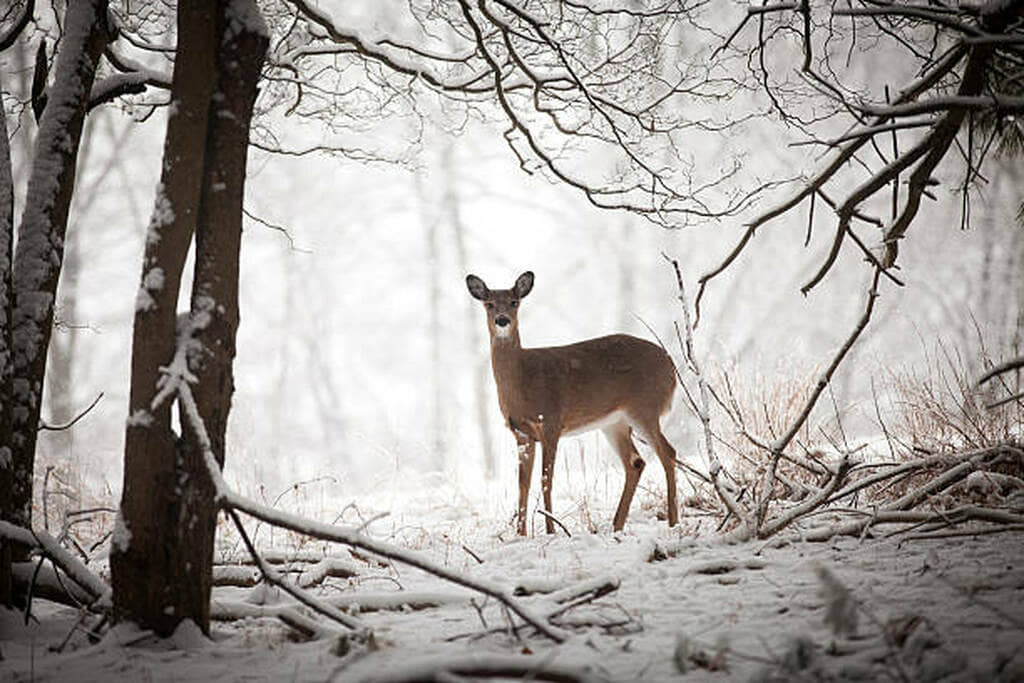
Deer survive the winter by conserving energy, growing an insulating winter coat, relying on stored body fat, and switching to woody plants when fresh vegetation disappears. Unlike many mammals that hibernate, deer remain active throughout the coldest months, making seasonal adaptation essential for survival. Every behavior during winter—from choosing sheltered habitats to reducing daily movement—helps them balance energy use with limited food availability.
Winter creates several challenges for deer. Snow covers grasses and other preferred plants, freezing temperatures increase the body’s demand for heat, and food becomes less nutritious than during spring or summer. Deep snow also makes travel more difficult and increases the risk of predation because escaping requires more energy. To overcome these conditions, deer change both their physiology and behavior long before winter reaches its harshest stage.
This guide explains how deer survive the winter by examining their seasonal adaptations, winter diet, energy conservation strategies, shelter selection, and the threats they face during cold weather. You’ll also learn why deer do not hibernate, how different deer species adapt to snowy environments, and what people can do to help maintain healthy deer populations during winter.
How Do Deer Survive the Winter?
Deer survive the winter through a combination of physical adaptations, behavioral changes, and efficient energy management. Rather than relying on a single survival strategy, deer prepare for winter months in advance by storing body fat, growing a dense winter coat, reducing unnecessary movement, and changing their feeding habits. These adaptations allow them to remain active even when temperatures drop below freezing and food becomes scarce.
One of the most important adaptations is the buildup of fat reserves during spring, summer, and autumn. Deer consume large quantities of nutrient-rich vegetation throughout the growing season, converting excess calories into body fat. This stored fat becomes their primary energy source when winter plants contain fewer nutrients and food is harder to find. Adult deer can lose 20–30% of their body weight over the course of a harsh winter while relying on these reserves to survive.
Deer also adjust their daily behavior to minimize energy expenditure. They spend less time traveling, limit unnecessary activity, and often follow established trails through deep snow instead of creating new paths. Moving through untouched snow requires significantly more energy, so reusing packed trails helps conserve calories that would otherwise be wasted.
Another key survival strategy is selecting sheltered habitats. Deer often remain in dense evergreen forests or protected valleys where tree canopies reduce wind exposure, intercept snowfall, and create slightly warmer microclimates. These sheltered areas, commonly called deer yards in northern regions, provide easier access to food while reducing heat loss during extended periods of cold weather.
Together, these physiological and behavioral adaptations allow deer to maintain a balance between energy intake and energy expenditure. Their survival depends not on avoiding winter, but on using every available resource as efficiently as possible.
Why Is Winter So Challenging for Deer?
Winter is challenging for deer because food becomes limited while the energy required to survive increases. Cold temperatures force deer to generate more body heat, yet the plants they depend on during warmer months disappear beneath snow or stop growing altogether. This imbalance between energy intake and energy demand makes winter the most difficult season of the year.
Food scarcity is the greatest obstacle. During spring and summer, deer feed on grasses, leaves, herbs, fruits, and agricultural crops that provide abundant protein and digestible nutrients. Once winter arrives, these food sources become unavailable, forcing deer to switch to lower-quality browse such as twigs, buds, evergreen needles, and tree bark. Although these foods help sustain life, they provide considerably less energy than fresh vegetation.
Deep snow creates another major challenge by making movement more difficult. Every additional step through soft snow requires more effort, causing deer to burn valuable fat reserves. Heavy snowfall can also bury shrubs and young plants, limiting access to available food and increasing the distance deer must travel to find enough forage.
Predation pressure often increases during winter as well. Wolves, coyotes, and other predators may gain an advantage when weakened deer struggle to move through deep snow. Young fawns, elderly individuals, and deer that entered winter with insufficient fat reserves are particularly vulnerable because they tire more quickly and have fewer energy reserves for escaping predators.
Severe winters can also produce cumulative effects. Long periods of freezing temperatures, repeated snowstorms, and extended food shortages gradually deplete fat reserves. Even if deer avoid predators and disease, many may enter spring in poor physical condition, reducing reproductive success and lowering survival rates among young animals.
How Do Deer Stay Warm During Winter?
Deer stay warm during winter by growing an insulating winter coat, storing body fat, reducing heat loss, and selecting sheltered habitats. These adaptations work together to maintain a stable body temperature even when air temperatures fall well below freezing.
A deer’s winter coat is its first line of defense against the cold. As daylight hours shorten in autumn, hormonal changes trigger the growth of a dense coat made up of two layers. The soft underfur traps warm air close to the skin, while the longer hollow guard hairs create additional insulation by holding pockets of air. This natural insulation reduces heat loss and helps deer remain comfortable during snowstorms and freezing winds.
Body fat provides both insulation and energy. During late summer and fall, deer increase their food intake and convert excess calories into fat deposits beneath the skin and around internal organs. These reserves slow heat loss while supplying energy when winter forage cannot meet daily nutritional needs. Deer that enter winter with larger fat reserves generally have a higher chance of surviving long periods of cold weather than individuals in poor physical condition.
Deer also conserve body heat by changing their behavior. They reduce movement during the coldest parts of the day, often remaining bedded in sheltered locations until it is more efficient to forage. Curling their legs beneath their bodies while resting minimizes exposed surface area, reducing heat loss to frozen ground and cold air. This simple behavioral adaptation allows them to preserve valuable energy over the course of the winter.
Habitat selection is equally important. Dense conifer forests block strong winds, intercept snowfall, and create a slightly warmer microclimate than open fields. These sheltered areas reduce the amount of energy deer must spend maintaining their body temperature while also providing easier access to browse that remains above the snow.
Rather than relying on a single adaptation, deer combine insulation, stored energy, efficient behavior, and habitat selection to withstand winter conditions. Each strategy reduces energy demands, allowing them to survive until fresh vegetation returns in spring.
What Do Deer Eat During the Winter?
Deer survive the winter by switching from nutrient-rich summer vegetation to woody plants that remain available after snowfall. Although their winter diet contains fewer calories and less protein, it provides enough nutrition to sustain life when combined with reduced energy expenditure.
Fresh grasses, broadleaf plants, fruits, and agricultural crops largely disappear once temperatures fall below freezing. In response, deer become browsers rather than grazers. Instead of feeding on low-growing vegetation, they consume twigs, buds, young shoots, leaves from evergreen shrubs, and the tender growth of trees. Common winter food sources include cedar, hemlock, pine, maple, willow, birch, dogwood, and aspen, depending on the region and habitat.
Tree bark becomes an emergency food source during periods of prolonged snow cover. Deer strip bark from young trees when preferred browse is buried or exhausted. While bark contains less digestible nutrition than fresh vegetation, it supplies carbohydrates and fiber that help deer survive until better food becomes available. This behavior is most common during severe winters when snowfall limits access to shrubs and understory plants.
Winter feeding patterns also change. Deer typically feed during the warmest parts of the day to reduce energy loss associated with movement in extreme cold. They often revisit the same feeding areas repeatedly because familiar routes require less effort than exploring new locations covered by deep snow. Remaining within a smaller home range further conserves calories while ensuring consistent access to available browse.
The quality of winter forage directly influences survival. Deer entering winter with healthy fat reserves can tolerate a lower-quality diet for several months. However, if severe weather persists or food supplies become depleted, fat reserves are gradually exhausted, leading to weight loss, weakened immunity, and a greater risk of starvation before spring vegetation emerges.
Read more: What Do Deer Eat In The Winter? How to Feed Deer During the Cold
How Do Deer Conserve Energy in Cold Weather?
Deer conserve energy during winter by reducing movement, slowing their metabolism, limiting their home range, and following established travel routes. Because food is scarce and every calorie becomes valuable, conserving energy is just as important as finding enough to eat.
As winter approaches, deer naturally become less active. Instead of traveling long distances throughout the day, they spend more time resting and make shorter trips between bedding areas and feeding sites. This behavioral shift significantly reduces the number of calories burned, allowing stored body fat to last longer through the cold season.
A slower metabolism also contributes to winter survival. Deer experience a seasonal decline in metabolic rate that lowers their daily energy requirements. Their heart rate and overall activity decrease, enabling them to maintain essential bodily functions while consuming less food. Although they remain alert and active enough to feed and avoid predators, they avoid unnecessary exertion whenever possible.
Deep snow presents another major energy challenge. Walking through fresh snow requires considerably more effort than moving across bare ground. To minimize this cost, deer repeatedly use established trails, creating compact pathways that are easier to navigate. Entire groups often share the same trail system, reducing the effort needed for each individual and improving access between feeding areas and shelter.
Deer also reduce the size of their home range during winter. Rather than searching widely for food, they remain close to reliable sources of browse and protected bedding sites. This strategy limits travel distance and ensures that valuable energy is spent only on essential activities. In regions with severe winters, deer may remain within a relatively small area for several months until temperatures rise and vegetation begins to grow again.
Timing also plays a role in energy conservation. Deer frequently adjust their feeding schedule to coincide with the warmest parts of the day, when maintaining body temperature requires less energy. During periods of extreme cold or heavy snowfall, they may stay bedded for extended periods and feed only when conditions become more favorable.
By combining lower activity levels, a reduced metabolic rate, efficient travel routes, and strategic habitat use, deer maximize the amount of energy they can retain throughout winter. These adaptations help them survive months of limited food availability before spring restores abundant forage.
Where Do Deer Sleep During Winter?
Deer sleep and rest in sheltered bedding areas that protect them from wind, deep snow, and extreme cold. Rather than building nests or dens, they select natural locations that provide insulation, concealment, and quick access to nearby food sources.
One of the most important winter habitats is the deer yard, a traditional area where multiple deer gather during periods of prolonged snow cover. Deer yards are commonly found in mature conifer forests with dense canopies that intercept snowfall before it reaches the ground. Because less snow accumulates beneath these trees, deer can move more easily while conserving energy.
Evergreen forests provide several additional advantages. Thick stands of cedar, spruce, fir, or hemlock reduce wind speed, creating a warmer microclimate than surrounding open areas. The canopy also limits heat loss by shielding deer from snow, freezing rain, and cold winter winds. Even a small increase in shelter can reduce the amount of energy needed to maintain body temperature over the course of the season.
Within these protected habitats, deer create shallow depressions in the snow known as beds. They often choose locations beneath low-hanging branches or beside fallen logs where natural cover offers additional protection. While resting, deer tuck their legs beneath their bodies and keep their heads raised enough to remain alert for approaching predators. This position minimizes heat loss while allowing a rapid escape if necessary.
Bedding sites are usually located close to feeding areas. By resting near available browse, deer avoid long daily movements that would consume valuable fat reserves. They often alternate between short feeding periods and extended rest, maintaining a balance between acquiring food and conserving energy.
Deer also select bedding areas based on changing weather conditions. During strong winds, they favor slopes protected by hills or dense vegetation. After heavy snowfall, they may remain in established wintering areas where compacted trails provide easier movement between beds and feeding sites. This flexibility allows deer to respond efficiently to changing winter conditions without wasting energy.
Choosing the right shelter is as important as finding food. A well-protected bedding area reduces heat loss, lowers daily energy requirements, and improves the likelihood of surviving until spring, especially during long periods of severe weather.
Read more: Do Deer Move When It’s Snowing?
Do Deer Hibernate?
No, deer do not hibernate during winter. Unlike animals such as bears, ground squirrels, and bats, deer remain active throughout the season because they must continue searching for food and stay alert to avoid predators. Their survival strategy depends on conserving energy rather than entering a prolonged state of dormancy.
Hibernation is a physiological state in which an animal’s body temperature, heart rate, breathing rate, and metabolism drop dramatically to conserve energy for weeks or even months. Hibernating animals rely almost entirely on stored body fat until environmental conditions improve. Deer cannot survive this way because their digestive system requires regular food intake to function properly, and they need to remain mobile to find available browse.
Instead of hibernating, deer undergo seasonal metabolic adjustment. Their metabolic rate declines moderately during winter, reducing daily energy requirements without shutting down normal body functions. Combined with reduced activity, this adaptation allows deer to stretch their fat reserves over several months while continuing to feed on twigs, buds, evergreen foliage, and bark.
Daily behavior also changes to support energy conservation. Deer spend longer periods resting in sheltered bedding areas and make fewer trips between feeding sites. They often forage during the warmer parts of the day and avoid unnecessary movement during severe weather. This pattern enables them to conserve calories while remaining responsive to changing conditions.
Remaining active offers another important advantage: flexibility. Winter weather can change quickly, and food availability varies from day to day. By staying active, deer can relocate to better feeding areas, avoid predators, or seek improved shelter after heavy snowfall. A hibernating animal would not be able to respond to these rapidly changing conditions.
Although deer may appear less active during winter, they are never truly dormant. Their winter survival depends on balancing reduced energy expenditure with continuous access to food and shelter rather than entering hibernation.
What Threats Make Winter Harder for Deer?
Food shortages, prolonged snow cover, predators, disease, and human activity are the primary threats that reduce deer survival during winter. While healthy adult deer are well adapted to cold climates, these challenges can quickly overwhelm individuals with limited fat reserves or poor access to winter habitat.
Food scarcity is the greatest threat throughout the season. As winter progresses, the nutritional value of available browse declines while fat reserves continue to shrink. During particularly long or severe winters, deer may exhaust their stored energy before fresh vegetation becomes available in spring. Starvation is most likely to affect fawns, older deer, and animals that entered winter in poor physical condition.
Deep snow further increases the risk of mortality. Snow deeper than a deer’s chest makes movement slow and physically demanding, forcing animals to burn additional calories with every step. Deep snow also buries shrubs and low-growing plants, reducing access to food while making it more difficult to escape predators.
Predators often gain an advantage under these conditions. Wolves, coyotes, and, in some regions, mountain lions can more easily catch deer weakened by malnutrition or slowed by heavy snow. Young deer and older adults are especially vulnerable because they have lower endurance and fewer energy reserves than healthy mature adults.
Disease and parasites can also reduce winter survival. Deer weakened by illnesses or heavy parasite loads enter winter with lower body condition and fewer fat reserves. Nutritional stress during winter further suppresses immune function, making recovery more difficult and increasing the likelihood of mortality before spring.
Human activity creates additional challenges, particularly in areas where winter habitat is fragmented. Roads, residential development, logging operations, and recreational activities such as snowmobiling can repeatedly disturb resting deer. Each unnecessary escape forces deer to expend valuable calories that cannot be easily replaced during periods of food scarcity.
Climate change is introducing new pressures as well. Warmer winters do not always benefit deer populations. Frequent freeze-thaw cycles can create thick ice layers over vegetation, making browse inaccessible despite relatively mild temperatures. Changing snowfall patterns can also alter migration routes, winter habitat quality, and predator-prey interactions, affecting deer survival in different ways across North America.
Winter survival is rarely determined by a single factor. Instead, it reflects the combined effects of food availability, weather conditions, habitat quality, predation, and overall physical condition before winter begins.
How Do Different Deer Species Adapt to Winter?
Different deer species survive winter by adapting to the climate and habitat in which they evolved. While all deer rely on thicker coats, stored fat, and energy conservation, their survival strategies vary depending on snowfall, food availability, and migration patterns.
White-tailed Deer
White-tailed deer are highly adaptable and occupy forests, farmland, wetlands, and suburban areas across North America. During winter, they migrate to sheltered habitats known as deer yards, where dense conifer forests reduce wind exposure and snow accumulation. Their winter diet consists primarily of woody browse, including twigs, buds, cedar, maple, dogwood, and other shrubs.
Because white-tailed deer are relatively small, they lose body heat more quickly than larger species. As a result, conserving energy becomes critical during prolonged periods of deep snow and extreme cold.
Mule Deer
Mule deer are better adapted to mountainous and semi-arid environments in western North America. Instead of remaining in one wintering area, many populations undertake seasonal migrations, traveling dozens or even hundreds of miles between high-elevation summer ranges and lower-elevation winter habitats.
These migrations allow mule deer to avoid deep snow while accessing shrubs such as sagebrush, bitterbrush, and mountain mahogany that remain available throughout winter. Their larger hooves also provide better traction on rocky terrain and shallow snow than those of many forest-dwelling deer.
Northern Deer Populations
Deer living in northern regions experience the harshest winters and have evolved stronger seasonal adaptations. They typically develop thicker winter coats, accumulate larger fat reserves during autumn, and begin preparing for winter earlier than populations living in milder climates.
Although these adaptations improve survival, unusually severe winters with persistent deep snow can still reduce survival rates, particularly among fawns and older adults.
Despite differences among species and regions, the fundamental strategy remains the same: reduce energy loss, maximize available food, and remain protected until spring vegetation returns.
How Can People Help Deer Survive the Winter?
People can improve deer survival by protecting winter habitat and minimizing unnecessary disturbances. In many regions, habitat quality has a greater influence on winter survival than temperature alone.
Protecting mature forests is one of the most effective conservation measures. Dense evergreen stands provide shelter from wind, reduce snow accumulation, and offer reliable winter browse. Conserving these habitats allows deer to maintain established wintering areas that have supported local populations for generations.
Avoiding unnecessary disturbance is equally important. Hiking, snowmobiling, skiing, or allowing dogs to chase deer during winter forces animals to flee, burning calories they cannot easily replace. Repeated disturbances can significantly reduce survival during long periods of severe weather.
People should also avoid feeding wild deer unless local wildlife authorities specifically recommend it. Deer have digestive systems that gradually adapt to seasonal diets. Introducing large amounts of corn, bread, or other human foods during winter can disrupt digestion and may lead to serious health problems. Wildlife agencies generally recommend improving habitat rather than providing supplemental food.
Supporting conservation organizations and habitat restoration projects also benefits deer populations. Restoring native forests, protecting migration corridors, and reducing habitat fragmentation help ensure deer have access to food and shelter throughout the year.
Healthy winter habitat supports not only deer but also birds, small mammals, and numerous other wildlife species that depend on the same ecosystems.
How Does a Deer’s Digestive System Help It Survive Winter?
A deer’s four-chambered stomach allows it to extract nutrients from woody plants that many other animals cannot digest efficiently. During winter, fresh grasses and leafy vegetation become scarce, forcing deer to consume twigs, buds, bark, and evergreen foliage. Microorganisms living inside the rumen break down cellulose and other complex plant fibers, converting them into usable energy.
The digestive system also adapts to seasonal changes in diet. As deer gradually switch from nutrient-rich summer vegetation to woody browse during autumn, the microbial population inside the rumen changes to digest the new food sources more efficiently. Sudden dietary changes can disrupt this balance, which is one reason wildlife biologists discourage feeding wild deer large amounts of corn, bread, or other human foods during winter.
How Does Daylight Trigger Winter Adaptations?
Shorter daylight hours, rather than colder temperatures, trigger most of a deer’s winter adaptations. As autumn days become shorter, hormonal changes stimulate the growth of a thicker winter coat, increase food consumption, and promote fat storage before severe weather arrives.
This biological response, known as photoperiodism, allows deer to prepare for winter weeks before food becomes scarce. By the time heavy snowfall arrives, most healthy deer have already developed their insulating coat and accumulated the fat reserves needed to survive several months of limited nutrition.
Why Is Body Fat More Important Than Body Size?
Body fat is a stronger predictor of winter survival than body size alone. Deer with greater fat reserves can continue producing heat and maintaining essential body functions long after food quality declines.
Wildlife studies consistently show that fawns entering winter with low body fat experience lower survival rates than healthy adults. Older deer may also struggle because age reduces their ability to accumulate fat during autumn and recover from nutritional stress before spring.
Why Doesn’t Feeding Deer Always Help?
Feeding wild deer during winter can sometimes do more harm than good. Although providing food appears helpful, abrupt dietary changes may upset the microbial balance in the rumen, reducing the deer’s ability to digest its natural winter diet.
Artificial feeding stations can also attract large numbers of deer to a single location. Increased crowding raises the risk of disease transmission, intensifies competition for food, and may attract predators. For these reasons, wildlife agencies often recommend protecting natural winter habitat instead of providing supplemental feed unless emergency management programs are in place.
What Happens to Deer When Spring Arrives?
Spring marks the beginning of physical recovery after months of nutritional stress. As temperatures rise, deer gradually replace their thick winter coats with lighter summer coats and shift back to nutrient-rich grasses, herbs, and fresh leaves.
Improved nutrition allows deer to rebuild muscle, restore fat reserves, and prepare for reproduction. Does require high-quality forage to support pregnancy and milk production, while bucks begin recovering body condition lost during winter before growing new antlers later in the season.
Frequently Asked Questions
How long can deer survive without food in winter?
Healthy deer can survive for several weeks with very little food by relying on stored body fat, but prolonged starvation eventually weakens their immune system and reduces their ability to escape predators.
Do deer drink water during winter?
Yes. Deer continue drinking water throughout winter whenever it is available. They may drink from unfrozen streams, springs, or ponds, and they can also obtain small amounts of water by eating snow and moisture-rich vegetation.
Can deer find food beneath the snow?
Yes. Deer use their sense of smell and their hooves to locate buried vegetation. However, deep or ice-covered snow can prevent access to many food sources, making survival much more difficult.
Why do deer look thinner after winter?
Deer often lose between 20% and 30% of their body weight during winter because stored fat is gradually converted into energy. Most regain this weight after fresh vegetation becomes abundant in spring.
Do all deer migrate before winter?
No. Seasonal migration depends on the species and location. Many mule deer migrate between summer and winter ranges, while numerous white-tailed deer remain within the same general area if food and shelter remain available.