
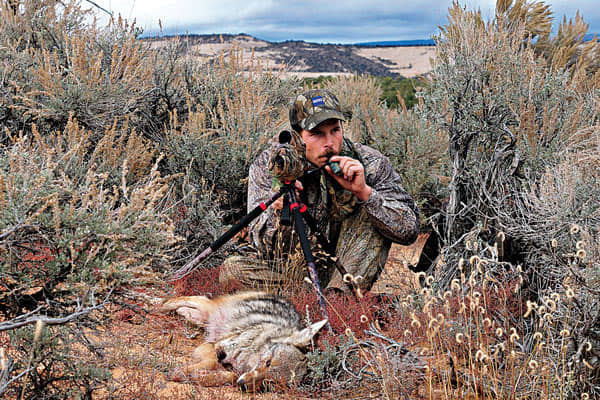
Coyotes respond to a howler only when the sound matches their natural communication and the situation around them. A realistic howl can locate nearby coyotes, trigger a territorial response, or encourage curious animals to investigate your stand. However, using the wrong howl, calling too frequently, or choosing the wrong time of year often alerts coyotes instead of attracting them.
Learning how to use a coyote howler starts with understanding why coyotes howl in the first place. Unlike prey distress calls that imitate an easy meal, a howler mimics coyote vocalizations used to communicate territory, social hierarchy, breeding status, and family groups. Because every howl carries a specific meaning, selecting the right vocalization is just as important as producing a realistic sound.
This guide explains how to use a coyote howler step by step, including when to call, which howl to choose, how long to wait between calling sequences, and how to react when a coyote answers. You’ll also learn the most common mistakes beginners make and how experienced predator hunters adjust their calling strategy based on season, weather, wind direction, and coyote behavior. By the end of this guide, you’ll understand not only how to use a coyote howler, but why each technique works in the field.
What Is a Coyote Howler?
A coyote howler is a predator-calling device that imitates natural coyote vocalizations to communicate with wild coyotes. Hunters use it to locate coyotes, trigger territorial behavior, attract breeding pairs, or assess whether coyotes are present before switching to other calling techniques. Unlike a distress call that imitates prey in danger, a coyote howler speaks the coyotes’ own language.
Coyotes rely on vocal communication throughout the year to establish territory, maintain family groups, locate pack members, and interact with potential mates. Each vocalization carries a different meaning. A lone howl often signals a single coyote announcing its presence without threatening nearby animals, while a challenge howl communicates territorial aggression. During the breeding season, female invitation howls can encourage curious or receptive coyotes to investigate. Choosing the appropriate vocalization increases the likelihood of receiving a natural response instead of warning nearby coyotes that something is unusual.
A coyote howler is most effective when the objective is to start a conversation rather than immediately imitate vulnerable prey. Many experienced predator hunters begin a stand with one or two non-aggressive locator howls to determine whether coyotes are nearby. If a coyote answers, the hunter can adapt the calling sequence based on the animal’s behavior instead of relying on guesswork.
When Should You Use a Coyote Howler?
The best time to use a coyote howler depends on coyote behavior, seasonal activity, and environmental conditions. Although a howler can produce responses throughout the year, it becomes significantly more effective when coyotes are actively defending territory or searching for mates.
Late fall through the breeding season is generally the most productive period because adult coyotes respond more readily to unfamiliar vocalizations entering their territory. During these months, territorial instincts are stronger, making locator howls, lone howls, and female invitation howls particularly effective. In spring and early summer, coyotes become protective of den sites and pups, requiring more careful call selection to avoid educating pressured animals.
Time of day also influences calling success. Early morning, the final hour before sunset, and nighttime often produce the highest response rates because coyotes are naturally more active during low-light periods. Reduced human activity and cooler temperatures encourage movement, increasing the chance that a nearby coyote hears and responds to your howl.
Weather conditions play an equally important role. Calm or light-wind conditions allow howls to travel farther and remain more natural. Strong winds distort sound, reduce calling distance, and make it harder for coyotes to pinpoint the source. Before making the first howl, choose a stand that provides good visibility, favorable wind direction, and minimal background noise so the vocalization carries naturally across the landscape.
How to Use a Coyote Howler Step by Step
Choose the Right Stand Location
Set up where coyotes are likely to travel, hear your calls, and approach without detecting your presence. Productive stands are typically located near ridges, open fields, creek bottoms, fence lines, brush edges, and travel corridors that connect bedding and feeding areas. Before calling, scan the terrain for shooting lanes and identify the most likely direction a coyote will use to approach.
Avoid walking through the area where you expect coyotes to appear. Coyotes rely heavily on scent and quickly recognize fresh human odor. A quiet approach that leaves minimal scent contamination increases the chance that an approaching coyote remains confident instead of circling out of range.
Set Up with the Wind in Your Favor
Position yourself so the wind carries your scent away from the expected direction of approaching coyotes. Wind direction influences calling success more than the quality of the howl itself because coyotes almost always attempt to verify a sound with their nose before committing.
A crosswind is often the most effective setup. It encourages coyotes to move across your field of view as they try to reach your scent cone instead of approaching directly from downwind. If the wind is constantly shifting or blowing toward the area you expect coyotes to use, move to another stand rather than hoping conditions improve.
Start with a Locator Howl
Begin the calling sequence with one or two soft, non-aggressive locator howls. The objective is to announce the presence of another coyote, not to challenge every animal within hearing distance.
Deliver each howl naturally, allowing it to rise and fall in pitch before fading out. Avoid making long, exaggerated howls or repeatedly blowing the call. Most experienced callers use one or two locator howls before remaining completely silent. This pause gives nearby coyotes enough time to respond without creating unnecessary pressure.
If no response occurs, repeat another short locator howl after several minutes. Resist the temptation to call continuously. Excessive vocalization often sounds unnatural and can educate experienced coyotes that have already encountered hunters.
Wait for a Response
Remain silent after calling and listen carefully for both vocal and non-vocal responses. A coyote may answer immediately, several minutes later, or approach silently without making any sound.
Many beginners assume a stand is unproductive because they do not hear a howl within the first minute. In reality, coyotes frequently investigate quietly, using terrain and vegetation as cover while attempting to identify the source of the sound. Continue scanning downwind areas, brush lines, and terrain features throughout the stand instead of focusing only on the direction where the howl originated.
Patience is critical during this stage. Depending on terrain and coyote activity, remaining on stand for 15 to 25 minutes often provides enough time for nearby animals to respond or approach.
Adjust Your Calling Sequence
Change your calling strategy according to the coyote’s behavior instead of repeating the same howl. Every response provides information about the animal’s location, confidence, and willingness to approach.
If a coyote answers with a non-aggressive howl but stays in place, answer with another calm lone howl or remain silent to encourage curiosity. If the coyote begins closing the distance, stop calling altogether. Continuing to howl while the animal is already approaching can make it suspicious because real coyotes rarely vocalize continuously during an encounter.
When coyotes refuse to commit after several minutes, many hunters transition to prey distress sounds. The combination suggests another coyote has located food, creating competition that may encourage hesitant animals to investigate more aggressively.
End the Stand or Move to a New Location
Leave the stand if no coyote appears after a complete calling sequence and adequate waiting time. Continuing to call from the same location rarely improves success once nearby coyotes have had sufficient time to respond.
Exit quietly without excessive movement or unnecessary noise. Travel far enough before making another stand so you are calling to a different group of coyotes rather than repeating the sequence to animals that have already heard it. In areas with high hunting pressure, rotating locations and varying your calling sequence helps prevent coyotes from associating specific vocalizations with danger.
Read more: Explore The Best Coyote Bait For Trapping
Which Coyote Howl Should You Use?
The most effective coyote howl depends on the season, the coyotes’ social behavior, and your objective during the stand. Using the wrong vocalization can reduce response rates or even push cautious coyotes away, while selecting the right howl helps create a realistic interaction that encourages investigation.
Lone Howl
Use a lone howl to locate coyotes and announce your presence without sounding aggressive. This is the best vocalization for beginners because it works throughout most of the year and rarely intimidates nearby animals.
A lone howl mimics a single coyote checking in with others. It often receives responses from territorial adults, family groups, or curious transient coyotes. Start with one or two moderate-volume howls and allow several minutes of silence before deciding whether to call again.
Challenge Howl
Use a challenge howl only when territorial aggression is likely to produce a response. This vocalization imitates a dominant coyote defending its territory and is most effective during the breeding season or when mature resident coyotes occupy a defined area.
Because a challenge howl represents a direct threat, it should be used carefully. Dominant coyotes may approach aggressively, but younger or subordinate animals often avoid confrontation. Overusing challenge howls in heavily hunted areas can also educate coyotes that have previously encountered hunters.
Female Invitation Howl
Use a female invitation howl during the breeding season to attract receptive males and curious pairs. This softer, higher-pitched vocalization imitates a female searching for companionship rather than defending territory.
The technique works best from late winter through the peak breeding period, when coyotes naturally increase vocal communication. Outside this seasonal window, its effectiveness generally declines because it no longer matches typical coyote behavior.
Group Howl
Use a group howl only when you want to imitate multiple coyotes occupying an area. This vocalization can encourage resident packs to respond, particularly if they believe unfamiliar coyotes have entered their territory.
Group howls require realistic timing and cadence. Beginners often overcomplicate the sequence, creating unnatural sounds that experienced coyotes quickly recognize. Unless you are confident reproducing multiple vocalizations, a simple lone howl usually produces more consistent results.
What Mistakes Should You Avoid?
Most unsuccessful calling stands result from poor calling decisions rather than poor equipment. Avoiding a few common mistakes can significantly improve your chances of receiving a response.
Calling too often is one of the most common errors. Continuous howling sounds unnatural because wild coyotes spend much of their time listening. After making a locator howl, remain silent long enough for nearby animals to process the sound and decide whether to investigate.
Calling too loudly is another frequent mistake. A high-volume howl may seem like it reaches more coyotes, but it can also sound unrealistic at close range and immediately alert nearby animals. Begin with moderate volume and increase only if you need to project your call across large areas or in windy conditions.
Using the wrong howl for the season also reduces success. For example, aggressive challenge howls during periods of low territorial activity often discourage cautious coyotes instead of attracting them. Matching the vocalization to seasonal behavior creates a more believable scenario.
Ignoring wind direction allows coyotes to identify your scent before entering shooting range. Even a perfectly executed calling sequence usually fails if an approaching coyote reaches your scent cone. Check the wind before every stand and reposition whenever conditions change.
Finally, avoid staying in one location too long after completing your calling sequence. If no coyotes respond within a reasonable period, continuing to repeat the same howls rarely changes the outcome. Moving to a new stand exposes your calls to different animals and keeps your strategy efficient throughout the hunt.
Should You Combine a Howler with Distress Calls?
Yes, combining a coyote howler with prey distress calls is one of the most effective predator-calling strategies because it creates a realistic hunting scenario. The howl establishes another coyote’s presence, while the distress sound suggests that coyote has found an easy meal. This combination appeals to both territorial instincts and feeding behavior.
A proven sequence starts with one or two locator howls, followed by three to five minutes of silence. If no coyote responds or appears, transition to a rabbit, rodent, or bird distress call for 30 to 60 seconds. Pause for another two to three minutes before repeating the distress sound. This pattern sounds natural because wild coyotes do not vocalize continuously, and prey animals rarely remain in distress without interruption.
If a coyote answers your locator howl but stays at a distance, avoid immediately switching to aggressive calling. Instead, remain silent or offer a single, non-threatening response. Many coyotes will investigate out of curiosity without additional encouragement. Switching to distress calls too early can make the sequence sound artificial and reduce the animal’s confidence.
The strategy should also match the season. During the breeding season, vocal communication often produces stronger responses than distress calls alone because territorial and mating behavior becomes the primary motivation. During late summer and early fall, when young coyotes are learning to hunt independently, prey distress sounds may become the stronger trigger. Adapting the sequence to seasonal behavior generally produces more consistent results than using the same routine throughout the year.
Frequently Asked Questions
How many howls should you make?
One or two locator howls are usually enough to begin a stand. Additional howls should only be used after several minutes of silence or in response to a vocal coyote. Calling repeatedly without a purpose often makes the sequence sound unnatural.
How long should you wait for a response?
Wait at least three to five minutes after the initial howl before making another call. Even if no vocal response is heard, continue watching the surrounding terrain because coyotes frequently approach in silence. A complete stand typically lasts 15 to 25 minutes before moving to another location.
Can coyotes recognize fake howls?
Coyotes can distinguish unnatural calling patterns more easily than imperfect sounds. Most experienced coyotes become suspicious when calls are too loud, too frequent, or inconsistent with normal coyote behavior. A realistic rhythm and proper timing are usually more important than perfectly reproducing every note.
Why do coyotes ignore a howler?
Coyotes may ignore a howler because the vocalization does not match the season, the animal has detected human scent, or previous hunting pressure has made it cautious. Poor stand selection, unfavorable wind direction, excessive calling, and unrealistic sequences are among the most common reasons a coyote refuses to respond or approaches without committing.
How far away can coyotes hear a howler?
A coyote can hear a well-produced howl from more than a mile away under favorable conditions. The actual distance depends on terrain, wind, vegetation, humidity, and the volume of the call. While a howl may travel a long distance, hearing the sound does not guarantee a response. Coyotes still evaluate territory, scent, competition, and perceived risk before deciding whether to investigate.
Final Thoughts
Using a coyote howler successfully depends more on strategy than on the call itself. Hunters who understand coyote communication, choose the appropriate vocalization for the season, and remain patient between calling sequences consistently achieve better results than those who rely on constant calling. Every stand provides information about coyote behavior, whether through a vocal response, silent approach, or complete lack of activity.
Focus on making realistic calls, controlling your scent, and selecting productive stand locations instead of trying to imitate every possible vocalization. As your field experience grows, you’ll recognize when to remain silent, when to answer a vocal coyote, and when to transition to distress calls. Mastering these decisions is what turns a simple coyote howler into an effective predator-calling tool.