
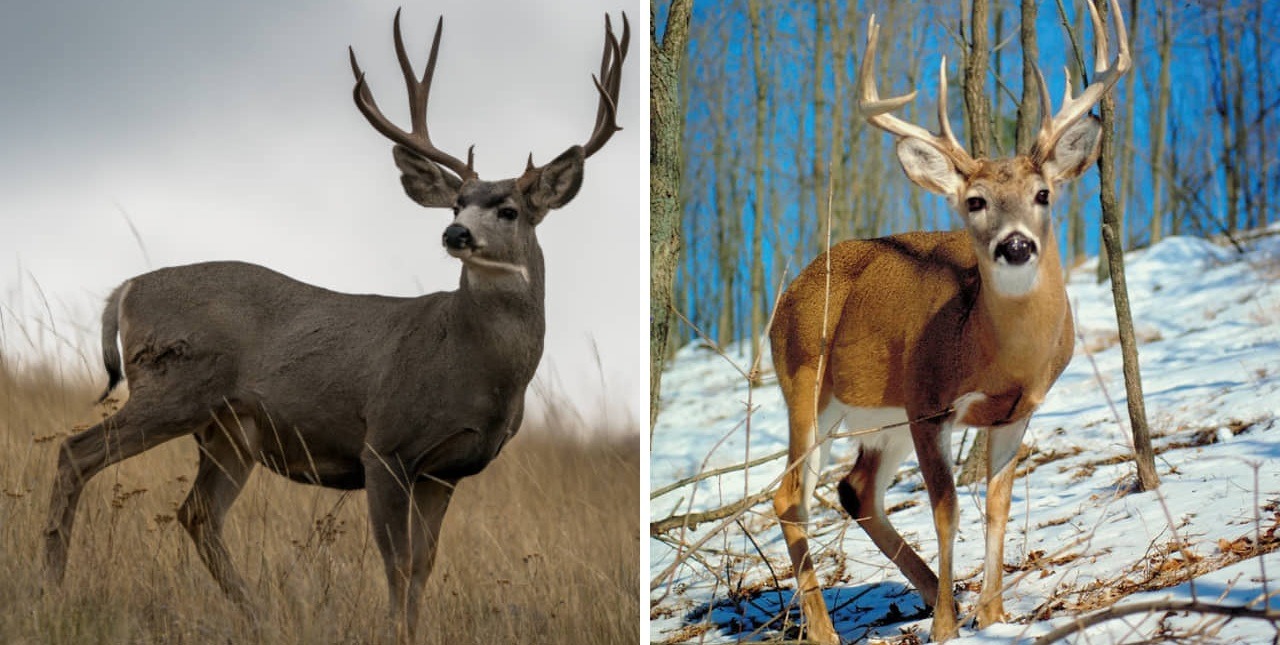
Mule deer and whitetail deer are two of North America’s most popular big game species, but they require different hunting strategies. Although they belong to the same deer family and share some physical characteristics, their appearance, habitat, movement patterns, and reactions to hunting pressure differ significantly. Misidentifying the species can lead to poor scouting decisions, choosing the wrong hunting method, or overlooking prime opportunities in the field.
Understanding these differences allows hunters to make better decisions before and during a hunt. A mule deer is more likely to be found in open basins, foothills, and rugged western terrain, where glassing from a distance and spot-and-stalk tactics are highly effective. A whitetail deer, by contrast, typically relies on dense cover, predictable travel corridors, and an exceptional ability to detect danger, making stand hunting, careful scent control, and patience more successful approaches.
This guide compares mule deer and whitetail deer from a hunter’s perspective. You’ll learn how to identify each species in the field, where they live, how they behave throughout the season, and which hunting strategies work best for each. By the end of the article, you’ll understand not only how to tell these deer apart but also how their unique characteristics influence scouting, shot opportunities, and overall hunting success.
What are the main differences between mule deer and whitetail deer?
Mule deer and whitetail deer differ in appearance, habitat, behavior, movement, and the hunting strategies they require. While both species belong to the deer family, they have adapted to different environments across North America, making each one a unique challenge for hunters.
The table below highlights the most important differences hunters should recognize before heading into the field.
| Feature | Mule Deer | Whitetail Deer |
|---|---|---|
| Ears | Large, mule-like ears | Smaller, rounded ears |
| Tail | White tail with a black tip | Brown tail with a bright white underside |
| Antlers | Fork evenly as they grow | Grow from a single main beam with vertical tines |
| Preferred Habitat | Mountains, foothills, sagebrush, open country | Woodlots, farmland, river bottoms, dense forests |
| Geographic Range | Primarily western North America | Most of North America, especially central and eastern regions |
| Escape Behavior | Bounding “stotting” gait and long-distance travel | Fast sprint to cover with a raised white tail |
| Hunting Style | Spot-and-stalk, glassing from long distances | Tree stand, ground blind, ambush hunting |
| Daily Movement | Often visible in open terrain | Frequently concealed in thick cover |
| Response to Hunting Pressure | May relocate to nearby ridges or higher elevations | Becomes increasingly nocturnal and avoids human activity |
These differences influence nearly every stage of a hunt, from preseason scouting to shot opportunities. Mule deer spend much of their time in open landscapes where hunters can locate animals from a distance using binoculars or spotting scopes. Success often depends on reading terrain, planning a careful stalk, and using elevation and wind to remain undetected.
Whitetail deer present a different challenge. They rely on dense vegetation, sharp senses, and familiar travel routes to avoid predators. Instead of covering vast open areas, hunters often focus on food sources, bedding cover, funnels, and travel corridors. Remaining motionless, controlling human scent, and waiting for deer to move naturally are typically more effective than actively pursuing them.
Neither species is objectively more difficult to hunt because the challenge comes from different behaviors. Mule deer test a hunter’s ability to locate animals across expansive landscapes and execute a precise stalk. Whitetail deer reward patience, discipline, and a deep understanding of deer movement within relatively small home ranges. Recognizing these differences is the foundation for selecting the right equipment, scouting strategy, and hunting method throughout the season.
How can you tell mule deer and whitetail deer apart in the field?
Hunters can distinguish mule deer from whitetail deer by examining six key characteristics: ears, tail, antlers, body shape, coat color, and running style. While a single feature may not always provide a definitive identification, combining multiple characteristics allows for accurate recognition even at long distances.
Ears
The easiest way to identify a mule deer is by its ears. Mule deer have oversized ears that can measure up to three-quarters of the length of their head, giving them the appearance of a mule. Their ears are broad, pointed, and constantly rotate to detect movement across open landscapes.
Whitetail deer have noticeably smaller, more rounded ears that appear proportional to the head. In dense forests where visibility is limited, these shorter ears are often less noticeable than the animal’s face or tail.
For hunters using binoculars or a spotting scope, ear size is often the first clue when the deer’s body is partially hidden behind vegetation.
Tail
The tail provides one of the most reliable identification features, especially when a deer is walking away or fleeing.
A mule deer’s tail is relatively short and mostly white with a distinct black tip. Even when relaxed, the black tip remains visible and contrasts sharply against the white rump.
A whitetail’s tail is brown on top but reveals a bright white underside when raised. When alarmed, the deer raises its tail like a flag while running, creating the familiar “white flag” that gives the species its name.
If you see a deer sprinting through timber with its white tail held high, it is almost certainly a whitetail. If the tail remains down and ends with a black tip, you are likely watching a mule deer.
Antlers
Antler structure also differs significantly between the two species.
Mule deer antlers divide into repeated forks, with each branch splitting into two additional tines as the buck matures. This forked growth pattern creates a symmetrical appearance and is one of the defining characteristics of the species.
Whitetail antlers develop differently. They grow from a single main beam that curves forward, with individual tines projecting upward from the beam. Mature bucks often develop numerous points, but the main beam remains clearly visible throughout the rack.
Although antler size varies with age, genetics, and nutrition, the growth pattern is consistent enough to identify mature bucks during hunting season.
Body shape and coat color
Mule deer generally appear larger-framed with longer legs, a deeper chest, and a more robust body built for traveling rugged terrain. Their face often looks longer, and the transition between the forehead and nose is more gradual.
Whitetails usually have a more compact body, shorter legs, and a narrower chest. Their profile appears slimmer, allowing them to move efficiently through thick vegetation and forest cover.
Coat color can provide additional clues. Mule deer often display a grayish-brown coat that blends with sagebrush, rocky slopes, and dry grasslands. Whitetails tend to have a richer reddish-brown coat during summer that gradually changes to gray-brown in winter, helping them blend into hardwood forests and brush.
Running style
A deer’s escape behavior is often the quickest way to identify the species after it has been startled.
Mule deer use a stiff-legged bounding gait known as stotting (or pronking). All four feet leave the ground together before landing almost simultaneously, allowing the deer to cover rocky terrain efficiently while maintaining visibility over obstacles.
Whitetail deer escape differently. They sprint with a smooth, fluid running motion, making sharp turns through trees and thick cover while displaying their raised white tail. This speed and agility help them disappear into dense vegetation within seconds.
Recognizing these movement patterns is especially valuable when visibility is limited or when only a brief glimpse of the animal is available before taking a shot or continuing a stalk.
Where do mule deer and whitetail deer live?
Mule deer and whitetail deer occupy different habitats because each species has evolved to survive in distinct environments. Knowing where each deer prefers to live helps hunters narrow their search area, identify productive glassing locations, and choose the most effective hunting approach.
Mule deer primarily inhabit western North America, including the Rocky Mountains, Great Basin, desert foothills, prairie breaks, and sagebrush flats. They thrive in open landscapes where they can detect predators at long distances and use rugged terrain as cover. During early season, mule deer are often found in higher elevations with abundant summer forage. As temperatures drop and snow accumulates, many populations migrate to lower elevations and winter ranges.
Whitetail deer have a much broader distribution across North America and are especially abundant in the Midwest, Southeast, Northeast, and parts of southern Canada. They prefer habitats that combine food, water, and thick cover within a relatively small area. Hardwood forests, agricultural fields, river bottoms, brushy creek corridors, and suburban woodlots all provide ideal conditions for whitetails because they offer both nutrition and security.
In some regions, particularly the Great Plains and portions of the western United States, the ranges of mule deer and whitetail deer overlap. Hunters may encounter both species during the same trip, especially near river systems, agricultural valleys, or transitional habitat where open country meets dense vegetation. Identifying habitat features before spotting the animal often provides the first clue about which species is nearby.
Habitat also determines how hunters should approach each species. Open country allows mule deer hunters to glass from ridges, locate animals over long distances, and plan careful stalks that account for terrain and wind. Dense cover limits visibility for whitetail hunters, making stand placement, travel corridor identification, and scent control far more important than covering large areas on foot.
How do mule deer and whitetail deer behave differently?
Behavior is one of the biggest differences between mule deer and whitetail deer, and it directly influences hunting success. Although both species feed, bed, and breed according to seasonal patterns, they react differently to terrain, predators, and hunting pressure.
Mule deer generally rely on eyesight and elevation to detect danger. They often bed on hillsides, ridges, or rocky outcrops where they can observe large sections of surrounding terrain. Their daily movements are relatively predictable in open country, allowing hunters to locate a buck from a distance, monitor its routine, and plan a deliberate stalk. Mature mule deer may travel considerable distances between feeding and bedding areas, particularly in mountainous landscapes.
Whitetail deer depend more heavily on cover and their exceptional senses of smell and hearing. Rather than remaining visible on open slopes, they spend much of the day hidden in thick vegetation and move through established trails that connect bedding areas with feeding locations. Mature bucks often minimize daylight movement once hunting pressure increases, becoming increasingly nocturnal and using dense cover to avoid detection.
Feeding behavior also differs between the two species. Mule deer commonly browse on shrubs, sagebrush, bitterbrush, and woody vegetation, although they also consume grasses and forbs when available. Whitetail deer have a more varied diet that frequently includes agricultural crops, acorns, mast, fruits, and tender vegetation. Because food availability strongly influences movement, hunters often locate whitetails by identifying active feeding areas before selecting an ambush site.
The rut changes behavior in both species, but not in the same way. Mule deer bucks expand their range as they search for receptive does, increasing daytime movement across open terrain. Whitetail bucks also become more active during the rut, yet they continue using funnels, creek crossings, ridge saddles, and other terrain features that naturally concentrate deer movement. Hunters who understand these predictable travel routes often see significant increases in encounter rates during peak breeding activity.
Response to hunting pressure further separates the two species. Mule deer frequently relocate to less accessible terrain, higher elevations, or neighboring drainages after repeated disturbance. Whitetails are more likely to remain within their home range while becoming harder to observe, shifting movement into thicker cover or after dark. This difference explains why aggressive spot-and-stalk tactics can remain productive for mule deer, whereas patience and low-impact hunting often produce better long-term results for mature whitetails.
Which deer is harder to hunt?
Neither mule deer nor whitetail deer is universally harder to hunt because each species tests a different set of hunting skills. Mule deer challenge hunters to locate animals across vast landscapes and execute a successful stalk, while whitetail deer demand patience, concealment, and the ability to predict movement within dense cover.
Mule deer often appear easier to locate because they spend more time in open terrain. A hunter may spot several bucks from a distant ridge using binoculars or a spotting scope. However, seeing a mature mule deer is only the beginning of the challenge. Closing the distance without being detected requires careful route planning, constant attention to wind direction, and effective use of terrain features. In open country, even a small movement can alert a buck hundreds of yards away, ending the stalk before reaching shooting range.
Whitetail deer present the opposite challenge. Mature bucks frequently remain hidden in thick vegetation throughout daylight hours and may not reveal themselves until the final minutes of legal shooting light. Hunters rarely spend time searching visually for deer. Instead, they focus on identifying travel corridors, bedding cover, food sources, and seasonal movement patterns before waiting in carefully selected stand locations. Success often depends on preparation rather than pursuit.
Hunting pressure affects each species differently. Mule deer typically respond by moving into steeper terrain, deeper basins, or neighboring ridges where human activity is lower. Whitetails usually stay within their established home range but reduce daylight movement, rely more heavily on cover, and become increasingly difficult to pattern. As the season progresses, hunters often need to adjust stand locations or hunting times rather than expecting deer to abandon the area.
For beginners, mule deer may be easier to observe because open terrain provides frequent opportunities to study deer behavior and practice judging distance. Whitetails can be more difficult to understand because encounters are often brief and occur in low-light conditions. However, hunters with access to productive private land or well-managed stand locations may find whitetail hunting more consistent than covering miles of western backcountry in search of mule deer.
Ultimately, the more difficult species depends on the hunting environment and the hunter’s experience. Those who enjoy hiking, glassing, and making calculated stalks often prefer mule deer. Hunters who enjoy patterning mature bucks, reading subtle sign, and waiting for a single opportunity generally find whitetail hunting more rewarding.
What hunting strategies work best for mule deer and whitetail deer?
The best hunting strategy depends on the species because mule deer and whitetail deer use their habitat differently. Matching your approach to each deer’s behavior significantly improves the chances of a successful hunt.
Mule deer hunting strategies
Spot-and-stalk is the most effective method for mule deer in open country. Hunters typically begin the day by glassing from elevated vantage points that overlook basins, ridges, burns, or sagebrush flats. Once a target buck is located, the next step is to study its movement, identify its bedding area, and plan an approach that keeps terrain between the hunter and the deer.
Wind direction is critical throughout the stalk. Even though mule deer rely heavily on vision, they can quickly detect human scent when the wind shifts. Successful hunters continuously monitor wind conditions and adjust their route rather than committing to a direct approach.
Because mule deer are often located at long distances, quality optics are just as important as firearms or bows. Spending an extra hour behind binoculars frequently reveals more deer than hiking several additional miles. This glass-first approach conserves energy while reducing unnecessary disturbance across the landscape.
During rifle season, hunters often take advantage of longer shooting distances in open terrain. Bowhunters, however, must rely on terrain features, vegetation, and water sources to close the distance to within ethical archery range. Patience during the final approach usually matters more than speed.
Whitetail hunting strategies
Whitetail hunting emphasizes positioning rather than pursuit. Instead of searching for deer across large areas, hunters identify locations where deer naturally travel and wait for animals to appear within range. Tree stands remain one of the most productive methods because they reduce visibility, improve shooting angles, and help disperse human scent above ground level.
Ground blinds are another effective option, particularly along field edges, food plots, creek crossings, or travel corridors where elevated stand locations are unavailable. Regardless of the setup, minimizing disturbance is essential. Entering and leaving hunting areas without alerting deer often determines whether mature bucks continue using the location during daylight.
Scent control plays a much larger role in whitetail hunting than in most mule deer hunts. Washing clothing, storing gear away from foreign odors, approaching stands with favorable wind, and avoiding unnecessary movement all help prevent detection. A mature whitetail may tolerate distant noise but rarely ignores human scent carried by the wind.
Calling and rattling can also be productive during the rut when bucks actively search for does or respond to perceived competition. Techniques such as grunt calls, doe bleats, and antler rattling are most effective when timed to local rut activity and used sparingly. Excessive calling often educates mature bucks rather than attracting them.
Regardless of the species, successful hunters spend more time scouting than hunting. Understanding seasonal food sources, bedding areas, travel routes, weather patterns, and prevailing winds consistently produces better results than relying on luck alone. The hunter who adapts to deer behavior, rather than expecting deer to behave predictably, usually enjoys the highest success throughout the season.
Read more: Difference Between Deer and Reindeer for Hunters
How do tracks and other deer signs differ?
Tracks and field signs help hunters identify which deer species is using an area, especially when animals are not visible. While mule deer and whitetail deer leave similar evidence, subtle differences in tracks, droppings, bedding locations, and rut sign can reveal which species is nearby.
Tracks
Mule deer tracks are generally wider and more rounded than those of whitetails. Their larger body size and heavier build produce a broader hoof print with blunter toe tips. In soft soil or snow, mature bucks often leave deep impressions because of their greater weight.
Whitetail tracks are typically narrower, more pointed, and slightly heart-shaped. Mature bucks still leave larger tracks than does, but the overall print remains slimmer than that of a similarly sized mule deer. Track patterns can also provide clues. Mule deer often travel across open hillsides or ridge systems, while whitetails tend to follow well-defined trails through timber, creek bottoms, and field edges.
Scat
Droppings vary with diet and season, but consistent differences are still noticeable.
Mule deer commonly feed on woody browse such as sagebrush, bitterbrush, and shrubs, producing compact, dry pellets that are fairly uniform in shape. Whitetails consume more agricultural crops, acorns, mast, and green vegetation, resulting in pellets that are often larger and softer during periods of abundant forage.
Fresh scat indicates recent deer activity, but it should always be evaluated alongside tracks, browsing sign, and bedding cover rather than used as the only indicator of deer presence.
Bedding areas
Mule deer usually bed on elevated slopes, ridgelines, or rocky benches where they can observe the surrounding terrain. Their bedding sites often provide wide visibility and multiple escape routes, making them difficult to approach without careful use of the landscape.
Whitetails prefer concealed bedding locations inside thick vegetation, brush piles, cattail marshes, young timber, or dense creek-bottom cover. Mature bucks frequently choose bedding areas with the wind at their back and an open view of their primary escape route, allowing them to detect danger through both scent and sight.
Rubs and scrapes
Both species create rubs and scrapes during the rut, but these signs are encountered in different environments.
Whitetail rubs commonly appear along travel corridors connecting bedding and feeding areas. Scrapes are often located beneath overhanging branches and may be revisited repeatedly throughout the breeding season, making them valuable locations for trail cameras and stand placement.
Mule deer also rub trees and shrubs during the rut, but scrape activity is generally less concentrated than in whitetails. Hunters often find rut sign scattered across open ridges, brushy draws, and transition zones rather than clustered along heavily used forest trails.
No single sign confirms which species is present. The most accurate interpretation comes from combining tracks, droppings, bedding locations, habitat characteristics, and recent deer movement into a complete picture of how the area is being used.
Which deer should you hunt?
The better species to hunt depends on your location, experience, and hunting style rather than one deer being superior to the other. Both mule deer and whitetail deer offer rewarding but very different hunting experiences.
Hunters who enjoy covering long distances, glassing expansive landscapes, and making strategic stalks often prefer mule deer. Western terrain provides opportunities to observe deer behavior from afar, plan multiple approaches, and test physical endurance throughout the hunt. Backpack hunting and multi-day backcountry trips are also more common in mule deer country.
Whitetail hunting appeals to those who enjoy studying deer movement, improving stand placement, and waiting patiently for a mature buck to appear. Success often comes from careful preseason scouting, understanding seasonal food sources, and minimizing hunting pressure instead of covering large distances on foot.
Accessibility is another important consideration. Whitetail deer are distributed across much of North America and are available through a wide range of public and private hunting opportunities. Mule deer are limited primarily to western states and provinces, making tags, travel, and terrain more challenging for hunters who live outside their range.
If you’re new to deer hunting, start with the species most common in your area. Local knowledge, frequent scouting opportunities, and additional time in the field contribute far more to long-term success than choosing one species over another. As your experience grows, hunting both mule deer and whitetails will develop a broader set of field skills and a deeper understanding of deer behavior across different landscapes.
Frequently asked questions about mule deer vs whitetail deer
Can mule deer and whitetail deer interbreed?
Yes. Mule deer and whitetail deer can interbreed where their ranges overlap, producing hybrid offspring. However, hybrids are relatively uncommon in the wild because the two species differ in habitat preference, breeding behavior, and movement patterns.
Which deer is bigger?
Mule deer are generally larger than whitetail deer. Mature mule deer bucks often have heavier bodies, longer legs, and larger ears, although body size varies by region, genetics, nutrition, and age.
Which deer runs faster?
Whitetail deer typically reach higher top speeds over short distances and excel at rapid acceleration through dense cover. Mule deer are built for covering rough, open terrain efficiently with their distinctive bounding gait rather than making sharp turns through forests.
Which deer has better eyesight?
Mule deer rely heavily on vision to detect movement across open landscapes, making them exceptionally alert to motion at long distances. Whitetails also have excellent eyesight, but they depend more on their highly developed sense of smell and hearing when living in dense vegetation.
Which deer has a stronger sense of smell?
Whitetail deer are widely regarded as having an exceptional sense of smell, which is one of the primary reasons scent control is so important during whitetail hunts. Although mule deer also possess an excellent sense of smell, hunters generally place greater emphasis on wind management and visual concealment when pursuing them in open country.