
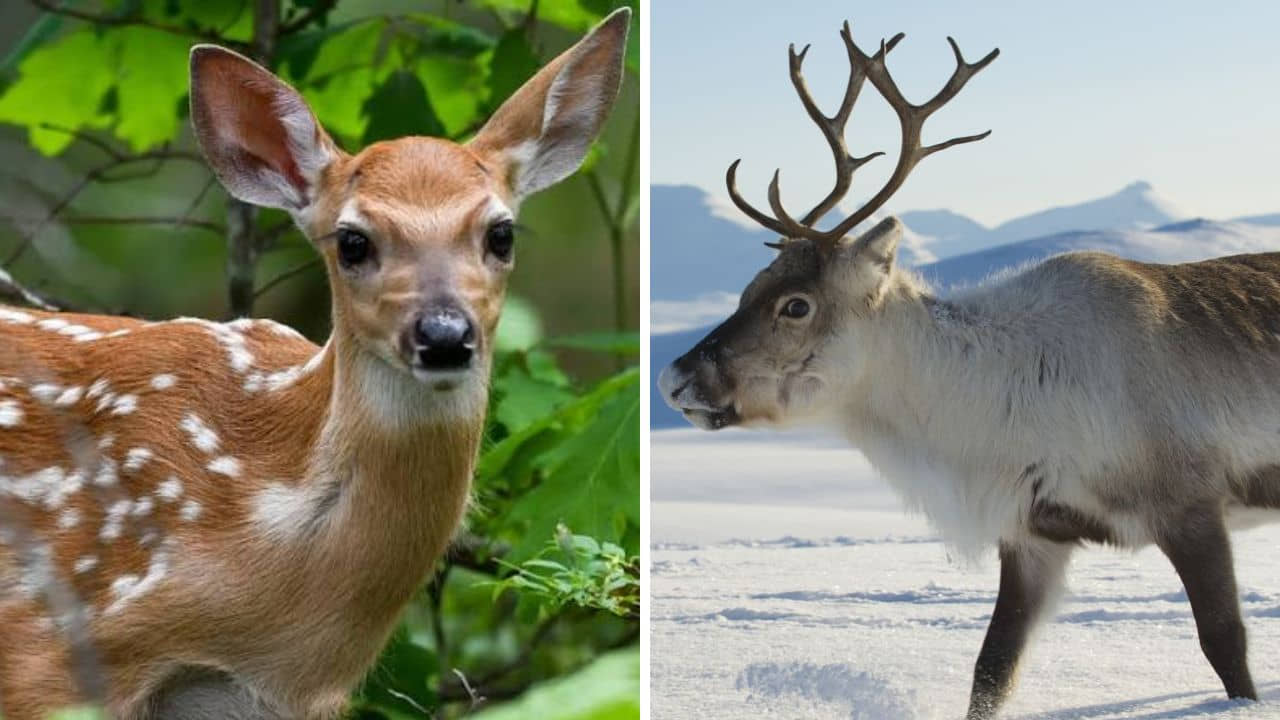
Deer and reindeer belong to the same deer family (Cervidae), but they differ in appearance, habitat, behavior, and hunting considerations. Hunters who mistake one for the other can misidentify game in the field, choose ineffective hunting strategies, or misunderstand local hunting regulations. Learning how these species differ makes it easier to recognize them at a distance, interpret animal signs, and prepare for the environments where each species lives.
Although both animals share traits such as antlers, cloven hooves, and herbivorous diets, they have evolved for very different ecosystems. Most deer species thrive in forests, grasslands, agricultural edges, and mountainous regions across North America, Europe, and Asia. Reindeer, known as caribou in wild populations across North America, are specially adapted to Arctic tundra and boreal forests, where harsh winters, deep snow, and long seasonal migrations shape their behavior. These environmental differences influence everything from body structure and coat insulation to herd movement and feeding patterns.
This guide compares the difference between deer and reindeer from a hunter’s perspective. You’ll learn how to identify each species in the field, compare their habitats, antlers, tracks, and behavior, understand where each can be legally hunted, and discover the characteristics that matter most when planning a successful hunt. Whether you’re researching wildlife or preparing for a hunting trip, this comparison will help you distinguish deer and reindeer with confidence.
What Is the Difference Between Deer and Reindeer?
The main difference between deer and reindeer is that deer include more than 50 species adapted to forests, grasslands, and mountains, while reindeer are a single species adapted to Arctic and subarctic environments. Reindeer also differ from most deer species because both males and females typically grow antlers, they migrate over much longer distances, and they have specialized physical features that help them survive in deep snow and extreme cold.
The table below summarizes the key differences that matter most to hunters and wildlife enthusiasts.
| Feature | Deer | Reindeer |
|---|---|---|
| Scientific classification | More than 50 species in the family Cervidae | Rangifer tarandus |
| Common habitat | Forests, woodlands, grasslands, farmland, mountains | Arctic tundra, boreal forest, alpine regions |
| Geographic range | North America, Europe, Asia, South America | Northern North America, Scandinavia, Greenland, Russia |
| Antlers | Usually only males grow antlers | Both males and females typically grow antlers |
| Social behavior | Solitary or small family groups outside the rut | Large migratory herds |
| Seasonal movement | Limited home range | Long-distance seasonal migration |
| Hooves | Narrower, suited for firm ground | Wide, splayed hooves for snow and soft tundra |
| Hunting style | Spot-and-stalk, stand hunting, still hunting | Spot-and-stalk across open tundra, often involving long glassing sessions |
From a hunting perspective, habitat is often the quickest way to distinguish the two animals. Most deer species are associated with woodland cover and edge habitat, where they rely on vegetation for concealment. Reindeer, by contrast, spend much of the year in open landscapes with few trees. Their survival depends on constant movement, strong herd instincts, and the ability to travel efficiently across snow, frozen rivers, and tundra.
Physical appearance also provides reliable identification clues. Reindeer have shorter legs relative to their body, broader hooves, a thicker neck, and a dense double-layered coat that provides insulation in freezing temperatures. Many deer species appear slimmer, with longer legs, narrower hooves, and coats better suited to temperate climates. These differences become even more noticeable during winter, when reindeer develop a lighter, fuller coat and deer generally retain a darker appearance adapted to forest environments.
Understanding these distinctions helps hunters identify game more accurately before taking a shot. Correct species identification not only improves hunting success but also ensures compliance with local hunting regulations, which often differ between deer species and reindeer populations.
Are Deer and Reindeer the Same Animal?
No, deer and reindeer are not the same animal. Reindeer are one species within the deer family (Cervidae), while the term deer refers to an entire family of mammals that includes more than 50 living species. In other words, every reindeer is a deer, but not every deer is a reindeer.
The deer family includes well-known species such as white-tailed deer, mule deer, elk, moose, red deer, roe deer, sika deer, and fallow deer. Each species has evolved to survive in different climates and landscapes, ranging from tropical forests to temperate woodlands and high mountains. Reindeer, scientifically known as Rangifer tarandus, are unique because they are specialized for Arctic and subarctic environments, where freezing temperatures, deep snow, and seasonal food shortages are common.
One point that often causes confusion is the name caribou. In North America, wild populations of Rangifer tarandus are generally called caribou, while the term reindeer is commonly used for domesticated or semi-domesticated populations found in Scandinavia and parts of Russia. Biologically, however, they belong to the same species. The distinction is based primarily on domestication, management, and regional naming rather than major anatomical differences.
For hunters, recognizing this classification is more than a matter of terminology. Deer species are hunted across a wide variety of habitats using techniques such as tree stand hunting, still hunting, and spot-and-stalk. Reindeer or wild caribou hunts, by contrast, usually take place in open tundra or boreal landscapes where visibility is greater, travel distances are longer, and hunters often rely on optics to locate migrating herds. Understanding these ecological differences helps hunters select appropriate gear, plan effective hunting strategies, and comply with species-specific hunting regulations.
How Can Hunters Tell Deer and Reindeer Apart in the Field?
Hunters can tell deer and reindeer apart by comparing their habitat, body shape, antlers, coat, hooves, and herd behavior. While both belong to the deer family, they have evolved for different environments, making their physical characteristics and movement patterns noticeably different in the field.
Body shape is one of the first identification clues. Most deer have a slim body, long legs, and a narrow chest that allows them to move quickly through forests and dense vegetation. White-tailed deer and roe deer are good examples of this build. Reindeer have a stockier body, shorter legs, and a deeper chest that helps conserve heat and support long-distance travel across snow-covered terrain. Their thicker neck and heavier shoulder muscles also give them a more robust appearance than most deer species.
The coat provides another reliable field marker, especially during winter. Deer typically have reddish-brown or grayish coats that blend into forests and grasslands, with only moderate thickening during colder months. Reindeer develop an exceptionally dense double-layered coat made of hollow hairs that trap air for insulation. This adaptation gives them a lighter, fluffier appearance and allows them to withstand Arctic temperatures that would challenge most other deer species.
Antlers are often the easiest feature to compare, but hunters should not rely on them alone. In most deer species, only males grow antlers, and females remain antlerless throughout the year. Reindeer are the exception because both males and females usually grow antlers, although mature bulls develop much larger and more complex racks. If a hunter observes a female with antlers during winter, it is a strong indication that the animal is a reindeer rather than another deer species.
Hooves also reveal how each animal is adapted to its environment. Deer have relatively narrow, compact hooves that provide speed and agility on firm ground. Reindeer have wide, splayed hooves that spread their weight across snow, mud, and tundra. These hooves function like natural snowshoes, improving stability while also helping the animals dig through snow to reach lichens and other winter forage.
Behavior can confirm an identification when physical features are difficult to see. Deer often travel alone or in small family groups outside the breeding season and spend much of their time using vegetation for cover. Reindeer are highly social and frequently move in large herds that may number hundreds or even thousands of animals during migration. In open country, spotting a large, constantly moving herd is often one of the clearest signs that the animals are reindeer rather than deer.
For hunters, no single characteristic should determine identification. Combining habitat, body structure, antlers, hoof shape, and herd behavior provides the most accurate way to distinguish deer from reindeer before taking a shot. This approach reduces the risk of misidentification and helps hunters make ethical, legal, and informed decisions in the field.
Where Do Deer and Reindeer Live?
Deer and reindeer live in very different environments because each has evolved to survive under distinct climate conditions. Most deer species inhabit temperate forests, grasslands, agricultural landscapes, and mountain regions, while reindeer are native to Arctic and subarctic ecosystems where long winters, deep snow, and limited vegetation dominate the landscape.
Deer occupy a wide range of habitats across North America, Europe, Asia, and parts of South America. White-tailed deer thrive in mixed forests, woodland edges, river bottoms, and farmland, where food and cover are abundant throughout the year. Mule deer are commonly found in open hills, deserts, shrublands, and mountainous terrain, while red deer prefer large forests, heathlands, and highland valleys. Although each species favors different terrain, they all depend on vegetation that provides both forage and protection from predators.
Reindeer have a much more restricted distribution. Wild populations, known as caribou in North America, range across Alaska, northern Canada, Greenland, Scandinavia, and northern Russia. Their habitats include Arctic tundra, boreal forests, and alpine plateaus, where temperatures remain below freezing for much of the year. Unlike woodland deer, reindeer spend much of their lives in open country with little natural cover, relying on constant movement and herd vigilance rather than dense vegetation for protection.
Seasonal movement creates another major distinction between the two animals. Most deer maintain relatively small home ranges and adjust their movements according to food availability, weather, and the breeding season. They may shift between summer and winter ranges, but these movements are generally limited to a few miles. Reindeer, by contrast, undertake some of the longest terrestrial migrations of any land mammal. Certain herds travel hundreds of miles each year between calving grounds and winter feeding areas, crossing rivers, mountain passes, and frozen tundra along established migration routes.
These habitat differences directly influence hunting strategies. Deer hunting often focuses on locating feeding areas, bedding cover, travel corridors, or rut activity within a defined property or management unit. Hunters commonly use tree stands, ground blinds, or still-hunting techniques in wooded environments where visibility is limited. Success depends on understanding local movement patterns rather than covering large distances.
Reindeer hunting requires a different approach because the animals inhabit vast, open landscapes. Hunters frequently rely on binoculars or spotting scopes to locate distant herds before planning a careful stalk. Wind direction, terrain features, and migration timing become more important than concealment alone, and reaching productive hunting areas may involve hiking, boating, snowmobiles, or aircraft, depending on local regulations and the season.
Understanding where each species lives not only improves identification but also helps hunters choose appropriate equipment, develop realistic hunting plans, and adapt their tactics to the environment they are likely to encounter.
How Do Deer and Reindeer Behave Differently?
Deer and reindeer display different behaviors because they have adapted to vastly different environments. Deer rely on cover, caution, and familiarity with a relatively small home range, while reindeer depend on herd movement, long-distance migration, and constant travel across open landscapes. These behavioral differences influence where hunters find them, how they react to pressure, and which hunting techniques are most effective.
Most deer spend much of the year alone or in small family groups. Adult bucks are typically solitary outside the breeding season, while does often remain with their offspring. During the rut, bucks become more active, expand their range, and travel frequently in search of receptive females. After the breeding season, they usually return to more predictable movement patterns and seek areas with abundant food and cover.
Reindeer are highly social throughout the year. They often travel in herds ranging from dozens to several thousand animals, depending on the population and season. Living in large groups improves predator detection and increases survival in exposed environments where natural cover is scarce. Instead of relying on camouflage, reindeer depend on the collective awareness and movement of the herd to respond quickly to danger.
Feeding behavior also differs significantly. Deer are selective browsers that feed on leaves, buds, acorns, berries, agricultural crops, and other high-quality vegetation. Their diet changes with the seasons, but they usually remain close to reliable food sources within their home range. Reindeer are adapted to regions where vegetation is sparse for much of the year. During winter, they dig through snow with their broad hooves to reach lichens, mosses, and other low-growing plants that many other herbivores cannot access.
Seasonal movement creates another major contrast. Most deer make relatively short movements between bedding areas, feeding sites, and seasonal ranges. Weather, hunting pressure, and food availability may alter these patterns, but their core home range often remains stable for years. Reindeer, however, undertake some of the longest migrations of any terrestrial mammal. Entire herds move hundreds of miles between calving grounds and winter feeding areas, following routes that have been used for generations.
These behavioral patterns require different hunting strategies. Successful deer hunting often depends on predicting daily movement between bedding cover and feeding areas. Hunters position tree stands or ground blinds near travel corridors, funnels, and natural pinch points where deer are likely to pass within range.
Reindeer hunting is generally more dynamic because herd locations change continuously. Hunters spend considerable time glassing open terrain, monitoring migration routes, and planning stalks based on wind direction and terrain. Rather than waiting for animals to approach a fixed location, they often cover significant distances to intercept moving herds while avoiding detection in open country.
Understanding how deer and reindeer behave allows hunters to choose more effective tactics, improve field observations, and make better decisions based on the landscape and the season instead of relying on a single hunting method for both species.
Read more: Mule Deer vs Whitetail: Key Differences Explained
How Do Deer and Reindeer Antlers Differ?
Antlers are one of the most noticeable differences between deer and reindeer, particularly because reindeer are the only deer species in which both males and females typically grow antlers. While antlers in all deer species are made of bone and are shed and regrown annually, their size, shape, growth cycle, and function vary significantly between reindeer and most other deer.
Most deer species produce antlers only on mature males. Bucks use their antlers to establish dominance, compete for mates during the rut, and defend breeding territories. Antler size generally increases with age, nutrition, and genetics, making mature males more recognizable during hunting season. Females of species such as white-tailed deer, mule deer, red deer, and roe deer rarely develop antlers, except in uncommon cases caused by hormonal abnormalities.
Reindeer are unique because both bulls and cows usually grow antlers every year. Bulls develop the largest and most elaborate antlers, which they use to compete for breeding rights during the autumn rut. Female reindeer grow smaller, more slender antlers that help them defend feeding areas during winter, particularly when digging through snow to reach lichens. This adaptation is uncommon within the deer family and is one of the easiest ways to distinguish reindeer from other deer species.
The annual antler cycle also differs between the two animals. Male deer typically shed their antlers shortly after the breeding season, while male reindeer usually drop theirs in late autumn or early winter after the rut. Female reindeer, however, often retain their antlers until spring, allowing pregnant cows to compete more effectively for limited winter food. As a result, seeing an antlered female during winter strongly suggests the animal is a reindeer rather than another deer species.
Antler shape provides another useful identification feature. Most deer species develop antlers with upright beams and forward-pointing tines that vary according to species. White-tailed deer generally produce a compact, symmetrical rack, while mule deer have forked antlers that branch repeatedly. Reindeer antlers are broader, more irregular, and often feature a distinctive forward-projecting brow tine, sometimes called a shovel or palm. Mature bulls can develop complex racks with numerous points extending in multiple directions, creating a silhouette unlike that of most woodland deer.
For hunters, antlers should be used alongside other field characteristics rather than as the sole identification feature. Habitat, body size, coat color, hoof shape, and herd behavior remain essential for accurate species identification, especially outside the rut or after antlers have been shed. Combining these characteristics reduces the risk of misidentification and improves ethical decision-making in the field.
What Tracks and Signs Help Hunters Identify Deer and Reindeer?
Tracks and field signs provide reliable evidence for distinguishing deer from reindeer, especially when the animals are no longer visible. While both species leave cloven hoof prints and similar feeding signs, differences in track size, hoof shape, scat, and habitat can help hunters determine which animal passed through an area.
Hoof prints are usually the first clue. Most deer leave narrow, heart-shaped tracks with pointed toes that reflect their adaptation to firm ground and forest travel. Depending on the species, an adult deer track typically measures 2 to 3.5 inches (5–9 cm) long. Reindeer leave noticeably wider, rounder tracks because their hooves spread under pressure. This larger surface area acts like a snowshoe, preventing the animal from sinking deeply into soft snow, mud, or tundra soils.
Track patterns also reveal differences in movement. Deer often follow established game trails through forests, moving cautiously between bedding cover and feeding areas. Their tracks usually weave around vegetation and natural obstacles. Reindeer are more likely to travel across open terrain, creating broad travel corridors as entire herds move together during seasonal migrations. Instead of a single line of tracks, hunters may encounter dozens or hundreds of overlapping prints covering a wide area.
Scat offers another useful identification feature. Deer droppings consist of small, oval pellets that vary slightly in size depending on diet and season. Fresh pellets are dark, smooth, and moist, while older pellets become dry and lighter in color. Reindeer pellets are generally larger and more cylindrical, particularly during winter when their diet consists largely of lichens and woody vegetation. Because pellet size overlaps between species, scat should always be evaluated alongside tracks and habitat.
Feeding signs can also help identify the species. Deer browse on shrubs, saplings, agricultural crops, berries, and mast such as acorns. Hunters commonly find clipped twigs, stripped leaves, and rubs on young trees where bucks remove velvet or mark territory during the rut. Reindeer feed primarily on lichens, mosses, sedges, grasses, and dwarf shrubs. During winter, they scrape away snow with their broad hooves to expose forage beneath the surface, leaving shallow feeding craters scattered across the tundra.
Bedding areas differ because of the environments each species occupies. Deer usually bed in thick vegetation, tall grass, brush, or wooded slopes that provide concealment from predators and human activity. Reindeer often rest in open, windswept locations where visibility is excellent and biting insects are less active during warmer months. These exposed bedding sites allow the herd to detect approaching predators long before they come within range.
For hunters, no single sign confirms an animal’s identity. The most accurate field identification comes from combining multiple clues, including hoof shape, track pattern, feeding evidence, bedding locations, and the surrounding habitat. Reading these signs together improves scouting efficiency and reduces the likelihood of confusing deer with reindeer, particularly in northern regions where the ranges of different members of the deer family may overlap.
Can You Hunt Deer and Reindeer?
Yes, hunters can legally hunt both deer and reindeer in certain regions, but the regulations, seasons, licensing requirements, and available hunting opportunities differ significantly. Deer hunting is widespread across North America, Europe, and parts of Asia, whereas reindeer hunting is generally limited to Arctic and subarctic regions where wild populations are carefully managed.
Deer hunting is one of the most accessible forms of big-game hunting. Species such as white-tailed deer, mule deer, red deer, roe deer, and sika deer are managed through annual hunting seasons designed to maintain healthy populations. Most jurisdictions issue licenses based on species, hunting method, weapon type, or management unit. Hunters may also need separate tags for antlered and antlerless animals, depending on local wildlife objectives.
Reindeer hunting is far more geographically restricted. In North America, hunters pursue wild caribou in Alaska and parts of northern Canada, where harvest quotas are adjusted according to herd size and migration trends. In Scandinavia, wild reindeer hunting is available in selected mountain regions under strict permit systems, while domesticated reindeer are privately owned livestock and cannot be hunted without authorization. In Russia and Greenland, hunting regulations vary by region and may include additional restrictions for Indigenous harvesting rights and conservation programs.
Hunting seasons reflect each species’ biology and management goals. Deer seasons are often divided into archery, muzzleloader, and modern firearm periods, with separate dates for bucks and does. These seasons are scheduled around breeding activity, population control, and habitat conditions. Reindeer and caribou seasons are typically timed around migration and herd distribution, ensuring harvest levels remain sustainable while minimizing disturbance during calving.
Ethical hunting practices are equally important regardless of the species. Hunters should positively identify the animal before taking a shot, understand local regulations, and select equipment capable of making a clean, humane harvest. In northern environments, hunters must also prepare for rapidly changing weather, long recovery distances, and limited access to roads or emergency services. Proper planning includes carrying navigation equipment, emergency supplies, and sufficient gear for meat care in remote conditions.
Understanding the legal and practical differences between deer and reindeer hunting helps hunters avoid costly violations, protect wildlife populations, and choose hunting destinations that match their experience, equipment, and goals. Careful preparation is just as important as marksmanship when pursuing either species.
Which Animal Is Harder to Hunt?
Reindeer are generally more difficult to hunt than most deer species because they inhabit remote landscapes, travel long distances, and are constantly on the move. Deer rely more on concealment and familiar home ranges, making them challenging in different ways, but hunters usually have more opportunities to pattern their movements and hunt them repeatedly within a specific area.
The environment creates the biggest difference in hunting difficulty. Most deer are hunted in forests, agricultural edges, foothills, or mixed woodlands where hunters can use natural cover to approach undetected. Although limited visibility makes spotting deer more difficult, these habitats also provide tree stands, ground blinds, and terrain features that allow hunters to set ambushes along predictable travel routes.
Reindeer hunting takes place primarily in open tundra, alpine plateaus, and boreal landscapes where concealment is limited. Hunters are often visible from long distances, forcing them to rely on terrain, wind direction, and careful route planning instead of vegetation. A successful stalk may require several hours of hiking across exposed ground before getting within ethical shooting distance.
Animal movement patterns also influence hunting success. Deer generally maintain a defined home range and repeatedly visit food sources, bedding areas, and travel corridors. This predictable behavior allows hunters to scout an area, identify fresh sign, and position themselves where deer are likely to appear. During the rut, bucks expand their movements, but they still tend to remain within a recognizable territory.
Reindeer are far less predictable because entire herds migrate over vast distances. A productive valley one day may be completely empty the next as animals continue along established migration routes. Instead of waiting at a fixed location, hunters often need to locate the herd first and then adjust their strategy based on its direction of travel, speed, and surrounding terrain.
The animals also respond differently to danger. Deer usually freeze, hide, or retreat into dense cover before fleeing, giving hunters brief opportunities to observe or reposition. Reindeer depend on the collective awareness of the herd. Once one animal detects a threat, the entire group may move rapidly across open ground, making a second approach difficult. Large herds can also make it harder to identify a legal or mature animal before taking a shot.
Physical endurance becomes another deciding factor. Many deer hunts can be completed within a relatively small hunting property or public land unit. Reindeer hunts often involve covering many miles on foot while carrying camping equipment, optics, survival gear, and harvested meat. In remote Arctic regions, changing weather, river crossings, and limited transportation add another layer of difficulty that many woodland deer hunters never encounter.
Neither species should be considered “easy” to hunt. Deer challenge hunters through exceptional senses of smell, hearing, and their ability to disappear into dense cover. Reindeer challenge hunters through harsh environments, long-distance travel, unpredictable herd movements, and physically demanding conditions. For most hunters, the greater overall difficulty comes not from the animal itself but from the landscape and logistics required to hunt it successfully.
Which Animals Are Commonly Confused With Deer and Reindeer?
Several members of the deer family share similar features, making them easy to confuse with deer or reindeer. Understanding the differences helps hunters identify game accurately, comply with hunting regulations, and select the appropriate hunting strategy for each species.
Caribou
Caribou and reindeer are the same species (Rangifer tarandus). The difference lies primarily in geography and management rather than biology. In North America, wild populations are called caribou, while reindeer generally refers to domesticated or semi-domesticated animals in Northern Europe and parts of Asia. Hunters should therefore expect nearly identical anatomy, behavior, and habitat requirements.
Elk
Elk are significantly larger than most deer species and are not reindeer. Adult bulls commonly weigh between 600 and 1,000 pounds (270–450 kg), nearly twice the weight of many mature deer. Elk also produce long, sweeping antlers with multiple tines extending from a single main beam. Unlike reindeer, female elk do not grow antlers.
Elk inhabit mountain forests, meadows, and open foothills across western North America and parts of Europe, making them far more likely to be confused with large deer than with Arctic reindeer.
Moose
Moose are the largest members of the deer family and are easily distinguished by their massive size. Mature bulls can exceed 1,200 pounds (545 kg) and stand over 6 feet (1.8 meters) at the shoulder. Their broad, palm-shaped antlers, long legs, large muzzle, and shoulder hump make them unmistakable once seen at close range.
Unlike reindeer, moose are typically solitary animals that prefer wetlands, boreal forests, and areas with abundant aquatic vegetation.
Red Deer
Red deer resemble elk more than they resemble reindeer. Native to Europe, western Asia, and parts of North Africa, they occupy forests, moorlands, and mountainous terrain. Mature stags develop large branching antlers, but females remain antlerless throughout life. Their reddish-brown summer coat and preference for temperate habitats clearly separate them from Arctic-adapted reindeer.
Fallow Deer
Fallow deer are smaller than red deer and are recognized by their broad, palm-shaped antlers. Their spotted summer coat and variable coloration often cause new hunters to mistake them for juvenile deer or unfamiliar species. Unlike reindeer, fallow deer inhabit woodlands, parklands, and agricultural landscapes instead of tundra or boreal environments.
For hunters, habitat is often the fastest way to narrow down species identification. An antlered animal crossing an Arctic tundra is far more likely to be a reindeer or caribou than a red deer or fallow deer. In contrast, an antlered animal moving through deciduous woodland in the eastern United States is almost certainly a white-tailed deer rather than a reindeer.
Frequently Asked Questions
Is a reindeer a type of deer?
Yes. A reindeer belongs to the deer family (Cervidae), but it is a distinct species called Rangifer tarandus. The word deer describes an entire family of mammals, while reindeer refers to one specific member of that family.
Is a caribou different from a reindeer?
Biologically, no. Caribou and reindeer are the same species. The name caribou is commonly used for wild populations in North America, whereas reindeer usually refers to domesticated or semi-domesticated populations in Northern Europe and Asia.
Which animal is larger, a deer or a reindeer?
It depends on the deer species. Reindeer are larger than white-tailed deer and roe deer but smaller than moose and many mature elk. Adult reindeer generally weigh between 180 and 700 pounds (80–320 kg), depending on sex and population.
Why do female reindeer have antlers?
Female reindeer grow antlers to compete for food during winter. Keeping their antlers after males have shed theirs allows pregnant females to defend feeding areas and access limited food resources beneath the snow.
Can deer survive in the Arctic?
Most deer species cannot survive in true Arctic environments. They lack the specialized adaptations that allow reindeer to endure extreme cold, deep snow, and long periods with limited vegetation.
Which species migrates farther?
Reindeer migrate much farther than most deer species. Some herds travel hundreds of miles each year between calving grounds and winter feeding areas, making them among the longest-distance terrestrial migrants in the world.
Which animal is more challenging to hunt?
Both species present unique challenges. Deer rely on exceptional senses, dense cover, and cautious movement, while reindeer test hunters through harsh weather, remote terrain, and constantly moving herds. The more difficult hunt usually depends on the environment rather than the animal itself.