
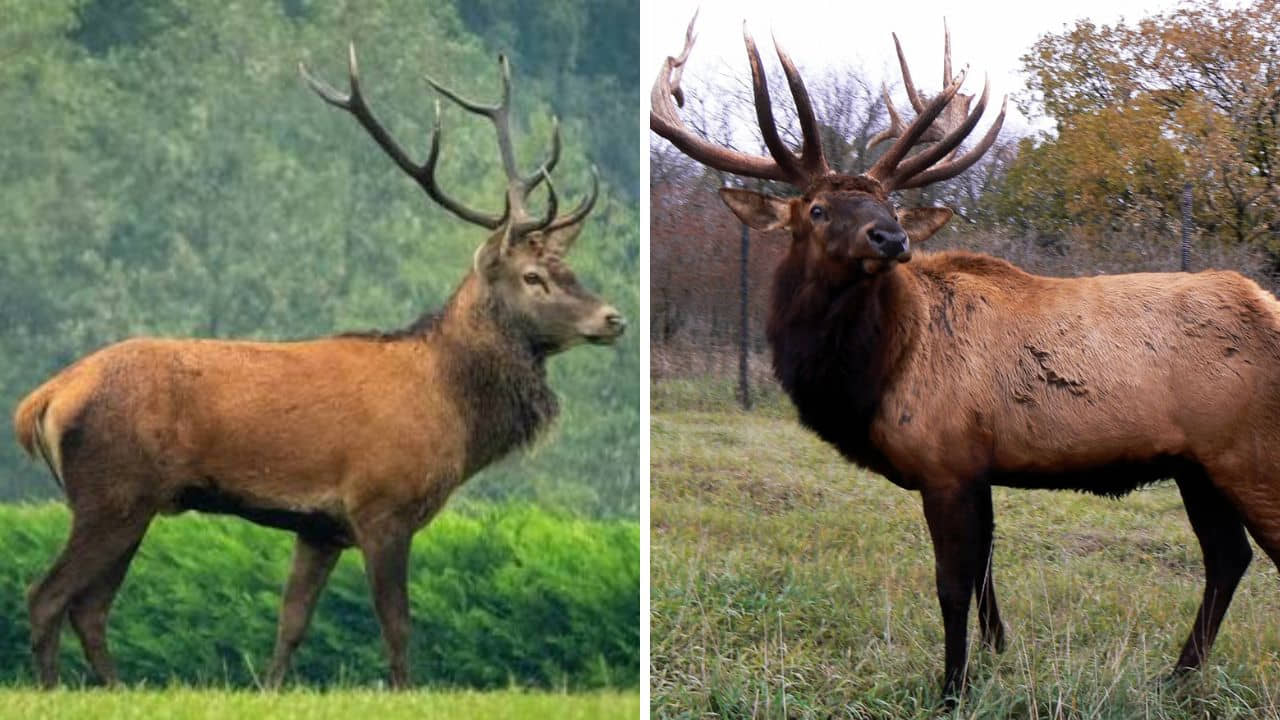
Red deer and elk are two of the largest members of the deer family, but they are not the same animal. Although both belong to the genus Cervus, they differ in body size, antler structure, habitat, behavior, and hunting tactics. These differences matter to hunters because they influence how each species is identified in the field, where they are found, how they respond during the rut, and which strategies are most effective for a successful hunt.
This guide compares red deer vs elk from a hunter’s perspective rather than a purely biological one. You’ll learn how to distinguish the two species by their physical characteristics, understand where they live and how they behave during the hunting season, and compare their difficulty, trophy potential, and meat yield. The guide also explains how habitat affects hunting methods, what shot placement considerations hunters should keep in mind, and which species is better suited for different levels of hunting experience. Whether you’re planning a red deer hunt in Europe or New Zealand or an elk hunt in North America, this comparison will help you make informed decisions before heading into the field.
What is the difference between red deer and elk?
The main difference between red deer and elk is that elk are generally larger, heavier, and more adapted to open mountain and forest-edge habitats, while red deer are usually smaller and more common across Europe, parts of Asia, and introduced hunting areas such as New Zealand. Both species belong to the deer family, but elk are widely known as wapiti in North America and are classified separately from red deer in modern taxonomy.
For hunters, the practical difference starts with size. A mature bull elk has a larger body, longer legs, and a heavier frame than a mature red stag. This affects tracking, shot placement, meat yield, and pack-out difficulty. In the field, elk often appear taller through the shoulder and deeper through the chest, while red deer usually look more compact and lighter-bodied.
Antlers are another clear difference. Elk antlers are typically longer, more sweeping, and more open, with prominent tines extending from a main beam. Red deer antlers are often more compact and may form a crown near the top, especially in mature stags. This matters for trophy hunters because antler structure, symmetry, tine length, and mass are judged differently depending on the species and scoring system.
Their calls also differ during the rut. Elk bulls produce a high-pitched bugle that carries across open terrain, while red stags make a deeper roar. This difference changes how hunters locate animals, call during the rut, and decide when to move closer. A hunter who mistakes a red stag roar for an elk bugle may misread distance, terrain, and animal behavior.
How can hunters identify red deer and elk in the field?
Hunters can identify red deer and elk by comparing body size, antler configuration, coat color, and overall body proportions. While these species share many physical characteristics, several field marks remain consistent enough to distinguish them, even at long distances.
Body size is usually the first clue. Mature bull elk are among the largest deer species in the world, commonly weighing 600–1,000 lb (270–450 kg), with exceptional individuals exceeding that range. Mature red stags typically weigh 350–550 lb (160–250 kg), although exceptionally large animals may approach 700 lb (320 kg). Elk also stand noticeably taller, often reaching 4.5–5 feet (1.4–1.5 m) at the shoulder, giving them a longer-legged and more imposing appearance than red deer.
Antlers provide the most reliable identification feature during the hunting season. Elk antlers grow long, sweeping main beams with multiple upright tines that project outward, creating a wide and open profile. Mature bulls commonly carry six or more points per side, making the classic “6×6 bull” highly recognizable. Red deer antlers are generally shorter and denser, with a distinctive crown of terminal tines on mature stags. Their antlers appear more compact and upright, especially when viewed from the front.
Coat color also differs throughout much of the year. Elk usually have a light tan or buff-colored body, a dark brown neck, and a large cream rump patch that is clearly visible from behind. Red deer are more uniformly reddish-brown to dark brown, with a less pronounced rump patch and no sharp contrast between the neck and body outside the rut. During autumn, mature red stags may develop darker neck hair, but the color transition remains subtler than in elk.
Head shape and body proportions offer additional confirmation. Elk have a longer face, larger ears, a deeper chest, and a more elongated neck, giving them a distinctly taller profile. Red deer have a shorter head, a more compact torso, and lighter bone structure. These differences become especially useful when antlers are partially hidden by vegetation or when observing females and young animals that lack antlers.
When several characteristics are evaluated together instead of relying on a single feature, hunters can identify red deer and elk with much greater confidence, reducing the risk of misidentification before taking a shot.
Where do red deer and elk live?
Red deer and elk occupy different native ranges, although both thrive in temperate forests, mountain landscapes, and open grasslands. Understanding where each species lives helps hunters choose suitable destinations, predict animal movement, and adapt hunting strategies to local terrain.
Red deer are native to Europe, western and central Asia, and parts of North Africa. They have also been successfully introduced to countries such as New Zealand, Argentina, Chile, and Australia, where free-ranging populations support well-established hunting opportunities. In Europe, some of the best-known destinations for wild red deer hunting include Scotland, Spain, Hungary, Romania, and the Carpathian Mountains.
Elk, also known as wapiti, are native to North America and eastern Asia. Today, the largest huntable populations are found across the western United States and Canada, particularly in the Rocky Mountains. States such as Colorado, Montana, Idaho, Wyoming, Utah, Arizona, and New Mexico are internationally recognized for producing healthy elk populations and mature trophy bulls.
Habitat preferences also differ between the two species. Red deer commonly inhabit mixed woodlands, rolling hills, forest edges, and agricultural valleys, where they can move easily between cover and feeding areas. During daylight, they often remain inside dense woodland before emerging into open fields and meadows during dawn and dusk.
Elk generally occupy larger and more rugged landscapes. They are frequently found in conifer forests, alpine meadows, mountain basins, river valleys, and high-elevation public lands. Seasonal migration is common in many elk herds, with animals moving to higher elevations during summer and descending into lower valleys after heavy snowfall.
These habitat differences directly influence hunting tactics. Red deer hunts often involve glassing forest edges, stalking across farmland, or waiting along travel corridors during the rut. Elk hunting usually requires covering greater distances on foot, locating herds through bugling activity, and navigating steep terrain where elevation, wind direction, and thermals play a significant role in a successful approach.
Hunters planning an international hunt should also consider regional hunting regulations, tag availability, and season dates. While many European countries manage red deer through estate or concession systems, elk hunting in North America often combines limited-entry draws, over-the-counter tags, guided hunts, and public-land opportunities, depending on the state or province.
How do red deer and elk behave during hunting season?
Red deer and elk become significantly more active and vocal during the rut, making this the most productive period for hunters. Although both species compete aggressively for breeding rights, they communicate differently, organize harems differently, and respond to hunting pressure in unique ways.
The rut generally begins in September for both species, although timing varies by latitude, elevation, and local climate. Mature males increase their activity, establish territories or breeding areas, and spend much of the day searching for receptive females. During this period, bulls and stags often neglect feeding, travel longer distances, and become more willing to challenge rival males, creating excellent opportunities for hunters who understand their behavior.
One of the most obvious differences is their vocalization. Bull elk produce a distinctive bugle—a high-pitched call followed by a series of grunts—that can travel for more than a mile under favorable conditions. Hunters frequently use bugle tubes and cow calls to imitate this behavior, encouraging dominant bulls to investigate or defend their harems.
Red stags communicate with a deep, guttural roar rather than a bugle. Roaring is used to advertise dominance, attract hinds, and warn competing stags to stay away. Instead of responding aggressively to bugling-style calls, red stags are more likely to react to roaring, movement near their harem, or the presence of another mature stag. As a result, calling techniques for red deer are generally less aggressive than those used for elk.
Daily movement patterns also differ. Elk often travel several miles between bedding and feeding areas, especially on large public lands where hunting pressure is high. They usually bed in north-facing timber during the day and move into meadows, burns, or open parks during early morning and late evening. Red deer typically have smaller home ranges and remain closer to woodland cover, emerging into open grassland or farmland during periods of low disturbance.
Hunting pressure changes the behavior of both species, but elk generally respond by moving into steeper terrain, thicker timber, or areas with limited human access. Mature bulls may become almost entirely nocturnal after repeated disturbance. Red deer also become more cautious, yet they often continue using established travel routes and traditional rutting grounds, making careful observation and knowledge of local movement patterns especially valuable.
For hunters, understanding these behavioral differences is just as important as identifying the animal itself. Reading fresh sign, recognizing vocalizations, and anticipating daily movement patterns often determine whether a stalk ends with a shot opportunity or an empty tag.
Which is harder to hunt, red deer or elk?
Elk are generally more challenging to hunt than red deer because they inhabit larger, steeper landscapes, travel greater distances, and can quickly move into inaccessible terrain after detecting danger. Red deer are by no means easy to hunt, but their habitat and movement patterns are often more predictable, particularly in regions where populations are well established.
Terrain is one of the biggest factors separating the two hunts. Elk are commonly found in expansive mountain ranges, dense conifer forests, alpine basins, and rugged public lands. A typical elk hunt may require hiking 5–10 miles (8–16 km) per day, climbing significant elevation, and carrying heavy gear in rapidly changing weather. Recovering a mature bull can be physically demanding, as boned-out meat and antlers may require multiple trips from the kill site.
Red deer hunting is typically less physically demanding, although this depends on the country and hunting area. In Scotland, hunters often stalk stags across open hillsides and heather-covered moorland. In Central Europe, hunts frequently take place in mixed forests, agricultural landscapes, or managed estates where access is easier. In New Zealand, however, free-range red deer can occupy steep alpine terrain that rivals the difficulty of many North American elk hunts.
Animal behavior also affects hunting success. Mature elk have exceptional hearing and an acute sense of smell, allowing them to detect hunters long before they are seen. During heavily hunted seasons, bulls often move into thick timber during daylight and become increasingly nocturnal. Their large home ranges mean they can leave an area entirely after repeated disturbance, forcing hunters to relocate and begin searching again.
Red deer are equally alert but generally follow more consistent feeding and bedding routines. During the rut, dominant stags often remain close to traditional rutting grounds where they defend groups of hinds. This behavior allows experienced hunters to pattern movement more effectively, although mature stags quickly become cautious when pressured and may retreat into dense woodland before sunrise.
The hunting method also influences the level of difficulty. Elk hunting frequently combines spot-and-stalk, calling, and still-hunting, with success depending on wind direction, terrain, and accurate interpretation of bugles. Calling can create close-range opportunities, but it can also expose the hunter if used incorrectly. Red deer hunting relies more heavily on stalking, glassing from elevated vantage points, and patiently waiting along travel routes during peak movement periods. Calling plays a smaller role and is generally less aggressive than during elk hunts.
Overall, hunters looking for the greatest physical and mental challenge often consider elk one of the most demanding big-game species in North America. Red deer offer a different experience, emphasizing careful observation, precise stalking, and effective use of terrain rather than long-distance mountain travel. The better choice depends on your fitness level, hunting experience, preferred terrain, and the type of challenge you want from the hunt.
How does shot placement differ between red deer and elk?
Shot placement principles are the same for red deer and elk, but elk require greater attention to anatomy because their larger body, heavier muscle mass, and thicker skeletal structure can make visual judgment more difficult. A well-placed shot through the heart and lungs remains the most ethical and effective option for both species.
The vital organs occupy a similar position in both animals, sitting low in the chest directly behind the front shoulder. However, elk have a noticeably deeper chest cavity and a larger shoulder assembly than red deer. Hunters who aim too high often strike muscle above the lungs, while shots placed too far forward may impact the heavy shoulder blade instead of entering the thoracic cavity. Waiting until the animal presents a broadside or slightly quartering-away angle provides the largest vital target and increases the likelihood of a quick, humane harvest.
Distance also affects shot placement decisions. Red deer are commonly hunted in landscapes where shooting distances range from 100 to 300 yards (90–275 m). Elk hunting can involve similar distances in timber, but shots across mountain basins or open parks may extend beyond 400 yards (365 m). As distance increases, bullet drop, wind drift, and shooter stability become increasingly important. Ethical hunters should only shoot within the range at which they can consistently place every bullet inside the vital zone.
Cartridge selection should match the size of the animal and expected shooting conditions. For red deer, cartridges such as the .270 Winchester, 7mm Remington Magnum, .308 Winchester, and .30-06 Springfield are widely used with controlled-expansion bullets. Elk are commonly hunted with the same cartridges, although many hunters prefer heavier bullet weights or more powerful options such as the .300 Winchester Magnum, 7mm PRC, .300 PRC, or .338 Winchester Magnum to maintain penetration on large bulls, particularly at extended distances or on quartering shots.
The most common mistakes occur before the trigger is pulled. Hunters sometimes underestimate an elk’s body depth and aim too high, shoot at animals that are quartering sharply toward them, or rush a shot before the bull clears brush. Others focus on the shoulder instead of visualizing the heart and lungs behind it. On both red deer and elk, patience usually results in a higher-percentage opportunity. Waiting a few extra seconds for the animal to turn broadside often leads to a cleaner harvest, a shorter tracking job, and better meat preservation.
Successful shot placement depends on more than caliber alone. Understanding anatomy, reading the animal’s body position, controlling breathing, and knowing your effective shooting range contribute far more to a quick, ethical kill than simply choosing a larger cartridge.
Which species offers the better trophy?
Neither species is objectively a better trophy because trophy quality depends on the hunter’s goals, hunting location, and the scoring system used. Elk are prized for their massive, sweeping antlers and impressive body size, while red deer are admired for their classic crown-shaped antlers, long history in European hunting culture, and strong presence in international trophy hunting.
For many North American hunters, harvesting a mature bull elk is considered one of the highest achievements in big-game hunting. Mature bulls commonly carry six or more points per side, with exceptional animals producing antlers exceeding 350 inches under the Boone and Crockett scoring system. Large bulls combine antler length, beam mass, symmetry, and tine development to create one of the most recognizable trophies in the hunting world.
Red deer trophies are evaluated differently. In Europe, trophy quality is commonly assessed using the Conseil International de la Chasse (CIC) scoring system, which considers antler weight, length, circumference, symmetry, and appearance. Mature stags are known for their distinctive crown formation, making antler shape as important as overall size. While red deer antlers are generally smaller than those of elk, exceptional stags remain highly sought after because of their rarity and the tradition associated with stalking them during the rut.
The hunting experience also contributes to trophy value. Elk hunts often involve covering long distances in rugged mountain terrain, locating bugling bulls, and making physically demanding stalks. Red deer hunts emphasize fieldcraft, patience, and careful observation, particularly during the roaring season. Many hunters value the experience of the hunt as much as the measurements of the antlers.
Ultimately, the better trophy depends on personal preference. Hunters seeking the largest antlers and one of North America’s most iconic big-game animals often choose elk. Those who appreciate traditional stalking, European hunting heritage, or hunting in New Zealand may find a mature red stag equally rewarding.
How does red deer meat compare with elk meat?
Both red deer and elk produce high-quality venison, but elk generally provide more meat because of their larger body size, while red deer are often described as having a slightly richer flavor. Meat quality is influenced by the animal’s age, diet, physical condition, and field care after harvest rather than species alone.
A mature bull elk can yield 200–300 pounds (90–135 kg) of boneless meat, depending on body size and processing methods. A mature red stag typically produces 120–200 pounds (55–90 kg) of boneless venison. For hunters who prioritize filling the freezer, elk usually offer a clear advantage in total meat yield.
Flavor differences are generally subtle. Elk venison is widely regarded as mild, lean, and slightly sweet, making it popular with hunters who are new to wild game. Red deer venison has a fuller, more pronounced game flavor while remaining considerably milder than many other wild ungulates. Animals harvested outside the peak rut often provide more tender meat, as mature males can lose body condition and develop stronger flavors during the breeding season.
Both species produce exceptionally lean meat that is naturally high in protein and rich in nutrients such as iron, zinc, vitamin B12, and niacin. Because venison contains very little intramuscular fat, proper cooking techniques are essential to maintain tenderness. Many hunters prefer medium-rare preparation for steaks and roasts, while tougher cuts are commonly slow-cooked, ground for burgers, or processed into sausages.
Field handling has a greater impact on meat quality than species differences. Prompt recovery, rapid cooling, clean dressing, and proper aging help preserve texture and flavor. Even an outstanding bull elk can produce poor-quality meat if left unrecovered for too long in warm weather, while a well-handled red stag can provide excellent venison from nearly every usable cut.
From a practical hunting perspective, hunters focused on maximizing meat production will generally favor elk. Those who value traditional venison flavor and hunt in regions where red deer are abundant will find red deer equally rewarding on the table.
Read more: Mule Deer vs Whitetail Deer: Key Differences for Hunters
Which species is better for first-time hunters?
Red deer are generally a better choice for first-time hunters because their hunts are often more accessible, less physically demanding, and available in a wider range of hunting environments. Elk hunting typically requires greater physical fitness, advanced calling skills, and the ability to navigate rugged mountain terrain over multiple days.
For beginners, red deer hunts usually involve shorter stalks, more predictable animal movement, and easier logistics. Many European hunting estates and New Zealand outfitters provide guided hunts with high game densities, allowing new hunters to focus on shot execution and field experience rather than spending days locating animals.
Elk hunts present a steeper learning curve. Hunters often cover long distances at high elevations while dealing with rapidly changing weather, difficult pack-outs, and heavily pressured animals. Calling effectively during the rut also requires practice, as experienced bulls can quickly recognize unnatural sounds or unexpected movement.
Budget is another important consideration. Guided red deer hunts are generally more affordable than premium elk hunts, although prices vary by country and trophy quality. DIY elk hunts on public land can reduce costs significantly, but they demand more planning, physical preparation, navigation skills, and knowledge of local hunting regulations.
Hunters looking for their first international big-game experience often find red deer to be an excellent starting point. Those seeking a physically demanding backcountry adventure and willing to invest more time preparing may find elk hunting to be the more rewarding long-term challenge.
Red Deer vs Elk Comparison Table
| Feature | Red Deer | Elk |
|---|---|---|
| Scientific name | Cervus elaphus | Cervus canadensis |
| Common name | Red deer | Elk (Wapiti) |
| Native range | Europe, Asia, North Africa | North America, Eastern Asia |
| Average bull/stag weight | 350–550 lb (160–250 kg) | 600–1,000 lb (270–450 kg) |
| Shoulder height | 3.5–4.5 ft (1.1–1.4 m) | 4.5–5 ft (1.4–1.5 m) |
| Antler shape | Compact with crown formation | Long, sweeping beams with multiple tines |
| Rut vocalization | Deep roar | High-pitched bugle |
| Preferred habitat | Forests, hills, farmland, woodland edges | Mountains, conifer forests, alpine meadows |
| Home range | Smaller and more localized | Larger and often migratory |
| Hunting difficulty | Moderate | High |
| Trophy systems | CIC | Boone & Crockett, SCI |
| Typical meat yield | 120–200 lb (55–90 kg) | 200–300 lb (90–135 kg) |
| Best hunting methods | Stalking, glassing, ambush | Spot-and-stalk, calling, still-hunting |
| Best for beginners | Yes | Experienced hunters |
Frequently Asked Questions About Red Deer vs Elk
Is an elk bigger than a red deer?
Yes. Mature bull elk are significantly larger than mature red stags in both body weight and shoulder height. They also produce greater meat yields and generally carry larger antlers.
Are red deer and elk the same species?
No. Although both belong to the genus Cervus and share a common evolutionary history, modern wildlife authorities classify elk (Cervus canadensis) and red deer (Cervus elaphus) as separate species.
Can red deer and elk interbreed?
Yes. Red deer and elk can produce fertile offspring where they coexist. Hybridization has been documented in both captive populations and a limited number of free-ranging herds, although it is uncommon in most wild hunting areas.
Which species has larger antlers?
Elk generally have larger antlers. Mature bulls develop longer main beams and greater overall spread, while mature red stags are recognized for their distinctive crown-shaped antler formation.
Which species is harder to hunt?
Elk are usually harder to hunt. Their larger home ranges, mountainous habitat, exceptional senses, and demanding pack-outs make elk one of the most challenging big-game species in North America.
Which has better-tasting venison?
Both provide excellent table fare. Elk is widely regarded as having a mild, slightly sweet flavor, while red deer venison has a richer and more traditional game taste. Proper field care and meat handling have a greater influence on flavor than the species itself.
Final Takeaway
Choose red deer if you prefer a more accessible hunt, traditional stalking, and a lower barrier to entry. Choose elk if you want a physically demanding backcountry adventure, larger trophies, and the opportunity to pursue one of North America’s most iconic big-game animals. Both species offer outstanding hunting experiences, and the better choice ultimately depends on your hunting goals, budget, fitness level, and preferred style of hunting.