
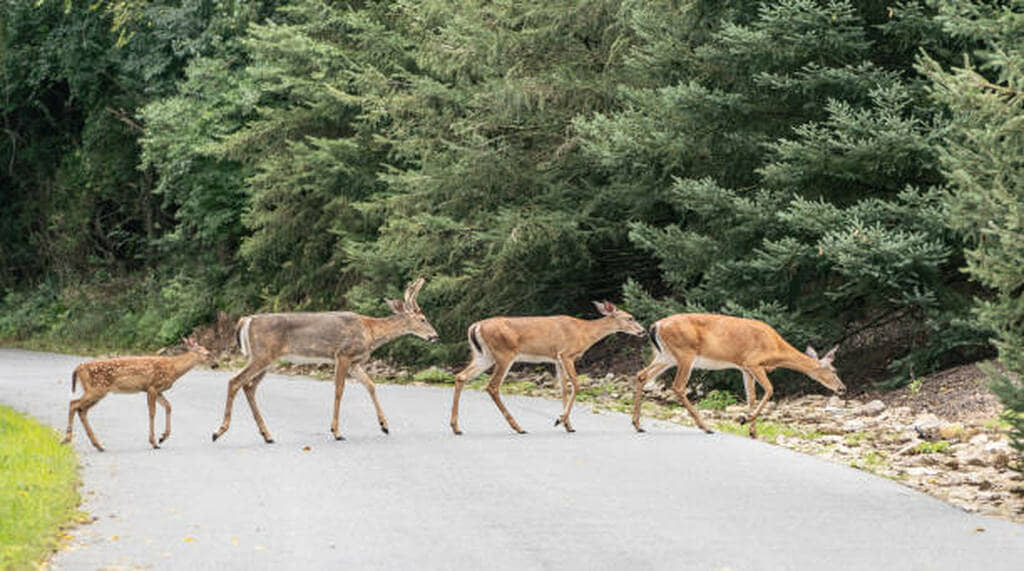
A group of deer is called a herd. While herd is the standard and most widely accepted collective noun in modern English, you may also come across less common terms such as parcel or mob in historical texts and regional usage. Among these, herd is the term used in wildlife biology, field guides, and everyday conversation because it accurately describes the social behavior of most deer species.
Deer often gather in groups to improve their chances of survival. Living in a herd helps them detect predators earlier, protect young fawns, find food more efficiently, and conserve energy during seasonal movements. However, not every deer species lives in large herds throughout the year. Some species form only small family groups, while others, such as moose, spend much of their lives alone except during the breeding season.
This guide explains what a group of deer is called, why herd is the preferred term, and whether other names are also correct. You’ll also learn how herd behavior differs among deer species, the meaning of related terms such as stag, doe, and fawn, and how the collective noun for deer compares with those of other animals.
What Is a Group of Deer Called?
A group of deer is called a herd. The word herd is the standard collective noun for deer in modern English and is the term most commonly used by wildlife biologists, conservation organizations, hunters, and English dictionaries. Whether the group contains a few individuals feeding together or dozens of deer moving across a landscape, herd is the accepted and widely recognized name.
A collective noun is a word that refers to a group of people, animals, or things as a single unit. In the case of deer, herd reflects their natural social behavior. Many deer species spend part or all of the year living in groups to improve survival, locate food, and reduce the risk of predation. Because grouping is a common characteristic of grazing and browsing mammals, the same collective noun is also used for animals such as elephants, cattle, bison, and antelope.
Here are a few examples of how the term is used:
- A herd of deer crossed the road just before sunrise.
- Rangers spotted a herd of deer grazing near the forest edge.
- During winter, a herd of deer may gather in sheltered areas where food is more accessible.
Although you may occasionally encounter alternative collective nouns such as parcel or mob, these terms are uncommon in modern English. For almost every everyday, educational, or scientific context, herd of deer is the correct and preferred expression.
Are There Other Names for a Group of Deer?
Yes, deer have a few alternative collective nouns, but “herd” is the only term widely used in modern English. Historical dictionaries and collections of animal group names list terms such as parcel and mob, yet these are rarely used in everyday conversation, wildlife research, or educational materials.
Parcel of deer
Parcel is an old collective noun that appears in historical English literature and traditional lists of animal group names. Unlike herd, it is not commonly used by wildlife experts or native speakers today. You may encounter the phrase a parcel of deer in older books, poetry, or discussions about archaic English, but it is considered uncommon in contemporary usage.
Mob of deer
The term mob is another alternative collective noun, although it is much less familiar than herd. In some English-speaking regions, particularly where mob is also used for groups of livestock such as kangaroos or cattle, the word has occasionally been applied to deer. However, this usage is regional rather than standard and is rarely found in scientific publications or major dictionaries.
Which term should you use?
Use “herd” in almost every situation. It is the preferred collective noun in modern English because it is widely understood, grammatically correct, and consistently used in wildlife biology, conservation, education, and everyday communication.
The table below summarizes the differences.
| Collective noun | Common today | Typical usage |
|---|---|---|
| Herd | Yes | Everyday English, wildlife biology, education |
| Parcel | Rare | Historical literature, archaic English |
| Mob | Rare | Regional usage and occasional informal references |
If your goal is to write or speak naturally, “a herd of deer” is the expression that native speakers and authoritative wildlife sources expect. The alternative terms are useful to know because they appear in older references, but they should be viewed as historical or regional variants rather than standard modern English.
Read more: How Long Do Deer Live For? The Surprising Truth Revealed!
Why Are Deer Called a Herd?
Deer are called a herd because many species naturally live and move together in organized social groups. The word herd describes animals that travel, feed, and respond to danger as a group, making it the most accurate collective noun for deer in both everyday English and wildlife science.
Living in a herd provides several survival advantages. A larger group increases the number of eyes and ears watching for predators, allowing deer to detect threats earlier. Herd members also benefit from shared vigilance, meaning each individual spends less time scanning for danger and more time feeding. During winter, grouping together helps deer locate food sources, follow established travel routes, and reduce energy expenditure by moving along the same paths through snow or dense vegetation.
Herd size varies throughout the year. During spring and summer, females often stay in small family groups with their fawns, while adult males may live alone or form separate bachelor groups outside the breeding season. In autumn and winter, food availability, migration, and mating behavior can bring multiple groups together, creating much larger herds. Species such as reindeer (caribou) are well known for forming massive migratory herds that can include hundreds or even thousands of individuals.
The term herd is also used for many other hoofed mammals because they share similar social structures. Animals such as bison, elephants, antelope, and cattle commonly travel and forage in groups, so English uses the same collective noun to describe their behavior. Since deer exhibit these same grouping patterns, herd has become the standard and universally accepted name for a group of deer.
Do All Deer Species Live in Herds?
No, not all deer species live in herds throughout the year. While many deer are social animals, their group size and behavior depend on the species, season, habitat, and breeding cycle. Some species regularly form large herds, whereas others spend much of their lives alone or in small family groups.
White-tailed deer
White-tailed deer usually live in small groups rather than large herds. Females often remain with their fawns and other related females, creating family groups of two to six individuals. Adult males are more solitary outside the breeding season but may form temporary bachelor groups during spring and summer. As winter approaches, several family groups often gather into larger herds to improve protection and access to food.
Red deer
Red deer commonly form herds, especially in open grasslands and mountainous regions. Females and their young typically stay together year-round, while mature stags live separately for much of the year. During the rut, or breeding season, males join female herds to compete for mates before separating again once breeding ends.
Reindeer (Caribou)
Reindeer are famous for forming some of the largest deer herds in the world. Many populations migrate over hundreds of miles each year in search of fresh vegetation. During these migrations, herds can include hundreds or even thousands of animals, providing greater protection from predators and improving navigation across long distances.
Moose
Moose are the major exception within the deer family. Unlike most deer species, moose are predominantly solitary animals. Adults usually live alone except during the breeding season or when a cow is raising a calf. Because they rarely gather in large social groups, the term herd is used less frequently when describing moose in the wild.
The table below compares the typical social behavior of several well-known deer species.
| Deer species | Typical social behavior |
|---|---|
| White-tailed deer | Small family groups; larger winter herds |
| Red deer | Regular herds, especially females and young |
| Reindeer (Caribou) | Very large migratory herds |
| Moose | Mostly solitary except during breeding or while raising calves |
Although social behavior varies across species, herd remains the standard collective noun for deer because grouping is a defining characteristic of many members of the deer family.
The words deer, stag, doe, and fawn describe different members of the deer family based on species, sex, or age. While deer is the general name for the animal, the other terms identify specific categories within a deer population.
| Term | Meaning |
|---|---|
| Deer | The general name for any member of the deer family (Cervidae). |
| Stag | An adult male deer, typically one with fully developed antlers. |
| Doe | An adult female deer. |
| Fawn | A young deer, usually less than one year old. |
Deer
Deer is the collective name for mammals in the Cervidae family, which includes species such as white-tailed deer, red deer, elk, reindeer, roe deer, and moose. When people ask, “What is a group of deer called?” the word deer refers to all individuals regardless of their sex or age.
Stag
A stag is an adult male deer, especially in species such as red deer. In North American English, the term buck is more commonly used for adult males of species like the white-tailed deer and mule deer. During the breeding season, stags use their antlers to compete with rivals for access to females.
Doe
A doe is an adult female deer. Does are responsible for raising their young and often remain in small family groups with other females and their fawns. Outside the breeding season, these family groups make up the core of many deer herds.
Fawn
A fawn is a young deer, generally from birth until it reaches about one year of age. Most fawns are born with white spots on their coats, providing camouflage that helps them blend into vegetation and avoid predators during the first months of life. As they mature, these spots gradually disappear in many deer species.
Understanding these terms makes it easier to describe deer accurately. For example, a herd may include several does, their fawns, and, depending on the season, one or more stags or bucks. Using the correct terminology also helps distinguish between the animal itself and the different roles individuals play within a deer population.
What Are Other Common Animal Group Names?
Deer are not the only animals with a special collective noun. English includes hundreds of collective nouns that describe groups of animals, although some are used far more frequently than others. Like herd for deer, many of these terms reflect an animal’s behavior, social structure, or historical usage.
The table below lists some of the most common and widely recognized animal group names.
| Animal | Collective noun |
|---|---|
| Deer | Herd |
| Wolves | Pack |
| Lions | Pride |
| Sheep | Flock |
| Fish | School |
| Geese | Gaggle |
| Crows | Murder |
| Cattle | Herd |
| Elephants | Herd |
| Dolphins | Pod |
Some collective nouns are practical and widely used in everyday English. For example, pack accurately describes the cooperative hunting behavior of wolves, while school refers to fish swimming in coordinated groups. Similarly, pod is commonly used for dolphins and whales because these marine mammals travel and communicate as closely connected social units.
Other collective nouns are more traditional than practical. Terms such as murder of crows, parliament of owls, or unkindness of ravens originated in medieval English and are now used mainly for literary effect, trivia, or educational content rather than scientific writing.
Among all these examples, herd is one of the most straightforward and universally accepted collective nouns. It applies not only to deer but also to other large grazing mammals such as cattle, elephants, bison, and antelope. Because the word clearly describes animals that live, feed, or travel together, it remains the preferred term in wildlife biology, conservation, and everyday communication.
Learning common collective nouns also makes it easier to recognize patterns in English vocabulary. Animals with similar social behavior often share the same collective noun, while highly specialized or historical terms tend to be reserved for specific species or traditional expressions.
Frequently Asked Questions
Is “herd” the only correct name for a group of deer?
No, but it is the only collective noun that is widely accepted in modern English. Alternative terms such as parcel and mob appear in historical references and some regional usage, but they are uncommon today. If you are writing for a general audience, academic purpose, or wildlife context, herd of deer is the recommended expression.
How many deer make a herd?
There is no minimum number of deer required to form a herd. A herd can consist of just a few deer traveling together or hundreds of individuals, depending on the species, habitat, and season. White-tailed deer often form small family herds, while migratory reindeer may gather in massive herds numbering thousands of animals.
Do male deer stay in herds?
Male deer do not always remain in herds year-round. Outside the breeding season, adult males often live alone or form small bachelor groups. During the rut, they join female groups to compete for mates before becoming more solitary again after the breeding season ends.
What is a baby deer called?
A baby deer is called a fawn. Fawns are born with spotted coats that provide natural camouflage against predators. They usually stay close to their mothers during the first months of life until they become strong enough to travel with the rest of the herd.
What family do deer belong to?
Deer belong to the family Cervidae. This biological family includes more than 50 living species, including white-tailed deer, red deer, elk, moose, reindeer (caribou), roe deer, and fallow deer. Although these species differ in size, habitat, and social behavior, they all share key characteristics such as hooves and, in most species, antlers on adult males.