
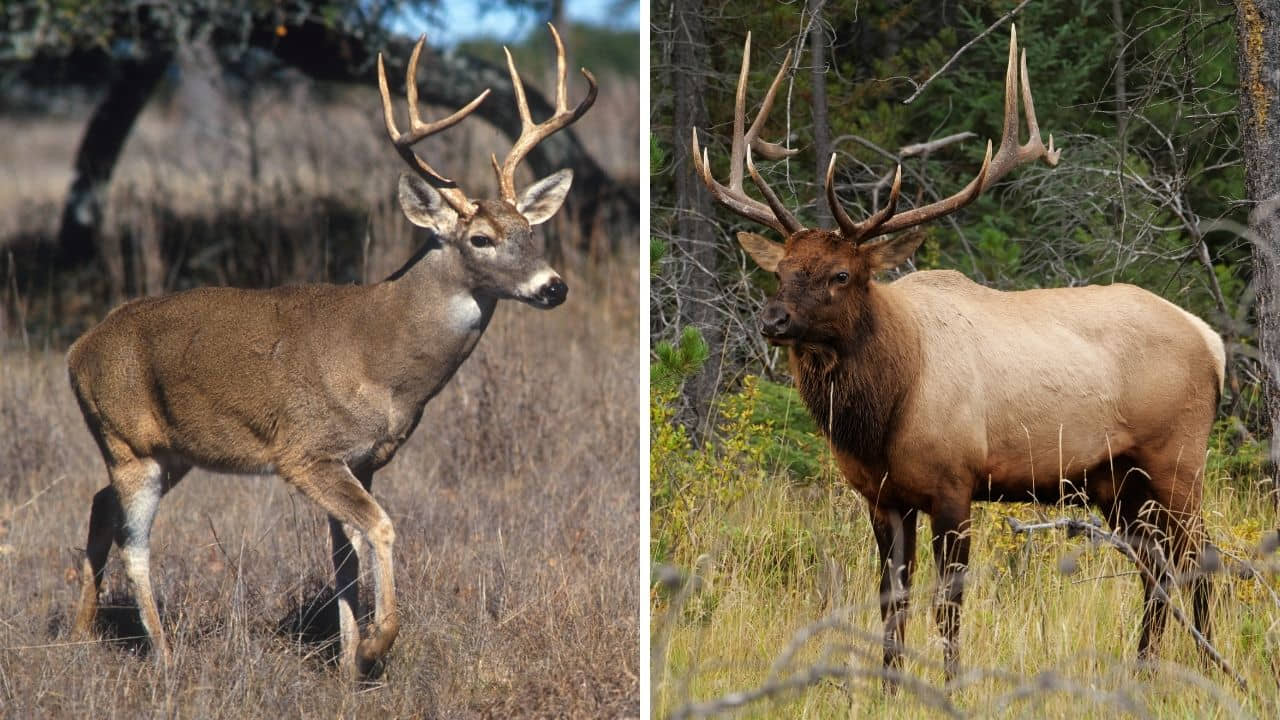
Elk and deer belong to the same deer family, but they differ significantly in size, appearance, behavior, and habitat. Because both animals have antlers, four legs, and similar body shapes, many people assume an elk is simply a large deer. In reality, elk are a distinct species with characteristics that make them easy to distinguish once you know what to look for.
The biggest differences between elk and deer include body size, antler structure, vocalizations, preferred habitat, and social behavior. Adult elk can weigh several times more than many common deer species, form larger herds, and produce a unique bugling call during the breeding season. Most deer, such as white-tailed deer, are smaller, quieter, and more adaptable to forests, farmland, and suburban environments.
Understanding these differences is useful for wildlife enthusiasts, hikers, hunters, photographers, and anyone interested in North American mammals. Correct identification also helps explain why elk and deer occupy different ecological roles despite belonging to the same family, Cervidae.
This guide compares elk and deer across every major characteristic, including taxonomy, physical appearance, antlers, habitat, diet, behavior, and safety around humans. You’ll also find a side-by-side comparison table and answers to common questions, making it easy to identify each animal and understand how they differ in the wild.
What is the difference between elk and deer?
The main difference between elk and deer is that elk are much larger, have longer and more heavily branched antlers, live in larger herds, and prefer open forests and mountain meadows, while most deer are smaller, more solitary, and adapt to a wider variety of habitats. Although both belong to the deer family (Cervidae), they are different species with distinct physical characteristics and behaviors.
The table below summarizes the most important differences.
| Feature | Elk | Deer |
|---|---|---|
| Average weight | 500–1,100 lb (225–500 kg) | 70–300 lb (32–136 kg) for most species |
| Shoulder height | 4–5 ft (1.2–1.5 m) | 2–4 ft (0.6–1.2 m) |
| Antlers | Long, sweeping, many tines | Smaller and more compact |
| Habitat | Mountains, grasslands, open forests | Forests, woodlands, farmland, suburban areas |
| Social behavior | Large herds | Solitary or small family groups |
| Breeding call | Loud bugle | Mostly grunts, bleats, or snorts |
| Geographic range | North America and eastern Asia | Nearly worldwide, depending on species |
Size is usually the easiest way to distinguish the two animals. An adult bull elk is significantly taller and heavier than even the largest common deer species, making the difference obvious when both animals are seen together.
Antlers also provide a reliable identification feature. Bull elk grow long antlers that sweep backward before branching into multiple points, whereas most deer species develop shorter, more compact antlers that vary in shape depending on the species.
Behavior offers another clear distinction. Elk are highly social animals that often gather in herds of dozens or even hundreds during parts of the year. In contrast, many deer species spend much of their lives alone or in small family groups, especially outside the breeding season.
Is an elk a type of deer?
Yes. An elk is a member of the deer family (Cervidae), but it is a separate species rather than simply a large deer. In North America, the animal commonly called an elk is the species Cervus canadensis, also known as the wapiti. It shares the same biological family as white-tailed deer, mule deer, moose, reindeer, and red deer, yet it has its own physical traits, behavior, and ecological role.
All members of the deer family share several defining characteristics. Males of most species grow and shed antlers each year, possess cloven hooves, and are herbivorous mammals. These shared traits explain why elk and deer resemble each other at first glance, even though their overall appearance differs considerably.
One common source of confusion comes from regional naming. In North America, “elk” refers to Cervus canadensis. In many parts of Europe, however, the word “elk” refers to the animal that North Americans know as the moose. To avoid confusion in scientific literature, the North American elk is often called the wapiti, a name derived from an Indigenous word meaning “white rump.”
Another misconception is that “deer” refers to a single species. In reality, deer is a broad term that describes more than 50 living species within the family Cervidae. Elk are one of those species, just as white-tailed deer, mule deer, sika deer, and red deer are separate species within the same family. Understanding this classification makes it clear that an elk is biologically a deer, but not the same type of deer that people commonly encounter in forests or suburban areas.
How do elk and deer differ in appearance?
Elk and deer differ in appearance through their body size, antlers, head shape, coat color, tail, and overall build. While both animals share the typical features of the deer family, elk have a much larger and more muscular frame that makes them easy to distinguish from most deer species.
Body size is the most obvious difference. Adult bull elk typically stand 4–5 feet (1.2–1.5 m) at the shoulder and weigh 500–1,100 pounds (225–500 kg). Adult cows usually weigh between 450 and 600 pounds (204–272 kg). In comparison, an adult white-tailed deer generally weighs 70–300 pounds (32–136 kg) and stands 2–4 feet (0.6–1.2 m) tall at the shoulder. Even without measuring, an elk appears noticeably taller, longer, and broader than a deer.
Antlers provide another reliable identification feature. Bull elk grow massive antlers that can exceed 4 feet (1.2 m) in length and often carry six or more tines on each side. Their antlers sweep backward before curving upward, creating a wide, elegant profile. Most deer species have shorter, more compact antlers with fewer points, although their exact shape varies by species and age.
Coat color also helps distinguish the two animals. Elk usually have a tan or light brown body, a dark brown neck, and a distinctive cream-colored rump patch that becomes especially noticeable during late summer and autumn. White-tailed deer are generally reddish-brown in summer and grayish-brown in winter, with a bright white underside on the tail that flashes when the animal is alarmed. Mule deer tend to have a gray-brown coat and a white rump but lack the prominent mane found on elk.
Facial features reinforce these differences. Elk have a longer head, a broader muzzle, and a thick neck that becomes especially muscular in mature bulls during the rut. Deer have a smaller, narrower face, proportionally larger eyes, and a more delicate body shape, giving them a lighter overall appearance.
The tail is another quick field mark. Elk have a short, inconspicuous tail surrounded by a pale rump patch. White-tailed deer have a long tail with a bright white underside that is raised like a flag when escaping danger. Mule deer have a rope-like tail with a black tip, making them easy to distinguish from both elk and white-tailed deer.
When tracks are available instead of a direct sighting, hoof prints can also provide clues. Elk leave tracks that are wider, deeper, and rounder because of their greater body mass. Deer tracks are smaller, narrower, and more pointed. In areas where both species occur, track size is often one of the fastest ways to identify which animal passed through.
Where do elk and deer live?
Elk and deer occupy different habitats, although their ranges overlap in some regions of North America. Elk generally prefer large landscapes with open meadows and mountainous forests, while many deer species thrive in forests, agricultural land, wetlands, and even suburban neighborhoods.
Elk are most commonly found in the western United States, Canada, and parts of eastern Asia. Large populations live in the Rocky Mountains, the Pacific Northwest, and protected areas such as national parks and wildlife refuges. They spend much of the year in mountain forests, alpine meadows, and open grasslands where abundant grasses provide their primary food source. Seasonal migration is common, with herds moving to higher elevations during summer and descending into lower valleys during winter.
Deer have a much broader geographic distribution. White-tailed deer occupy nearly every U.S. state except Alaska and are also widespread throughout southern Canada, Mexico, and Central America. Mule deer dominate many western landscapes, while red deer are native to Europe and parts of Asia. Because different deer species have adapted to a wide variety of environments, they can be found in dense forests, shrublands, farmland, river valleys, wetlands, and suburban parks.
Habitat preferences reflect differences in feeding behavior. Elk are primarily grazers, so they favor open habitats where grasses and sedges are plentiful. Deer are more flexible feeders that browse on leaves, twigs, shrubs, fruits, and young tree shoots. This dietary difference allows many deer species to live successfully in areas with thicker vegetation where grasses are less abundant.
Elk and deer often share the same ecosystem, particularly in parts of the Rocky Mountains and western North America. Even when they occupy the same landscape, they typically reduce competition by using different food resources and selecting different feeding areas. Elk spend more time in open meadows and mountain slopes, while deer remain closer to forest edges, brush, or dense cover that offers protection from predators.
Human activity has also influenced where each animal lives today. Conservation programs have successfully restored elk populations to several regions where they had disappeared, while many deer species have expanded their range because fragmented forests, farmland, and suburban development create ideal browsing habitat. As a result, encounters with deer are far more common than encounters with elk across most of North America.
Read more: When To Put Out Salt Blocks For Deer?
What do elk and deer eat?
Elk and deer are both herbivores, but they differ in the types of plants they prefer and the way they feed. Elk are primarily grazers that consume large amounts of grasses, while most deer are browsers that feed on leaves, twigs, shrubs, and other woody vegetation. These feeding habits reduce competition when both animals live in the same ecosystem.
Grasses make up the majority of an elk’s diet during spring and summer. Elk also eat sedges, wildflowers, and fresh shoots when they are readily available. As seasons change, they switch to bark, shrubs, and tree twigs to compensate for the decline in green vegetation. An adult elk consumes 15–20 pounds (7–9 kg) of vegetation per day, although intake increases during periods of rapid growth or before winter.
Most deer have a more selective diet. White-tailed deer, for example, prefer nutrient-rich browse such as young leaves, buds, berries, acorns, vines, mushrooms, and agricultural crops. Rather than grazing continuously across open meadows, they often move through dense vegetation and choose the most digestible plant parts. This selective feeding strategy allows deer to thrive in forests, farmland, and suburban landscapes where grasses are less abundant.
Seasonal food availability changes the diet of both animals. During spring and summer, fresh vegetation provides the protein and nutrients needed for body growth, antler development, and reproduction. In autumn, both elk and deer consume energy-rich foods such as nuts, seeds, and late-season vegetation to build fat reserves before winter. When snow covers the ground, woody browse, evergreen plants, and tree bark become increasingly important food sources.
Their feeding behavior also influences habitat selection. Elk spend much of their time in open meadows and mountain valleys where grasses are plentiful, while deer remain closer to forests and brush where shrubs and tree seedlings provide year-round forage. This difference explains why both species can coexist in the same region without competing heavily for food.
How does elk behavior differ from deer behavior?
Elk are generally more social and vocal than deer, while most deer are more solitary, secretive, and dependent on dense cover for protection. These behavioral differences become especially noticeable during feeding, migration, and the breeding season.
Elk typically form large herds that may contain dozens or even hundreds of individuals outside the breeding season. Cow herds consist of females and calves, while mature bulls often remain in separate bachelor groups until autumn. Living in large groups improves predator detection and increases survival in open landscapes where cover is limited.
Most deer live in much smaller groups. White-tailed deer commonly travel alone or in family units made up of a doe and her offspring. Temporary groups may form during winter when food is concentrated, but they rarely reach the size of elk herds. Their reliance on camouflage and dense vegetation makes small group sizes more effective than large gatherings.
Breeding behavior differs considerably between the two animals. During the autumn rut, bull elk compete aggressively for harems of females and advertise their dominance with a loud, high-pitched bugle that can be heard over long distances. They also spar with rivals using their antlers and defend breeding territories until the rut ends.
Male deer also compete during the breeding season, but their displays are usually less dramatic. Bucks establish dominance through scent marking, antler rubbing, scraping the ground, and short antler fights. Instead of bugling, they communicate with grunts, snorts, bleats, and body language. Because many deer inhabit dense forests, quieter communication is often more effective than long-distance vocalizations.
Movement patterns further distinguish the two species. Many elk populations migrate seasonally between high-elevation summer ranges and lower wintering grounds, sometimes traveling dozens of miles each year. Most deer occupy much smaller home ranges and make shorter seasonal movements, although migration occurs in some northern populations.
Both species are naturally cautious around humans, but they respond differently when disturbed. Deer usually rely on stealth and rapid escape into nearby cover. Elk are more likely to stand together briefly, assess the threat, and then move as a herd toward open terrain. During the rut or when protecting calves, elk may become unusually defensive and should always be observed from a safe distance.
These behavioral adaptations reflect the environments each species occupies. Elk have evolved to survive in expansive landscapes where cooperation and visibility are advantages, whereas deer depend more heavily on concealment, agility, and selective movement through dense vegetation.
Are elk more dangerous than deer?
Yes, elk are generally more dangerous than deer because of their larger size, greater strength, and more aggressive behavior during the breeding and calving seasons. Although both animals usually avoid humans, either species can become defensive when threatened or cornered.
An adult bull elk can weigh more than 1,000 pounds (450 kg), making it capable of causing serious injuries with its antlers or hooves. During the autumn rut, bulls become highly territorial and may charge rivals, vehicles, or people who approach too closely. Female elk are also protective of their calves in late spring and early summer and may attack if they perceive a threat.
Deer are less powerful but should not be considered harmless. Bucks become more aggressive during the rut and may use their antlers to defend territory or challenge perceived rivals. Injured or trapped deer can also kick with surprising force. However, compared with elk, deer are far more likely to flee than confront people.
Vehicle collisions represent the greatest danger associated with both animals. Deer are responsible for hundreds of thousands of wildlife-vehicle collisions each year because they frequently cross roads near developed areas. Elk are involved in fewer accidents, but collisions tend to be more severe because of their larger body size.
If you encounter either species in the wild, maintain a safe distance, avoid approaching calves, never feed wild animals, and back away slowly if the animal shows signs of agitation. Warning behaviors include pinned ears, raised hair, pawing the ground, lowered heads, and repeated vocalizations.
Elk vs Deer Comparison Table
| Feature | Elk | Deer |
|---|---|---|
| Scientific name | Cervus canadensis | More than 50 species within Cervidae |
| Average weight | 500–1,100 lb (225–500 kg) | 70–300 lb (32–136 kg) for most species |
| Shoulder height | 4–5 ft (1.2–1.5 m) | 2–4 ft (0.6–1.2 m) |
| Body build | Large and muscular | Smaller and more slender |
| Antlers | Long, sweeping, many tines | Shorter and more compact |
| Coat color | Tan body with dark neck | Brown or gray, depending on species |
| Tail | Short, barely visible | Longer and more noticeable |
| Rump patch | Large cream-colored patch | White underside of tail or white rump, depending on species |
| Habitat | Mountains, grasslands, open forests | Forests, farmland, wetlands, suburban areas |
| Diet | Primarily grasses | Leaves, shrubs, twigs, fruits, nuts |
| Feeding style | Grazer | Browser |
| Social behavior | Large herds | Solitary or small family groups |
| Vocalization | Loud bugle | Grunts, bleats, snorts |
| Migration | Seasonal migration is common | Usually limited seasonal movement |
| Lifespan | 10–15 years in the wild | 6–14 years, depending on species |
| Main predators | Wolves, bears, mountain lions | Coyotes, wolves, bears, mountain lions, bobcats |
| Human encounters | Less common | Very common |
How is an elk different from a moose?
Elk, deer, and moose all belong to the deer family, but the moose is the largest and most distinctive member of the group. People often confuse elk and moose because both are much larger than most deer, yet they have very different physical characteristics.
Moose are significantly larger than elk, with mature bulls weighing 800–1,600 pounds (360–725 kg) and standing more than 6 feet (1.8 m) at the shoulder. They have long legs, a pronounced shoulder hump, a broad overhanging muzzle, and a dewlap of skin beneath the throat known as a bell. Their antlers are wide and flattened with broad palm-shaped surfaces, unlike the long, branching antlers of elk.
Elk are slimmer and more athletic in appearance. Their antlers sweep backward before branching upward, and they are highly social animals that often live in large herds. Moose, by contrast, are usually solitary except during the breeding season or when females are raising calves.
Habitat preferences also differ. Moose favor wetlands, boreal forests, and lakes where they browse on aquatic plants, willow, birch, and aspen. Elk prefer open forests, mountain meadows, and grasslands where grazing opportunities are abundant.
For quick identification, remember three key features:
- Moose are the largest and have broad, palm-shaped antlers.
- Elk are medium-sized with long branching antlers and a light-colored rump.
- Most deer are much smaller, with compact antlers and slimmer bodies.
Frequently Asked Questions
Which is bigger, an elk or a deer?
An elk is much larger than most deer species. Adult bull elk can weigh more than 1,000 pounds (450 kg), while common deer species such as white-tailed deer typically weigh less than 300 pounds (136 kg).
Can elk and deer mate?
No. Although elk and deer belong to the same family, they are different species with separate evolutionary histories and reproductive barriers. Natural hybridization between elk and common deer species has not been documented.
Are elk aggressive?
Elk are generally calm but become aggressive during the rut and when females are protecting calves. Keeping a safe distance and avoiding direct interaction greatly reduces the risk of conflict.
Why are elk called wapiti?
The name “wapiti” comes from an Indigenous North American word meaning “white rump.” The name refers to the large cream-colored rump patch that is one of the elk’s most recognizable features.
Are elk found only in North America?
No. Wild elk occur naturally in North America and parts of eastern Asia. Reintroduced populations also exist in several other regions, although North America supports the largest and most well-known populations.