
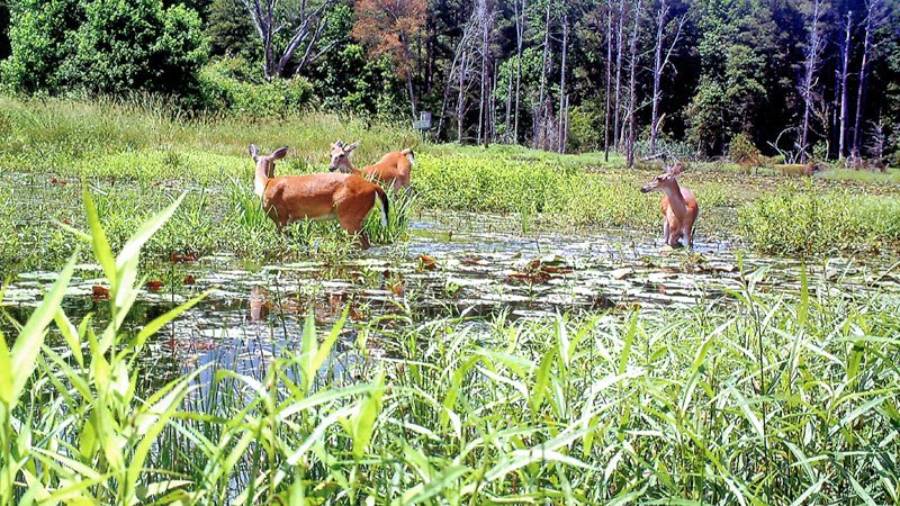
Deer often stop using an area after flooding because floodwater changes the food, bedding cover, travel routes, and security conditions that made the area useful before the flood. Low-lying bedding areas can become inaccessible, established trails can disappear under water, and deer may shift toward nearby dry ground where they can reach food and cover with less effort. Even after the water recedes, deer activity may not immediately return to its previous pattern because the habitat itself can remain altered.
A lack of deer activity after a flood does not necessarily mean the deer have left the property or abandoned their entire home range. In many cases, flooding redistributes deer activity. Deer can begin using higher terrain, alternative bedding cover, different feeding areas, and new travel corridors while previously productive locations receive little or no traffic.
For hunters, the key is to identify what changed rather than simply waiting for deer to return to an old trail, stand, or camera location. This article explains why deer stop using flooded areas, where displaced deer are likely to move, what determines when they return, and which signs can reveal their current movement patterns. It also explains how to scout and adjust hunting locations after floodwater changes the habitat.
Why do deer stop using an area after flooding?
Deer stop using an area after flooding when the flood changes the food, bedding cover, travel routes, or security that made the location useful before the water arrived. Deer select areas based on access to essential resources rather than loyalty to a specific trail, stand location, or patch of ground. When flooding makes those resources harder to reach, deer redistribute their activity toward habitat that provides them more efficiently.
There are 5 main ways flooding can reduce deer use of an area. First, rising water can block established travel routes through creek bottoms, river bottoms, drainage areas, and other low terrain. A trail that previously connected bedding and feeding areas may no longer provide a practical route. Deer can respond by using a different crossing, traveling along the edge of the flooded ground, or approaching the same destination from higher terrain.
Second, flooding can change food availability. Water can temporarily prevent deer from reaching low-lying browse, crops, mast, and other feeding locations. Longer or more severe flooding can also alter vegetation after the water recedes. When the distribution of available food changes, deer have a reason to establish new travel patterns between their current bedding and feeding areas.
Third, flooded bedding areas can force deer onto dry ground. A low-lying thicket, creek bottom, or patch of dense cover may provide suitable bedding habitat under normal conditions but lose that function when the ground becomes submerged or saturated. Deer then need alternative bedding cover that provides dry ground and sufficient security. This shift can move daytime deer activity away from a previously productive hunting location.
Fourth, flooding can alter security cover. Moving water, deposited debris, erosion, and changes in vegetation can modify the physical structure of an area. A location does not automatically become suitable again simply because the visible floodwater has disappeared. If the cover deer previously relied on has changed, their use of the area can remain different after the flood.
Fifth, deer can establish new movement patterns while avoiding the flooded habitat. Repeated use of alternative bedding areas, feeding locations, and travel corridors gives deer functioning routes that did not exist in the same way before the flood. This explains why a hunter may see little activity on an old trail even several days after the ground becomes accessible again. The original obstacle has disappeared, but the deer are now meeting their needs through another route.
Where do deer go when their usual area floods?
Deer generally move toward accessible dry habitat that still provides bedding cover, food, and secure travel routes. Higher ground is an obvious destination when low terrain floods, but elevation alone does not determine where deer concentrate. A dry ridge with poor cover and limited food may receive less use than a slightly elevated patch of timber that provides both security and access to feeding habitat.
Do deer move to higher ground during a flood?
Deer can move to higher ground when rising water makes lower portions of their habitat unusable. Ridges, elevated timber, slopes, and isolated areas of dry ground can provide temporary alternatives to flooded creek bottoms and lowlands. The most useful locations are those that combine elevation with the resources deer need rather than simply being the highest points available.
The relationship between flooded and dry habitat is especially important for hunters. Deer moving away from low ground still need routes between bedding and feeding locations. The transition between flooded terrain and usable dry habitat can therefore redirect movement. Instead of assuming deer have disappeared from the general area, hunters should examine where the flood physically prevented their previous movement and identify the nearest practical alternatives.
Food and cover further narrow the search. If several pieces of high ground remain dry but only one provides dense bedding cover near an accessible food source, that location offers more of the habitat requirements displaced deer need. Scouting should therefore evaluate elevation together with cover, food, and travel efficiency.
Do deer stay close to their home range after flooding?
Deer do not necessarily abandon their entire home range when one portion floods; reduced activity at a specific location can result from local displacement within the surrounding habitat. A hunter can therefore lose deer activity at one camera, trail, or stand while deer remain relatively close and use another part of the property or neighboring habitat.
The scale of displacement depends on which resources the flood removes. When suitable dry bedding cover and food remain nearby, deer have less reason to make a larger movement. When floodwater affects several important resources at once, deer need to travel farther to find a functional combination of bedding, feeding, and secure travel habitat.
This distinction changes how a flooded hunting area should be scouted. The first question should not be simply, “Where did all the deer go?” A more useful question is, “Where is the nearest habitat that now provides the food, bedding, cover, and access this flooded area previously provided?” Following those resources can reveal a shift in deer activity that an old trail or trail-camera location no longer shows.
How long do deer stay away from an area after flooding?
There is no fixed number of days that deer stay away from an area after flooding because their return depends on how quickly the habitat becomes useful again. Water level is only one factor. Flood duration, flood severity, season, food availability, bedding conditions, security cover, and access can all affect how soon deer resume using the area.
A short flood that covers a travel corridor without significantly changing food or cover can produce temporary displacement. Deer may use nearby dry routes while the water is high and begin moving through the general area again after conditions improve. A longer flood can have a greater effect because prolonged inundation can change vegetation, leave saturated ground, deposit debris, and disrupt multiple travel routes at the same time. In that situation, deer have more reasons to continue using the alternative habitat they found during the flood.
Water recession also does not mean the habitat has immediately returned to its pre-flood condition. A creek bottom may be above water while the ground remains saturated, a former crossing may contain debris, or vegetation along a feeding route may have changed. Deer respond to the conditions they encounter after the flood rather than to the simple absence of standing water.
Season further affects how quickly an area becomes useful again because deer resource requirements and food availability change throughout the year. An area that loses an important seasonal food source can remain less attractive even after it dries. In contrast, a location that quickly regains accessible food, secure bedding cover, and efficient travel connections gives deer stronger reasons to use it again.
Hunters should therefore measure recovery through fresh deer activity rather than through a calendar. The important question is not whether 3, 7, or 14 days have passed since the flood. The important question is whether the habitat conditions that previously attracted deer have returned and whether fresh sign confirms that deer are using them.
Do deer return to the same area after flooding?
Deer can return to the same area after flooding when it again provides useful food, bedding cover, security, or travel access. Returning to the general area, however, does not guarantee that deer will use it exactly as they did before the flood. A recovered habitat can support deer again while individual trails, crossings, bedding locations, and movement directions remain different.
The likelihood of reuse increases when the flood causes temporary rather than lasting habitat changes. For example, an area that temporarily loses access because of high water but retains its vegetation and surrounding cover has a clearer reason for deer to reuse it after access improves. If flooding changes the distribution of food or security cover, deer may return only to certain portions of the area or use it at different times.
Deer also have to choose between the recovering habitat and the alternatives they began using during the flood. If an adjacent area now provides an efficient connection between bedding and feeding habitat, deer do not need to immediately abandon that route simply because their previous route is dry again. This creates a situation in which the original hunting area appears normal to a hunter but continues to receive less deer traffic.
Will deer use the same trails after a flood?
Deer may reuse old trails after a flood, but hunters should not assume that every established trail will become active again. Floodwater can alter crossings, remove or damage vegetation, deposit debris, and change how efficiently a trail connects current bedding and feeding areas. Deer can consequently return to the same general habitat while traveling through it differently.
An old trail remains valuable as a scouting reference because it identifies a route deer previously considered useful. Its historical use, however, is not proof of current activity. Fresh tracks, droppings, browsed vegetation, trail-camera detections, and other recent sign provide stronger evidence that deer have resumed using the route.
This distinction matters when selecting a stand or repositioning a trail camera. A hunter who relies only on pre-flood movement can continue monitoring an inactive route while deer travel 50 or 100 yards away through a new corridor. Post-flood scouting should establish the current route first and use the old trail only as a point of comparison.
Can flooding permanently change deer movement patterns?
Flooding can produce long-term changes in deer movement when it creates lasting changes to food, cover, waterways, crossings, or travel efficiency. A brief rise in water may cause only temporary displacement, while a severe or prolonged flood has greater potential to alter the physical habitat that shaped the original movement pattern.
Long-term change occurs through habitat modification rather than because deer simply “remember” that an area flooded. Erosion can alter a creek crossing, deposited material can obstruct an established route, and vegetation changes can affect both food and security cover. When those changes modify the relationship between bedding and feeding habitat, deer have a practical reason to maintain a different route.
The opposite is also possible. An area can recover enough that its previous advantages return, allowing deer movement to shift back toward former travel corridors. This is why the presence of a past flood alone cannot determine whether a hunting location has been permanently damaged.
Hunters should treat a major flood as a potential reset of local movement rather than automatically writing off the property. Compare old travel patterns with current food, bedding cover, terrain, and fresh sign. If those habitat features have changed, scout the area as if deer movement needs to be mapped again instead of assuming last season’s stand locations still intercept the same routes.
How can you tell if deer have returned after a flood?
Fresh deer sign created after the flood is the clearest evidence that deer have returned to an area. Tracks, droppings, fresh browse, active trails, and trail-camera detections can confirm current use, while sign that existed before the flood only shows where deer traveled under previous habitat conditions. Hunters should focus on when the sign was made, not simply whether deer sign is present.
Tracks can be especially useful where receding water leaves mud or soft soil. Fresh tracks reveal both current presence and travel direction, making it possible to see whether deer are returning to old routes or moving along newly established ones. Multiple sets of tracks using the same path provide stronger evidence of repeated movement than a single isolated track.
Droppings and recently browsed vegetation can help confirm that deer are spending time in an area rather than merely passing through it. Trail cameras provide another layer of evidence by showing the frequency and timing of deer activity. A camera that produced consistently before the flood but remains inactive afterward should not automatically stay in the same location. Moving it to fresh tracks, a new crossing, or a current travel corridor provides better information about post-flood movement.
The age of deer sign matters because flooding can leave old evidence in misleading locations. Trails, rubs, and other established sign can remain visible even when deer have shifted elsewhere. Hunters should separate historical sign from evidence created after water levels changed. The goal is to identify where deer are using the habitat now rather than reconstruct where they used it before the flood.
Where should you scout for deer after flooding?
Scout the transition between flooded habitat and usable dry habitat first, then follow fresh deer sign toward current bedding areas, food sources, and travel corridors. Flooding redistributes the locations deer can use, so post-flood scouting should concentrate on the remaining resources rather than automatically returning to productive pre-flood spots.
Start along the edges of the flooded area. These boundaries show where previously usable terrain becomes inaccessible and can reveal how deer movement has been redirected. A flooded creek bottom, for example, can force deer to travel farther up a slope or around the end of standing water. Fresh tracks along that transition can identify the route deer selected as an alternative.
Nearby higher ground is another priority, particularly when it contains security cover. Do not simply scout the highest point on the property. Look for dry terrain that also connects bedding cover with available food. A moderately elevated patch of thick cover beside an accessible feeding area can be more valuable to displaced deer than an exposed ridge that provides elevation but few other habitat benefits.
Dry bedding cover deserves additional attention because flooding can remove low-lying bedding options. Thick vegetation, elevated timber, slopes, and other secure areas near the flooded habitat can absorb displaced deer activity. From these locations, hunters can work outward to identify trails connecting bedding cover with current food sources.
New crossings and travel corridors are equally important. Water can make one crossing unusable while concentrating movement at another. Changes of only a short distance can be enough for deer to stop appearing at an established stand or camera. Follow fresh tracks instead of assuming the former route remains the most efficient path.
Should you scout old deer trails after the water goes down?
Scout old deer trails as reference points, but only hunt them when fresh sign confirms that deer are using them again. An established trail proves that the route worked under previous conditions; it does not prove that the route remains active after flooding has changed access, cover, or nearby resources.
Start by checking where the old trail approaches the area affected by water. If fresh tracks continue along the same route, deer may have resumed their previous movement. If the tracks turn toward higher ground, follow the edge of the floodplain, or disappear near a damaged crossing, expand the search in the direction that current conditions make easier to travel.
Comparing old and new sign also helps determine whether the flood caused a small route adjustment or a larger habitat shift. Deer traveling 50 yards around a blocked crossing require a different stand adjustment than deer that have relocated their bedding activity to another section of the property. The first situation calls for repositioning around a modified route; the second requires scouting the new bedding-to-feeding relationship.
Post-flood scouting is therefore a process of rebuilding the local movement map. Begin with known trails and previous deer locations, but allow fresh evidence to replace old assumptions. The most useful hunting location after a flood is the location that intercepts current deer movement, not necessarily the location that produced the most activity before the water rose.
Read more: Why Are Deer Suddenly Moving During Daylight?
Should you keep hunting the same area after a flood?
Keep hunting the same area after a flood only when fresh sign shows that deer are currently using it or moving back toward it. A stand, trail, creek crossing, or feeding area that produced consistent deer activity before flooding should not be treated as productive based on its history alone. Flooding can change the relationship between bedding cover, food, and travel routes enough to make a previously reliable location less useful.
Start by comparing current deer sign with the movement pattern that existed before the flood. Fresh tracks, droppings, active trails, browsed vegetation, and trail-camera detections indicate whether deer have resumed using the area. When fresh sign follows approximately the same routes as before, continuing to hunt the general location can make sense, although a small stand adjustment may still improve access to the current travel line.
Move your hunting location when fresh evidence shows that deer movement has shifted. For example, deer that previously crossed a low creek bottom may begin traveling around flooded ground and along an elevated edge. Keeping a stand on the old crossing would leave the hunter watching an inactive route even though deer remain nearby. Moving toward the new corridor aligns the setup with current habitat use instead of historical movement.
A lack of fresh sign is a stronger reason to scout than to wait. Check adjacent dry ground, available food, secure bedding cover, floodplain edges, and alternative crossings before concluding that deer have left the larger area. Local displacement can move activity beyond a single stand or trail-camera location without removing deer from the surrounding property.
Hunting pressure should also be considered when relocating. Finding a new concentration of tracks does not automatically mean the center of that activity is the best place to enter repeatedly. Scout enough to identify the relationship between bedding, feeding, and travel, then select an approach that limits unnecessary disturbance. The objective is not simply to find deer after a flood but to intercept their current movement without immediately disrupting it.
Can flooding create new deer hunting opportunities?
Flooding can create new hunting opportunities by redirecting deer toward a smaller number of usable bedding areas, feeding locations, crossings, and travel corridors. The same event that makes an old stand less productive can make another portion of the property more relevant because deer still need to move between essential resources.
Travel-route changes can be particularly useful to identify. When water blocks several low-ground paths but leaves one practical route around the flooded habitat, deer from different directions may begin using the same general corridor. The resulting movement pattern can create a temporary concentration of activity that did not exist under normal water conditions.
The edges between wet and dry terrain can also become useful scouting zones. These boundaries restrict where deer can travel efficiently and help hunters identify where movement has been redirected. A dry strip between floodwater and steep terrain, an elevated crossing near a flooded creek bottom, or a covered route connecting higher bedding ground with food can become more important after surrounding habitat is unavailable.
New opportunities can continue after the water recedes when deer maintain the alternative routes established during the flood. A newly used corridor may provide an efficient connection between bedding and feeding areas even after the original trail becomes accessible again. Hunters who monitor fresh sign can identify whether the new pattern is temporary or has become part of regular habitat use.
Flooding can also improve a location over a longer period when habitat changes eventually create useful food or cover, but hunters should not assume every flooded area will improve. The practical indicator remains deer use. Habitat changes matter to hunting when they alter where deer feed, bed, or travel.
The most effective post-flood strategy is therefore to stop treating the pre-flood movement map as fixed. Identify where usable food, dry bedding cover, security, and efficient travel are located now, then use fresh deer sign to determine how those resources are connected. A flood can make an established hunting location temporarily or permanently less productive, but it can also reveal a new movement pattern that creates a better setup elsewhere on the property.