
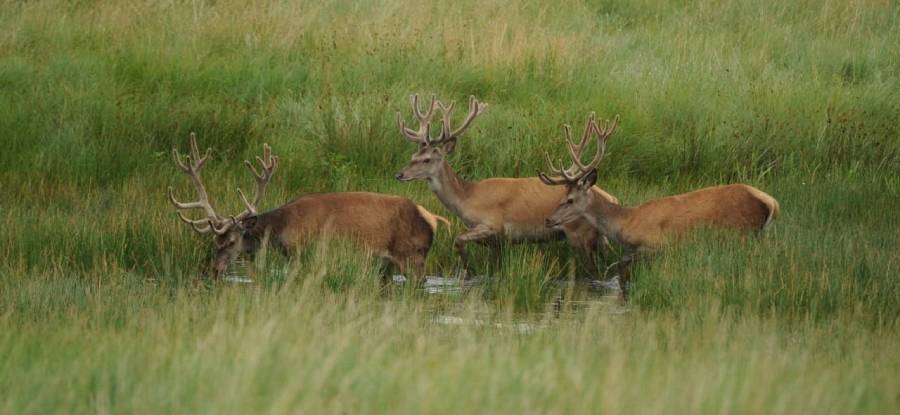
Deer have a social hierarchy that determines dominance and influences how individual deer interact within a group. This hierarchy is especially visible among bucks, which establish dominance through body posture, intimidation, sparring, and physical confrontations. Does also maintain social relationships within family groups, although their hierarchy differs from the dominance structure seen among bucks.
A deer’s social rank is not permanent or determined by a single characteristic. Age, body size, physical condition, previous encounters, sex, and season all influence how one deer responds to another. Social relationships also change throughout the year. Bucks that tolerate each other in summer bachelor groups, for example, become increasingly competitive as the breeding season approaches. For this reason, describing one deer as the permanent “alpha buck” of an area oversimplifies how deer dominance works.
For hunters, understanding deer social hierarchy provides useful context for interpreting behavior in the field. Displacement at feeding areas, avoidance between bucks, sparring, body posture, and repeated trail-camera encounters can reveal dominance relationships. However, social rank alone does not determine where a buck will travel or bed. Food availability, breeding activity, cover, and hunting pressure also influence deer movement.
Deer have a social hierarchy in which individual animals develop dominance and subordinate relationships with other deer. The hierarchy influences how deer interact when feeding, traveling, resting, and competing with members of the same sex. It is especially noticeable when two deer want access to the same resource or when bucks begin competing more intensely as the breeding season approaches.
Deer hierarchy is not a single ranking system that places every deer in an area from most to least dominant. Bucks and does form different social groups, and relationships can differ between groups and seasons. Bucks commonly associate with other males in bachelor groups outside the breeding season, while does are more closely associated with family groups that can include their offspring. As group composition changes, the social relationships visible within those groups can change as well.
Dominance should also be distinguished from leadership and territorial ownership. A buck that causes another buck to move away during an encounter has demonstrated dominance in that interaction, but this does not mean it permanently controls every deer or every location within its home range. The term “alpha buck” can therefore create a misleading picture if it implies that one male maintains absolute control over the local deer population.
A deer’s position in a social hierarchy is influenced by age, body size, physical condition, sex, and previous interactions with other deer. These factors affect an animal’s ability and willingness to challenge another deer, as well as whether the other animal chooses to confront it or yield.
Age matters partly because mature deer have had more time to reach their adult body size and accumulate social experience. Body size and physical condition also affect the potential cost of confrontation. A smaller or subordinate deer does not need to fight during every encounter to recognize a deer that has defeated, displaced, or intimidated it previously. Repeated interactions can therefore establish relationships that reduce the need for physical fights.
No single physical characteristic reliably determines rank in every encounter. Large antlers, for example, can contribute to visual displays and provide a weapon during buck-to-buck fighting, but antler size alone does not prove that a buck dominates every smaller-antlered deer. Hunters should therefore evaluate dominance through repeated behavioral interactions rather than assigning social rank from appearance alone.
How do bucks establish dominance over other bucks?
Bucks establish dominance through repeated social interactions that can progress from visual displays and intimidation to sparring and direct physical fighting. Physical combat is only one part of this process. When two bucks already have an established relationship, the subordinate animal can avoid or yield to the other buck without requiring another fight.
Body posture provides an early signal during these interactions. A buck can approach another animal assertively, hold its body in a threatening position, or cause the other buck to move away. When neither buck yields, the interaction can escalate into sparring or fighting. Sparring allows bucks to physically test one another, while more aggressive confrontations become especially relevant as breeding competition intensifies.
Hunters can recognize dominance more reliably through repeated patterns than through a single encounter. One buck consistently displacing another from a feeding location, subordinate bucks avoiding an approaching individual, or the same buck repeatedly prevailing during interactions provides stronger evidence than body size or antler measurements alone. Trail-camera video can be particularly useful because it records interactions that a hunter may not observe directly.
Buck hierarchy also has limits. A dominant relationship between two bucks does not establish a universal ranking that applies to every buck they encounter. Group membership changes, physical condition changes, and breeding competition changes throughout the year. For hunters, dominance is therefore best treated as one behavioral signal within a changing social system rather than a permanent label attached to an individual buck.
Does age determine which buck is dominant?
Age influences buck dominance, but age alone does not determine which buck will be dominant. Older bucks generally have advantages associated with physical maturity, body development, and previous social experience, but dominance is established through interactions between individual deer rather than through age alone.
Physical maturity matters because a fully developed buck can have greater body mass and strength than a younger buck. Experience also affects how bucks respond to competitors. A buck that has participated in previous dominance encounters can recognize threatening behavior, assess competitors, and respond without every encounter escalating into a fight. Physical condition adds another variable because an injured, exhausted, or nutritionally stressed mature buck may be less capable of competing than its age would suggest.
Antler size is also not a reliable standalone measure of dominance. Antlers function in visual displays, sparring, and physical fights between bucks, so larger antlers can provide an advantage during certain encounters. However, the buck with the largest antlers is not automatically the dominant buck. Body size, condition, experience, previous interactions, and the behavior of the competing buck all contribute to the outcome.
This distinction matters when hunters evaluate trail-camera images. A large-antlered buck appearing alongside smaller bucks should not immediately be labeled the dominant buck. Stronger evidence comes from behavior across repeated encounters, such as one buck consistently displacing another, receiving little resistance when approaching, or causing other bucks to yield. Age and antler development provide clues about a buck’s competitive ability, while actual interactions provide better evidence of its social position.
Does have social relationships and dominance hierarchies, but their social structure differs from the competitive hierarchy commonly observed among bucks. Doe groups are strongly connected to family relationships, with adult females associating with offspring and related females rather than forming the same type of bachelor groups seen among males.
A typical family group can include a mature doe, her current fawns, and female offspring from previous years. Within these groups, individual deer are not socially equal. Mature females can displace younger deer during close interactions, and established relationships influence how group members respond to one another. These relationships can be expressed through approach, avoidance, displacement, and access to space or resources without requiring frequent aggressive fights.
Doe hierarchy is relevant to hunters because family groups can provide behavioral information beyond the actions of a single deer. At a feeding area, for example, repeated observations can show which doe approaches confidently, which deer yield space, and how younger animals respond to mature females. These patterns provide evidence of social relationships within the group rather than proof that one doe controls every deer using the area.
Doe social behavior can also affect how hunters interpret deer movement. Several does appearing together on a trail camera may represent a family-based social unit rather than unrelated deer independently using the same trail. However, hierarchy should not be treated as the sole explanation for where the group travels. Food, cover, reproductive condition, disturbance, and seasonal changes also influence where does and their offspring spend time.
Deer social hierarchy changes throughout the year as group composition, breeding priorities, physical condition, and competition change. A dominance relationship observed during summer does not necessarily remain identical through the rut and winter. This seasonal change is especially noticeable among bucks because their social groups become less stable as breeding competition increases.
During spring and early summer, bucks can spend considerable time apart before increasingly associating with other males as their antlers develop. Summer bachelor groups allow bucks to interact repeatedly, creating opportunities for dominance relationships to develop without constant serious fighting. Hunters using trail cameras during this period may record several bucks feeding or traveling together, including mature and younger animals within the same group.
As late summer progresses toward the pre-rut, social interactions between bucks become more competitive. Antlers harden, velvet is shed, and sparring becomes one way bucks test other males. Repeated encounters help establish which animal yields and which animal maintains its position. These interactions can reduce the need for every dominance encounter to become a serious fight because bucks can respond to social signals and previous outcomes.
The structure becomes less stable as breeding activity intensifies. Bucks increasingly focus on locating receptive does rather than maintaining the same bachelor-group associations seen during summer. Competition, breeding opportunities, physical exhaustion, and encounters with unfamiliar bucks can alter the relationships a hunter observed earlier in the year. Post-rut physical condition can change those relationships again as bucks recover and prioritize food and survival.
For hunters, this means a summer hierarchy should not be treated as a fixed prediction for the entire hunting season. A buck that consistently displaced other members of a bachelor group in August may behave differently when breeding activity changes its movement and brings it into contact with different competitors. Trail-camera observations are most useful when interpreted within the specific stage of the season in which they were recorded.
What happens to buck hierarchy during the rut?
Buck hierarchy becomes more competitive and less predictable during the rut because access to receptive does becomes a primary source of competition between males. Established dominance relationships can still influence encounters, but breeding activity increases the likelihood that bucks will challenge, avoid, or fight competitors under circumstances that differ from their summer interactions.
A dominant buck does not simply control every doe and every subordinate buck within a fixed area throughout the rut. Bucks travel, encounter different competitors, and respond to the reproductive status of does. A buck that yields to a stronger competitor in one encounter can continue breeding activity elsewhere rather than remaining permanently excluded from reproduction.
Physical condition also changes during this period. Rutting bucks devote substantial time and energy to searching, tending, chasing, and competing. As an individual loses body condition or becomes injured, its ability or willingness to confront another buck can change. Dominance should therefore be understood as a relationship affected by the condition and context of the animals involved rather than a permanent title.
This changing hierarchy has practical implications for hunting. The disappearance of a buck from a summer bachelor group does not by itself mean that a more dominant buck drove it permanently from the area. The change can also reflect breeding movement, altered food use, changing cover, hunting pressure, or interactions with does. Hunters should combine social observations with fresh sign, trail-camera timing, bedding and feeding patterns, and current rut activity before drawing conclusions about a specific buck’s movement.
Is a dominant buck the same as an alpha buck?
A dominant buck is not necessarily an “alpha buck” that permanently controls all other deer in an area. Dominance describes a social relationship in which one buck consistently causes another buck to yield, withdraw, or avoid confrontation. The term “alpha buck,” by contrast, can imply a fixed leadership position over an entire local deer population, which oversimplifies deer social behavior.
A buck can be dominant over several animals within a bachelor group without dominating every buck it encounters. Social relationships depend on the individuals involved. A mature buck that regularly displaces younger bucks at a feeding area can encounter another mature male that does not yield. The outcome of that interaction depends on factors such as body size, physical condition, previous encounters, and the willingness of each animal to escalate the confrontation.
Group composition also changes the meaning of dominance. Summer bachelor groups provide repeated interactions among familiar bucks, allowing recognizable relationships to develop. During the rut, those groups break apart as bucks search for receptive does and encounter animals outside their previous social group. A buck that appeared dominant within a summer group therefore does not automatically occupy the same position relative to every competitor it meets during the breeding season.
Hunters should use “dominant buck” to describe observed behavioral relationships rather than assume the presence of one permanent alpha male. Repeatedly seeing one buck displace specific competitors provides evidence of dominance between those animals. Seeing the largest buck in a trail-camera photo does not provide the same evidence.
Does a dominant buck control a territory?
A dominant buck does not necessarily control a fixed territory, because social dominance and territorial ownership describe different behaviors. Dominance concerns interactions between individual deer, while a home range describes the area an animal regularly uses. A buck can dominate another buck during an encounter without preventing that animal from using overlapping portions of the same landscape at another time.
This distinction matters around feeding areas, bedding cover, and travel corridors. A dominant buck may displace another deer when both animals arrive at the same resource simultaneously. The subordinate buck can still use that location after the dominant animal leaves or at a different time of day. Resource displacement during an encounter therefore does not prove exclusive ownership of the location.
Home-range overlap also means hunters should avoid interpreting dominance as a boundary around a buck’s movements. Social rank does not create an invisible line that subordinate bucks cannot cross. Deer movement responds to several immediate needs, including access to food, secure bedding cover, breeding opportunities, and avoidance of disturbance. During the rut, movement can become especially dynamic as bucks search for and follow does.
Rubs and scrapes should not automatically be interpreted as territorial boundary markers either. These signs provide information about buck activity and communication, but finding a large rub or active scrape does not demonstrate that one dominant buck exclusively controls the surrounding property. Multiple deer can interact with the same locations.
For hunting purposes, dominance is more useful for interpreting deer interactions than for defining where a buck is allowed to travel. Hunters can combine observations of dominance with trail-camera records, current deer sign, food sources, bedding cover, and seasonal breeding activity. This approach provides a stronger behavioral picture than assuming a dominant buck owns a fixed territory.
How can hunters recognize deer dominance in the field?
Hunters can recognize deer dominance by observing repeated displacement, avoidance, body posture, sparring, and other interactions between the same deer. A single encounter provides limited information because aggression can depend on the immediate situation. Repeated behavior provides stronger evidence that one deer consistently occupies a dominant position relative to another.
Displacement is one of the clearest behaviors to watch. At a feeding area, one buck may approach and cause another to leave its position without a physical fight. The subordinate buck may step away, wait for the other animal to leave, or avoid approaching while the dominant animal is present. When the same relationship appears across several encounters, it provides stronger evidence of an established dominance relationship.
Body posture and avoidance provide additional clues. Deer do not need to fight every time they interact. An animal that recognizes a socially dominant competitor can reduce conflict by yielding before physical contact occurs. Hunters may therefore learn more from which deer repeatedly gives way than from waiting to observe an aggressive fight.
Sparring provides another visible form of social interaction between bucks. It allows two males to make physical contact and test one another, but hunters should not classify every sparring session as a serious dominance fight. The context, intensity, outcome, and behavior immediately after the encounter are more informative than the presence of antler contact alone.
Repeated observation is particularly important because social rank is relational. A buck can consistently displace one animal but yield to another. Instead of labeling a deer as the dominant buck after one observation, hunters should identify patterns between specific animals and determine whether those patterns remain consistent over time.
What can trail cameras reveal about buck hierarchy?
Trail cameras can reveal buck hierarchy by documenting repeated interactions between identifiable deer across multiple days or weeks. They are especially useful because hunters cannot personally observe every feeding area, trail, or social interaction throughout the day and night.
Video mode can provide more behavioral information than a single photograph. A still image may show two bucks standing together but provide little evidence about their relationship. A video sequence can show one buck approaching, another yielding, changes in body posture, sparring, or one animal waiting until a competitor leaves before entering a feeding location.
Hunters should compare encounters involving the same identifiable bucks. Antler configuration, body characteristics, injuries, and other visible features can help distinguish individuals. If Buck A repeatedly approaches Buck B and Buck B consistently yields, that pattern provides stronger evidence of their social relationship than one image showing Buck A closer to a food source.
Camera frequency alone does not establish dominance. A buck appearing most frequently may simply use the camera location more often. Likewise, the largest-antlered buck recorded on a property should not automatically be classified as dominant. Behavior between individual deer is stronger evidence of hierarchy than photograph count or antler size.
Trail-camera observations also need seasonal context. Relationships documented within a summer bachelor group can change as the rut approaches and bucks begin interacting with different competitors. Hunters should therefore compare recent footage rather than assume observations made several months earlier still describe the current hierarchy.
Read more: Do Deer Recognize Their Offspring? Doe-Fawn Behavior
Deer social hierarchy can help hunters interpret buck movement, but dominance alone cannot reliably predict where or when a buck will move. Social relationships explain how bucks respond to competitors, while actual movement also depends on food, bedding cover, breeding activity, hunting pressure, and seasonal changes. Hunters should therefore treat hierarchy as one behavioral signal rather than a complete movement model.
Feeding areas provide a practical example. A subordinate buck that repeatedly yields to a dominant buck may avoid entering the same feeding location while that competitor is present. The subordinate animal could use the resource earlier, later, or from a different approach rather than abandoning the area completely. Repeated trail-camera observations can reveal this temporal separation and help a hunter distinguish social avoidance from the disappearance of a buck.
Bachelor-group behavior can also provide useful information before the rut. Hunters may observe several bucks traveling and feeding together during summer and early fall. Their repeated interactions can reveal which individuals yield to others, but those relationships should not be converted into fixed movement predictions. As breeding activity increases, bucks separate from their summer groups, encounter different competitors, and begin prioritizing receptive does.
During the rut, breeding opportunity can outweigh patterns observed earlier in the season. A buck may expand or shift its movements while searching for does, and encounters with unfamiliar males can create different dominance relationships. For this reason, a summer trail-camera pattern becomes less useful when current sign and breeding behavior indicate that the buck’s priorities have changed.
Hunting pressure adds another layer. A buck that previously visited a feeding area during shooting hours can alter its timing or route after detecting repeated human disturbance. This movement change should not automatically be attributed to a dominant competitor. Comparing hunting pressure with recent camera records, entry routes, bedding cover, food availability, and rut activity provides a more complete explanation.
The most useful approach is to combine social hierarchy with current behavioral and habitat evidence. Hunters can identify which bucks yield to others, determine whether those relationships affect timing at shared resources, and then compare those patterns with current food, bedding, breeding, and pressure conditions. Social hierarchy helps explain why a deer may alter its behavior around another deer; it does not establish a fixed route that the animal must follow.
Hunters commonly misunderstand deer social hierarchy in 4 ways: assuming the largest-antlered buck is always dominant, treating one buck as the permanent alpha, equating dominance with territorial ownership, and assuming hierarchy remains unchanged throughout the year. Correcting these assumptions makes observations from trail cameras and encounters in the field more useful.
The first misconception is that the buck with the largest antlers must be dominant. Antlers matter during displays, sparring, and physical confrontations, but they represent only one characteristic involved in an interaction. Age, body size, physical condition, experience, and previous encounters also affect how two bucks respond to each other. Hunters need behavioral evidence before assigning social rank.
The second misconception is that every area has one permanent alpha buck. Dominance is better understood as a relationship between individual deer. One buck can consistently displace several familiar animals but encounter another buck that does not yield. Changes in group composition make a permanent, universal ranking even less useful.
The third misconception is that a dominant buck owns a territory that subordinate bucks cannot enter. Dominance does not equal territorial ownership. Deer can use overlapping areas, and a subordinate buck may visit the same feeding location, trail, or cover at a different time. Displacing another deer during an encounter demonstrates a social relationship, not exclusive ownership of the surrounding land.
The fourth misconception is that hierarchy established during summer remains unchanged throughout hunting season. Buck groups and priorities change as the rut approaches, breeding competition increases, and physical condition changes. New encounters can also occur as bucks alter their movements. A hierarchy observed in August should therefore not be assumed to describe every interaction in November.
For hunters, deer social hierarchy is most valuable when it explains observed interactions rather than presumed behavior. Repeated displacement, avoidance, sparring, and trail-camera encounters can reveal relationships between individual deer. Those relationships become more useful for hunting decisions when they are interpreted alongside season, food, bedding cover, breeding activity, and hunting pressure.