
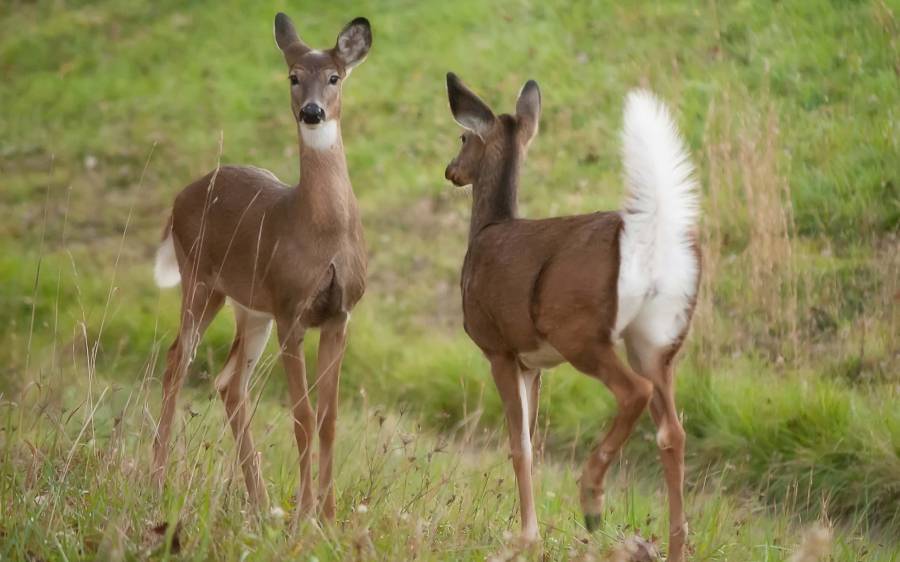
Yes, deer communicate through scent by leaving chemical signals that other deer can detect and interpret. Deer produce scent through urine, saliva, feces, and specialized scent glands, then deposit these odors on the ground, vegetation, their bodies, and locations such as scrapes. This form of chemical communication allows information to remain in an area even after the deer that produced the scent has moved away.
Scent can provide other deer with information about the animal that left it and its reproductive or social condition. Bucks and does do not use every scent source in the same way or with the same intensity throughout the year. Scent-related behavior becomes especially noticeable around the rut, when bucks increase activities such as scraping, rubbing, and interacting with licking branches.
For hunters, deer scent communication provides context for interpreting sign in the field. A scrape, licking branch, or rub can indicate that deer have interacted with a location, but the presence of scent does not by itself predict exactly when a deer will return. Understanding how deer produce, deposit, and detect scent helps hunters distinguish observable deer activity from assumptions about future movement.
How Do Deer Communicate Through Scent?
Deer communicate through scent by depositing chemical signals in their environment and detecting the scents left by other deer. Unlike visual communication, scent does not require two deer to be in the same place at the same time. A deer can leave odor on vegetation, soil, or another surface, allowing another deer to investigate the location later. This makes scent particularly useful for communicating information across wooded habitat where vegetation and terrain can limit direct visual contact.
The communication process has three main stages: scent production, scent deposition, and scent detection. Deer produce odors through several sources, including specialized glands and bodily substances. Those odors reach the environment through behaviors such as urinating, rubbing against vegetation, walking across the ground, and interacting with scrapes and licking branches. Another deer can then investigate the odor using its olfactory system and respond according to the information associated with the scent.
Scent communication is closely connected with deer behavior rather than functioning as a single isolated action. A buck working a scrape, for example, may interact with both the ground and an overhead licking branch. These actions create a location containing scent associated with deer activity. Other deer can investigate the same location even when the original animal is no longer present. For hunters, this explains why a scrape is more than disturbed soil: it can function as a location where deer repeatedly leave and investigate scent.
The meaning of a scent should not be separated from its behavioral context. The location of the scent, the way it was deposited, the deer responsible for it, and the time of year can affect what the sign indicates. Rut-related scent behavior, for instance, provides a different context from scent deposited simply as a deer moves through an area. Hunters therefore gain more useful information by interpreting scent together with tracks, scrapes, rubs, trails, and seasonal behavior instead of treating odor alone as proof of a specific future movement.
What Types of Scent Do Deer Use to Communicate?
Deer use several scent sources for communication, including urine, saliva, feces, and secretions associated with specialized scent glands. These sources do not all serve an identical purpose. They occur on different parts of the body and can enter the environment through different behaviors, creating multiple ways for deer to leave chemical information behind.
Urine is particularly relevant to scent-related behavior around scrapes and the breeding season. When urine reaches the ground or contacts parts of a deer’s body before reaching the ground, it adds odor to a location that other deer can investigate. This makes urine-associated scent an important part of understanding scrape behavior and rut activity. For a hunter, however, finding a scrape associated with scent is evidence that deer used the location; it is not enough to determine the exact identity of the deer or predict the precise time of its next visit.
Glandular secretions provide another major source of deer scent. Deer possess multiple scent glands located on different parts of the body, including glands associated with the legs, head, and face. Their locations allow scent to become associated with behaviors such as movement, rubbing, and interaction with vegetation. The tarsal, interdigital, preorbital, and forehead glands are therefore relevant when examining how deer create and distribute scent signals.
Saliva also becomes relevant when deer interact with vegetation. Licking branches above scrapes are a clear hunting example because deer may lick, mouth, or rub against the branch while visiting the site. The resulting branch is both a physical sign of deer interaction and part of the scent environment surrounding the scrape. Repeated interaction can make the branch useful when evaluating whether deer continue to use a particular communication site.
Feces also carry deer odor, but the presence of odor does not automatically mean every dropping represents deliberate scent marking. This distinction matters when reading deer sign. Tracks, droppings, and incidental body odor can reveal that a deer passed through an area, while behaviors such as working a scrape or interacting with a licking branch provide stronger behavioral context for scent communication. Hunters should therefore evaluate how and where scent was deposited, rather than classifying every source of deer odor as an intentional scent mark.
What Scent Glands Do Deer Use for Communication?
Deer have several specialized scent glands, including the tarsal, interdigital, preorbital, and forehead glands, that contribute to their scent profile and scent-related behavior. These glands occur on different parts of the body, so their secretions can enter the environment through different actions. Instead of functioning as one scent-producing system with a single purpose, the glands create multiple potential sources of chemical information associated with movement, physical contact, and social or reproductive behavior.
The tarsal glands are located on the inside of a deer’s hind legs near the hock. They are particularly noticeable in bucks during the breeding season because of their association with rut-related behavior. Bucks may urinate over the tarsal area during rub-urination, allowing urine and material associated with the gland and surrounding hair to contribute to a strong individual odor. For hunters, the tarsal gland is therefore most useful to understand within the broader context of buck behavior during the rut rather than as an isolated scent organ.
Interdigital glands are located between the hooves. Their position means scent associated with the feet can be deposited as a deer walks, creating a scent component along its route of travel. This differs from a concentrated communication site such as a scrape because the scent can be associated with ordinary movement. The distinction is important for hunters: deer can leave chemical traces while traveling even when there is no obvious scrape, rub, or other visible scent-marking location.
Preorbital glands are located near the eyes and are associated with scent deposition when deer bring their faces into contact with objects or vegetation. Forehead glands provide another scent source around the head, particularly relevant when examining rubbing behavior in bucks. When a buck rubs its head and antlers against vegetation, the resulting sign can involve more than visible damage to bark. Physical contact also creates an opportunity for odor associated with the animal to remain on the contacted surface.
The presence of these glands demonstrates why deer scent communication cannot be reduced to urine alone. A deer can distribute odor through its feet, legs, head, face, and bodily substances, depending on its behavior. Hunters should therefore interpret scent-related sign according to both where the scent originates and what the deer was doing when it was deposited. A scrape, trail, and rub represent different behavioral contexts even though scent can be present at all three.
What Information Can Deer Communicate Through Scent?
Deer scent can convey information associated with individual identity, sex, reproductive condition, and social interactions. Chemical communication gives deer a way to obtain information about another animal without requiring direct visual contact. This is especially useful because scent can remain at a location after the animal responsible for depositing it has left.
Individual information is one important component of scent communication. Deer do not all produce an identical odor because scent reflects multiple biological sources, including glandular secretions and bodily substances. When deer repeatedly investigate scent-marked locations, they can obtain chemical information associated with the animals that have used those locations. This helps explain why established communication sites can receive attention from more than one deer rather than functioning only as a mark left by a single animal.
Reproductive information becomes especially important during the rut. Bucks increase several scent-related behaviors during the breeding period, while chemical cues associated with does become relevant to reproductive interactions. This creates a direct relationship between scent communication and breeding behavior: scent helps deer gather information that would be difficult to obtain from visual signals alone when the animals are separated by vegetation or distance.
Scent also occurs within the social interactions of deer. Bucks, for example, increase rubbing, scraping, and other scent-associated activities as the breeding season develops. These signs can provide information about deer activity within an area, but hunters should avoid translating them into overly specific conclusions. A heavily used scrape confirms interaction with that site more reliably than it confirms the age, dominance rank, or future arrival time of a particular buck.
The practical distinction is between information available to deer and information available to a hunter. Deer can directly investigate chemical cues with an olfactory system adapted to scent detection. Hunters normally encounter the physical evidence surrounding those signals, such as disturbed soil, tracks, rubs, droppings, or worked licking branches. Those signs can establish that deer have used an area and reveal the type of behavior occurring there, but they do not automatically reveal every piece of chemical information another deer could detect.
How Do Bucks Use Scent to Communicate?
Bucks use scent communication through glandular secretions, urine, scraping, rubbing, and physical contact with vegetation. These behaviors allow a buck to deposit scent at specific locations while also leaving visible signs of activity. Scent communication becomes especially noticeable as the breeding season approaches because bucks increase behaviors associated with finding and interacting with other deer.
Scraping is one of the clearest examples of buck scent communication that hunters can observe. A buck creates or works a scrape by pawing away leaves and other surface material to expose the ground. The deer may then deposit urine and interact with an overhead licking branch. These actions combine ground disturbance, scent deposition, and branch interaction at one location, making a scrape different from an incidental track or other sign left as a deer simply travels through an area.
Rubbing provides another way for bucks to combine physical behavior with scent deposition. When a buck rubs its forehead and antlers against a sapling or other vegetation, the action produces a visible rub while bringing the head into direct contact with the plant. Scent associated with the forehead and surrounding areas can therefore become part of the sign. A rub should not be interpreted solely as a visual marker because physical contact creates an opportunity for chemical information to remain at the site.
Buck scent behavior also changes with seasonal context. Scraping, rubbing, and other scent-associated behaviors become particularly relevant around the rut, when communication connected with reproduction intensifies. For hunters, concentrations of fresh rubs, worked scrapes, tracks, and other signs can establish that bucks are using an area. They do not, however, provide enough information on their own to guarantee that a specific buck will appear at the site during legal shooting hours or return according to a predictable schedule.
How Do Does Use Scent to Communicate?
Does use scent to communicate biological and reproductive information to other deer, including bucks, rather than relying on the conspicuous scraping and rubbing behavior commonly associated with mature males. Their scent originates from bodily substances and scent-producing structures, allowing other deer to gather chemical information when investigating an individual or an area it has recently used.
Reproductive information is particularly relevant during the breeding season. Bucks need to locate receptive does, and scent provides chemical information that contributes to reproductive interactions. A buck can investigate scent associated with a doe instead of relying exclusively on sight. This helps explain behaviors such as prolonged sniffing and close investigation during the rut, when identifying reproductive condition becomes more important to breeding activity.
Doe scent communication is also important because not every scrape or scent-associated location should be treated as a buck-only sign. Does can investigate communication sites used by bucks and other deer. A scrape can therefore be part of a broader deer communication system rather than simply a marker created by one buck for another buck. Recognizing this distinction helps hunters avoid interpreting every scrape visit as evidence of aggressive or territorial behavior between males.
Scent also contributes to communication between does and their young. Mothers and fawns depend on sensory recognition during the period when young deer are especially vulnerable and may spend time separated from their mothers. Olfactory information contributes to recognition alongside other sensory cues. This represents a different function from breeding-related scent communication: the same broad chemical communication system can support social recognition as well as reproductive interactions.
For hunters, the difference between buck and doe scent behavior provides useful context when reading sign. A scent communication site can involve multiple deer, sexes, and purposes. Identifying a scrape or licking branch confirms a type of deer interaction more reliably than it identifies every deer using that location. Tracks, trail-camera observations, seasonal timing, and repeated physical sign provide additional context when determining which deer are actually visiting an area.
How Do Deer Use Scrapes to Communicate Through Scent?
Deer use scrapes as scent communication sites where they can deposit chemical signals and investigate scent left by other deer. A typical scrape combines disturbed ground with scent-related activity above and around the site. Bucks are strongly associated with creating and maintaining scrapes, particularly around the breeding season, but other deer can also investigate and interact with these locations.
A buck typically works the ground by pawing leaves and debris away from a small area. Scent can then be deposited through urine and physical contact with the scrape site. This creates a concentrated location where chemical information and visible deer sign occur together. Other deer encountering the scrape can smell the site, investigate it, and potentially add their own scent. For this reason, a scrape is better understood as a communication location than simply as a patch of exposed soil.
Scrapes become especially relevant to hunters because they provide physical evidence of scent-related behavior. Freshly disturbed soil, tracks, recently worked vegetation, and repeated use can indicate ongoing deer activity. However, the presence of an active scrape does not establish exactly when the deer responsible for it will return. Scrape activity should be interpreted together with trail location, surrounding cover, food sources, bedding areas, seasonal timing, and additional deer sign.
The location of a scrape can also provide context. A scrape along a regularly used travel route represents a different hunting situation from one located in or near secure cover. Similarly, multiple scrapes along the same general route can indicate repeated scent-related activity in that area. These observations help hunters identify where communication behavior occurs, but they should not be treated as proof that every scrape was made by the same buck.
Why Do Deer Use Licking Branches Above Scrapes?
Deer use licking branches as part of the scent communication associated with scrapes by licking, mouthing, rubbing, or otherwise contacting the branch. The branch provides a physical surface above the scrape where deer can leave scent and investigate evidence of previous deer activity. This creates two connected components at many scrape sites: the worked ground below and the branch above.
Physical contact is important because it allows scent from the mouth, face, and associated scent-producing areas to reach vegetation. A deer approaching an established scrape may therefore investigate the overhead branch in addition to smelling the ground. Repeated contact by different deer can make the branch an important part of the communication site rather than an incidental piece of vegetation hanging above disturbed soil.
For hunters, a worked licking branch can provide useful evidence that deer are interacting with a scrape rather than merely walking past exposed ground. The condition of the branch, tracks beneath it, disturbed soil, and repeated observations can help establish continued use. Trail-camera data can add another layer of evidence by showing which deer visit the location and when those visits occur.
The licking branch should not be interpreted as a guaranteed predictor of a buck’s future location. Its strongest value is as evidence of deer communication behavior at a specific site. Combining that evidence with fresh tracks, repeated scrape activity, nearby trails, cover, and direct observations produces a stronger interpretation than relying on the branch alone.
How Does Deer Scent Communication Change During the Rut?
Deer scent communication becomes more closely associated with reproductive behavior during the rut as bucks search for receptive does and interact with other deer. Scraping, rubbing, scent investigation, and close-range olfactory behavior become particularly relevant during this period because chemical cues can provide information connected with breeding activity.
Bucks increase their interaction with scent-marked locations as the breeding season develops. Scrapes and licking branches are especially important examples for hunters because both leave physical evidence that can be observed after the deer has departed. A buck can work the ground, deposit scent, investigate existing odor, and interact with vegetation during a scrape visit. Other deer can subsequently investigate the same site, allowing communication to occur without simultaneous contact.
Scent from does becomes particularly relevant when bucks are searching for breeding opportunities. Bucks investigate does and scent associated with them as part of reproductive behavior. Chemical information works alongside visual, auditory, and behavioral cues rather than replacing them. This is why rutting deer may spend considerable time checking areas used by other deer and directly investigating animals they encounter.
The rut also changes how hunters should interpret scent-related sign. An increase in fresh scrapes and rubs establishes increased scent-associated activity more reliably than it predicts the future position of a specific buck. A scrape may receive repeated visits, but visitation can vary by individual deer, location, hunting pressure, weather, breeding activity, and other conditions. The existence of a scrape therefore answers “have deer communicated or interacted here?” more confidently than “will this buck be here at a particular time?”
For hunting purposes, rut-related scent sign becomes most informative when combined with additional evidence. Fresh tracks can establish recent movement, trail cameras can identify individual visitors and visit times, and surrounding trails can show how deer approach or leave a communication site. Reading these signals together allows hunters to use scent communication as one component of deer behavior analysis instead of treating a single scrape or rub as a standalone prediction.
How Can Hunters Read Deer Scent Communication in the Field?
Hunters can read deer scent communication by identifying the physical signs associated with scent deposition and interpreting those signs within their location, freshness, season, and surrounding deer activity. Scrapes, licking branches, rubs, tracks, and trails provide observable evidence, but each sign answers a different question. The strongest interpretation comes from combining several signs rather than assuming one scrape or rub reveals exactly what a deer will do next.
Start with the physical condition of the sign. A scrape with recently exposed soil, fresh tracks, and an actively worked licking branch provides stronger evidence of current use than an old scrape covered with leaves. A rub with fresh-looking bark damage indicates a different level of recency from a weathered rub remaining from an earlier period. These observations help hunters distinguish recent deer activity from historical sign, although appearance alone cannot establish an exact time of use.
Location adds another layer of information. A scent communication site beside an established trail, near cover, or along a route connecting important habitat features should be interpreted in relation to the movement visible around it. Tracks entering and leaving a scrape, for example, provide additional information about how deer physically use the location. Multiple signs concentrated within the same area provide more behavioral context than an isolated scrape with little surrounding evidence.
Season also changes the meaning hunters assign to scent-related activity. Scraping and rubbing are particularly relevant in the context of breeding behavior, so fresh concentrations of these signs during the rut deserve different attention from old sign found outside the same behavioral period. The correct interpretation is not simply “a buck is here.” It is that deer have performed specific behaviors at that location, and the surrounding evidence determines how useful that information is for hunting.
What Can Scrapes, Licking Branches, and Rubs Tell a Hunter?
Scrapes, licking branches, and rubs can tell hunters where deer have performed scent-associated behaviors, but they cannot independently predict the exact deer, time, or direction of the next movement. A scrape provides evidence of interaction with the ground and associated scent behavior. A licking branch provides evidence of contact with vegetation above the scrape. A rub records physical interaction between a buck and vegetation and can also involve scent deposition through contact.
These signs become more informative when they occur together. A worked scrape beneath an actively used licking branch, combined with tracks and nearby rubs, provides several independent observations of deer behavior within the same area. The hunter can then examine trails and surrounding habitat to understand how deer reach the site. This approach uses physical evidence to build context instead of assigning a specific meaning to a single sign.
Trail cameras can provide information that scent sign alone cannot. A scrape proves that deer have interacted with a location, whereas repeated images can identify which deer are visiting and record when those visits occur. When physical sign and repeated observations point to the same pattern, a hunter has stronger evidence about local deer activity. Even then, past visits describe an observed pattern rather than guaranteeing the timing of the next visit.
The most useful rule is to separate observation from prediction. Fresh scrape activity is an observation. Tracks beneath a licking branch are an observation. A trail-camera image of a buck visiting at a recorded time is an observation. Saying that the same buck must return tomorrow at that time is a prediction. Keeping these categories separate allows hunters to use scent communication as evidence without assigning more certainty to deer sign than it provides.
How Good Is a Deer’s Sense of Smell?
A deer’s sense of smell is a major sensory system for detecting other deer, environmental odors, and potential threats. This olfactory ability is what makes scent communication practical: chemical signals would have little communication value if other deer could not efficiently detect and investigate them.
Deer constantly encounter odor from multiple sources in their environment. Scent from other deer can occur on the ground, vegetation, trails, scrapes, and other contacted surfaces. Air movement can also carry odor away from its source. Deer can therefore gather olfactory information both by directly investigating a scent-marked location and by detecting odor carried through the surrounding air.
Their reliance on smell also explains why deer frequently investigate scent-related signs with their noses. A deer approaching a scrape or licking branch can examine chemical information that is unavailable to a hunter through visual inspection alone. The hunter sees disturbed soil, tracks, or worked vegetation; the deer can also detect odor associated with the site. This difference limits how precisely hunters can interpret the chemical message from physical sign alone.
For hunters, deer olfaction has a second consequence: the same sensory ability used for deer-to-deer scent communication can also detect human odor. Hunters therefore participate in the scent environment whenever they enter deer habitat. Understanding deer communication through scent consequently leads to a broader hunting question—not only how deer detect each other, but how they detect the hunter.
How Long Does Deer Scent Last in the Woods?
There is no single fixed amount of time that deer scent lasts in the woods because scent persistence changes with the scent source, surface, temperature, moisture, airflow, and environmental exposure. Scent deposited on soil can behave differently from scent left on vegetation, while urine, gland-associated odor, and scent transferred through physical contact do not necessarily persist at identical levels. A hunter should therefore avoid assigning every scent mark a specific lifespan.
Environmental conditions affect how a scent changes after deposition. Rain can dilute or physically remove scent material from exposed surfaces, while wind disperses airborne odor away from its original source. Temperature and moisture also influence how odor compounds enter and move through the surrounding air. The surface itself matters because soil, leaves, bark, and living vegetation retain and expose scent differently.
Scent persistence should also be separated from scent detectability. A chemical residue can remain at a location without producing the same odor intensity it had when fresh. Likewise, the fact that a hunter can no longer detect an odor does not establish that a deer cannot detect chemical information at the site. Deer and humans do not experience scent in the same way, so human smell is not a reliable measurement of what remains detectable to a deer.
For hunters, physical evidence provides useful context when evaluating the age of a scent-related site. Freshly disturbed soil, tracks, recently damaged vegetation, and repeated trail-camera activity can help establish whether deer continue to use a scrape or other communication location. These observations are more defensible than assuming a scent remains effective for an exact number of hours or days under every set of conditions.
Can Deer Smell Human Scent While Hunting?
Yes, deer can detect human scent while hunting, making hunter odor an important part of the same scent environment deer use to gather information about their surroundings. Human odor comes from multiple sources, including the body, breath, clothing, footwear, and materials a hunter touches. Once released, odor can remain on contacted surfaces or move through the air.
Airborne human scent is particularly relevant because deer do not need to walk directly across a hunter’s tracks to encounter odor. Air movement can transport scent molecules from the hunter toward another location. A deer positioned downwind may therefore encounter human odor without seeing or hearing the person responsible for it. This makes scent exposure fundamentally different from visual concealment: a hunter can remain visually hidden while still producing detectable odor.
Ground and vegetation contact create another route for human scent. Walking through habitat means boots and clothing may contact soil, leaves, grasses, branches, or other surfaces. Touching a licking branch, scrape area, trail-side vegetation, or equipment can also introduce human odor into a location. The existence of this odor does not guarantee that every deer will respond identically, but it adds information to an environment in which deer already rely heavily on olfaction.
Hunters should therefore treat scent management as an exposure problem rather than assume that one product can make a person completely odorless. Reducing unnecessary contact with vegetation, considering the approach route, monitoring wind direction, and avoiding preventable disturbance can reduce opportunities for deer to encounter hunter-related cues. The objective is not to eliminate every molecule of human odor but to reduce the probability that relevant deer encounter a concentrated scent stream or contaminated location.
Read more: Do Deer Have a Social Hierarchy? How Dominance Works
Does Wind Direction Affect How Deer Detect Scent?
Yes, wind direction affects deer scent detection because moving air transports airborne odor from its source toward downwind locations. This applies to scent produced by deer as well as odor produced by hunters. Wind therefore influences where an airborne chemical signal travels after it leaves the source.
The basic mechanism is straightforward: odor enters the air, moving air carries it away from the source, and a deer can encounter that odor when the scent-bearing air reaches its position. The scent does not necessarily travel as a perfectly straight, uniform line. Vegetation, terrain, changes in wind speed, thermal conditions, and local air currents can alter its movement and concentration.
This explains why wind direction matters when selecting a hunting approach or position. A hunter located upwind of a deer creates the possibility that human odor will travel toward the animal. Positioning so the primary airflow carries odor away from the expected deer location reduces that direct exposure. Hunters should still account for terrain and changing conditions because a wind reading at one location does not describe every air movement across an entire hunting area.
Wind also demonstrates the difference between scent deposited on a surface and scent traveling through the air. A scrape or licking branch creates a relatively localized scent site that deer can approach and investigate directly. Human odor carried by wind can reach a deer before the animal reaches the hunter’s physical location. Both depend on olfaction, but the route through which the deer encounters the chemical information is different.
For hunters, wind direction is therefore one of the most practical applications of understanding deer olfaction. Deer use scent to obtain information about other deer, but the same sensory system also allows them to gather information about potential threats. Reading the wind helps hunters account for that sensory advantage instead of relying exclusively on visual concealment.
What Should Hunters Learn From Deer Scent Communication?
Hunters should use deer scent communication to understand where deer have interacted, what type of behavior occurred, and how scent influences deer activity without treating scent sign as a guaranteed prediction of future movement. Scrapes, licking branches, rubs, tracks, and other physical signs become more useful when interpreted together rather than individually. Each piece of evidence adds context to how deer use a location.
There are 4 practical lessons hunters can take from deer scent communication. First, distinguish communication sites from ordinary travel sign. A worked scrape and licking branch represent a different behavioral context from tracks left by a deer simply walking along a trail. Second, evaluate freshness because recently disturbed soil, fresh tracks, and newly worked vegetation provide stronger evidence of current activity than old sign. Third, combine scent-related sign with location, seasonal behavior, trails, cover, and repeated observations. Fourth, separate observed activity from predictions. Evidence that a buck visited a scrape does not establish when that buck will visit again.
Hunters should also recognize that deer use their sense of smell for more than communication with other deer. The same olfactory ability that allows deer to investigate urine, glandular scent, licking branches, and other chemical signals also allows them to detect odors associated with people. Wind direction, access routes, contact with vegetation, and hunter position therefore become relevant whenever deer may encounter human scent.
Deer scent communication is most useful to hunters as behavioral evidence, not as a standalone forecasting system. Understanding how deer produce, deposit, and investigate scent makes scrapes, rubs, and licking branches easier to interpret within the broader context of deer behavior. Combining that knowledge with tracks, trails, seasonal timing, habitat, wind, and direct observations provides a stronger basis for hunting decisions than relying on any single scent sign.