
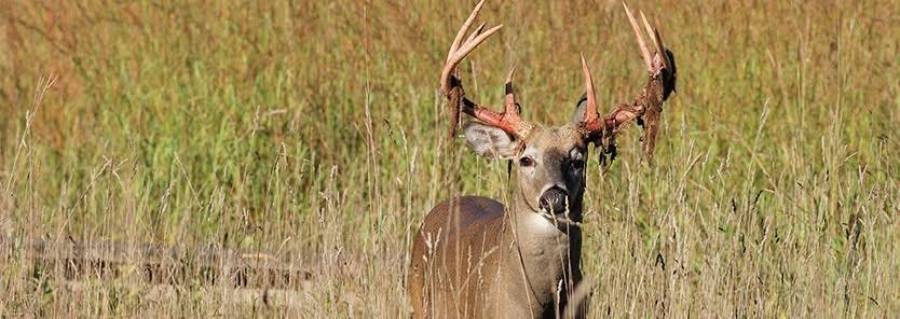
Bucks shed velvet early when their antlers finish growing and rising testosterone causes the blood supply to the velvet to decline sooner than it does in other bucks. Once the antlers become sufficiently mineralized, the velvet dries, loosens, and eventually peels away, exposing the hardened antler underneath.
Not every buck sheds velvet at the same time. Seven main factors can influence the timing: testosterone levels, changing daylight, age, genetics, nutrition and body condition, geographic location, and health-related issues such as injury or severe physiological stress. Because these factors vary between individual deer, one buck may appear on a trail camera with clean hard antlers while another buck in the same area still carries full velvet.
Early velvet shedding does not automatically mean the rut will begin early. Velvet loss is part of the seasonal transition from summer antler growth to the hard-antler stage, while breeding timing depends on a broader reproductive cycle. For hunters, an early-shedding buck is best treated as an individual data point. Tracking that buck alongside local trail-camera history, fresh rub activity, feeding patterns, and movement changes gives a more reliable picture of what is happening in the local deer herd.
Why Do Bucks Shed Velvet Early?
Bucks shed velvet early when their antlers complete the growth and hardening process sooner than those of other bucks in the same seasonal period. Velvet shedding is not controlled by a single calendar date. It occurs as the buck moves from active summer antler growth into the hard-antler stage, and individual bucks can reach that transition at different times.
During spring and summer, a buck’s antlers are living, rapidly growing structures covered by velvet. This velvet contains an extensive blood supply that delivers the nutrients required for antler development. As summer progresses and antler growth nears completion, the antlers mineralize and become solid bone. Penn State’s Deer-Forest Study explains that increasing testosterone accompanies this mineralization process; once the antlers have hardened, blood flow to the velvet is interrupted, the tissue dies, and the buck rubs or sheds it away.
A buck that reaches this physiological stage before neighboring bucks can appear to have shed “early.” For example, a trail camera may photograph one buck with clean hard antlers while another buck using the same food source still has velvet-covered antlers. That difference does not automatically indicate a problem with either deer. The antler cycle is regulated by hormones and seasonal signals, and the timing of those biological processes can differ among individual bucks. Research on white-tailed deer has also demonstrated that seasonal antler events, including velvet shedding, are closely associated with endocrine cycles influenced by the pineal system and day length.
There are 7 main factors worth considering when one buck sheds noticeably earlier than expected: testosterone timing, photoperiod, age, genetics, nutrition and body condition, geographic differences, and abnormal conditions such as injury or hormonal disruption. These factors should not be treated as seven independent switches. They interact within the buck’s broader seasonal antler and reproductive cycle.
For hunters, “early” should therefore be defined relative to the local deer population rather than a single nationwide shedding date. A buck that looks early compared with deer hundreds of miles away may be completely normal for its location. The stronger comparison is between individual bucks living in the same area and, when possible, trail-camera records from the same property across multiple seasons.
How Does Testosterone Affect When Bucks Shed Velvet?
Rising testosterone helps trigger antler hardening and velvet shedding in whitetail bucks. As testosterone increases toward the end of the summer antler-growth period, antler growth stops, mineralization progresses, and the velvet eventually loses the blood supply that kept it alive during development. The dried velvet then separates from the hardened antler and is removed through shedding and rubbing. Penn State describes increasing testosterone as a trigger for antler mineralization, followed by interruption of blood flow and death of the velvet tissue once hardening is complete.
The relationship becomes especially clear when normal testosterone production is disrupted. Penn State reports that antlers can remain in velvet when testosterone does not reach the levels required for normal antler hardening and velvet shedding. Damage to the testes or developmental abnormalities affecting testosterone production can therefore produce persistent velvet rather than the normal transition to hard antlers.
Testosterone timing also helps explain why bucks standing in the same field do not necessarily shed velvet on the same day. Seasonal hormonal cycles are synchronized broadly by environmental signals, but individual deer do not progress through those cycles identically. In a controlled study of white-tailed deer, changes to pineal function delayed testosterone peaks and delayed seasonal events including velvet shedding, demonstrating a close relationship between hormonal timing and the antler cycle.
This individual variation is important for hunters using trail cameras. Seeing the first hard-antlered buck of the year confirms that that particular buck has completed the velvet-to-hard-antler transition. It does not prove that every buck on the property is at the same stage, and it does not by itself establish that the rut has started. Mississippi State University’s Deer Ecology and Management Lab notes that bucks can be physiologically capable of breeding from velvet shedding onward, while actual breeding activity depends on receptive does and the broader reproductive season.
For that reason, testosterone should be understood as a central biological mechanism behind velvet shedding rather than a stand-alone rut predictor. A hunter can use velvet status as one seasonal observation, but it becomes more useful when combined with repeated trail-camera images, local shedding history, rub activity, and later changes in deer movement.
How Does Daylight Affect When Bucks Shed Velvet?
Shortening daylight helps synchronize the seasonal hormonal cycle that leads to antler hardening and velvet shedding in bucks. Whitetail deer respond to photoperiod, or the changing number of daylight hours, as a reliable seasonal signal. As days shorten during late summer, changes in the endocrine system help move bucks from active antler growth toward mineralized, hard antlers.
Photoperiod matters because daylight follows a predictable annual pattern, unlike daily weather. Experimental research on deer has shown that manipulating light cycles changes the timing and expression of antler and reproductive cycles, demonstrating that these seasonal events are closely connected to photoperiodic control. Deer also maintain an internal circannual rhythm, meaning their annual biological cycle involves both environmental light cues and internal physiological timing.
The effect of daylight ultimately operates through hormonal changes. Testosterone remains relatively low during much of the antler-growing period and rises as bucks approach the hard-antler and reproductive portions of their annual cycle. Research on white-tailed deer has documented a strong seasonal testosterone pattern and a close association between testosterone and annual antler development. When this hormonal transition occurs slightly earlier in an individual buck, that deer may lose its velvet before other bucks being photographed on the same property.
Cooler weather should not be confused with the primary seasonal signal. An unusually cool week in late summer does not by itself cause bucks to shed velvet early. Temperature can change deer activity and therefore affect when hunters see a buck on camera, but a cold front does not suddenly shorten the antler-development cycle. Day length changes predictably regardless of whether a particular week is hot or cool.
This distinction matters when interpreting trail-camera observations. A hunter might see the first hard-antlered buck immediately after a cool spell and assume the temperature caused the velvet loss. The more defensible interpretation is that the buck had already reached the appropriate stage of its seasonal hormonal and antler cycle. The weather may have changed its movement enough to make the deer easier to photograph, while the velvet transition itself was driven by the underlying physiological process.
Photoperiod also helps explain why velvet shedding tends to occur within a recognizable seasonal window. In one controlled study of adult white-tailed deer, bucks grew velvet antlers beginning in spring and shed their velvet in September as part of a repeatable annual endocrine and antler cycle. The exact date should not be treated as universal, but the pattern shows why velvet loss is a seasonal event rather than a random response to short-term weather.
Does a Buck’s Age Affect When It Sheds Velvet?
A buck’s age can influence its hormonal and antler-development patterns, but age alone does not determine the exact day it will shed velvet. Younger and mature bucks differ physiologically, yet there is not a dependable rule stating that an older buck must lose its velvet before a younger buck.
Age matters because antler development changes substantially as a whitetail matures. Young deer are still allocating resources toward body growth, while mature bucks have reached a different stage of physical and reproductive development. Endocrine research on white-tailed deer has found age-related differences in hormone profiles. One study comparing adults with fawns reported higher annual testosterone levels in adult males and different developmental patterns in their first antler cycles. More recent research on known-age white-tailed bucks has also shown that testosterone patterns vary across an animal’s lifetime and among individual bucks.
Those differences make age a reasonable contributing factor when hunters compare velvet status among bucks, but they do not create a simple age-based shedding schedule. Mature bucks do not always shed velvet before younger bucks. Individual hormonal timing, antler development, genetics, physical condition, and local seasonal biology can create enough variation for a younger buck to appear hard-antlered while an older buck nearby still carries velvet.
For example, suppose a trail camera records a 4½-year-old buck still carrying velvet and a 2½-year-old buck with clean antlers during the same week. That observation does not establish that the older animal has a health problem or that the younger animal is unusually mature. It shows that velvet status is not a precise aging tool. Hunters should continue using body characteristics such as chest depth, belly profile, neck development, leg-to-body proportions, and repeated observations when estimating a buck’s age.
Age also should not be inferred from a single velvet-shedding date. Research confirms that testosterone and antler cycles change with age, but the available evidence does not support assigning a fixed shedding date to each age class. A trail-camera photo showing a buck in hard antler therefore provides useful information about its current seasonal stage, not a reliable measurement of how old the deer is.
For hunters, the stronger approach is to track known individual bucks across several seasons. If the same recognizable buck repeatedly loses its velvet within a similar late-summer window, that property-specific history becomes more useful than assuming every mature buck should shed before every younger buck.
Can Genetics Make Some Bucks Shed Velvet Earlier?
Genetics can contribute to differences in velvet-shedding timing because inherited traits influence antler development, hormone regulation, and reproductive physiology. Bucks living in the same habitat can therefore reach the hard-antler stage at slightly different times even when they experience similar daylight, weather, and food conditions.
Antler development is a genetically influenced biological process, but genetics does not operate independently. A buck’s inherited traits interact with age, nutrition, hormone levels, health, and seasonal environmental signals. This interaction explains why two bucks using the same food source and bedding cover can show different antler-development timelines. One may appear on a trail camera with clean hard antlers while another still carries intact velvet.
Genetics should therefore be treated as a contributing factor rather than a direct explanation that hunters can confirm from photographs. A buck shedding velvet before neighboring bucks does not prove that it has a genetic tendency for early shedding. Establishing a genetic cause would require information that a normal trail-camera observation cannot provide. The photograph only confirms that the individual deer reached the hard-antler stage earlier than the other bucks observed at that time.
The most useful evidence for hunters comes from repeated observations of identifiable deer. For example, a buck with a distinctive antler configuration may consistently transition from velvet to hard antler within a similar seasonal window over several years. That pattern can establish an individual history, but it still does not isolate genetics from age, hormone cycles, or environmental conditions.
For hunting purposes, genetics helps explain why a local herd should not be expected to shed velvet simultaneously. Hunters should track each target buck as an individual rather than assuming all deer using the same property will follow the same calendar.
Can Nutrition and Body Condition Affect Velvet Shedding Time?
Nutrition and body condition can affect antler development, but good nutrition does not automatically cause a buck to shed velvet early. Growing antlers require substantial energy, protein, minerals, and other nutrients, so a buck’s physical condition influences its ability to support normal antler growth during spring and summer.
Velvet-covered antlers grow rapidly because they receive an extensive blood supply carrying the materials needed to build new tissue. Calcium and phosphorus become especially important as the antlers mineralize and harden. Protein and dietary energy also support overall growth and body maintenance. A buck experiencing prolonged nutritional stress must allocate limited resources among basic body functions, recovery, and antler development rather than investing those resources exclusively in antlers.
Body condition adds another layer to this relationship. A healthy buck entering summer with adequate forage has better resources available for normal seasonal development than a deer recovering from disease, severe winter stress, or poor habitat conditions. However, the final transition from velvet to hard antler remains closely tied to the seasonal endocrine cycle. Better summer forage supports antler growth, but it does not create a simple rule in which better-fed bucks always shed velvet first.
For example, two bucks may spend July and August feeding in the same soybean field or food plot while receiving access to nearly identical forage. One can lose its velvet several days before the other because their individual hormonal and developmental timelines differ. The availability of high-quality forage does not force both animals to complete antler development simultaneously.
Poor nutrition also should not be assumed whenever a buck remains in velvet longer than another deer. A later-shedding buck may still be healthy and carrying normally developed antlers. Hunters need additional evidence, such as visibly poor body condition, reduced antler development, illness, injury, or an unusual pattern that persists well beyond the local seasonal window, before treating nutrition or health as the likely explanation.
This distinction is particularly important on managed hunting properties. Improving forage quality, native browse, agricultural food availability, or habitat conditions can support healthier deer and better antler development, but habitat improvement should not be expected to move velvet-shedding dates forward by a predictable number of days. Trail-camera records remain the better tool for establishing what is normal for individual bucks on a specific property.
Does Location Affect When Bucks Shed Their Velvet?
Location can affect when bucks shed their velvet because deer populations experience different photoperiod patterns, reproductive schedules, and regional biological conditions. Hunters should therefore compare a buck with other deer in the same area rather than assume every whitetail across North America follows one exact shedding date.
Latitude is relevant because it changes the annual pattern of daylight. Photoperiod is closely connected to hormonal cycles that regulate antler development, mineralization, and velvet shedding. Research on white-tailed deer has shown that altering seasonal light signals can shift antler events substantially. In one experiment, a melatonin schedule designed to mimic changing photoperiod advanced antler mineralization, velvet shedding, and rutting behavior by approximately 50 to 55 days. Another study found that disrupting normal pineal function delayed velvet shedding and the testosterone peak by one to three months, supporting the role of seasonal light signals in synchronizing the antler cycle.
Regional populations can also differ in reproductive chronology. A study of captive white-tailed deer from eastern Mexico recorded velvet shedding in August and found that their breeding season began earlier than has been reported for northern white-tailed deer populations. By comparison, a controlled study of adult white-tailed deer reported velvet shedding around mid-September. These studies were conducted under different conditions and should not be treated as a direct state-by-state comparison, but they demonstrate why one universal shedding date is too simplistic.
For hunters, this means that a buck should be considered “early” relative to the normal pattern for the local herd. A hard-antlered buck photographed in late August may look unusually early when compared with deer from another region, yet that timing may fall within the normal transition period for its local population. The same principle applies when hunters compare observations from northern and southern states: differences in latitude, population biology, and breeding chronology make national averages less useful than local records.
Trail cameras provide a practical way to establish that local baseline. If cameras on the same property have shown most recognizable bucks losing velvet within a similar two- or three-week period for several consecutive years, that history provides a stronger comparison than a generalized date found in a national hunting calendar. A buck that changes significantly ahead of that local pattern is more reasonably described as an early shedder.
Location should not be confused with short-term weather. A property experiencing an unusually cool August does not suddenly receive a different photoperiod. Temperature and rainfall can affect food availability, movement, and the probability of photographing deer, but the underlying antler cycle remains strongly connected to seasonal endocrine signals. Hunters should therefore separate when a buck becomes visible from when its physiology causes velvet to shed.
Can Injury, Stress, or Poor Health Affect Velvet Shedding?
Injury, severe physiological problems, and hormonal abnormalities can alter the antler cycle, although shedding velvet slightly earlier than other bucks is not enough to diagnose poor health. Abnormal antler development is most clearly associated with conditions that interfere with testosterone production, antler growth, or the normal hormonal sequence controlling mineralization.
Testicular damage provides one of the clearest examples. Testosterone is required for the normal transition from growing velvet-covered antlers to hardened antlers. Penn State’s Deer-Forest Study notes that bucks can retain velvet when testosterone fails to reach the levels necessary for normal hardening and velvet shedding, with testicular loss, testicular damage, or developmental abnormalities among the possible causes. In these cases, the more characteristic problem is often persistent velvet, not simply shedding a few days earlier than another healthy buck.
Research on wild deer supports this relationship between reproductive health and abnormal antlers. A study of mule deer found that males with severe testicular atrophy frequently carried unusually shaped velvet-covered antlers and had abnormally low testosterone concentrations. Twenty-seven of 116 adult males examined in the population showed the abnormal condition. Although mule deer are not whitetails, the findings illustrate how disruption of the reproductive endocrine system can produce obvious abnormalities in the antler cycle.
Antler injury can create a different type of abnormality. Velvet-covered antlers are living structures supplied by blood while they grow, so physical damage during this stage can alter the shape or development of an individual antler. An injured buck may later appear unusual on a trail camera because of a broken tine, distorted beam, or asymmetrical growth. That observation is evidence of abnormal antler development, but it does not establish that the injury caused early velvet shedding.
Stress should be interpreted with similar caution. Severe illness, poor body condition, or major physiological disruption can affect the resources and endocrine processes involved in antler development. However, a healthy-looking buck shedding velvet several days before neighboring bucks should not automatically be labeled stressed or unhealthy. Individual variation in normal hormonal timing provides a simpler explanation unless additional signs suggest otherwise.
Hunters can look for 5 additional signs when deciding whether unusual velvet timing deserves closer attention: persistent velvet well beyond the normal local period, visibly abnormal antler growth, poor overall body condition, an obvious physical injury, and repeated abnormal observations of the same buck. A single trail-camera image showing clean antlers earlier than expected provides much weaker evidence than a series of photographs showing abnormal development over several weeks.
Persistent velvet is particularly informative because normal velvet loss depends on adequate androgen activity. Experimental research has demonstrated that testosterone and antler mineralization are closely linked in white-tailed deer. When testosterone production or its normal seasonal pattern is disrupted, the entire antler cycle can change rather than merely shifting the shedding date by a few days.
For hunters, the practical rule is to separate normal individual variation from persistent abnormality. One buck shedding before the rest of a bachelor group is usually an observation worth recording, not evidence that something is wrong. A buck remaining in velvet far beyond the normal local shedding period, especially when accompanied by abnormal antlers or poor physical condition, provides a stronger reason to suspect an underlying health or hormonal issue.
When Do Whitetail Bucks Normally Shed Their Velvet?
Whitetail bucks normally shed their velvet from late August through September, although the exact timing varies among individual deer and local populations. Velvet loss occurs after antler growth is complete and the antlers have mineralized sufficiently to become hard. In Missouri, for example, university extension guidance places completion of antler growth in late August or early September, when blood flow stops and the velvet dries and is rubbed away.
Wild-deer research provides a more specific example of how wide this window can be. A camera-trap study of white-tailed deer in central Nebraska recorded velvet shedding across approximately 35 days. The earliest shedding observation occurred on August 22, 95% of shedding had occurred by September 17, and the latest buck observed still carrying velvet was photographed on September 25. The researchers also found that bucks at least 2.5 years old shed velvet about 13% sooner on average than 1.5-year-old bucks in that population. These numbers provide a useful regional baseline, but they should not be treated as universal dates for every whitetail population.
The actual shedding process can happen much faster than the overall seasonal window suggests. Once the velvet loses its blood supply and dries, a buck may remove it rapidly by rubbing vegetation. University of Missouri Extension reports that velvet shedding itself commonly occurs in less than 24 hours, although trail-camera observations can make the transition appear longer when photographs are separated by several hours or days.
Hunters can recognize 5 practical stages of this transition: full velvet, drying velvet, peeling or hanging velvet, newly exposed antler, and clean hard antler. A camera may photograph a buck in full velvet one evening and show it with almost completely clean antlers shortly afterward. Freshly exposed antlers can initially look darker or stained before repeated rubbing produces the polished appearance associated with hard-antlered bucks later in the season.
This rapid transition is one reason a buck can appear to have shed unusually early. Suppose three recognizable bucks use the same late-summer food source. One appears in hard antler on August 28, the second sheds during the first week of September, and the third remains in velvet another week. The August 28 buck is early relative to the other two deer, but its timing can still fall within the normal biological shedding window.
The best definition of “early” is therefore earlier than the established pattern for that individual buck or local population, not simply earlier than a date mentioned in a hunting article. Regional studies demonstrate that shedding dates have measurable variation, while individual deer within the same population can also transition at different times.
Trail-camera history is particularly valuable for hunters trying to establish this baseline. Record the first date each recognizable buck appears with clean antlers and compare those observations across several seasons. After several years, a property may reveal a consistent local window for velvet loss. A buck transitioning well ahead of that pattern provides much stronger evidence of early shedding than a comparison with deer photographed in another state.
Does Shedding Velvet Early Mean the Rut Will Start Early?
No, a buck shedding velvet early does not mean the rut will start early. Velvet shedding and the rut are both parts of the whitetail’s seasonal reproductive cycle, but losing velvet is not a reliable predictor of when does will enter estrus or when peak breeding will occur.
Velvet loss primarily marks the transition from growing antlers to hardened antlers. The rut centers on reproduction and depends heavily on the timing of female estrus. Penn State notes that the breeding season occurs at a relatively consistent time because photoperiod helps cue females to enter estrus, while individual breeding dates can still vary. In Pennsylvania, for example, the primary rut occurs around mid-November, well after most bucks have already transitioned into hard antler.
This creates an important distinction for hunters. A hard-antlered buck in late August or early September has completed one seasonal physiological transition; it has not provided evidence that peak breeding is occurring. Illinois Natural History Survey describes August through September as the hard-antler transition phase, while peak breeding activity in that region occurs much later, around mid-November. The two events belong to the same broad annual cycle but occur at different stages.
Rising testosterone can make the relationship appear more direct than it is. Testosterone increases as bucks progress toward the breeding season, and the hormonal shift is also associated with antler hardening and velvet loss. However, the fact that both processes involve seasonal hormones does not make the date of velvet shedding a countdown clock for the rut. A buck can have hard antlers for weeks before peak breeding occurs.
Doe reproductive timing is especially important. The breeding period begins as does enter estrus, and bucks respond by searching for receptive females. Indiana’s Department of Natural Resources describes the rut as a breeding period spanning several weeks, with the number of estrous does increasing toward a peak and declining afterward. A single buck losing velvet early cannot shift that population-level reproductive schedule by itself.
Weather can also create misleading impressions. A cold front after velvet shedding may increase visible deer movement and produce more daylight trail-camera activity. Hunters may then interpret the combination of hard antlers, cooler temperatures, and increased sightings as an “early rut.” The observable movement has changed, but that does not establish that female estrus or peak breeding has shifted equally early. Research-based deer guidance consistently identifies photoperiod as a major seasonal cue, while weather can influence how much movement hunters observe.
For hunters, an early hard-antler photo should therefore be recorded as an individual seasonal milestone, not a rut prediction. It becomes more useful when combined with other field evidence such as increasing rubs, scrapes, changes in bachelor-group behavior, expanding buck movement, and eventually the appearance of bucks actively seeking or tending does.
A hunter who sees a buck shed velvet early should continue monitoring the property rather than immediately changing a rut hunting schedule. Velvet status reveals where that buck is in its antler cycle. Repeated behavioral observations reveal much more about where the local herd is in its progression toward breeding season.
What Do Bucks Do After They Shed Their Velvet?
After shedding velvet, bucks rub vegetation, begin using their hardened antlers during social interactions, and gradually shift from summer behavior toward the fall breeding season. These changes do not occur all at once on the day the velvet disappears. Velvet shedding marks the beginning of the hard-antler stage, while rubbing, sparring, scraping, and changes in movement develop as the seasonal reproductive cycle continues.
Rubbing is one of the first behaviors hunters may notice. Once antler growth is complete, blood flow to the velvet stops and the tissue dries. Bucks can accelerate its removal by rubbing their antlers against small woody shrubs, grasses, and other vegetation. University of Missouri Extension reports that velvet shedding usually occurs in less than 24 hours once the process begins, and rubbing helps remove the remaining tissue from the hardened antlers.
The earliest rubs therefore do not necessarily mean intense pre-rut activity has started. Some initial rubbing serves the immediate function of removing dried velvet, while rubbing later in the season becomes part of a broader set of reproductive and social behaviors. As daylight decreases, bucks become more aggressive, rub trees, spar with other males, establish dominance relationships, and begin creating scrapes. A fresh rub seen shortly after velvet loss should consequently be interpreted in the context of date, local deer behavior, and other sign rather than treated automatically as evidence of an active rut.
Sparring also becomes more relevant once antlers are hardened. Velvet-covered antlers are highly vascularized and vulnerable to injury, making forceful antler contact undesirable during the growing stage. After mineralization is complete, the antlers can function in physical interactions between bucks. As fall progresses, these interactions help bucks establish or test social relationships before breeding competition becomes more intense.
Movement can change during this period, but velvet loss itself does not force a buck to abandon its summer range. Mississippi State University Extension notes that a buck is physiologically capable of breeding from velvet shedding until shortly after antler drop, yet its movement is influenced much more strongly when local does begin entering estrus. A hunter may therefore see a hard-antlered buck continue using the same food source, bedding area, or travel route that it used while in velvet.
This distinction is especially useful when interpreting late-summer trail-camera data. A buck photographed in hard antler should not immediately be assumed to have moved into a full pre-rut pattern. Instead, hunters can watch for several changes over subsequent weeks: increasing rub density, sparring between bucks, scrape activity, changes in daylight movement, and shifts away from predictable summer feeding patterns. These observations provide stronger evidence of behavioral transition than velvet status by itself.
For example, a buck may shed its velvet in early September but continue appearing at the same agricultural field every evening for another week or more. Later, its camera appearances may become less predictable as food sources change and reproductive behavior becomes more important. The significant hunting information is not simply that the velvet disappeared; it is how the buck’s behavior changes afterward.
Do Bucks Leave Their Bachelor Groups After Shedding Velvet?
Bucks eventually break up their summer bachelor groups as fall progresses, but velvet shedding does not cause every group to separate immediately. The two events occur during the same broad seasonal transition, which can make them appear directly connected even though individual groups and bucks may separate on different schedules.
Bachelor groups are a common summer social pattern among male white-tailed deer. Bucks can feed, travel, and spend time together during the period when antlers are growing in velvet. Penn State’s Deer-Forest Study describes these male groupings as part of a broader pattern of sexual segregation in which male and female deer occupy space differently outside the breeding season. These groups also give hunters an opportunity to inventory several bucks at once around summer food sources.
As breeding season approaches, this social structure changes. Bachelor groups break apart as bucks transition toward greater competition for breeding opportunities. Penn State reports that these groups eventually separate and that fall behavior can make familiar summer bucks seem to disappear even when adult animals have not actually abandoned their home ranges. The breakup should therefore be viewed as a seasonal process rather than an event triggered on the exact day velvet is lost.
A trail camera illustrates how this transition can look in practice. In August, a camera overlooking a soybean field might consistently photograph four bucks entering together shortly before dark. One buck could shed velvet first, while the group continues appearing together for several more days. Later, photographs may show two bucks together, followed by isolated appearances as fall progresses. Velvet loss and bachelor-group breakup occurred during the same period, but the first event did not instantly produce the second.
Age can also affect what hunters observe after groups separate. Penn State reports that more than half of yearling males in its Pennsylvania research can disperse during fall, with much of that movement occurring from mid-September through early November. Adult bucks, by contrast, very rarely establish an entirely different breeding-season home range, although their movements can expand substantially during the rut. A young buck disappearing from a camera after bachelor-group breakup therefore does not necessarily represent the same behavioral change as an adult buck appearing less frequently.
Adult bucks can also become more difficult to photograph without permanently leaving the property. Penn State’s research indicates that buck home ranges can expand by approximately 2 to 5 times during the rut. A buck that was photographed daily on one summer food source may consequently appear less often once it begins using a larger portion of its home range.
For hunters, bachelor-group breakup is more useful as evidence of a developing seasonal transition than as a precise rut clock. The strongest approach is to track individual deer rather than assume a missing group has completely relocated. Cameras positioned around food sources, bedding transitions, travel corridors, and new rub activity can reveal whether a familiar buck remains within the property while changing where and when it moves.
An early-shedding buck can therefore remain with other velvet or hard-antlered bucks for a period before the group separates. Hunters should treat velvet status, group structure, movement, rubs, and trail-camera frequency as separate observations that become more informative when analyzed together.
What Does Early Velvet Shedding Mean for Deer Hunters?
Early velvet shedding shows that an individual buck has completed the transition to hard antlers, but it does not prove that the rut has started or that the buck will immediately change its movement pattern. For hunters, the most useful interpretation is that the deer has reached a new stage in its seasonal cycle and should now be monitored for additional behavioral changes.
The first mistake to avoid is treating one early-shedding buck as representative of the entire local herd. White-tailed bucks differ in hormonal timing, age, body condition, genetics, and individual behavior. A hunter may photograph one clean-antlered buck while several other bucks on the same property remain in velvet. That observation confirms the status of one deer rather than establishing that every buck in the area has entered the same phase.
Velvet loss is nevertheless an important seasonal marker because it occurs as antlers finish mineralizing and testosterone increases. Missouri Extension explains that antler growth is typically completed by late August or early September, after which blood flow stops, the velvet dries, and bucks remove it through natural shedding and rubbing. Hunters who see this transition can begin watching for the next behavioral signals, including fresh rubs, increasing sparring, changes in food-source use, and eventually greater interest in areas used by does.
Fresh rub activity is one of the most visible changes after velvet loss, but an early rub should not automatically be interpreted as evidence of an early rut. Initial rubbing can help remove dried velvet from hardened antlers. Later in the season, rubbing and scraping become increasingly associated with social signaling, dominance behavior, and reproduction. The date and surrounding deer behavior therefore matter when interpreting a rub.
Movement should be evaluated separately from velvet status. Mississippi State University research shows that bucks are physiologically capable of breeding from velvet shedding until shortly after antler drop, but their movement is influenced most strongly when does begin entering estrus. Adult bucks in that research traveled about 4,800 yards per day during the pre-rut, more than 7,000 yards during the early rut, and more than 7,500 yards during peak rut. This demonstrates why a hard-antlered buck in late summer should not be expected to behave like a buck actively searching for receptive does during peak breeding.
Hunters should instead look for 4 practical changes after an early velvet shed.
First, track the individual buck rather than the herd as a whole. A recognizable buck with a distinctive rack can be followed across multiple cameras to determine whether its home-range use changes after shedding.
Second, watch for new rubbing behavior. A few fresh rubs immediately after velvet loss may reflect antler cleaning, while increasing rub density over time can provide stronger evidence of progression toward fall social behavior.
Third, monitor feeding patterns. A buck may continue using the same soybean field, food plot, browse area, or agricultural edge after shedding velvet. If food availability changes, its movement may shift even though that change is not directly caused by velvet loss.
Fourth, compare movement across several weeks. A meaningful change is easier to identify when hunters compare repeated observations rather than two isolated photographs.
For example, assume a buck appears in hard antler on August 29 after being photographed in velvet three days earlier. The buck continues entering the same food plot shortly before dark for another two weeks. In this case, velvet shedding clearly occurred, but its feeding pattern remained stable. A later shift toward different travel corridors, increased rub activity, or broader movement would provide much stronger hunting information than the shedding date alone.
Individual buck behavior can also differ substantially. Mississippi State University’s movement research identifies both mobile and sedentary adult bucks. About one-third of the studied adults displayed a mobile strategy involving two distinct seasonal home ranges, while other bucks remained comparatively sedentary. This difference helps explain why one buck may disappear from a familiar camera shortly after summer while another continues using the same property.
Early velvet shedding should therefore be treated as one biological data point within a larger hunting pattern. The most reliable hunting decisions come from combining velvet status with movement, food availability, rubs, scrapes, bachelor-group changes, and eventual breeding behavior.
Read more: Why Do Deer Develop Abnormal Antlers? 7 Causes
How Can Trail Cameras Help Hunters Track Velvet Shedding?
Trail cameras help hunters identify when individual bucks lose their velvet, compare shedding dates within the local herd, and determine whether behavior changes after the transition to hard antlers. Their greatest value comes from repeated observations of recognizable deer rather than a single photograph.
The first use is establishing a local shedding timeline. Hunters can record the last date a buck appears in full velvet and the first date it appears with clean antlers. Because the actual shedding process can occur rapidly, sometimes in less than 24 hours, the exact moment may not be captured. Even so, consistent camera coverage can narrow the transition to a useful date range.
A simple record for each buck can include 5 details: individual identification, last velvet photo, first hard-antler photo, camera location, and notable behavioral changes afterward. Repeating this process for several bucks creates a property-specific dataset that is more useful than assuming a nationwide average applies to every deer.
Trail cameras can also distinguish individual variation from a herd-wide shift. Suppose six recognizable bucks are photographed on a property during late August. One loses velvet on August 24, two transition during the first week of September, and the remaining three transition later. The August 24 buck can reasonably be described as an early shedder within that local group. Without repeated camera observations, the hunter would have no reliable local comparison.
Long-term records are even more valuable. Penn State documented one identifiable buck on trail-camera photographs across multiple years, demonstrating how repeated photographs can be used to follow the development of a known individual through different seasons. For hunters, maintaining similar records can reveal whether a particular buck tends to appear in hard antler during a consistent part of the calendar each year.
Camera placement determines what information can be collected. Late-summer cameras positioned near food sources are useful for inventory because bachelor groups often follow predictable feeding patterns. Additional cameras along travel corridors, habitat transitions, bedding-area approaches, and emerging rub lines can then reveal whether movement changes after velvet loss.
Hunters should avoid assuming that a buck has left the property simply because it disappears from one camera. Research on adult buck movement shows that some individuals shift seasonal ranges, while others remain within relatively consistent areas. Mississippi State researchers specifically note that hunters can successfully pattern a buck on cameras and then see that deer disappear because its seasonal movement strategy changes. Moving or adding cameras can determine whether the buck actually relocated or simply stopped using a particular summer route.
Trail-camera timestamps also help separate antler changes from movement changes. If a buck sheds velvet but continues arriving at the same location at similar times, there is little evidence that velvet loss itself altered its routine. If its appearances gradually shift to different routes, different hours, or different areas over the following weeks, hunters can document that transition rather than assume it happened immediately.
The strongest trail-camera strategy is therefore to compare velvet status, location, timing, and behavior together. A single photograph answers whether a buck is currently in velvet or hard antler. A sequence of photographs can answer much more: when the transition occurred, whether other bucks followed at the same time, whether feeding behavior changed, and whether the buck’s fall movement pattern is beginning to develop.
For hunters trying to determine why a buck shed velvet early, this local evidence is more valuable than treating a generalized national shedding date as a strict rule. Trail cameras turn an isolated observation into a repeatable record of how individual bucks actually progress through the late-summer and early-fall transition.
What Should Hunters Remember About Early Velvet Shedding?
A buck that sheds velvet early has reached the hard-antler stage sooner than other bucks being compared with it, but early shedding alone does not indicate an early rut, poor health, or an immediate change in movement. The timing reflects a combination of seasonal hormone changes, photoperiod, individual development, age, genetics, nutrition, location, and, in abnormal cases, injury or physiological problems.
For hunters, the strongest evidence comes from local observations rather than a universal calendar date. Record when individual bucks transition from velvet to hard antlers, compare those dates with other bucks on the same property, and continue monitoring movement after shedding. Fresh rubs, changing bachelor-group behavior, shifts in food-source use, expanding travel patterns, and later breeding activity provide more hunting value when interpreted together than velvet status provides on its own.
Trail-camera history makes that comparison increasingly useful over multiple seasons. A buck that consistently sheds around the same period establishes an individual baseline, while records from several deer establish a local shedding window. This allows hunters to identify genuinely unusual timing without assuming that every hard-antlered buck signals the same stage of the fall hunting season.
Early velvet shedding is therefore best used as one measurable point in a buck’s seasonal progression, not as a stand-alone predictor of the rut.