
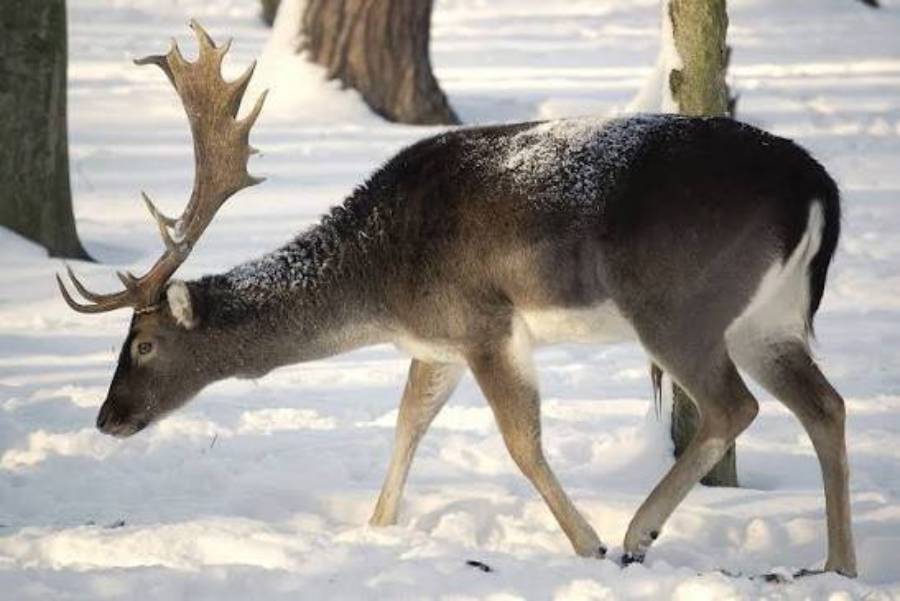
Deer lose their winter coat in spring because they no longer need the dense insulation that protects them during cold weather. As seasonal conditions change, deer shed the thick winter pelage and replace it with a shorter, lighter summer coat that releases body heat more efficiently. This seasonal molt is a normal part of the deer’s annual biological cycle.
A deer’s winter coat is built for heat retention. Long guard hairs and dense underfur trap insulating air close to the body, helping the animal conserve warmth through winter. In spring, that same coat becomes unnecessary as days grow longer and temperatures rise. Changes in daylight, known as photoperiod, help synchronize seasonal processes in deer, including coat growth and shedding.
For hunters, the transition can be especially noticeable on trail-camera images or during spring scouting. Deer may temporarily look patchy, rough, or uneven as old winter hair falls out and the reddish-brown summer coat appears underneath. That appearance does not automatically indicate poor health or disease. Understanding when and why deer shed their winter coat helps hunters distinguish a normal seasonal change from coat conditions that may require closer attention.
Why Do Deer Lose Their Winter Coat in Spring?
Deer lose their winter coat in spring because they no longer need the heavy insulation that protects them during winter. White-tailed deer grow a specialized cold-weather coat made of long guard hairs over a dense layer of underfur. This structure traps air close to the body and reduces heat loss, allowing deer to conserve body heat during freezing temperatures, wind, and other harsh winter conditions.
That insulation becomes less useful as deer move into the warmer part of their annual cycle. Instead of keeping the same coat throughout the year, deer molt and replace the heavy winter pelage with a shorter and thinner summer coat. The summer coat lacks the dense underfur found in the winter coat, which reduces insulation and makes it better suited to warm conditions. Pennsylvania wildlife authorities describe the summer coat of white-tailed deer as short, thin, and reddish brown, while the winter coat is grayish brown and contains both hollow guard hairs and dense underfur.
The spring molt is therefore a normal seasonal adaptation rather than abnormal hair loss. White-tailed deer follow a repeating coat cycle: they shed the winter coat in spring, carry a lighter coat through summer, and replace that summer coat with a heavier winter coat during late summer and early fall. Each coat serves a different thermal function. The winter coat limits heat loss, while the thinner summer coat prevents the animal from carrying unnecessary insulation as conditions become warmer.
Hunters may notice this transition before the summer coat is completely established. A deer in the middle of its spring molt can look rougher or less evenly colored than it did during winter because old winter hairs are being lost while the new coat is becoming visible. The important distinction is that seasonal shedding is expected. Seeing loose or changing hair during the normal spring molt does not by itself mean the deer is unhealthy.
When Do Deer Shed Their Winter Coat?
White-tailed deer generally shed their winter coat during spring, although the exact timing varies with location and seasonal conditions. The Pennsylvania Game Commission reports that white-tailed deer shed their winter coats during April and May, while broader management material describes the change as occurring from mid to late spring. These dates provide a useful reference for hunters, but they should not be treated as an identical schedule for every deer across its entire range.
A deer does not normally lose its entire winter coat at once. Molting is a transition in which the old pelage is gradually replaced by the coat needed for the next season. This is why a deer photographed during spring may appear to have both grayish winter hair and reddish-brown summer hair at the same time. As the molt progresses, the thick winter coat disappears and the shorter summer coat becomes dominant.
The reverse transition happens later in the year. Pennsylvania wildlife guidance states that white-tailed deer shed their summer coats during August and September before growing the heavier winter pelage. This creates two major coat transitions within the annual cycle: a spring molt from winter to summer pelage and a late-summer or early-fall molt from summer to winter pelage.
For hunters using trail cameras, the date of an image provides important context when evaluating a deer’s coat. A patchy-looking deer photographed during the spring shedding period may simply be between seasonal coats. Coat appearance should therefore be interpreted together with the time of year rather than judged from a single photograph alone.
What Triggers Deer to Shed Their Winter Coat?
Changing day length is an important biological signal that helps synchronize a deer’s seasonal coat molt. Deer respond to photoperiod, which is the changing ratio of daylight to darkness across the year. Because this cycle follows a predictable annual pattern, it provides deer with a reliable seasonal cue for processes such as reproduction, growth, antler development, and coat molting. Deer Industry New Zealand specifically identifies coat molt as one of the annual physiological patterns synchronized with photoperiod.
Photoperiod allows the coat cycle to follow the seasons rather than depend only on the temperature of individual days. Deer perceive changes in the daylight-to-darkness ratio through the eyes, and those signals are transmitted to the brain as part of the animal’s seasonal physiological regulation. This mechanism is useful because short periods of unusually warm or cold weather do not necessarily represent a true change of season. A deer therefore does not need to wait until it becomes uncomfortably hot before beginning the transition away from its winter coat.
Warm spring weather still explains why replacing the winter coat is beneficial. The winter pelage is designed to limit heat loss, so carrying the same level of insulation into warm weather would make heat dissipation less efficient. As spring progresses, deer replace this heavy pelage with a thinner coat suited to summer conditions. The important distinction is that temperature helps explain the function of the coat change, while seasonal biological signals help regulate its timing.
Hunters should therefore avoid treating one warm week as proof that every deer in an area should have completed its spring molt. The visible stage of shedding can differ between individual animals and locations. A deer may retain patches of gray winter hair while another deer photographed in the same general season already shows much more of its reddish summer coat. The molt is a biological transition rather than an immediate response in which the entire winter coat falls out as soon as temperatures rise.
The annual pattern also works in the opposite direction later in the year. As the seasons progress toward fall, white-tailed deer replace the thin summer coat with a thicker winter pelage. Missouri Extension reports that the summer coat is shed around August or September, while the next spring molt begins around April. This repeating cycle allows the coat to match the thermal demands of different parts of the year.
How Is a Deer’s Winter Coat Different From Its Summer Coat?
A deer’s winter coat is thicker and more insulating than its summer coat because it contains dense underfur beneath longer guard hairs. The summer coat is much lighter, consisting primarily of short, thin guard hairs without the dense underfur found in winter pelage. These structural differences allow the two coats to perform different functions during cold and warm seasons.
A white-tailed deer’s winter coat has two important layers. The outer layer contains long, thick guard hairs, many of which are hollow. Beneath those hairs is soft, densely packed underfur. Together, these layers trap insulating air close to the body and reduce the rate at which body heat escapes into the surrounding environment. Pennsylvania Game Commission describes this winter pelage as providing strong protection against winter conditions.
The difference in thickness can be substantial. Missouri Extension reports that a white-tailed deer’s summer coat is relatively thin at less than one-quarter of an inch, while its brownish-gray winter coat can exceed one inch in thickness. That winter pelage consists of both short underfur and outer guard hairs, giving deer considerably more insulation during the coldest part of the year.
The summer coat has a different structure because heat retention is no longer the primary requirement. Pennsylvania Game Commission describes the summer pelage as short, thin, and wiry, with no underfur. Without the dense insulating layer underneath, body heat can move away from the skin more readily during warm conditions. This makes the summer coat better suited to the thermal demands deer face from late spring through summer.
Color also makes the seasonal transition visible to hunters. White-tailed deer are generally reddish brown during summer and grayish brown during winter. When a deer is midway through its spring molt, remnants of the gray winter pelage can occur alongside the developing reddish summer coat. This contrast contributes to the uneven or scruffy appearance hunters sometimes see in spring trail-camera photos.
The two coats can therefore be distinguished by four main characteristics: thickness, hair structure, insulation, and color. Winter pelage is thick, grayish brown, and built around guard hairs plus dense underfur. Summer pelage is thinner, reddish brown, and lacks the heavy underfur. The spring molt is the process that replaces one functional coat with the other as the deer enters the warmer portion of its annual cycle.
What Does a Deer Look Like While Shedding Its Winter Coat?
A deer shedding its winter coat can look patchy, uneven, or temporarily scruffy as old winter hair falls out and the shorter summer coat replaces it. This appearance is a normal part of the spring molt. The Pennsylvania Game Commission notes that white-tailed deer and elk can have a distinctly scruffy appearance while undergoing their complete spring molt.
The uneven appearance occurs because the winter and summer coats are different in both structure and color. Winter pelage is generally grayish brown and consists of long guard hairs combined with dense underfur. Summer pelage is reddish brown and consists of shorter, thinner guard hairs without the insulating underfur. During the transition, portions of both coats may be visible at the same time, producing irregular areas of gray, brown, and reddish hair.
Shedding also takes place over time rather than as a single event. Old winter hair loosens while new summer hair becomes increasingly visible, so the deer’s coat may not look uniform during the transition. A trail-camera photo taken in the middle of this process can therefore make an otherwise healthy deer look rougher than it did several weeks earlier. Pennsylvania wildlife management material places the loss of winter pelage in mid to late spring, confirming that this temporary appearance occurs during a defined seasonal transition.
Color makes the molt particularly noticeable to hunters. A deer carrying its completed winter coat has a predominantly grayish-brown appearance, while its summer coat is noticeably more reddish brown. When those two pelages overlap visually during spring shedding, the contrast can make individual areas appear thin or irregular. The change becomes much less noticeable once the summer coat has fully replaced the winter hair.
For hunters using trail cameras, the time of year is therefore essential context. A deer photographed with an uneven coat during the normal spring molt should not be classified as unhealthy based only on hair appearance. Comparing photographs of the same deer across several weeks can provide more useful information because a normal seasonal molt should progress toward the shorter, more uniform summer pelage.
Is Patchy Fur on a Deer Normal During Spring?
Yes, patchy fur can be normal on a deer during spring because the winter coat is being shed and replaced by summer hair. Spring molting does not always produce a visually uniform coat throughout the entire transition, so deer can temporarily appear ragged or patchy even when the seasonal change is proceeding normally.
A hunter should first consider season and coat progression when evaluating this appearance. Winter coats in white-tailed deer are shed during spring, with the Pennsylvania Game Commission specifically identifying April and May as typical shedding months in Pennsylvania. A deer showing irregular gray winter hair mixed with emerging reddish summer hair during this period fits the expected seasonal pattern.
Patchiness can also look more dramatic because the summer coat provides less coverage than the winter coat. The Pennsylvania Game Commission explains that summer pelage does not contain the dense underfur present during winter. With this lighter coat, variations in the skin and other minor imperfections can become more visible. The agency notes that darker skin may show through areas where summer hair is thin, creating a blotchy appearance that can look unusual in trail-camera photographs.
Normal shedding should therefore be interpreted as a process rather than judged from one image. A single photograph captures only one point during the molt. Sequential trail-camera photographs can show whether winter hair is gradually disappearing and a more consistent summer coat is developing. That progression provides stronger evidence of normal seasonal shedding than the appearance of one isolated patch.
When Can Patchy Hair Indicate More Than Normal Shedding?
Patchy hair deserves closer attention when hair loss occurs with visible skin lesions, crusting, wounds, poor body condition, or other abnormalities that are not explained by the normal seasonal molt. Coat appearance alone cannot identify a specific disease, so hunters should distinguish between observing abnormal signs and attempting to diagnose their cause.
Skin condition provides one useful distinction. Normal molting primarily involves the replacement of hair. In contrast, some wildlife diseases can produce changes to the skin itself. For example, the Pennsylvania Game Commission reports that dermatophilosis can cause crusty scabs together with patchy or extensive hair loss. More severe cases can expose red, inflamed, or bleeding skin and may occur alongside declining body condition.
The pattern over time is also useful. A deer that looks patchy during the spring molt but progressively develops a normal summer coat presents a different situation from an animal that continues losing hair, develops exposed or damaged skin, or appears increasingly weak. Hunters reviewing repeated trail-camera images can use this progression to decide whether they are seeing an ordinary seasonal transition or an appearance that deserves additional attention.
Hunters should not diagnose a deer from coat appearance alone. Different conditions can produce superficially similar signs, and identifying a wildlife disease may require examination or laboratory testing. The Pennsylvania Game Commission, for example, states that dermatophilosis is diagnosed by isolating the responsible bacteria from skin lesions rather than by visual appearance alone.
The practical rule is to evaluate the whole animal rather than a single patch of hair. Uneven winter hair during spring can be normal; persistent hair loss combined with abnormal skin, deteriorating body condition, or unusual behavior provides a stronger reason for concern. This distinction helps hunters avoid mistaking the normal spring molt for illness while still recognizing when an abnormal-looking deer may warrant reporting to the appropriate state wildlife agency.
Read more: Why Do Bucks Shed Velvet Early? 7 Key Reasons
What Can Hunters Learn From a Deer’s Seasonal Coat Change?
A deer’s seasonal coat change helps hunters identify where the animal is in its annual biological cycle, but coat appearance should be interpreted together with the date, location, and the deer’s overall condition. White-tailed deer do not keep the same pelage year-round. Their reddish-brown summer coat and grayish-brown winter coat are structurally different, and the Pennsylvania Game Commission reports that winter coats are typically shed in April and May while summer coats are shed in August and September.
For hunters running trail cameras through spring, this cycle provides useful context for interpreting photographs. A deer that still carries substantial gray winter hair early in the shedding period may look very different several weeks later when the thinner reddish summer coat becomes dominant. Comparing images over time can therefore help a hunter recognize normal coat progression instead of treating every irregular patch of hair as a health problem.
Coat color also provides a visible indication of seasonal transition. Adult white-tailed deer generally have reddish-brown upper bodies during summer and grayish-brown upper bodies during winter. Because those colors can overlap during a molt, a spring deer may temporarily appear mottled or uneven. The Pennsylvania Game Commission also identifies major structural differences between the two pelages: summer hair is short and thin with no underfur, while winter pelage combines long hollow guard hairs with densely packed underfur.
Hunters should not use coat condition as a precise calendar, however. A trail-camera image can show that a deer is undergoing a seasonal transition, but it cannot establish an exact date based on hair alone. Individual deer may not appear identical at the same point in spring, and regional seasonal patterns differ across the whitetail’s range. The more reliable approach is to combine coat appearance with the actual date and local seasonal conditions.
Seasonal coat observations are also more useful when hunters compare multiple images of the same deer. If a buck or doe gradually loses the remaining winter hair and develops a consistent summer coat, the sequence supports a normal molt. If the animal instead develops worsening bald areas, abnormal skin, poor body condition, or unusual behavior, the coat change should no longer be interpreted solely as ordinary spring shedding.
The practical value of the coat cycle is therefore not that it predicts deer movement or hunting success by itself. It gives hunters another visible biological indicator for understanding what they are seeing in the field. Used with trail-camera history, seasonal timing, body condition, and behavior, coat appearance can help distinguish normal annual change from an animal that deserves closer observation.
Is Shedding a Winter Coat the Same as Shedding Antlers?
No, shedding a winter coat and shedding antlers are separate biological processes. Coat shedding replaces seasonal hair across the deer’s body, while antler shedding involves the loss of hardened bone structures from the skull of a buck. The two processes belong to the same broader annual cycle but occur through different biological mechanisms.
Winter-coat shedding is a pelage transition. White-tailed deer lose the long guard hairs and dense underfur that provided winter insulation and replace them with a shorter summer coat. In Pennsylvania, winter coats are typically shed during April and May.
Antler shedding follows a different sequence. Bucks grow and shed a new set of antlers annually. After the breeding season, declining testosterone is associated with weakening of the connection between the antler and its pedicle, allowing the hardened antler to fall off. Pennsylvania wildlife guidance places this event in late winter or early spring.
The timing of antler drop can vary substantially between bucks. Missouri Extension reports that in an average season, some white-tailed bucks may lose their antlers in late December, while most have shed them by early March. Nutrition, individual condition, location, and the animal’s antler cycle can influence when the drop occurs.
Antler shedding also does not mean that a buck stops producing antlers until the following year. Once an antler is shed, the next annual growth cycle begins, although visible new growth may not appear immediately. During late spring and summer, the developing antlers are supplied with blood and covered in velvet before eventually mineralizing and hardening ahead of the breeding season.
This distinction matters in hunting terminology because the word “shed” often refers specifically to dropped antlers. A hunter looking for “deer sheds,” for example, is normally searching for antlers rather than loose winter hair. Biologically, however, deer undergo both forms of shedding as part of their annual seasonal cycle.
The key difference is straightforward: coat shedding replaces hair for seasonal temperature regulation, while antler shedding resets the annual antler-growth cycle in bucks. The events may occur during overlapping portions of late winter and spring, but one does not cause the other.