
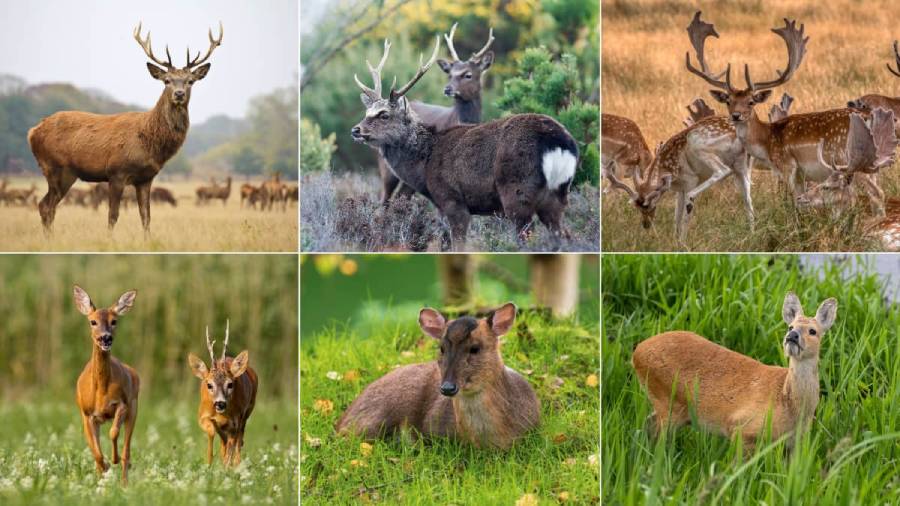
There are several major types of deer that hunters commonly encounter, including white-tailed deer, mule deer, black-tailed deer, red deer, roe deer, fallow deer, and sika deer. These deer differ in body size, antler structure, ear and tail shape, coat markings, geographic range, and preferred habitat. Elk, moose, and caribou also belong to the deer family Cervidae, although hunters commonly treat them as separate categories of big game.
Identifying a deer correctly requires more than looking at its antlers. White-tailed deer are distinguished by the white underside of their tail, while mule deer have noticeably larger ears and a different tail pattern. Fallow deer are recognizable by the palmate antlers of mature bucks, and roe deer have a much smaller body than larger members of the deer family. Geographic location and habitat provide additional identification clues because each species occupies a characteristic range.
For hunters, knowing these differences helps with field identification and provides context for understanding deer habitat and behavior. This guide covers the main types of deer, their distinguishing physical characteristics, geographic ranges, habitats, and the features hunters can use to tell similar species apart.
What Are the Different Types of Deer?
The main types of deer include white-tailed deer, mule deer, black-tailed deer, red deer, roe deer, fallow deer, and sika deer. These animals belong to the deer family Cervidae, which also includes larger cervids such as elk, moose, and caribou. Each type can be distinguished through a combination of physical characteristics, geographic range, habitat, and behavior.
White-tailed deer, mule deer, and black-tailed deer are especially relevant to hunters in North America. White-tailed deer occupy an extensive range and are recognized by the white underside of the tail. Mule deer are associated primarily with western North America and have large ears that resemble those of a mule. Black-tailed deer occur along the Pacific side of North America and are closely related to mule deer.
Red deer, roe deer, fallow deer, and sika deer are prominent deer types outside North America, although several have also been introduced into regions beyond their native ranges. Red deer are large-bodied deer with substantial antlers in mature males. Roe deer are considerably smaller and have relatively short antlers. Mature male fallow deer develop broad, palmate antlers, while sika deer can retain distinctive spotting into adulthood.
Hunters should use multiple characteristics to distinguish these deer because a single feature does not always provide reliable identification. Sex, age, season, and individual variation can alter appearance. Geographic range, body proportions, tail and rump markings, ears, coat pattern, and antler configuration provide stronger identification when considered together.
| Deer type | Key identification feature | General range | Relative size |
|---|---|---|---|
| White-tailed deer | White underside of tail | North America and parts of the Americas | Medium |
| Mule deer | Large mule-like ears | Western North America | Medium to large |
| Black-tailed deer | Dark upper surface of tail | Pacific North America | Medium |
| Red deer | Large body and substantial antlers | Europe, Asia, and introduced ranges | Large |
| Roe deer | Small body and prominent rump patch | Europe and parts of Asia | Small |
| Fallow deer | Palmate antlers in mature males | Europe and introduced ranges | Medium |
| Sika deer | Spotted coat and contrasting rump patch | East Asia and introduced ranges | Small to medium |
What Is a White-Tailed Deer?
A white-tailed deer is a medium-sized deer identified most easily by the bright white underside of its tail, which becomes conspicuous when the animal raises its tail. Its scientific name is Odocoileus virginianus, and the species is widely distributed across North America and other parts of the Americas. For hunters, the tail is an important field characteristic, but body shape, ears, antlers, habitat, and geographic location should also be considered.
White-tailed deer generally have a reddish-brown summer coat that changes toward grayish or gray-brown during colder months. Their ears are proportionally smaller than the notably large ears of mule deer. The tail is relatively broad, with a brown upper surface and a white underside. When a deer is moving away from an observer, this white tail can provide one of the quickest visual distinctions between a whitetail and a mule deer.
Adult male white-tailed deer grow antlers with tines that typically rise from a main beam. This configuration differs from the characteristic forked branching associated with mule deer. Antlers alone are not sufficient for identification because females generally lack them, males shed them seasonally, and antler size and form vary with factors such as age and development. Hunters therefore obtain a more reliable identification by combining antler structure with the tail, ears, body proportions, and location.
White-tailed deer occupy diverse habitats, including deciduous forests, mixed woodland, brushland, agricultural edges, and areas where forest cover meets open feeding habitat. Their broad habitat tolerance contributes to their extensive distribution. For field identification, habitat should therefore support other physical evidence rather than serve as the sole indicator of the species.
The clearest distinction becomes important where white-tailed deer and mule deer ranges approach or overlap. A hunter should first examine the tail and ears, then compare antler configuration when visible, and finally use geographic range and habitat as supporting evidence. This combination is more reliable than identifying a deer from antlers or body color alone.
What Is a Mule Deer?
A mule deer is a North American deer distinguished by its unusually large ears, black-tipped tail, forked antlers in mature males, and characteristic bounding movement. Its scientific name is Odocoileus hemionus, placing it in the same genus as the white-tailed deer. Mule deer occur primarily across western North America, where hunters encounter them in habitats ranging from open shrublands and grasslands to mountainous forests.
The ears provide one of the most useful identification features. Mule deer received their common name because their ears resemble those of a mule and appear proportionally larger than the ears of a white-tailed deer. The tail provides another visible clue. A mule deer generally has a mostly white tail with a distinct black tip, while a white-tailed deer has a broader tail that exposes a conspicuous white underside when raised. Hunters can use these differences even when antlers are absent or difficult to see.
Mature male mule deer typically develop antlers that fork as they grow rather than producing individual tines primarily from a single main beam. A main branch can divide and then divide again, creating the forked configuration associated with the species. This pattern contrasts with the typical antler structure of a white-tailed buck. Antler configuration remains supporting evidence rather than a standalone identification method because antlers change with age and development and are shed after the breeding season.
Movement provides an additional field clue. Mule deer are known for stotting, also called pronking, in which all four feet can leave the ground during a bounding movement. This locomotion is particularly noticeable when a deer moves quickly through uneven or brush-covered terrain. A fleeing whitetail is more strongly associated with a running or leaping escape accompanied by its raised white tail.
Mule deer occupy much of western North America and use varied terrain, including sagebrush country, desert environments, foothills, forests, and mountainous areas. Populations can move between seasonal ranges as food availability and snow conditions change. For hunters, location and habitat narrow the identification possibilities, while ears, tail pattern, antlers, and movement provide stronger visual confirmation.
What Is a Black-Tailed Deer?
A black-tailed deer is a deer of western North America recognized by its dark tail, relatively compact body, and close taxonomic relationship with the mule deer. Black-tailed deer belong to Odocoileus hemionus and are generally treated as subspecies of mule deer rather than a completely separate species. The two commonly recognized forms are the Columbian black-tailed deer and Sitka black-tailed deer.
The tail is the most obvious characteristic behind the animal’s common name. Black-tailed deer have noticeably dark coloration on the upper surface of the tail, providing an identification clue when the animal is viewed from behind. Hunters should still combine the tail with body proportions, facial coloration, ears, geographic range, and habitat because viewing conditions can make individual characteristics difficult to judge.
Black-tailed deer share several characteristics with mule deer, including relatively large ears and a related antler structure. Mature bucks generally develop branching antlers, although antler size and configuration vary with age and individual development. Their close relationship means that distinguishing a blacktail from a mule deer can require more attention to location and overall appearance than distinguishing either animal from a white-tailed deer.
Geographic range is particularly useful for blacktail identification. Columbian black-tailed deer are associated with the Pacific coastal region of western North America, while Sitka black-tailed deer occur farther north in coastal environments. Forests, dense vegetation, and other coastal habitats are therefore more relevant identification context than they would be for mule deer populations occupying open interior landscapes.
Hunters identifying a possible black-tailed deer should combine 4 main clues: geographic location, tail coloration, body characteristics, and habitat. This approach is more dependable than relying only on antlers. It also reflects the taxonomic relationship between black-tailed and mule deer: the animals share important characteristics, while their distribution and several visible features help hunters distinguish them in the field.
What Is a Red Deer?
A red deer is a large deer species identified by its reddish-brown coat, substantial body, and large branching antlers in mature males. Its scientific name is Cervus elaphus. Red deer are native to large parts of Europe and portions of Asia and have also been introduced to other regions, making them an important game species across several hunting areas.
Body size provides a useful identification clue because red deer are considerably larger than smaller species such as roe deer. Adult males, called stags, are larger and heavier than adult females, called hinds. Coat coloration changes with season and population, but the reddish-brown summer coat is responsible for the species’ common name. During colder months, the coat generally becomes thicker and more subdued in color.
Mature red deer stags develop large antlers with multiple branches. Antler development varies according to age, nutrition, health, and individual genetics, so hunters should not identify a red deer solely by counting antler points. Females normally lack antlers, which makes body proportions, coat characteristics, rump markings, and geographic location more important when identifying a hind.
Red deer use several habitats, including woodland, forest edges, grasslands, moorlands, and mountainous areas. Habitat use varies across their extensive geographic distribution, so a specific landscape does not identify the species by itself. Hunters obtain stronger evidence by combining location with body size, coat, rump characteristics, and antler structure when antlers are present.
The species also becomes easier to identify during the breeding season, or rut, because mature stags display conspicuous reproductive behavior and vocalize to compete for access to females. Behavior can support identification, but visible anatomical characteristics and geographic range remain more dependable. A large-bodied cervid with the characteristic appearance of a red deer, observed within an established red deer range, provides stronger identification than any single feature considered independently.
What Is a Roe Deer?
A roe deer is a small Eurasian deer identified by its compact body, short tail, prominent rump patch, and relatively short antlers in adult males. The European roe deer has the scientific name Capreolus capreolus and is widespread across much of Europe, while closely related roe deer occur farther east in Asia. Its small size makes it visually distinct from substantially larger deer such as red deer.
Roe deer have compact bodies with relatively slender legs. Their coat generally changes from reddish or reddish-brown during warmer months to a grayer or darker appearance in winter. The rump patch is particularly useful for field identification because it creates a conspicuous light-colored area at the rear of the animal. The tail is extremely short and is much less prominent than the tail of a white-tailed deer.
Adult males, called bucks, grow relatively short antlers. Mature animals commonly develop antlers with a limited number of points compared with the much larger racks found on mature red deer. Antler development still varies between individuals, making body size, rump markings, facial features, and geographic location necessary supporting clues. Female roe deer, called does, normally do not carry antlers.
Roe deer inhabit woodland, forest edges, farmland, scrub, and landscapes that combine feeding areas with nearby cover. Their relatively small body can make dense vegetation particularly important when hunters are attempting to identify an animal at distance. Observing the entire body rather than focusing on the head helps distinguish roe deer from young animals of larger deer species.
Hunters can identify roe deer most reliably by combining 5 characteristics: small body size, short tail, conspicuous rump patch, seasonal coat, and compact antlers in males. Geographic range provides additional confirmation. These characteristics separate roe deer particularly well from red deer, which have substantially larger bodies and mature males with much larger branching antlers.
What Is a Fallow Deer?
A fallow deer is a medium-sized deer identified by its variable coat, long tail, distinctive rump markings, and broad palmate antlers in mature males. Its scientific name is Dama dama. Fallow deer are strongly associated with Europe today but have been introduced into numerous regions, creating established populations in several countries where they are managed or hunted as game animals.
Fallow deer have more coat variation than many other deer species. The common coloration is reddish-brown with white spots during summer, while the winter coat becomes darker and the spots become less conspicuous. Individual animals can also display much darker, lighter, or nearly white coloration. Hunters should therefore avoid using coat color alone for identification. The combination of body proportions, tail and rump markings, antlers, and location provides stronger evidence.
Mature males, called bucks, provide one of the clearest identification features because they develop palmate antlers. Instead of consisting entirely of narrow branching beams, the upper portions become broad and flattened. Mature fallow bucks can consequently be distinguished from red deer stags, whose antlers have a branching structure without the same broad palmation. Younger fallow bucks do not immediately develop the full palmate form, so antlers remain less reliable when identifying immature animals.
The rear of the animal provides useful identification clues regardless of antler development. Fallow deer generally have a relatively long tail with contrasting coloration and a clearly marked rump area. These features are especially valuable when distinguishing females or young animals, which cannot be identified through mature male antler characteristics.
Fallow deer use habitats such as mixed woodland, forest edges, grassland, and other landscapes that combine cover with open feeding areas. Because populations have been introduced well beyond their earlier geographic distribution, location should be checked against the established local range rather than treated as definitive evidence. Hunters can identify fallow deer more reliably by combining 4 characteristics: body size, rump and tail pattern, coat characteristics, and palmate antlers when present.
What Is a Sika Deer?
A sika deer is a small- to medium-sized deer identified by its compact body, prominent rump patch, and a spotted coat that can remain visible in adults. Its scientific name is Cervus nippon. Sika deer originated in East Asia, but introduced populations have become established in other parts of the world, including areas where the species is hunted as a game animal.
Spotting is one of the most recognizable characteristics of sika deer. Unlike deer species in which spots are primarily associated with fawns, adult sika can retain visible white spots, particularly in their summer coat. Seasonal changes still affect appearance: the summer coat tends to show stronger reddish coloration and spotting, while the winter coat becomes darker and the spots can become less obvious. Hunters should account for these seasonal differences when using coat pattern as an identification feature.
Adult male sika deer, called stags, develop branching antlers rather than the palmate antlers characteristic of mature fallow bucks. Their antlers and body are also generally smaller than those of large mature red deer stags. Antler size varies with age and development, so rump pattern, coat, body proportions, and location should be examined alongside the antlers.
Sika deer have a conspicuous light-colored rump patch bordered by darker markings. This feature can remain visible when lighting or distance makes individual coat spots difficult to distinguish. A hunter observing a deer from behind can therefore use the rump pattern together with the animal’s compact proportions as important identification evidence.
Habitat varies across native and introduced populations, but sika deer can occupy forests, woodland edges, wetlands, grassland margins, and landscapes containing both dense cover and feeding areas. Their ability to occupy different environments means habitat alone provides limited identification value. Geographic range becomes more useful when combined with physical characteristics.
Hunters can distinguish sika deer by checking 5 primary features: body size, adult spotting, rump markings, antler structure in males, and geographic range. These characteristics are particularly useful where sika deer occur alongside red or fallow deer. Fallow bucks are distinguished by palmate antlers, while red deer are generally substantially larger. Using several features together reduces the risk of identifying an animal from one variable characteristic such as coat color or antler size.
Are Elk, Moose, and Caribou Types of Deer?
Elk, moose, and caribou are members of the deer family Cervidae, although hunters commonly refer to them as distinct types of big game rather than simply calling them deer. Their biological relationship explains why they share major cervid characteristics, including hooves, similar digestive systems, and annually grown antlers in the appropriate sex. However, substantial differences in size, antler structure, habitat, and appearance make each animal readily distinguishable from the deer species covered above.
Elk (Cervus canadensis) are large cervids with long legs, a relatively short tail, and a contrasting rump patch. Mature bulls develop large branching antlers that can extend well beyond the dimensions found on smaller deer such as whitetails and mule deer. Elk occur primarily in North America and use habitats ranging from forests and mountain environments to open grasslands. Their large body size provides one of the quickest ways to separate an adult elk from a typical North American deer.
Moose (Alces alces) are the largest living members of the deer family. Their long legs, large head, elongated muzzle, and prominent shoulder region create a body profile unlike that of whitetails, mule deer, or elk. Mature bulls normally develop broad palmate antlers, although antler development varies with age. Moose are strongly associated with northern environments containing forests, wetlands, lakes, and other aquatic habitat.
Caribou and reindeer belong to the same species, Rangifer tarandus. “Caribou” is the term commonly used for wild populations in North America, while “reindeer” is widely associated with Eurasian populations and domesticated or semi-domesticated animals. One important characteristic separates caribou from most other members of Cervidae: both males and females can grow antlers. Their broad hooves and body characteristics also reflect adaptation to northern environments.
For hunters, the distinction between biological classification and common terminology is useful. Calling elk, moose, and caribou members of the deer family is taxonomically appropriate, but hunting regulations, licenses, seasons, and management systems generally identify these animals by their individual species or game categories. Hunters should therefore use the legally defined species name when interpreting local hunting regulations.
How Can You Tell Different Types of Deer Apart?
You can tell different types of deer apart by comparing body size, ears, tail and rump markings, antlers, coat characteristics, geographic range, and habitat. No single characteristic works reliably in every situation because appearance changes according to sex, age, season, and individual development. The strongest field identification comes from matching several visible features with the species known to occur in that location.
How Do Body Size, Ears, and Tails Help Identify Deer?
Body size, ear proportions, and tail markings provide 3 of the most practical visual clues for identifying deer. These characteristics remain useful when antlers are absent, which makes them particularly important when identifying females, young animals, or males outside the antlered period.
Body size immediately narrows the possibilities. Roe deer are small and compact compared with red deer, while elk and especially moose occupy much larger size classes. Size should still be judged carefully at distance because terrain, vegetation, viewing angle, and the absence of another animal for scale can distort visual estimates.
Ear shape is especially useful when distinguishing mule deer from white-tailed deer. Mule deer have proportionally large ears that contribute directly to their common name. White-tailed deer have smaller-looking ears relative to the head. Black-tailed deer also have relatively large ears because of their close relationship with mule deer, so location and tail characteristics become important additional evidence.
Tail and rump patterns provide another strong clue. White-tailed deer expose the conspicuous white underside of the tail when it is raised. Mule deer generally show a mostly white tail ending in a black tip, while black-tailed deer have substantially darker coloration along the tail. Roe, fallow, and sika deer have distinctive rump characteristics that can help identify animals viewed from behind.
How Do Antlers Differ Between Deer Types?
Deer antlers differ in size, branching pattern, shape, and palmation, making them useful supporting features for identifying adult males. White-tailed bucks generally produce tines extending from main beams, while mule deer commonly develop a forked branching configuration. Mature fallow bucks develop broad palmate sections that make their antlers particularly distinctive.
Red deer stags develop large branching antlers, while roe bucks carry much smaller antlers suited to their smaller body size. Sika stags also produce branching antlers but remain smaller in overall body and antler dimensions than mature red deer in typical comparisons. Larger cervids create further distinctions: mature moose bulls are known for broad palmate antlers, whereas elk bulls develop long branching beams.
Antlers have clear limitations as an identification tool. Their appearance changes with age and individual development, and most deer shed and regrow them on an annual cycle. Females of most deer species do not normally carry antlers. Caribou are a notable exception because females can also grow them. Hunters should consequently confirm an antler-based identification with body characteristics, location, and other visible markings.
How Do Coat, Range, and Habitat Help Identify Deer?
Coat characteristics, geographic range, and habitat help confirm deer identification after the major physical features have been assessed. Coat markings can be highly informative, but seasonal changes mean color alone is insufficient. Geographic distribution is often more useful because it can eliminate species that do not normally occur in the area.
Fallow deer provide a clear example of coat variation. A common summer form has visible white spots, but the species occurs in several color forms and its appearance changes seasonally. Sika deer can also retain spotting as adults, making body size, rump pattern, antlers, and location necessary for separating them from other spotted deer.
Geographic range becomes particularly valuable when closely related animals have similar physical characteristics. Mule deer are primarily associated with western North America, while black-tailed deer occupy Pacific regions within the broader Odocoileus hemionus distribution. White-tailed deer have a much broader distribution across North America and overlap with mule deer in some areas.
Habitat provides the final layer of context rather than definitive proof. A deer observed in coastal forest, western sagebrush, European woodland, or northern wetland occurs within a different set of likely species. Hunters can therefore make a stronger identification by following a consistent sequence: determine the likely species from geographic range, examine body proportions and markings, assess ears and tail, compare antlers when present, and use habitat as supporting context.
What Is the Difference Between White-Tailed Deer and Mule Deer?
The main difference between white-tailed deer and mule deer is that whitetails have a broad tail with a conspicuous white underside, while mule deer have much larger ears and a mostly white tail with a black tip. The two species also differ in antler structure, typical geographic range, body characteristics, and escape behavior. Hunters should compare several of these features because individual characteristics can vary.
White-tailed deer (Odocoileus virginianus) and mule deer (Odocoileus hemionus) belong to the same genus, which explains several similarities in their overall appearance. Both are medium-sized North American deer, and both can occur in areas containing woodland, brush, agricultural openings, or other combinations of feeding habitat and cover. Their ranges can also overlap, making physical identification important in areas where both species occur.
The tail provides one of the fastest distinctions. A white-tailed deer has a relatively broad tail with a white underside. When alarmed, it often raises the tail and exposes this bright white surface. A mule deer generally has a narrower, mostly white tail ending in a noticeable black tip. Hunters viewing an animal from behind can therefore use the tail as an important identification feature.
Ear size provides a second distinction. Mule deer have proportionally large ears resembling those of a mule, while whitetails have smaller ears relative to their head. This difference can remain useful regardless of the animal’s sex because it does not depend on the presence of antlers.
Antlers provide additional evidence when comparing mature males. White-tailed bucks generally have tines projecting from main beams. Mule deer bucks more commonly develop antlers that repeatedly fork as they grow. Antler abnormalities and individual variation occur, so this characteristic should support rather than replace identification based on the entire animal.
The species also show different characteristic escape movements. Mule deer are known for stotting, a bounding movement in which all 4 feet can leave the ground together. White-tailed deer are more commonly associated with running and leaping while displaying the raised white tail. Behavior is most useful when combined with physical characteristics rather than treated as definitive evidence by itself.
| Feature | White-Tailed Deer | Mule Deer |
|---|---|---|
| Scientific name | Odocoileus virginianus | Odocoileus hemionus |
| Ears | Relatively smaller | Large and mule-like |
| Tail | Broad with white underside | Mostly white with black tip |
| Typical buck antlers | Tines from main beams | Forked branching |
| Primary North American distribution | Broad distribution | Primarily western regions |
| Characteristic escape clue | Running and leaping with raised tail | Bounding or stotting |
For hunters, the most dependable identification sequence is to examine the tail, ears, antlers when present, geographic location, and movement. Tail and ear characteristics are particularly valuable because they can be used on males and females rather than depending on mature antlers.
What Is the Difference Between Mule Deer and Black-Tailed Deer?
The main difference between mule deer and black-tailed deer is their geographic distribution and tail appearance, while the animals otherwise share many characteristics because black-tailed deer are generally classified within the mule deer species. Mule deer are broadly distributed through western interior regions of North America, whereas black-tailed deer are associated more strongly with Pacific coastal regions.
Taxonomy explains why separating these deer can be more difficult than separating mule deer from white-tailed deer. Mule deer have the scientific name Odocoileus hemionus. Black-tailed deer are generally classified as subspecies within Odocoileus hemionus, rather than as a separate deer species. This close relationship produces similarities in body structure, relatively large ears, and antler configuration.
Tail appearance provides a useful physical distinction. Typical mule deer have a mostly white tail with a conspicuous black tip. Black-tailed deer show considerably more dark coloration along the upper surface of the tail. Hunters should examine the entire tail pattern rather than relying only on the presence of black coloration because both animals can show black at the tail.
Geographic location is one of the strongest supporting clues. Black-tailed deer are associated with the Pacific side of North America. Columbian black-tailed deer occupy coastal portions of the Pacific Northwest and adjacent regions, while Sitka black-tailed deer occur farther north. Mule deer have a much broader western distribution that extends through interior landscapes.
Habitat reinforces this geographic distinction. Black-tailed deer are strongly associated with coastal forests and vegetation communities within their range. Mule deer occupy a wider variety of western habitats, including shrublands, foothills, mountains, forests, and more open environments. Habitat cannot prove identification, but it becomes useful when combined with location and physical characteristics.
| Feature | Mule Deer | Black-Tailed Deer |
|---|---|---|
| Classification | Odocoileus hemionus | Generally classified within O. hemionus |
| Ears | Large | Relatively large |
| Tail | Mostly white with black tip | More extensive dark coloration |
| Distribution | Broad western North America | Pacific coastal regions |
| Typical habitat context | Interior shrublands, mountains and forests | Coastal forests and related habitats |
| Best identification clues | Tail, ears, range and antlers | Tail, geographic range and habitat |
Hunters should therefore give geographic range and tail pattern greater weight than antler appearance when distinguishing mule deer from black-tailed deer. Their close biological relationship means that antlers and general body structure can look similar, whereas distribution and tail coloration provide clearer contextual differences.
Which Deer Identification Features Are Most Useful for Hunters?
The 6 most useful deer identification features for hunters are geographic range, body size and shape, tail and rump markings, ear size, coat characteristics, and antler configuration. Hunters should evaluate these features together because sex, age, season, distance, and individual variation can make a single characteristic unreliable.
Geographic range is a strong starting point because it narrows the number of likely deer types before physical characteristics are evaluated. Mule deer are primarily associated with western North America, while black-tailed deer occupy Pacific coastal regions. Roe deer are widespread across much of Europe, while sika deer originated in East Asia and now have introduced populations elsewhere. Location does not confirm a species by itself, especially where ranges overlap or deer have been introduced, but it establishes a useful identification context.
Body size and proportions provide the second layer of identification. Roe deer have compact bodies and are substantially smaller than red deer, while moose and elk occupy much larger size classes than the deer species hunters commonly encounter. Hunters should evaluate overall proportions rather than estimated weight alone because distance and terrain can make an animal appear larger or smaller than it actually is.
Tail, rump, and ear characteristics are especially useful because they can identify both sexes. White-tailed deer expose a conspicuous white underside when the tail is raised. Mule deer have a mostly white tail with a black tip and noticeably large ears. Black-tailed deer show more extensive dark coloration on the tail. Roe, fallow, and sika deer also have rump patterns that provide useful identification clues when the animal is facing away from the observer.
Coat characteristics provide additional evidence but should be interpreted with season in mind. Fallow deer can display conspicuous white spotting in their common summer coloration, while adult sika deer can also retain spots. Winter coats can change substantially in color and contrast. Coat color should therefore be matched with body structure, rump markings, range, and other features instead of being treated as a standalone identifier.
Antlers are most useful when an adult male is clearly visible. White-tailed bucks typically have tines extending from main beams, mule deer commonly show forked branching, and mature fallow bucks develop distinctive palmate antlers. Red deer stags have large branching antlers, while roe bucks carry much smaller antlers. Antlers provide less identification value when an animal is female, immature, has recently shed its antlers, or has atypical antler development.
A practical field identification sequence is range → body proportions → tail and rump → ears → coat → antlers. Using multiple characteristics provides a more defensible identification than choosing a species because one visible feature appears to match.
Can You Identify a Deer Species by Its Antlers?
Antlers can help identify a deer species, but antlers alone are not reliable enough to confirm every deer identification. Antler shape differs between several deer types, making it a valuable characteristic for mature males. However, antlers vary with age and individual development, are shed periodically, and are absent from females in most deer species.
White-tailed and mule deer demonstrate why antler structure is useful. A typical white-tailed buck develops a main beam from which individual tines project upward. A mule deer buck more commonly develops a forked structure in which the antler branches and those branches can divide again. When these configurations are clearly visible, they provide strong supporting evidence for distinguishing the 2 deer types.
Palmation provides an even more obvious distinction in some mature animals. Fallow bucks develop broad, flattened sections in their antlers, producing a structure markedly different from the typical branching antlers of red deer and sika deer. Mature moose bulls can also develop broad palmate antlers, but their much larger body, long legs, head shape, and geographic context make confusion with fallow deer unlikely.
Antler size is less dependable than antler structure. A young male can carry much smaller antlers than an older individual of the same species, while nutrition, physical condition, injury, and individual development can affect antler growth. Hunters should therefore avoid identifying species based on the assumption that a large rack automatically indicates one deer type and a small rack indicates another.
Season creates another limitation because deer periodically shed their antlers and grow new ones. An antlerless male cannot be identified using characteristics that depend on a mature rack. Females also normally lack antlers in most of the deer species discussed in this guide. Caribou are an important exception because both males and females can grow antlers.
The safest approach is to use antlers as one component of a multi-feature identification. A hunter who observes forked antlers should also check the animal’s ears, tail, body proportions, and geographic location before identifying it as a mule deer. Similarly, palmate antlers should be interpreted alongside body size and other physical features. Antler configuration strengthens an identification when the rest of the animal supports the same conclusion; it should not replace examination of the animal as a whole.
Read more: Do Deer Eat Hay? What Hunters Should Know
Can Deer Tracks Help You Identify the Species?
Deer tracks can help narrow down the species, but tracks alone usually cannot provide a definitive identification. Hunters can evaluate hoof size, track shape, stride, movement pattern, and surrounding signs, then combine those observations with geographic range and habitat. Tracks become most useful when the possible deer species in an area are already known.
Hoof size provides the first clue because larger cervids generally leave larger tracks than smaller deer. A mature moose produces a substantially larger track than a roe deer, for example. Size differences become less reliable between similarly sized species such as white-tailed deer and mule deer because individual size, age, sex, and ground conditions can change the apparent dimensions of a track.
Track shape provides additional information. Deer have cloven hooves that normally leave 2 primary impressions. The exact appearance changes according to substrate and movement. Soft mud, snow, sand, and firm soil can produce very different impressions from the same animal. Dewclaws can also register when a deer moves through soft ground or places greater force on its feet, so their presence should not automatically be treated as a species-specific characteristic.
Stride and track pattern provide behavioral context. The distance between tracks changes according to the animal’s body size, speed, and gait. A walking deer produces a different pattern from an animal that is running or bounding. Mule deer can also use the characteristic bounding movement known as stotting. Hunters should interpret movement patterns alongside tracks rather than attempting to identify a species from an isolated hoofprint.
Other deer signs can strengthen an identification. Rubs on woody vegetation indicate antler activity, while scrapes, droppings, beds, trails, feeding signs, and tracks can collectively establish how deer use an area. These signs are generally more useful for confirming deer presence and activity than for distinguishing closely related species on their own.
Geographic range provides the necessary context for interpreting tracks. A deer-sized track in an area occupied by only one deer species presents a much simpler identification problem than a similar track in an overlap zone. Where white-tailed deer and mule deer both occur, hunters should seek visual confirmation or additional evidence rather than assigning the track to a species solely from its shape.
Tracks should therefore function as supporting identification evidence rather than a substitute for visual identification. Hunters can first determine which deer species occur in the area, assess track dimensions and movement patterns, examine associated signs, and then compare those observations with habitat and direct sightings.
Which Types of Deer Are Most Commonly Hunted?
Commonly hunted deer include white-tailed deer, mule deer, black-tailed deer, red deer, roe deer, fallow deer, and sika deer, although their hunting importance differs substantially by region. There is no single worldwide ranking that accurately represents deer hunting because species distribution, hunting traditions, wildlife management systems, and legal seasons vary between countries and jurisdictions.
White-tailed deer are a major game species across North America. Their extensive distribution places them within reach of hunters across a broad range of habitats, including forests, agricultural landscapes, brushland, and mixed cover. Whitetails consequently occupy a central position in North American deer hunting and are managed under jurisdiction-specific seasons, licenses, bag limits, and other regulations.
Mule deer are another important North American game species, particularly across western regions. Their association with mountains, shrublands, foothills, deserts, and other western landscapes creates a different hunting context from that of many whitetail populations. Black-tailed deer are particularly relevant in Pacific coastal hunting areas, where geographic range is an important part of distinguishing them from other Odocoileus hemionus populations.
Red deer are an important game species in parts of Europe and other regions containing established populations. Mature males are known as stags and are distinguished by their large bodies and branching antlers. Fallow deer are also hunted across parts of their established and introduced ranges, with mature bucks particularly recognizable by their palmate antlers.
Roe deer represent another major European hunting species. Their small body size, short tail, rump markings, and relatively short antlers distinguish them from larger red deer. Sika deer are hunted within portions of their native East Asian range and in regions where introduced populations have become established.
Elk, moose, and caribou also belong to Cervidae and are hunted as big game within parts of their respective ranges. Hunters generally discuss these animals as separate game categories rather than grouping every cervid under the generic term “deer.” This distinction is particularly important when interpreting hunting regulations.
The deer available to a hunter ultimately depends on location and local wildlife regulations rather than a universal list of huntable species. Hunters should confirm the legal species designation, season dates, hunting area, license or permit requirements, sex and age restrictions, and applicable harvest limits with the wildlife authority responsible for the specific jurisdiction before hunting.