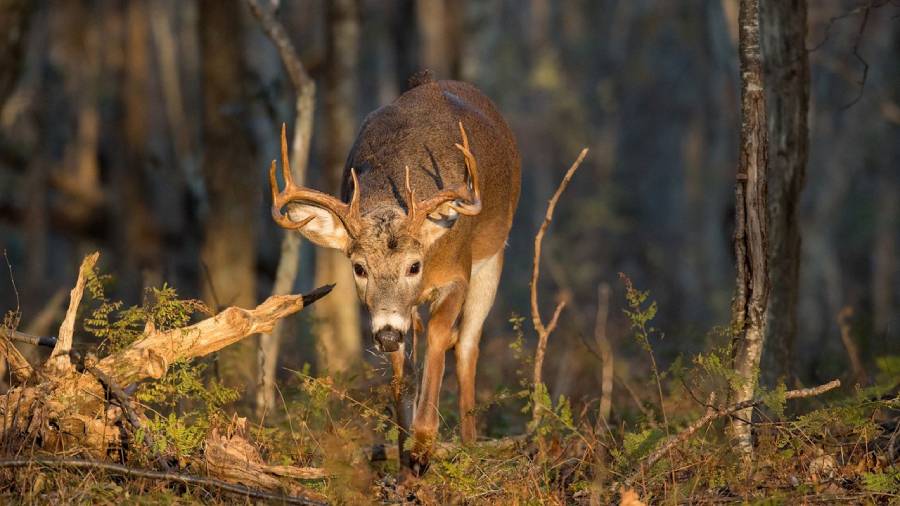
Yes, deer use logging clearcuts, especially after new vegetation has regenerated enough to provide food, security cover, or both. Removing the mature forest canopy allows more sunlight to reach the ground, which encourages grasses, forbs, shrubs, sprouts, and young woody plants to grow. This early successional vegetation can turn a logged area into feeding and cover habitat for whitetail deer.
However, deer do not use every clearcut in the same way. A newly logged opening with exposed ground provides different habitat than a cut filled with several feet of dense regeneration. Clearcut age, vegetation density, available browse, surrounding mature timber, season, and hunting pressure determine whether deer primarily feed, bed, travel, or seek security in the area. Deer may also concentrate along transitions where regenerating vegetation meets mature timber rather than consistently using the center of the cut.
For hunters, the important question is therefore not simply whether deer use logging clearcuts, but how deer use a specific clearcut. Identifying its food, cover, edges, travel routes, and relationship with surrounding habitat can reveal where deer are likely to spend time and where a hunter can intercept their movement.
Do Deer Use Logging Clearcuts?
Deer use logging clearcuts for feeding, cover, bedding, and travel when the vegetation and surrounding habitat provide those resources. A clearcut changes rapidly after timber removal, so deer use depends more on its current vegetation structure than on the fact that trees were logged. An open cut with bare ground has little in common with the same site after shrubs, hardwood sprouts, and other vegetation have established.
Whitetail deer can use different parts of a clearcut for different purposes. Feeding activity occurs where accessible vegetation provides browse, while thicker regeneration can provide concealment and potential bedding cover. Deer can also travel through a clearcut or along its boundaries when moving between feeding areas, bedding cover, and adjacent timber. As a result, finding deer tracks in a clearcut confirms use of the area but does not by itself show whether deer are feeding, bedding, or simply passing through.
The surrounding habitat also affects how valuable a clearcut becomes. A regenerating cut beside mature timber creates a transition between two vegetation structures, allowing deer to move between dense young growth and established forest. Terrain, nearby food sources, available cover, and human activity can further concentrate movement in particular parts of the cut. Hunters should therefore evaluate the clearcut together with the habitat around it rather than treating the logged acreage as an isolated hunting location.
Why Do Deer Use Logging Clearcuts?
Deer use logging clearcuts primarily because timber removal can create new food, dense vegetation, security cover, and habitat transitions. Cutting the forest canopy allows more sunlight to reach the forest floor. As the site regenerates, grasses, forbs, shrubs, sprouts, and young woody vegetation can occupy areas that previously received less sunlight beneath mature trees.
Food is one of the main reasons deer enter suitable regenerating clearcuts. Deer browse on available plant material, including leaves, shoots, shrubs, and accessible woody growth. The exact food available changes with location, season, plant species, and the stage of forest regeneration. A clearcut with abundant deer forage can therefore function as a feeding area, while a cut with limited palatable vegetation may receive less feeding activity even if it appears thick to a hunter.
Regeneration can also transform a clearcut into cover. Dense shrubs, saplings, and young trees reduce visibility and make portions of the cut more difficult for people to move through. Where vegetation provides sufficient concealment and suitable ground-level structure, deer can use this growth as security or bedding cover. This explains why an older, brush-filled cut can serve a different function from a recently harvested opening.
Clearcuts also create transitions between young vegetation and surrounding forest. These boundaries connect different habitat resources within a relatively small area. A deer may remain in thicker cover and move toward available browse, or travel between the clearcut and adjacent timber. For hunters, this means the most important feature is not necessarily the clearcut itself. The relationship between food, cover, edges, travel routes, and surrounding timber determines how deer use the logged area and which locations deserve closer scouting.
How Does the Age of a Clearcut Affect Deer Use?
The age of a clearcut affects deer use because vegetation changes as the harvested forest regenerates. A fresh cut, an early-regeneration cut, and a dense older cut provide different combinations of food, visibility, and cover. For hunters, the number of years since logging is useful, but the actual vegetation structure is a better indicator of how deer are likely to use the site.
Immediately after logging, a clearcut can contain exposed soil, logging debris, stumps, treetops, and scattered remaining vegetation. The loss of canopy increases the amount of sunlight reaching the ground, but the resulting vegetation does not appear at once. Deer may travel through or investigate a fresh cut, particularly when logging leaves accessible food or connects existing travel routes, but recently disturbed ground should not automatically be considered prime feeding or bedding habitat.
The habitat changes as grasses, forbs, shrubs, hardwood sprouts, and young trees establish. This stage can increase the amount of browse available within reach of deer while gradually creating thicker cover. A regenerating clearcut can therefore provide food and concealment in the same general area. Deer use can become more concentrated where nutritious vegetation overlaps with enough cover to make movement and feeding feel secure.
As regeneration becomes taller and denser, the function of the clearcut can shift again. Thick young growth may provide substantial security and bedding cover, but some food plants can become less accessible or be shaded as vegetation develops. Deer can continue using an older clearcut even when its value as a feeding area changes because dense vegetation may still provide cover or connect bedding areas with nearby food sources.
There is therefore no universal clearcut age that guarantees good deer habitat. Vegetation height, density, browse availability, cover, and surrounding habitat provide more useful information than age alone. Two clearcuts harvested in the same year can develop differently because of plant communities, soil, terrain, timber composition, and subsequent management. Hunters evaluating a cut should inspect what is growing there and how deer are using it instead of relying only on the harvest date.
Where Do Deer Spend Time Around a Clearcut?
Deer can spend time inside a clearcut, along its edges, in adjacent mature timber, and on travel routes connecting these habitat features. Their exact location depends on where food and security cover occur and how safely deer can move between them. This makes the entire clearcut-to-timber transition more important for scouting than a single arbitrary point inside the opening.
The interior becomes more valuable when regeneration supplies usable browse or sufficiently dense cover. In a large, thick cut, deer may feed, bed, and travel without regularly exposing themselves along an easily visible boundary. Conversely, an open interior with limited cover can push more activity toward vegetation changes, terrain features, or adjacent timber. Hunters should therefore avoid assuming that the center of every clearcut receives either more or less deer activity.
Adjacent mature timber can serve a different role. Deer may remain within timber or thicker cover before moving toward food in the cut, while established trails can connect the two habitat types. Terrain features such as benches, draws, saddles, and narrow strips of cover can further influence where those movements occur. A productive scouting location is often where several factors overlap rather than where the clearcut boundary simply looks obvious on a map.
Logging roads and skid trails can also influence movement because they create distinct routes through otherwise dense vegetation. Deer may walk these routes or cross them at established points, especially where a trail provides an efficient connection between habitat resources. However, the same roads frequently provide easy access for hunters. Repeated human traffic can therefore reduce the hunting value of an apparently convenient travel corridor.
Do Deer Prefer the Edge or the Middle of a Clearcut?
Deer do not universally prefer the edge or the middle of a clearcut; they use the portion that best combines food, cover, movement efficiency, and security. An edge can be productive because it marks a transition between regenerating vegetation and mature forest, but a dense interior can offer resources that make deer less dependent on the visible boundary.
Clearcut edges deserve attention when deer trails connect mature timber with young vegetation. An edge can give deer quick access to different habitat structures and can concentrate movement where terrain or vegetation limits the number of practical routes. Irregular edges, inside corners, narrow transitions, and locations where trails intersect the boundary can consequently provide more information than a long, uniform edge.
The middle of a clearcut becomes more important when vegetation is dense enough to provide both browse and concealment. In these conditions, deer may spend considerable time within the cut instead of merely entering it to feed. This creates a challenge for hunters because deer can move through thick vegetation without passing predictable exterior points.
The better scouting question is therefore not simply whether deer prefer the edge or middle. Hunters should determine where feeding vegetation, bedding cover, travel routes, and security overlap within the specific clearcut. Fresh tracks, trails, browse, beds, rubs, and other sign can then be used to test whether deer are actually using the locations that habitat structure suggests they should use.
When Do Deer Use Logging Clearcuts?
Deer can use logging clearcuts during both daylight and nighttime, but the timing of use depends heavily on security cover, food availability, human disturbance, and the surrounding habitat. A thick regenerating clearcut that allows deer to feed or travel without becoming exposed can support different movement patterns than an open cut where deer are visible from long distances.
Daylight use becomes more likely when a clearcut provides enough vegetation to conceal deer and connects directly with secure bedding cover. Deer do not need to cross a large exposed area if food and cover occur close together. Dense regeneration can also allow deer to move within the cut while remaining difficult for hunters to see, meaning a lack of visible deer does not necessarily indicate a lack of daytime activity.
More exposed clearcuts create a different situation. Deer can remain in adjacent cover and enter the opening when conditions feel safer rather than spending extended periods in the open. Hunters scouting these areas should identify where trails leave secure cover and enter feeding vegetation instead of assuming deer will consistently cross the center of the cut during legal shooting hours.
Time of use can also change as food sources change. A clearcut containing attractive browse may receive feeding activity while that vegetation remains available, but deer can shift toward other nearby food sources as conditions change. The clearcut may still retain value as bedding cover or a travel area even after its importance as a feeding location declines.
How Does Hunting Pressure Change Clearcut Use?
Hunting pressure can change when, where, and how deer use a clearcut. Repeated encounters with hunters, scent along access routes, vehicle traffic, and disturbance near bedding or feeding areas can make exposed locations less secure. Deer can respond by altering travel routes, remaining deeper in cover, or delaying movement into vulnerable areas.
Human access is particularly important around logged habitat because logging roads and skid trails make many clearcuts easy to reach. The same route that allows a hunter to walk quickly toward a stand can carry human scent through areas deer use for travel. Frequent disturbance along a prominent edge or road can consequently change deer movement even when the clearcut continues to provide good food and cover.
Dense regeneration gives deer additional options under pressure. Instead of abandoning the clearcut completely, deer may use thicker sections where visibility is limited or approach feeding areas from routes with more cover. A hunter who sees less activity from an exposed edge should therefore not immediately conclude that deer have left the area. Tracks, trails, beds, browse, rubs, and trail-camera observations can help determine whether activity has shifted deeper into cover or to a different time.
Hunters should account for pressure when choosing both stand locations and access routes. A productive clearcut must provide deer habitat while also allowing the hunter to reach a hunting position without repeatedly disturbing the deer using it. This distinction becomes increasingly important as hunting pressure accumulates through the season.
Do Deer Use Clearcuts Differently During Each Season?
Deer use of clearcuts changes through the hunting season because food availability, vegetation cover, breeding behavior, and security needs also change. A clearcut that functions primarily as a feeding area during one period can become more valuable as cover or a travel connection during another. Hunters should therefore reevaluate the same cut as seasonal conditions change rather than assuming deer will use it identically throughout the year.
During early season, vegetation can provide both browse and substantial foliage. Clearcuts containing desirable food near secure cover can attract feeding deer, while thick vegetation can conceal movement within the cut. Hunters should identify active browse and trails instead of selecting a location solely because the regeneration appears green and abundant. Available vegetation is only useful as a food source when deer are actually consuming it.
During the rut, movement patterns can change as bucks search for does. Clearcuts containing or connecting doe bedding and feeding habitat can become relevant to buck travel because bucks may move between locations used by does. Edges, terrain funnels, trails through adjacent timber, and narrow passages around dense regeneration can help concentrate this movement. The hunting value comes from the clearcut’s position within the larger movement network rather than from the timber harvest itself.
Late-season conditions can shift the balance again. Food becomes increasingly important as deer manage energy demands, while security remains critical in areas that have received sustained hunting pressure. A clearcut with remaining browse may continue attracting deer, but one with limited food can still provide thick security cover near another feeding destination. Hunters should determine whether deer are using the cut as the destination or as cover associated with a different destination.
Seasonal changes therefore do not make a clearcut automatically good or bad. They change the function the clearcut performs within deer habitat. Evaluating current food, cover, deer sign, nearby bedding areas, hunting pressure, and travel connections provides a more reliable hunting decision than treating clearcuts as static habitat throughout the season.
What Signs Show That Deer Are Using a Clearcut?
The clearest signs that deer are using a logging clearcut are tracks, trails, droppings, browsed vegetation, beds, rubs, and scrapes. Each sign provides different information about deer activity, so hunters should evaluate several types together rather than treating one track or rub as proof that a location is consistently productive.
Deer trails show repeated movement through the habitat. The most useful trails are not necessarily the widest ones; their location can reveal how deer connect mature timber, thick regeneration, bedding cover, and feeding areas. A trail entering a clearcut from dense adjacent cover may indicate a feeding route, while trails running through the thickest regeneration can connect bedding locations or other secure habitat. Intersections where multiple active trails converge deserve additional scouting.
Tracks and droppings confirm deer presence but provide limited information by themselves. Fresh tracks can show direction of travel and identify frequently used crossings, while concentrations of droppings can indicate that deer spend more time in a particular area. Neither sign alone establishes that deer will be present during legal hunting hours. Hunters need additional evidence to determine the timing and purpose of the activity.
Browsed vegetation provides stronger evidence that deer are using a clearcut as a food source. Hunters should look for repeated feeding on accessible shoots, leaves, shrubs, and woody growth rather than assuming every patch of young vegetation is deer forage. Concentrated browsing near trails or cover can help identify feeding locations and the routes deer use to reach them.
Beds indicate that deer are doing more than passing through the habitat. Bedding sign can be particularly important in dense regeneration where direct observation is difficult. Multiple beds, nearby droppings, trails, and surrounding security cover can reveal a bedding area. A single depression, however, should not automatically be classified as a regularly used bedding location or a buck bed without supporting evidence.
Rubs and scrapes become especially useful when evaluating buck activity. Rubs can show that bucks have traveled through an area, while active scrapes can identify locations associated with repeated communication behavior. Their hunting value increases when they occur alongside fresh tracks, trails, bedding cover, or terrain features that help explain how bucks move through the clearcut.
The strongest evidence comes from clusters of related sign. For example, a trail leaving dense cover, fresh tracks along that trail, browsed vegetation near its destination, and beds farther inside the cover create a more complete picture than any one sign alone. Hunters can use these relationships to distinguish feeding, bedding, and travel activity before selecting a hunting location.
How Do You Scout a Logging Clearcut for Deer?
Scout a logging clearcut by identifying food, security cover, edges, deer trails, bedding sign, and the routes connecting the cut to surrounding habitat. Start with habitat structure before following individual tracks. This approach helps determine why deer would use each part of the clearcut and makes physical sign easier to interpret.
Begin by examining the clearcut from a map, aerial image, or elevated observation point when available. Identify the shape of the cut and its relationship with mature timber, nearby fields, water, ridges, draws, saddles, logging roads, and other habitat features. Pay particular attention to irregular boundaries and narrow connections between cover types because these locations can influence travel.
Next, inspect the vegetation. Determine which portions provide accessible food and which have become dense enough to provide security cover. A visually thick clearcut is not automatically good feeding habitat, and an area with abundant browse is not automatically suitable bedding cover. Separating these functions helps predict where deer may feed, bed, and travel between the two.
Scout transitions between the clearcut and surrounding timber for active trails. Follow enough of a trail to determine what it connects rather than stopping when the first deer track appears. A trail becomes more informative when it leads from probable bedding cover toward feeding vegetation or passes through a terrain feature that restricts movement.
Then inspect the thicker portions for bedding evidence. Beds, concentrated droppings, connecting trails, and limited visibility can indicate that deer use the regeneration for security. Hunters should minimize unnecessary disturbance while investigating these locations. Walking through an entire bedding area simply to confirm deer presence can reduce the value of the information by disturbing the animals the hunter intends to hunt.
Logging roads and skid trails should also be evaluated from two perspectives. They can provide deer travel routes or crossings, but they also determine how hunters and other people enter the area. A promising deer trail beside a logging road may become difficult to hunt if reaching it requires walking through the same cover deer use.
Finally, connect the sign into a movement pattern. Determine where deer are likely bedding, where they are feeding, which routes connect those areas, and how human access affects those routes. A useful scouting result is not simply “deer are using this clearcut.” It is a working explanation such as deer bedding in dense regeneration, traveling through a specific transition, and reaching feeding vegetation along one side of the cut.
That movement pattern provides the information needed for stand selection. The best hunting location is often not where the greatest amount of sign exists, but where a hunter can intercept predictable movement while entering, hunting, and leaving without alerting deer.
Read more: Do Deer Prefer North or South Facing Slopes?
Where Should You Hunt Deer Around a Clearcut?
The best places to hunt deer around a clearcut are locations where predictable deer movement between bedding cover, feeding areas, and surrounding timber can be intercepted without exposing the hunter. Productive locations can include clearcut edges, trails entering or leaving thick regeneration, inside corners, terrain funnels, and transitions between mature timber and young growth. The best location depends on deer movement, wind direction, cover, visibility, and hunter access.
Start by identifying what the clearcut provides. If deer primarily feed in the regeneration but bed in surrounding timber, trails connecting those two areas deserve attention. If the clearcut itself contains dense bedding cover, hunting directly over the most obvious feeding vegetation may be less productive than intercepting deer as they leave secure cover. The function of the clearcut determines where a hunter should set up.
Terrain can further narrow movement. A clearcut may appear to provide hundreds of yards of usable edge, but a draw, saddle, bench, creek crossing, steep slope, or narrow strip of timber can make certain routes easier for deer to use. When an active trail coincides with both a habitat transition and a terrain feature, the location has more reasons to concentrate movement than a random section of edge.
Hunters should also consider visibility. Dense regeneration can make deer difficult to see even when animals regularly use the interior. A location overlooking an opening may offer better visibility, but visibility alone does not make it productive. The hunting position still needs to intersect actual deer movement while allowing the hunter to remain undetected.
Wind direction can eliminate an otherwise promising location. A stand should allow human scent to move away from the area where deer are expected to approach, travel, or remain. Hunters also need to consider changing wind conditions and thermals where terrain affects air movement. Choosing a stand based only on fresh sign without considering how scent reaches the deer can turn a high-use location into a poor hunting setup.
Access deserves equal attention. Logging roads provide convenient routes for hunters, but convenience can increase disturbance. Walking directly along an active deer trail, crossing feeding habitat before a hunt, or passing close to bedding cover can alert deer before the hunter reaches the stand. The best location must therefore work from both directions: deer need to use it predictably, and the hunter needs to reach it with minimal intrusion.
Should You Hunt Inside a Clearcut or Along Its Edge?
Hunt the edge when it concentrates predictable movement and hunt inside the clearcut when vegetation, visibility, access, and wind allow you to intercept deer without penetrating critical security cover. Neither location is automatically better. The correct choice depends on how deer use the individual cut.
Edges are practical starting points because they connect two habitat structures. Trails entering young regeneration from mature timber can reveal where deer transition between cover and food. Inside corners and irregular boundaries can be particularly useful when surrounding vegetation or terrain directs several trails toward a smaller area.
An edge becomes less valuable when deer can enter the clearcut from numerous locations or when hunting pressure makes the obvious boundary unsafe during daylight. Sitting on the most visible edge simply because it provides a long shooting lane can result in watching an area deer avoid until after dark. Active sign and an identifiable connection to bedding or feeding habitat provide stronger reasons for selecting an edge.
Hunting farther inside a clearcut can be effective when openings, logging trails, terrain, or variations in vegetation create huntable locations within dense regeneration. Interior positions can place the hunter closer to deer activity, but they also increase the risk of disturbing bedding cover. The advantage of getting closer disappears if access pushes deer out of the area or leaves scent across their primary travel routes.
A useful rule is to hunt as close to predictable deer movement as necessary, but no closer to secure cover than the access conditions allow. Hunters should move deeper only when sign, wind, visibility, and entry routes justify the additional intrusion.
How Can You Hunt a Clearcut Without Alerting Deer?
Hunt a clearcut without alerting deer by controlling four factors: access route, wind, noise, and exposure. A productive stand location loses value when the hunter repeatedly contaminates deer trails with scent, walks through feeding areas, or approaches within sight or hearing of bedding cover.
Plan the access route before selecting the final stand. Whenever possible, approach from the side opposite expected deer activity and avoid crossing the trails deer are most likely to use during the hunt. Logging roads can provide quiet and efficient access, but hunters should evaluate whether deer also use or monitor those roads before making them the default route.
Keep the wind favorable throughout both the hunt and the approach. A wind that works perfectly from the stand can still cause problems if it carries scent into bedding cover during the walk in. The entire route from the vehicle or access point to the hunting position should be evaluated against probable deer locations.
Noise becomes particularly important where dry leaves, logging debris, loose rocks, or dense branches make entry difficult. A shorter route is not always the least disruptive route. A slightly longer approach through terrain or vegetation that conceals movement can reduce disturbance compared with walking directly toward deer cover.
Visual exposure also matters around open cuts. Deer positioned inside thick regeneration or adjacent timber may observe an exposed logging road or open hillside before the hunter can see them. Terrain, standing timber, vegetation, and darkness during legal access periods where permitted can help conceal movement.
The objective is not to eliminate every trace of human presence. It is to avoid giving deer a reliable pattern of disturbance around the exact places they use for bedding, feeding, and travel. When a clearcut receives substantial hunting pressure, disciplined access can be as important as choosing the stand itself.
Are Logging Clearcuts Good Places to Hunt Deer?
Logging clearcuts can be good places to hunt deer when regenerating vegetation provides food or security cover and the surrounding habitat creates predictable deer movement. The presence of a clearcut alone does not make a location productive. Hunters should evaluate vegetation stage, available browse, cover density, adjacent habitat, fresh deer sign, hunting pressure, wind, and access before deciding where to hunt.
The first factor is vegetation. A clearcut becomes more useful when its regeneration provides something deer need. Accessible browse can create a feeding destination, while dense shrubs, saplings, and young trees can provide security or bedding cover. Some cuts provide both resources, allowing deer to spend substantial time within the regeneration rather than simply crossing it.
The second factor is the relationship between the clearcut and surrounding habitat. Mature timber, agricultural fields, other feeding areas, bedding cover, terrain features, and water can influence how deer approach and leave the cut. A clearcut positioned between important habitat resources can become part of a repeatable travel pattern even when the cut itself is not the primary feeding destination.
Fresh deer sign should confirm these habitat predictions. Active trails, tracks, droppings, browsed vegetation, beds, rubs, and scrapes can establish where deer are actually spending time. Several related signs provide stronger evidence than one isolated track. Hunters should then determine whether the sign represents feeding, bedding, travel, or seasonal buck activity before choosing a setup.
Hunting pressure can reduce the value of otherwise attractive locations. Easy access along logging roads can bring repeated human activity to the most obvious edges and openings. Deer may respond by moving deeper into regeneration, changing entry routes, or using exposed portions at different times. A less obvious location with secure access can consequently outperform an edge covered with deer sign but frequently disturbed by hunters.
A practical clearcut assessment should answer 7 questions: Does the cut contain deer food? Does it provide security cover? Where is the likely bedding cover? Which trails connect the cut with surrounding habitat? Is the sign currently active? Can the location be hunted with a favorable wind? Can the hunter enter and leave without disturbing deer? A clearcut that produces strong answers across these factors deserves more attention than one selected only because recent logging is visible on an aerial map.
For hunters, the key is to treat a logging clearcut as part of a larger habitat system. The best clearcuts combine usable food or cover with predictable movement and a low-impact hunting opportunity. Understanding how deer connect the cut with mature timber, bedding areas, feeding locations, terrain, and travel routes provides a stronger basis for stand selection than simply hunting the nearest clearcut edge.