
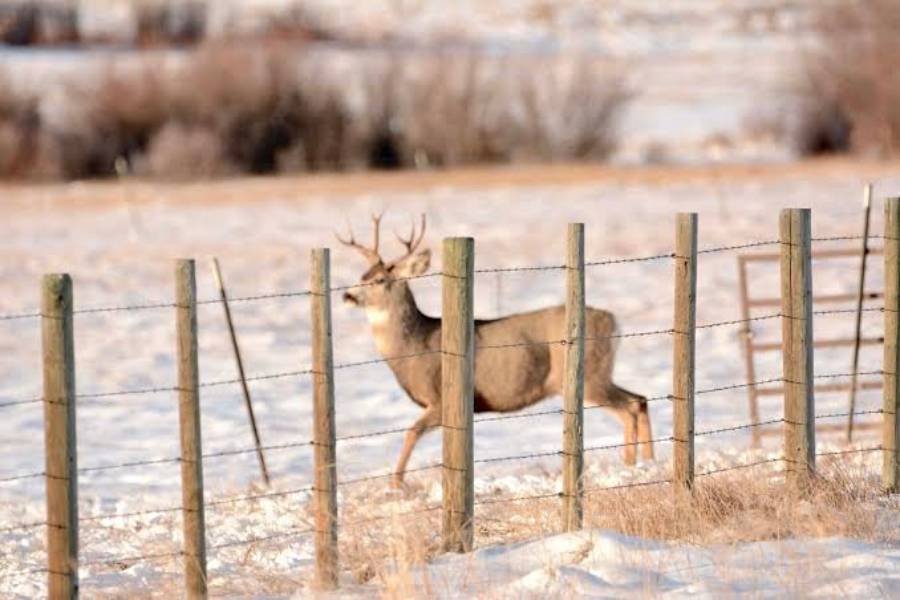
Yes, deer use fences and fence lines as part of their travel routes, especially when a fence aligns with existing trails, cover, terrain features, feeding areas, or bedding areas. A fence does not automatically create a deer travel route. Instead, it can guide deer along an edge, redirect movement toward an easier crossing point, or intersect a route deer already use to move through their habitat.
Deer interact with fences in two main ways. They may travel parallel to a fence line when it provides a convenient path or useful cover, or they may cross the fence to continue toward food, bedding cover, water, or another destination. Repeated crossings are especially important for hunters because deer often concentrate their movement where a fence is easier to negotiate, such as an opening, damaged section, low point, or location connected to an established trail.
For hunters, the key is not simply finding a fence. It is determining whether the fence influences repeatable deer movement. Fresh tracks, worn trails, hair, terrain funnels, movement direction, and repeated trail-camera activity can help distinguish an active travel route from an occasional crossing. This article explains how deer use fence lines, where they cross them, and how hunters can identify fence-related travel routes worth scouting or hunting.
Do Deer Use Fences as Travel Routes?
Deer use fences as travel routes when the fence line fits an efficient movement path between cover, bedding areas, feeding areas, water sources, or other regularly visited locations. The fence itself is not necessarily the reason deer choose the route. Instead, its position within the surrounding habitat determines whether deer travel beside it, cross it, or avoid portions that require unnecessary effort.
Fence lines are linear landscape features, so they can influence how deer move through an area. A fence running beside woods, brush, a field edge, or another form of cover may coincide with an existing deer trail. In this situation, deer can travel parallel to the fence because the route already connects useful habitat. Conversely, a fence running across an established path creates an obstacle that deer must negotiate before continuing toward their destination.
This distinction matters when scouting. A visible trail beside a fence does not prove that the fence caused the movement. Hunters should examine where the trail begins and leads. A route connecting bedding cover with an agricultural field, for example, provides a stronger explanation for repeated movement than the presence of the fence alone. The fence is one component of the travel corridor rather than the destination.
Fences can also concentrate movement. When several possible travel paths encounter the same barrier, deer may converge on locations where crossing requires less effort. An opening, damaged section, low portion of fence, or established trail crossing can therefore receive more repeated use than surrounding sections. This concentration is particularly useful for hunters because a defined crossing is easier to scout and monitor than movement spread across a broad area.
Do Deer Follow Fence Lines or Cross Them?
Deer can both follow fence lines and cross them, and the surrounding habitat determines which behavior is more useful for reaching their destination. Following and crossing should therefore be treated as two different movement patterns when scouting.
Parallel movement occurs when the fence line aligns with the direction deer are already traveling. For example, a fence running between dense woods and an open field can form part of an edge that deer follow while moving through cover. Hunters scouting this pattern should look for a trail extending along the fence rather than assuming every nearby gap is the primary crossing.
Crossing movement occurs when the fence stands between the deer and another destination. In this case, deer must go over, under, through, or around the barrier. Repeated use can produce a recognizable trail approaching the fence on one side and continuing away from it on the other. Fresh tracks on both sides strengthen the evidence that the location functions as a crossing rather than merely a trail running beside the fence.
The direction of the trail provides additional context. A crossing connected to thick bedding cover on one side and a feeding area on the other has a logical role within a larger travel route. A trail that simply reaches a fence and disappears provides weaker evidence. Hunters should therefore determine where the deer are coming from and where they are going, rather than treating the fence itself as the complete travel route.
Where Do Deer Usually Cross Fences?
Deer usually favor fence locations that allow them to continue an established movement route with less resistance. Useful places to inspect include existing gaps, openings, gates, damaged sections, lower portions of the fence, terrain depressions, and points where established trails meet the fence.
An existing opening provides an obvious route because deer do not need to negotiate the full height or structure of the barrier. A broken wire, open section, or gap can serve the same function. However, an easy opening is not automatically an active deer crossing. Its hunting value depends on evidence of repeated use, such as fresh tracks and a continuous trail entering and leaving the opening.
Low spots deserve similar attention. Changes in terrain can alter the effective height of a fence or create a more convenient approach. A depression, ditch, or uneven section of ground can therefore influence where deer encounter and negotiate the barrier. Hunters should inspect both sides because a genuine crossing should make sense as a continuous movement path rather than an isolated piece of sign.
Deer are physically capable of jumping fences, but the ability to clear a fence does not mean deer cross every section equally. When a repeatable route offers a convenient crossing, deer do not need to choose a new location on every trip. This is why established crossings can become useful scouting points.
The strongest crossing is consequently not always the most visually obvious gap in a fence. It is the location where crossing structure, fresh deer sign, an established trail, and surrounding habitat all support the same movement pattern. A hunter who finds these factors together has substantially more evidence of a travel route than a hunter who selects a location solely because the fence is easier to cross.
How Can You Tell if Deer Are Using a Fence Crossing?
You can tell deer are using a fence crossing by finding multiple signs of repeated movement at the same location, including fresh tracks, a worn trail, hair on the fence, disturbed vegetation, rubs, scrapes, or repeated trail-camera activity. One sign confirms deer presence; several signs that align with the same path provide stronger evidence that the crossing belongs to an established travel route.
Start with the trail itself. An active crossing should have a logical path approaching the fence and continuing beyond it. A worn trail that stops at the fence or turns parallel to it may indicate deer are following the fence rather than crossing there. In contrast, a defined trail entering the crossing from one side and continuing into suitable habitat on the other provides stronger evidence of through-movement.
Fresh tracks help establish both recent activity and travel direction. Hunters should examine tracks on both sides of the fence and determine whether they align with the same route. Repeated tracks traveling through one concentrated location are more useful than a single isolated print because one deer crossing once does not establish a predictable travel pattern. Track freshness also matters: an obvious trail containing only old sign may represent a route that is no longer receiving regular use.
Hair caught on wire can provide additional evidence where deer physically contact a fence while moving over, under, or through it. However, hair alone does not reveal how frequently deer use the location. Its value increases when the same crossing also contains fresh tracks, a defined trail, or other recent activity.
Rubs and scrapes require a different interpretation. They demonstrate deer activity near a fence line, particularly buck activity, but they do not independently prove that deer regularly cross the fence at that exact location. A rub beside a fence may occur along a parallel travel route, while a scrape can identify an activity location without revealing the direction deer traveled afterward. Hunters should use these signs to strengthen an existing movement pattern rather than treating them as standalone proof.
Trail cameras provide a stronger method for confirming repeated use because they can show frequency, direction, timing, and the deer using the route. For example, repeated images of deer entering from the same trail and crossing at the same location provide better evidence of a predictable route than one photograph taken during several days of monitoring.
The most reliable assessment therefore comes from evidence convergence. A worn trail is useful. Fresh tracks make it stronger. A continuous path on both sides of the fence strengthens it further. Repeated camera observations can then verify that deer continue using the crossing. Hunters should prioritize locations where several independent signs describe the same movement pattern.
What Types of Fences Affect Deer Travel Routes?
Fence type affects deer travel by changing how easily deer can cross, pass through, or move around the barrier. Barbed-wire, woven-wire, and electric fences present different physical obstacles, so hunters should evaluate the structure of a fence before assuming deer will interact with every section in the same way.
Barbed-wire fences can provide several possible crossing opportunities because the spaces between strands leave different routes for deer to negotiate the barrier. Hunters scouting these fences should look for concentrated trails, disturbed ground, hair caught on wire, or sections where repeated crossing has affected the fence or surrounding vegetation. These observations are more valuable than choosing a location based only on fence height.
Woven-wire fences create a different obstacle because the mesh restricts movement through the fence. Deer encountering one must generally find a suitable way over it, use an existing opening, or locate another accessible section. This can make gaps, gates, damaged portions, terrain changes, and established crossings particularly important scouting locations. The relevant question is not simply whether deer can overcome the fence, but where repeated movement is being concentrated by it.
Electric fences should also be evaluated according to their actual configuration rather than treated as a single category. Wire spacing, fence height, number of strands, surrounding terrain, and whether the fence is operating all affect the obstacle deer encounter. The source materials supplied for this workflow do not provide deer-specific research supporting a universal movement response to electric fences, so the article should not claim that all electric fences redirect deer in the same way.
For hunters, fence type is therefore a starting variable rather than a prediction of deer behavior. Actual deer sign remains the deciding evidence. A difficult-looking fence with a heavily used crossing can have greater scouting value than an easy-looking fence with no fresh tracks or established trail.
How Does Terrain Affect Deer Movement Along Fences?
Terrain affects deer movement along fences by determining whether a fence reinforces, interrupts, or concentrates an existing travel route. A fence becomes more relevant to hunters when it intersects terrain features that already influence how deer move, including field edges, dense cover, creeks, ditches, slopes, and transitions between habitat types.
A fence running through otherwise uniform terrain may offer limited information by itself. The same fence becomes more significant when it follows the edge between thick woods and an open field. In that setting, the habitat transition and fence create two linear features in the same location. Deer traveling along the edge can consequently appear to be following the fence when the combination of cover, terrain, and destination is actually shaping the route.
Creeks and ditches can further concentrate movement where they intersect a fence. A deer approaching both obstacles has fewer convenient options than one encountering only a fence. If a trail, terrain depression, or opening provides an easier route through the intersection, repeated movement may become concentrated there. Hunters should inspect these locations for fresh tracks and trails continuing through both sides of the terrain feature.
Changes in elevation can produce a similar effect. A fence crossing a steep slope may contain sections where the surrounding ground makes crossing easier or where deer trails naturally contour around the terrain. Rather than walking the entire fence and treating every section equally, hunters can first identify terrain features that are likely to channel movement and then determine whether fresh deer sign confirms the prediction.
The surrounding cover also affects the hunting value of a fence route. A crossing connected to thick cover can allow deer to remain concealed for more of their approach, while a crossing surrounded by exposed ground may receive different levels or timing of use. The important relationship is therefore terrain + cover + fence + deer sign, not the fence alone.
Can a Fence Create a Deer Funnel or Pinch Point?
A fence can contribute to a deer funnel or pinch point when it works with another terrain or habitat feature to reduce the number of practical travel paths available to deer. The fence usually does not create the entire funnel by itself. Its hunting value comes from how it interacts with surrounding features.
For example, consider a fence running toward a creek with thick cover on the opposite side. If only a narrow area between these features provides convenient passage, deer moving through the larger area may converge toward that corridor. A fence opening or established crossing within the corridor can concentrate movement further.
The same principle applies where fences intersect field corners, ditches, steep terrain, dense vegetation, or transitions between open and covered habitat. These intersections deserve scouting attention because multiple landscape features are influencing movement simultaneously. Fresh tracks and a defined trail are still necessary to confirm that deer actually use the predicted funnel.
Hunters should therefore distinguish between a potential funnel identified from terrain and an active funnel confirmed by deer sign. A map can reveal where movement should theoretically concentrate, but tracks, trails, trail-camera observations, and other recent sign establish whether deer currently use the location.
Do Deer Use Fence Routes Between Bedding and Feeding Areas?
Deer can use fence routes between bedding and feeding areas when the fence aligns with an established path connecting those destinations. Bedding and feeding areas provide a reason for movement, while the fence, terrain, and cover influence the route deer take between them.
This distinction prevents hunters from assigning too much importance to the fence itself. Deer do not need to travel a fence line simply because it exists. A fence becomes relevant when following or crossing it helps deer continue toward a location they regularly use. A trail connecting secure cover with a food source therefore provides more contextual evidence than an isolated trail beside a fence with no identifiable destination.
Movement direction can help hunters interpret the route. A trail emerging from bedding cover, approaching a fence, crossing at a concentrated point, and continuing toward feeding habitat forms a coherent travel pattern. Fresh tracks pointing in both directions can indicate the route receives movement at different times, while repeated trail-camera observations can help establish when deer use each direction.
Hunters should also expect the value of a route to change when the destinations change. Food availability, cover conditions, disturbance, and other habitat changes can alter where deer need to travel. A heavily used fence route discovered during one period should therefore not be assumed to maintain the same activity indefinitely.
The practical scouting question is what does this fence route connect? When a hunter can identify the likely origin, destination, continuous trail, active crossing, and fresh deer sign, the fence becomes part of a larger movement system rather than an isolated landscape feature. That context makes the route substantially more useful when deciding where to monitor deer and, eventually, where to hunt.
Does Hunting Pressure Change How Deer Use Fence Lines?
Hunting pressure can change how deer use fence lines by altering when, how often, and where they travel through exposed or repeatedly disturbed areas. A fence crossing that receives regular deer traffic does not remain equally predictable when hunters repeatedly walk the route, approach stands nearby, or otherwise increase human activity around the crossing.
This matters because a fence crossing is only one part of a larger travel route. Deer still have destinations such as bedding cover and feeding areas, but they can adjust the path used to reach those destinations. When disturbance increases around a particular crossing, hunters should look for fresh sign along nearby fence sections, alternative openings, parallel trails, or routes that provide more cover.
Hunting pressure can also affect the timing of fence-line movement. A crossing may remain active while deer use it at different times than before. This is one reason old tracks, worn vegetation, or a historically productive trail should not be treated as proof of current hunting opportunity. Fresh sign and recent trail-camera observations provide a better picture of present movement.
Seasonal changes add another variable. During the rut, buck movement can become less directly tied to a simple bedding-to-feeding pattern because bucks spend more time searching for and following does. A fence crossing used during another part of the season may remain active, become more active, or lose importance as movement patterns change. The supplied source materials do not provide deer-specific data establishing a universal rut response to fences, so this relationship should be evaluated through current field evidence rather than treated as a fixed rule.
Buck and doe use of a crossing should be evaluated in the same way. A hunter should not assume that a trail used regularly by does will produce identical buck movement, or that one photograph of a buck establishes a consistent buck route. Identify which deer are using the crossing, when they appear, and whether that behavior repeats before making a hunting decision.
The practical rule is straightforward: treat a fence crossing as a current travel route only while current evidence supports it. Historical trails identify locations worth checking, but fresh tracks, recent sign, and repeated observations determine whether the route remains relevant under present hunting pressure and seasonal conditions.
How Should Hunters Scout a Fence Line for Deer?
Hunters should scout a fence line by first identifying where the fence intersects likely deer movement, then confirming those locations with fresh and repeated deer sign. Walking every foot of fence without considering the surrounding habitat is less informative than evaluating the fence as part of a larger movement system.
Start by studying what the fence connects or separates. Locate bedding cover, feeding areas, field edges, wooded corridors, creeks, ditches, terrain changes, and other features that could influence deer movement. This establishes a reason for deer to approach or travel beside a particular portion of the fence.
Next, inspect the sections where predicted travel routes meet the fence. Look for gaps, low spots, damaged sections, gates, terrain depressions, and established trails. A convenient crossing deserves attention, but convenience alone is insufficient. Determine whether a trail approaches the location and continues beyond it.
Then examine the sign for recency and repetition. Fresh tracks, repeatedly disturbed ground, worn vegetation, hair on the fence, and a defined trail provide different pieces of evidence. Several signs occurring together are more informative than one isolated track. Hunters should also follow the trail far enough in both directions to determine whether deer are crossing the fence or simply traveling parallel to it.
Movement direction should be established before selecting a hunting location. Determine what lies on each side of the crossing and whether the route logically connects cover, bedding, food, water, or another travel corridor. For example, a heavily used crossing between thick security cover and a feeding area has clearer movement context than an equally visible crossing with no identifiable origin or destination.
A trail camera can then verify the pattern without relying solely on physical sign. Positioning a camera to capture the approach, crossing, and direction of travel can reveal whether the location receives repeated use, which deer use it, and when movement occurs. One image establishes presence; repeated observations under similar conditions provide stronger evidence of a predictable route.
Finally, evaluate the location from a hunting perspective rather than stopping when deer movement is confirmed. Consider wind direction, available cover, hunter access, visibility, and the risk of disturbing the route. The best fence crossing to scout is not automatically the best fence crossing to hunt. A highly active location can still be unsuitable if reaching it requires walking through the deer trail or allowing scent to enter bedding cover.
A useful scouting sequence is therefore identify likely movement → locate fence intersections → inspect fresh sign → establish direction → verify repeated use → evaluate hunting access. This process turns the fence from a visual landscape feature into evidence that can support a specific hunting decision.
Read more: Do Deer Use Creek Beds for Travel? Hunting Guide
Should You Hunt Near a Deer Fence Crossing?
An active deer fence crossing can be a good hunting location when repeated deer movement, favorable terrain, sufficient cover, wind direction, and hunter access align. The presence of a crossing alone is not enough to justify hunting it. Hunters first need to establish that deer use the location repeatedly and that the crossing can be hunted without disrupting the travel route.
Start by evaluating the quality of the movement evidence. A worn trail with fresh tracks on both sides of the fence provides stronger evidence than an isolated track or an easy-looking opening. Repeated trail-camera observations strengthen the case further because they can reveal whether deer consistently use the crossing and whether movement occurs during periods relevant to the hunter.
The surrounding terrain determines whether the crossing concentrates movement enough to create a useful hunting opportunity. A crossing located where a fence intersects a field edge, creek, ditch, narrow strip of cover, or another movement feature may provide more predictable traffic than a crossing surrounded by several equally convenient routes. In this situation, hunters are evaluating the entire travel corridor rather than the fence opening alone.
Wind is another important constraint. A crossing with frequent deer activity loses practical value when the prevailing wind carries human scent toward the approaching trail, bedding cover, or other areas deer use before reaching the crossing. Hunters should evaluate the direction deer approach from before deciding whether a location is huntable under a particular wind.
Access matters for the same reason. Walking directly along the deer trail, repeatedly crossing the route, or entering through nearby bedding cover can disturb the movement pattern the hunter intends to exploit. A less obvious crossing with cleaner access can therefore be a more practical hunting location than the crossing showing the greatest amount of sign.
Where Should You Place a Stand Near a Fence Crossing?
Place a stand where it covers the established travel route near the fence crossing while allowing favorable wind and low-impact access. The stand does not automatically belong directly beside the fence or directly over the crossing.
Determine the direction of deer movement first. If the trail approaches from thick cover, passes through the fence, and continues toward a feeding area, the stand should intercept that predictable route without forcing the hunter to enter the trail or primary cover during access. This preserves the movement pattern the stand depends on.
Cover and visibility then determine the practical position. A stand needs to provide an effective observation or shooting opportunity while keeping the hunter from becoming unnecessarily exposed. Moving farther from the actual crossing can be appropriate when the surrounding terrain provides a better interception point along the same trail.
There is no universal distance from a fence crossing that works for every stand. The materials supplied for this workflow do not establish a deer-specific distance that should be recommended. Stand distance should instead be determined by movement direction, cover, visibility, wind, access, and the hunting method being used. Giving one fixed distance would create false precision where the available evidence does not support it.
Hunters should also verify property boundaries and applicable hunting regulations before selecting a stand around a fence. A fence can mark a property boundary, but its physical location should not be assumed to establish legal hunting access or permission by itself.
A fence crossing should be rejected as a stand location when the evidence is weak or the setup creates excessive disturbance. Old sign without fresh activity, inconsistent trail-camera observations, unfavorable wind, exposed access, or an approach through bedding cover can outweigh the apparent advantage of the crossing.
The goal is therefore not to hunt the fence. It is to hunt a repeatable deer movement pattern that happens to interact with the fence. This distinction keeps stand selection focused on deer behavior rather than on a landscape feature that may or may not influence current movement.
What Is the Best Way to Determine Whether a Fence Is a Deer Travel Route?
The best way to determine whether a fence is part of a deer travel route is to combine an established trail, fresh deer sign, repeated use, logical movement direction, and the surrounding terrain into one movement pattern. No single piece of evidence provides the same confidence as several independent signs pointing to the same conclusion.
Begin with the route itself. Determine whether deer travel along the fence or approach it from another direction and cross it. Follow the trail far enough to understand where it leads. A trail connecting cover, bedding habitat, feeding habitat, or another established movement corridor provides meaningful context for why deer use that location.
Next, establish current use. Fresh tracks, disturbed vegetation, hair at a crossing, and other recent sign can confirm deer presence. A worn trail containing no recent activity should be treated differently from a trail that continues to accumulate fresh sign.
Then establish repetition. Repeated tracks or trail-camera observations are important because a deer can cross almost any accessible location once. A hunting travel route needs a degree of predictable reuse to become useful for scouting and stand placement.
Finally, evaluate the route against the surrounding terrain. A fence crossing that coincides with a field edge, cover transition, terrain funnel, creek crossing, ditch, or route between important habitat areas has a stronger contextual explanation than an isolated opening with little supporting sign.
The strongest assessment therefore follows this relationship:
Established trail + fresh sign + repeated use + logical travel direction + supporting terrain = strong evidence of a deer travel route.
A fence by itself is not evidence of predictable deer movement. Deer use fences as travel routes when those fences fit into the larger movement system connecting the places deer need to reach. For hunters, identifying that larger system is more valuable than simply finding the easiest place for a deer to cross.