
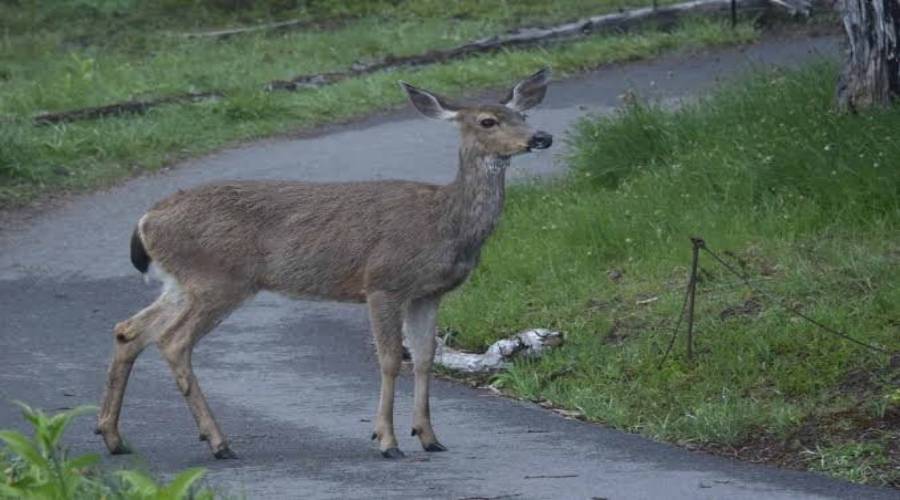
Yes, deer have hooves. Deer have cloven hooves, meaning each hoof is divided into two main weight-bearing toes. This split structure creates the distinctive paired hoofprints commonly found along deer trails, feeding areas, bedding cover, and travel corridors. Deer also have two smaller toes called dewclaws positioned higher on each foot, although these do not appear in every track.
A deer’s hoof structure supports movement across different types of terrain. The two main toes bear most of the animal’s weight, while the shape and flexibility of the hoof help deer walk, run, and jump across forests, slopes, fields, mud, and snow. When the hoof contacts soft ground, its two main toes usually leave separate impressions that form the basic shape of a deer track.
For hunters, understanding deer hooves has practical value because hoof anatomy determines what deer tracks look like in the field. Hoof shape, toe position, dewclaw impressions, track patterns, and ground conditions can all affect the appearance of a track. Recognizing these characteristics helps hunters distinguish deer tracks from other hoofed animals and interpret deer movement more accurately.
What Type of Hooves Do Deer Have?
Deer have cloven hooves. A cloven hoof is divided into two main weight-bearing toes that form the paired, split shape characteristic of deer feet. These two toes contact the ground during normal movement and support most of the deer’s body weight. Because they are separate rather than forming one solid hoof, the toes can respond individually to changes in the ground surface as a deer moves.
Each deer foot has two primary toes that make up the visible hoof. The hard exterior is made largely of keratin, the structural protein also found in human fingernails and the claws, horns, and hooves of other animals. This tough outer material protects the underlying tissues while providing a durable contact surface for walking and running. The two-toed structure also contributes directly to the paired impressions hunters recognize as deer hoofprints.
The shape of a deer’s cloven hoof matters when identifying tracks. When both main toes press into mud, snow, or soft soil, they normally produce two adjacent impressions rather than one continuous print. However, the exact appearance changes with the deer’s movement and the surface beneath it. A deep print in mud can look substantially different from a shallow impression on firm soil, even when both were made by the same deer.
What Are Deer Dewclaws?
Deer dewclaws are two smaller toes located higher on the back of each foot, above the two primary weight-bearing toes. Unlike the main toes, dewclaws generally do not contact firm ground during an ordinary step. This position explains why a clear deer hoofprint does not necessarily include dewclaw marks.
Dewclaws become more relevant when a deer sinks farther into a surface or its foot experiences greater pressure. Soft mud and deep snow, for example, allow the foot to penetrate farther into the substrate, increasing the chance that the dewclaws will leave impressions behind the main hoof marks. Running and other movements that place additional pressure on the foot can also affect the resulting track.
Hunters should therefore treat visible dewclaw impressions as one part of the complete track context rather than a standalone identification rule. Track depth, substrate, gait, the sequence of prints, and other nearby deer sign provide additional context for determining what animal produced a trail.
What Do Deer Hooves Look Like?
Deer hooves have a split, two-part appearance formed by the two main toes of each foot. Viewed from underneath, the hoof is divided along the center rather than forming a single continuous surface. This physical separation is the defining feature of a cloven hoof and is also responsible for the recognizable two-part pattern of most deer tracks.
The hoof has a hard outer surface surrounding the structures that support the deer’s weight. Its two main toes extend forward, while the two smaller dewclaws sit farther back and higher on the foot. The exact dimensions vary between individual deer because body size, age, species, and other physical characteristics differ. For hunters, the overall structure is more useful for basic identification than assuming every deer hoof has one fixed measurement.
A hoof seen on a deer and a hoofprint found on the ground are also different forms of evidence. The hoof is the anatomical structure, while the hoofprint is an impression produced when that structure contacts a surface. Mud can spread or distort an impression, snow can collapse around it, and hard ground may record only part of the hoof. Hunters should therefore identify the underlying hoof characteristics before drawing conclusions from the apparent shape of a single track.
Why Do Deer Have Cloven Hooves?
Deer have cloven hooves because the two-part hoof structure supports stable and efficient movement across varied terrain. The two main toes carry the deer’s weight while allowing each side of the hoof to respond to the surface beneath it. This structure is useful for an animal that regularly walks, runs, and jumps through forests, fields, slopes, and other uneven environments.
The split structure also affects how pressure is distributed when the foot contacts the ground. Instead of relying on one solid hoof surface, a deer places its weight through two primary toes. On uneven or soft terrain, the toes can interact with the ground separately as the animal moves. The result is a foot adapted to locomotion rather than a rigid, single contact point.
Terrain changes how this structure functions and what hunters subsequently see. On firm ground, the main toes may leave shallow or incomplete impressions. In mud or soft soil, the hoof penetrates deeper and produces a more defined track. Deep snow or very soft ground can allow more of the foot to sink into the surface, potentially producing additional impressions from the dewclaws.
Cloven hooves also support the movements that characterize deer travel. Walking produces a different sequence and depth of tracks than faster movement because speed changes foot placement and the pressure applied to the ground. For hunters, hoof function and track appearance are therefore directly connected: movement, pressure, and terrain determine how the anatomical structure is recorded on the ground.
What Do Deer Hoofprints Look Like?
Deer hoofprints typically appear as two adjacent impressions created by the two main toes of a cloven hoof. The central split between the toes gives the track its characteristic paired appearance. A clean print in suitable ground can show both sides distinctly, while an incomplete print may preserve only part of the hoof.
A deer track should not be expected to have exactly the same appearance on every surface. Mud can produce deep, well-defined impressions but can also deform as the foot enters and leaves the ground. Snow may preserve the general outline while collapsing around the edges. Soft soil and sand can record the two main toes clearly when conditions are suitable, whereas dry, hard ground may leave only faint portions of the hoof.
Dewclaw marks can appear behind the primary hoof impressions when the foot sinks deeply enough for the smaller toes to reach the surface. The absence of dewclaw marks does not mean a track was not made by a deer. During ordinary movement over firmer ground, the dewclaws sit high enough that they generally do not produce an impression. Softer substrate and movements that increase pressure on the foot make these marks more likely to appear.
Track appearance also depends on how the deer was moving. A hunter examining a trail should therefore look beyond the shape of one isolated hoofprint. A sequence of impressions provides more information about foot placement and movement, while nearby signs can add context to the identification. Hoof shape, substrate, track sequence, and surrounding evidence are more reliable together than a single characteristic considered alone.
How Can Hunters Identify Deer Tracks?
Hunters can identify deer tracks by examining hoof shape, toe position, track proportions, track pattern, and surrounding deer sign together. A typical deer track reflects the animal’s cloven hoof, so the clearest prints contain two main impressions separated by a central split. This paired structure provides the starting point for identification, but hunters should avoid identifying an animal from hoof shape alone when the print is distorted or incomplete.
Track quality depends heavily on the surface. Mud, moist soil, and suitable snow can preserve the two main toe impressions clearly, while leaves, dry soil, gravel, and hard ground may record only fragments of the hoof. A hunter should therefore distinguish an anatomical characteristic from a substrate effect. An unusually wide or irregular print, for example, may result from the hoof slipping or the surrounding soil collapsing rather than from an unusually shaped hoof.
Dewclaw impressions provide additional evidence when they are present. They occur behind the primary hoof impressions because the dewclaws sit higher on the foot. However, hunters should not require dewclaw marks to identify a deer track. Firm surfaces and ordinary walking may produce no visible dewclaw impressions, while deep mud, snow, or greater pressure on the foot makes them more likely to register.
The surrounding trail provides stronger identification evidence than one isolated print. Hunters can examine consecutive tracks for consistency in hoof shape, spacing, orientation, and direction. Other deer sign along the same route can add context. Combining multiple observations reduces the risk of treating one damaged or partial impression as a representative deer track.
What Does a Deer Track Pattern Look Like?
A deer track pattern is a sequence of hoofprints that records how the animal moved across the ground. Instead of examining only one impression, hunters can follow several consecutive tracks to observe foot placement, spacing, direction, and changes in movement. This sequence is especially valuable when individual prints are poorly preserved.
The spacing and arrangement of tracks change as the deer changes its gait. A deer moving calmly does not place its feet with the same spacing or pressure as one moving faster. Changes in gait can therefore alter both the distance between impressions and their depth. Hunters should interpret these differences as evidence of movement rather than assuming that every variation represents a different animal.
Direction of travel is another practical piece of information contained in a track pattern. Following several clear impressions allows a hunter to establish the orientation of the trail more reliably than interpreting one print in isolation. A sequence of tracks provides context that a single hoofprint cannot provide, particularly when the ground has distorted individual impressions.
Can You Tell a Buck From a Doe by Its Hoofprints?
A single hoofprint does not reliably prove whether a deer is a buck or a doe. Bucks can be larger than does, so a large track may contribute to an assessment of the animal that made it, but track size alone is not sufficient evidence of sex. Individual body size, age, movement, substrate, and distortion can all change the apparent dimensions of a hoofprint.
Ground conditions are particularly important when judging track size. A hoof sinking into soft mud can create an impression wider than the hoof itself, while an incomplete print on firm ground may appear smaller. Running, slipping, or turning can further change the outline. A large-looking track is therefore evidence of track dimensions under specific conditions, not automatic proof that a buck made it.
Hunters can make a stronger field assessment by combining tracks with additional evidence from the same area. A sequence of tracks can reveal relative size and movement more effectively than one impression, while other deer sign can provide further context. The objective is to build an identification from several consistent observations rather than assign sex from a single characteristic.
This distinction is important for practical tracking because observation and inference are not the same thing. A hunter can directly observe the dimensions, depth, shape, and pattern of tracks. Identifying the animal as a buck or doe is an inference that requires additional evidence. Keeping those two levels separate prevents an uncertain field clue from becoming an unsupported conclusion.
Read more: Do Deer Eat Potatoes? What Hunters Should Know
How Are Deer Tracks Different From Other Hoofed Animal Tracks?
Deer tracks differ from other hoofed animal tracks in their overall size, shape, toe proportions, dewclaw impressions, and trail pattern. Because several hoofed mammals have cloven hooves, the presence of two toe impressions alone does not prove that a deer made a track. Hunters should compare multiple characteristics and consider which species actually occur in the hunting area.
Deer and elk tracks share the same basic cloven-hoof pattern, but elk tracks are generally larger because elk have substantially larger bodies and feet. Size provides useful context when clear tracks from adult animals are available, but hunters should not use size as the only identification feature. A large deer and a smaller elk can create overlapping impressions, while mud, snow, and track deterioration can change apparent dimensions.
Moose also leave two-part hoofprints, but their much larger hooves generally produce larger tracks than deer. The difference becomes easier to recognize when hunters can examine several intact prints rather than one partial impression. Trail context also matters because consecutive tracks reveal relative dimensions and movement patterns that may not be visible in a single footprint.
Wild hog tracks can create a more challenging comparison because hogs also have cloven hooves and can leave visible dewclaw impressions. Hunters should compare the complete track rather than assuming every two-toed print belongs to a deer. Toe shape, overall proportions, dewclaw placement, track sequence, substrate, and other nearby animal sign provide a stronger basis for identification.
Geographic context should narrow the comparison further. A hunter does not need to compare a track against every hoofed mammal in North America. The useful comparison set consists of animals present in that specific hunting region. This approach reduces false identification while keeping attention on evidence that has practical value in the field.
What Can Deer Tracks Tell Hunters?
Deer tracks can tell hunters the direction of travel, movement pattern, relative animal size, repeated use of an area, and where deer activity has occurred. Tracks become more informative when hunters examine an entire trail and its surroundings rather than treating one hoofprint as complete evidence.
Direction of travel is one of the most practical observations. A sequence of clear hoofprints establishes how the animal moved through an area and can help a hunter understand how deer travel between cover, feeding locations, water, and other habitat features. Repeated tracks along the same route can also indicate that an area receives deer traffic, although tracks alone do not establish exactly how frequently a specific deer uses that route.
Track patterns provide information about movement. Changes in spacing, placement, and impression depth can indicate changes in gait or speed, while irregular tracks may reflect turning, slipping, or difficult terrain. Hunters should interpret these characteristics together because substrate also changes track depth and shape. A deep impression in mud, for example, does not by itself prove that a deer was moving quickly or that the animal was unusually heavy.
Track dimensions can contribute to an estimate of relative animal size, but they should not be converted into an exact body weight, age, or sex without additional evidence. Soft ground can enlarge an impression, hard ground can preserve only part of the hoof, and movement can distort the original shape. Measurements are most useful when hunters compare multiple well-preserved tracks made under similar conditions.
The condition of a track can also contribute to an assessment of deer activity, but a hoofprint alone does not provide a precise timestamp. Weather, temperature, wind, precipitation, soil moisture, snow conditions, and subsequent animal traffic can alter tracks at different rates. Hunters should compare track condition with recent environmental conditions and other deer sign before deciding how recent the activity is.
For hunting purposes, the strongest interpretation comes from combining hoofprints, track patterns, terrain, environmental conditions, and surrounding deer sign. Deer hooves create the physical impressions, but the sequence and context of those impressions provide the information needed for practical tracking. Understanding that relationship allows hunters to move from simply recognizing a deer hoofprint to interpreting how deer are using an area.