
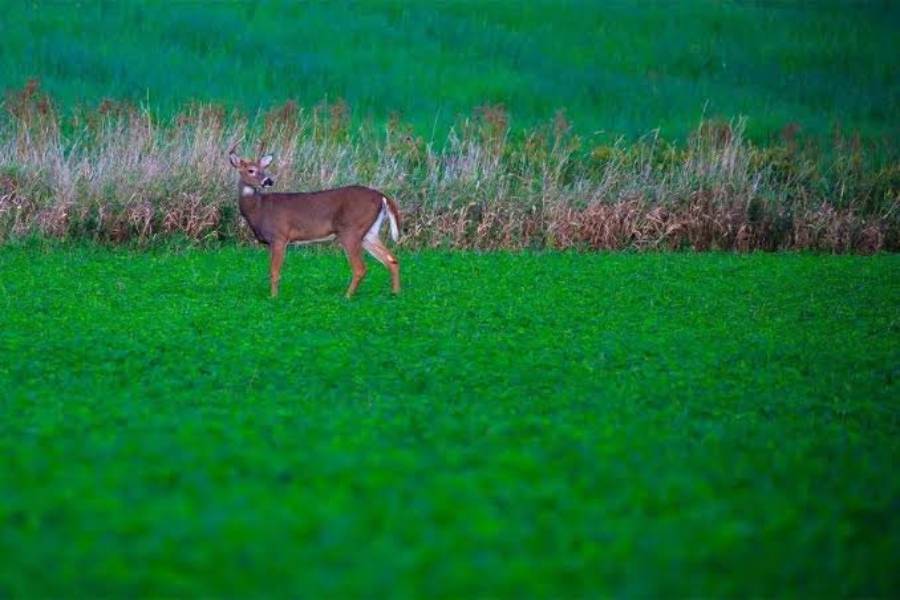
Corn and soybeans are two of the best crops to leave standing for deer because they provide concentrated food sources during hunting season, while standing corn also creates valuable cover. Grain sorghum, cereal grains, brassicas, and sunflowers can also provide food for whitetail deer, but their value depends on the stage of the hunting season, local food availability, and how long the crop remains accessible.
A standing crop serves a different purpose from a food plot that produces attractive forage for only part of the growing season. Crops left standing must continue providing usable food after maturity or into the period when deer need it most. Corn accomplishes this through energy-rich grain that can remain on the stalk, while mature soybeans provide beans that deer can consume after the green foliage has declined. Other crops provide seeds, leaves, roots, or green forage at different points in the season.
The best choice therefore depends on when deer will use the field and what other food is available nearby. This guide compares six standing crop options and explains how to select them based on seasonal deer feeding patterns, food value, cover, field placement, and hunting strategy.
What Are the Best Crops to Leave Standing for Deer?
The 6 best crops to leave standing for deer are corn, soybeans, grain sorghum, cereal grains, brassicas, and sunflowers. Corn and soybeans are the strongest all-around choices because they can provide substantial food during hunting season, while the other crops fill more specific roles based on climate, season, and surrounding food availability. A useful standing crop must do more than attract deer while actively growing; it should keep edible plant material available when hunters expect deer to use the field.
Corn is one of the best standing crops for deer because mature ears provide an energy-dense food source and the tall stalks also create cover. Deer consume the kernels for carbohydrates, making standing corn particularly relevant when their diet shifts toward concentrated energy sources. Unlike low-growing forage, mature corn can also conceal deer as they feed and move through a field. This combination of food and cover makes corn valuable, but it can complicate hunting because deer may enter, feed, bed, and travel within a large cornfield without exposing themselves along predictable field edges.
Soybeans provide two distinct food sources as the plants mature: green foliage during the growing season and beans after the pods develop. This seasonal transition gives soybeans a broader feeding role than crops that provide only green forage. Deer can browse soybean leaves when plants are green and return for mature beans later in the year. However, the value of standing soybeans depends on whether enough pods remain when hunting conditions become colder. Heavy deer browsing or poor soybean production can reduce the amount of late-season food available.
Grain sorghum is a useful alternative when hunters want a standing grain crop that produces seed heads above the ground. Mature sorghum provides grain while its stalks add vertical structure to a field. Its hunting value comes from combining accessible seed with enough vegetation to make the plot more secure than an exposed, low-growing food source. Sorghum should still be treated as an alternative rather than a universal replacement for corn because deer preference and crop performance depend on local conditions and the availability of more attractive foods.
Cereal grains such as winter wheat, cereal rye, and oats are valuable primarily because deer consume their green growth. This makes them different from standing corn and mature soybeans. Hunters may leave these crops unharvested, but their primary attraction can come from actively growing forage rather than mature grain remaining on the plant. Cereal grains are therefore most useful when the goal is to maintain an accessible green food source during the portion of hunting season when the plants are still palatable.
Brassicas such as turnips, radishes, rape, and kale provide deer with leaves and, depending on the species, edible roots. Their value changes as the plants mature and weather conditions change. Instead of functioning like a field of standing grain, brassicas create food at or close to ground level. This distinction matters when comparing crops because leaving brassicas in a food plot does not provide the same combination of grain and tall security cover that standing corn can provide.
Sunflowers can provide deer with mature seeds, but they generally serve a narrower role than corn or soybeans in a deer-focused planting strategy. Mature seed heads create an additional food source, while the standing stalks add some structure to the plot. Their usefulness depends heavily on how much seed remains available and what competing food sources surround the property. For this reason, sunflowers fit better as a complementary crop than as the primary standing crop intended to carry deer through a large portion of hunting season.
For hunters choosing only one or two crops, corn and soybeans provide the most versatile starting combination because their food sources become available at different stages and they perform different functions. Corn emphasizes mature grain, energy, and cover, while soybeans provide green forage followed by mature beans. Grain sorghum, cereal grains, brassicas, and sunflowers can then be selected to address specific seasonal or habitat needs rather than simply adding more crop varieties.
Is Standing Corn or Soybeans Better for Deer?
Standing corn is generally better when the priority is energy-rich late-season food and cover, while standing soybeans are better when the priority is providing both green forage earlier in the season and mature beans later. The better crop therefore depends on when deer are expected to use the property, how much food remains available, and whether the field also needs to provide security cover. Neither crop is superior under every hunting condition.
Corn’s primary advantage is its combination of concentrated grain and tall vegetation. Mature corn kernels contain carbohydrates that provide deer with an energy-dense food source. This becomes particularly useful when green forage declines and deer rely more heavily on available mast, grain, browse, and other winter foods. Leaving ears on standing stalks keeps that food concentrated within the field instead of removing it during harvest.
Standing corn also provides substantially more vertical cover than soybeans. Mature stalks can conceal deer while they feed, travel, and spend time within the field. That characteristic can encourage deer to use a food source before complete darkness when they otherwise avoid exposed areas. The same cover creates a hunting disadvantage: deer can remain inside a large standing cornfield rather than travel past a field edge or another predictable ambush location.
Soybeans serve a different role because deer can use the same crop in two stages. They browse leaves and tender plant material while soybeans are green, then consume beans from mature pods after the foliage dries. This gives a soybean field the potential to provide food across a longer portion of the growing and hunting cycle instead of becoming attractive only after grain develops.
Mature soybeans are especially valuable when pods remain abundant later in the season. However, a soybean field cannot provide late-season beans that were already consumed earlier. High deer density, a small field, or heavy summer browsing can reduce plant development and leave fewer mature pods. Hunters planning around standing soybeans should therefore consider how much usable food will actually remain rather than assuming that planting soybeans automatically creates a late-season food source.
The largest structural difference between the two crops is cover. Soybean plants are shorter and lose much of their foliage after maturity, leaving deer more exposed than they would be inside standing corn. This can benefit a hunter who needs visibility across a feeding area, but it provides less security for deer. Corn is the stronger option when food and cover must occupy the same acreage; soybeans are often more useful when suitable bedding and security cover already exist nearby.
For properties capable of supporting both crops, leaving some corn and soybeans standing can provide a more diverse food source than relying on either crop alone. Soybeans can attract browsing deer while the plants are green and provide mature beans later, while corn supplies grain and tall cover after maturity. The value of that combination still depends on field size, crop yield, surrounding agriculture, and how quickly deer consume the available food.
| Factor | Standing Corn | Standing Soybeans |
|---|---|---|
| Main deer food | Mature kernels | Green foliage and mature beans |
| Primary nutritional role | Concentrated energy | Forage and mature beans |
| Vertical cover | High | Low after maturity |
| Early-season food value | Depends on crop maturity | Strong while foliage is green |
| Late-season value | Strong when grain remains | Strong when pods remain |
| Hunter visibility | Lower in large standing fields | Higher after leaf drop |
| Best use | Food plus cover | Multi-stage food source |
Choose standing corn when late-season grain and security cover are the main objectives. Choose standing soybeans when you want a crop that provides green forage followed by mature beans and the property already has sufficient cover. On properties with enough acreage, using both allows each crop to perform the role it handles best.
Which Standing Crops Are Best for Each Part of Deer Season?
The best standing crops change throughout deer season because crop maturity, available forage, surrounding agricultural food, and deer feeding patterns change from early season through winter. Soybeans and green cereal grains can provide attractive forage earlier, while mature corn, soybean pods, and other standing grains become increasingly useful as green vegetation declines. Hunters should therefore select crops according to when they need the field to provide food rather than expecting one crop to perform identically throughout the entire season.
What Crops Are Best for Deer in the Early Season?
Soybeans and actively growing cereal grains are among the most useful crops for early-season deer because they provide palatable green forage. Deer can browse soybean leaves before the plants mature, while oats, winter wheat, and cereal rye can provide tender vegetation when they are actively growing. The exact availability of these foods depends on planting date, crop maturity, climate, and the timing of the local hunting season.
Early-season crop selection should account for competition from natural and agricultural foods. Deer may have access to green vegetation, mast, agricultural crops, and browse at the same time, so a standing crop does not operate in isolation. A soybean field surrounded by other attractive food sources, for example, may produce different deer activity from an identical field where alternative forage is limited.
Hunters should also avoid consuming the future value of the plot when planning exclusively for early-season attraction. Heavy browsing in a small soybean plot can reduce the amount of mature food remaining later. A crop intended to provide both early- and late-season food therefore needs enough production to survive early feeding pressure and still produce usable food after maturity.
What Crops Are Best for Deer During the Rut?
Corn and soybeans remain useful during the rut because food sources can concentrate does and influence travel patterns, even though breeding behavior becomes a major driver of buck movement. A standing crop should therefore be viewed as a food-based component of rut hunting rather than as a crop that directly causes rut activity.
The connection works through deer movement. Does continue to feed during the breeding period, and bucks frequently travel through areas used by does while searching for breeding opportunities. A standing crop located between bedding cover and feeding areas can consequently influence where deer travel. The hunting value comes from the relationship between bedding cover, travel routes, food, and doe activity, not simply from the presence of a particular crop.
Standing corn adds another variable because it provides cover as well as food. Deer can enter a large cornfield and remain concealed inside it, potentially making their movement less predictable from a hunter’s perspective. Soybean fields become more open after leaf drop, making deer easier to observe but providing less security. The better choice during the rut therefore depends partly on whether the property needs additional cover or greater visibility around the feeding area.
What Crops Are Best for Late-Season Deer?
Standing corn and mature soybeans are two of the strongest late-season crop choices when sufficient grain or beans remain available. As green forage becomes less abundant, concentrated food sources can become increasingly important. Corn provides energy-rich kernels, while soybean pods provide mature beans that deer can continue to consume after the plants have lost their leaves.
Food quantity becomes especially important at this stage. A field can contain the right crop but provide little hunting value if deer have already consumed most of it. Hunters should evaluate the amount of grain, beans, or other edible material actually remaining rather than judging a field only by the standing plants visible above ground.
Grain sorghum can supplement corn and soybeans where mature seed heads remain accessible, while brassicas can provide another late-season food source through their leaves and roots. Cereal grains may continue producing green forage where growing conditions permit. These crops expand food diversity, but their value depends on local weather, crop condition, and the alternatives available to deer.
Late-season crop selection should therefore prioritize remaining food over crop variety. A productive standing corn field with abundant ears can be more useful than several small plots that have already been heavily browsed. Likewise, mature soybeans provide little late-season benefit once most pods are empty. The best late-season field is the one that still contains an accessible, attractive food source when deer need and use it.
How Much of a Crop Should You Leave Standing for Deer?
Leave enough standing crop to provide food throughout the period you want deer using the field rather than targeting one fixed acreage or percentage for every property. The required amount depends primarily on field size, deer density, crop yield, surrounding food sources, hunting pressure, and how long the crop needs to remain available. A 2-acre standing crop surrounded by harvested fields can experience very different feeding pressure from the same acreage located beside hundreds of acres of unharvested grain.
Deer density directly affects how quickly a standing crop is consumed. More deer using a limited food source means ears, beans, seed heads, or green forage disappear faster. Crop productivity matters for the same reason. Two fields of equal acreage do not necessarily contain the same amount of deer food because differences in soil fertility, weather, planting density, browsing pressure, and crop development can produce substantially different yields.
The amount left standing should also match the intended hunting period. A hunter primarily targeting early-season deer may not need the crop to persist through winter, while a property managed for late-season hunting needs enough food to remain after weeks or months of deer use. This distinction is especially important with soybeans because deer can browse the plants before mature pods become available. Corn can face similar depletion when deer begin consuming ears before the period for which the field was intended.
Surrounding agriculture changes the amount of standing crop needed on an individual property. Large neighboring corn or soybean fields can provide abundant alternative food before harvest, reducing the relative importance of a small food plot. Once neighboring crops are harvested, the remaining standing food can become a more concentrated resource. Hunters should therefore evaluate the broader feeding landscape instead of calculating crop acreage from property size alone.
The practical measure is how much edible food remains, not simply how many acres remain unharvested. Check corn for intact ears, soybeans for filled pods, sorghum for remaining seed heads, and forage plots for usable vegetation. If deer are consuming the crop faster than it can remain available through the intended hunting period, more productive acreage or a different crop strategy is required.
Where Should You Leave Standing Crops for Deer?
Leave standing crops where deer can move naturally from secure cover to the food source without excessive exposure to hunters, vehicles, or other disturbances. Productive locations commonly connect bedding cover, travel routes, and feeding areas. Crop placement should also allow hunters to approach and leave a stand without repeatedly crossing the routes deer use to reach the food.
The relationship between bedding and feeding areas is particularly important. Deer traveling from daytime cover toward an evening food source can establish repeatable routes between the two areas. A standing crop positioned along that movement pattern gives deer a reason to continue toward the feeding area. Placing the crop directly against bedding cover, however, can make hunting access difficult because approaching the field may disturb deer before the hunt begins.
Field edges can provide more predictable observation opportunities than the center of a large standing crop. Deer entering soybeans, cereal grains, or other relatively open plots are easier to observe from surrounding cover. Standing corn creates a different situation because deer can disappear into the rows and continue feeding or traveling without returning to an exposed edge. Leaving every acre of a large cornfield standing can therefore provide excellent deer habitat while reducing the hunter’s ability to predict where deer will emerge.
Crop placement near a hunting stand should account for both wind direction and hunter access. A productive food source loses much of its hunting value when the only approach requires walking through the feeding area or allowing scent to blow toward approaching deer. The field, stand location, prevailing wind, bedding cover, and access route should function as one system rather than being planned independently.
Hunting pressure can ultimately determine whether deer use a well-placed standing crop during legal shooting hours or wait until human activity declines. Repeated disturbance around a feeding area teaches deer that entering it carries risk. A crop should therefore be positioned where hunters can reach observation or ambush locations with minimal disturbance while leaving portions of the feeding area relatively secure.
The best placement connects secure bedding cover to accessible food while keeping hunter intrusion away from the primary deer travel route. Standing crops can supply the food component of that system, but their hunting value depends on how the surrounding cover, field edges, wind, and access routes influence deer movement.
When Should You Plant Crops That Will Be Left Standing for Deer?
Plant crops early enough to reach the growth stage that provides the intended deer food during hunting season. The correct planting window therefore depends on the crop, local growing season, expected maturity date, and the period when hunters want the field to attract deer. Corn, soybeans, grain sorghum, cereal grains, and brassicas should not be planted according to one universal calendar because they produce usable food at different stages of development.
Corn and soybeans intended to remain standing need enough growing time to produce mature ears or pods. Planting too late can leave corn without fully developed grain or soybeans without enough mature beans when the targeted hunting period arrives. The objective is to work backward from crop maturity and the local hunting season so the field contains usable food when surrounding food availability begins to change.
Cereal grains and brassicas require a different approach because deer frequently consume the growing plants rather than waiting exclusively for mature seed. Winter wheat, cereal rye, and oats can attract deer through green forage, while brassicas such as turnips, radishes, rape, and kale provide leaves and, for certain types, roots. Their planting dates should therefore support sufficient plant establishment before deer browsing and seasonal weather affect growth.
Local conditions determine the actual planting window. Soil temperature, moisture, frost dates, rainfall, crop variety, and growing-season length all affect establishment and maturity. A planting date that produces mature corn or soybeans before hunting season in one region may be too early or too late in another. Hunters should use local agronomic recommendations for the selected crop rather than applying a planting date from a different climate zone.
Plan planting around the date the crop needs to become useful to deer, not simply the opening date of hunting season. If the objective is late-season food, the crop must both mature and retain enough edible material until that period. This connects planting directly to the real management objective: maintaining food availability when hunters want deer using the property.
Should You Harvest Part of a Crop and Leave the Rest for Deer?
Harvesting part of a field and leaving the remaining crop standing can provide deer with continued food while creating a more huntable field configuration. Partial harvest is especially relevant with corn because a completely standing field can offer so much cover that deer feed and travel within it without exposing themselves along predictable edges. Leaving selected portions standing retains food and cover while opening other parts of the field.
The amount harvested should reflect the amount of food that needs to remain. Removing too much crop can cause the remaining food to disappear before the targeted hunting period, particularly where deer density is high or alternative food is limited. Leaving more crop than necessary is not automatically better from a hunting perspective either. A large block of standing corn can provide extensive security cover and allow deer to remain inside the field.
Field configuration matters as much as total standing acreage. Remaining crops can be positioned so they connect existing cover and feeding areas without forcing deer to cross large exposed spaces. Harvested portions can improve visibility and create defined boundaries between standing food and open ground. The objective is not to manufacture a guaranteed travel route but to make existing feeding movement easier to observe and understand.
Partial harvesting also changes the food landscape as neighboring agricultural fields are harvested. Deer that previously had access to extensive corn or soybeans may face fewer concentrated agricultural food sources afterward. A portion deliberately left standing can then remain available when much of the surrounding crop has disappeared. Its value depends on whether sufficient grain or beans remain and whether deer can access the field without excessive disturbance.
Leave the portion that provides enough food for the intended hunting period while keeping the field practical to hunt. The appropriate balance depends on crop yield, field size, deer use, surrounding agriculture, cover, and access. These property-specific factors are more useful than applying a fixed percentage of crop to every field.
What Makes a Standing Crop Attractive to Deer?
A standing crop becomes attractive to deer when it provides palatable food that is accessible at the time deer need it, particularly when competing food sources are limited. The 5 main factors are food availability, palatability, nutritional or energy value, accessibility, and surrounding cover. Crop type matters, but these factors explain why the same crop can receive heavy deer use on one property and limited use on another.
Food availability determines whether a crop can continue attracting deer throughout the intended hunting period. A standing soybean field with empty pods provides little late-season food even though the plants remain in the field. The same principle applies to corn after most ears have been consumed. Hunters should evaluate the edible portion of the crop rather than using standing vegetation alone as evidence that food remains available.
Palatability affects which available foods deer choose to consume. Deer can switch among green forage, agricultural crops, mast, browse, and other foods as these resources become available or decline. This means a crop that receives limited attention at one point in the season can become more attractive after competing foods disappear. Surrounding food sources must therefore be considered when evaluating the performance of a standing crop.
Nutritional and energy value also influence the role a crop plays. Corn primarily provides energy-rich grain, while soybeans provide green forage during growth and mature beans later. Cereal grains such as oats, winter wheat, and cereal rye provide green vegetation when actively growing. Brassicas add leaves and, depending on the crop, edible roots. These differences explain why planting several crops with different food characteristics can extend food availability rather than simply duplicating the same resource.
Accessibility determines whether deer can actually use the available food. Snow, crop height, field structure, plant maturity, and remaining edible material can change access throughout the season. Mature grain held above ground, green forage near the soil surface, and roots below the surface present different feeding opportunities. A crop should therefore be evaluated according to both what food it produces and whether deer can reach that food under current field conditions.
Surrounding cover affects how securely deer can approach and use the field. A productive food source located far from secure cover may receive different daylight use from an identical crop connected to bedding habitat by concealed travel routes. Human disturbance can further alter that pattern. The most useful standing crop combines available food with a location deer can approach and use without repeated disturbance.
Read more: How to Identify an Old Buck by Body Characteristics
Do Standing Crops Provide Both Food and Cover for Deer?
Some standing crops provide both food and cover, but food value and cover value are separate attributes and should not be treated as interchangeable. Standing corn is the clearest example because mature ears provide grain while tall, dense stalks create substantial vertical structure. Soybeans, cereal grains, brassicas, and other shorter crops can provide valuable food without creating the same level of concealment.
Standing corn can function as more than a feeding area because deer can move and remain concealed between rows. This characteristic can increase the habitat value of a field where surrounding security cover is limited. However, additional cover does not automatically improve hunting conditions. Deer that feel secure inside a large cornfield may spend extended periods within it, making their entry and exit points less predictable.
Soybeans illustrate the opposite relationship. Green soybean fields provide forage, but mature plants lose their leaves and become considerably more open. The remaining beans can still attract deer even though the field provides limited visual concealment. From a hunting perspective, this openness can make deer easier to observe when they enter the field, provided the animals are comfortable using the exposed feeding area.
Grain sorghum can provide an intermediate structure because its standing stalks and seed heads add vertical vegetation while supplying grain. Cereal grains and brassicas function more strongly as food sources than tall security cover. These differences matter when deciding whether a property needs additional food, additional cover, or both.
Hunters should therefore evaluate a crop using two separate questions: how much usable food will it provide, and how much security cover will its structure create? A property with abundant timber, brush, or other bedding cover may benefit from an open soybean or cereal-grain feeding area. A property dominated by exposed agricultural ground may gain more habitat value from standing corn or another crop with greater vertical structure.
The ideal balance also depends on huntability. Dense cover can make deer comfortable but reduce visibility and predictable movement, while an exposed plot can improve observation but discourage daylight use when security cover is too distant. Standing crops work best when their food and cover functions complement the habitat already surrounding the field rather than attempting to make one crop perform every habitat function.
What Mistakes Should Hunters Avoid When Leaving Crops for Deer?
The 5 main mistakes hunters should avoid are choosing crops without considering seasonal food availability, confusing food-plot crops with true standing crops, leaving too little usable food, ignoring hunting access and pressure, and relying on a single food source. Each mistake can reduce the value of a field even when the crop itself is attractive to deer. Successful crop selection requires matching food production, timing, field placement, and hunting strategy.
Choosing a crop without considering when deer will use it is the first mistake. A crop can be highly attractive during one stage of growth and provide substantially less food during another. Soybeans demonstrate this difference because deer can browse green foliage during the growing season and consume mature beans later. Cereal grains provide much of their attraction through green growth, while standing corn becomes particularly useful after mature kernels are available. Match the crop’s usable food stage with the portion of deer season you intend to hunt.
Confusing a food-plot crop with a standing crop creates a second problem. Not every crop planted for deer performs the same function after maturity. Corn can retain grain on tall stalks, while mature soybean plants can retain pods containing beans. Brassicas and cereal grains primarily provide different forms of forage at or near ground level. Hunters should therefore distinguish between crops that remain valuable because mature food stays standing and crops that remain valuable because deer continue feeding on living foliage or roots.
Leaving insufficient food is the third mistake. Visible plants do not prove that a field still contains enough edible material to attract deer. A soybean plot can remain standing after most pods have been consumed, and a cornfield can retain thousands of stalks after much of its grain has disappeared. Check actual ears, pods, seed heads, leaves, and roots to determine how much food remains. This is particularly important when the objective is to maintain attraction into the late season.
Ignoring hunting access and pressure is the fourth mistake. A productive field can become difficult to hunt when reaching the stand requires repeatedly crossing feeding areas or major deer travel routes. Wind can create the same problem when human scent moves from the stand or access route toward bedding cover and approaching deer. Repeated disturbance can shift field use toward periods when hunters are absent, reducing the practical hunting value of an otherwise productive crop.
Relying on one food source is the fifth mistake because the attractiveness and availability of individual crops change throughout the season. Green soybean foliage eventually declines, mature beans can be consumed, corn grain can be depleted, and surrounding agricultural harvests can alter feeding patterns quickly. Combining complementary food sources can extend the period during which a property offers usable food. For example, soybeans can provide green forage and mature beans, while standing corn can add grain and vertical cover.
The best standing-crop strategy is therefore based on available food rather than crop reputation alone. Select crops that produce food during the targeted hunting period, leave enough edible material to withstand expected deer use, place the field where deer can access it securely, and maintain hunting access that minimizes disturbance. Corn, soybeans, grain sorghum, cereal grains, brassicas, and sunflowers each have a role, but their value depends on how well that role matches the property and the stage of deer season.