
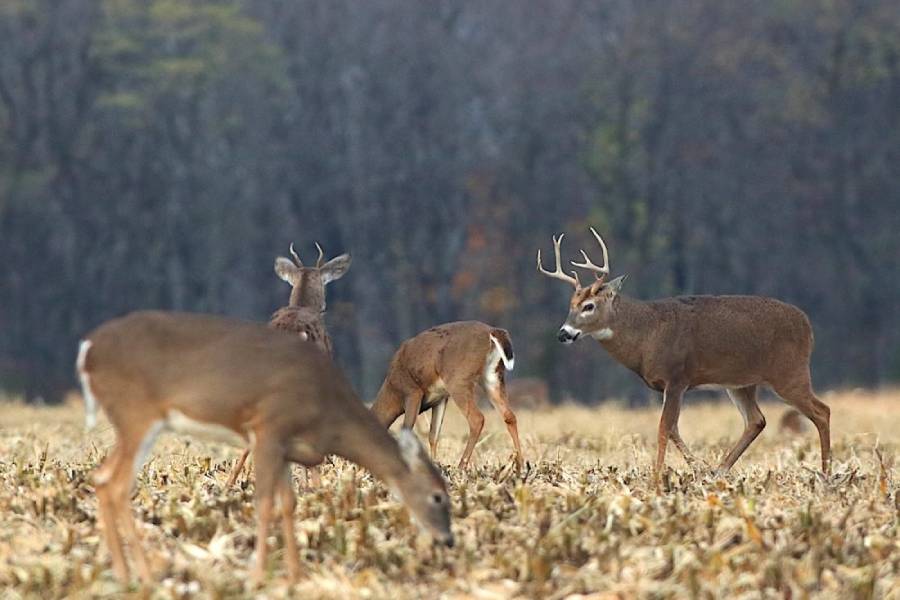
Deer do not automatically avoid cattle. Deer can remain on properties with cattle, but they may change where and when they feed, bed, and travel when cattle create enough disturbance or alter the habitat. The response depends on factors such as cattle density, grazing pressure, available forage, security cover, and how cattle are distributed across the property.
For hunters, seeing cattle in a pasture does not mean deer have abandoned the area. Deer may temporarily avoid places where cattle are concentrated while continuing to use nearby cover, feeding areas, water sources, and travel corridors. The effect can also change as cattle move between pastures. Heavy grazing can reduce forage or cover in certain locations, while controlled grazing can create vegetation conditions that deer use for feeding in suitable habitats.
The practical question is therefore not simply whether deer and cattle occupy the same property. Hunters need to determine how cattle activity changes deer movement within that property. Understanding the relationship between cattle presence, grazing pressure, habitat conditions, and current deer sign can help hunters decide whether to stay in an existing location, reposition a stand, or concentrate on areas receiving less livestock disturbance.
Do deer avoid cattle?
Deer do not consistently avoid cattle, but they can reduce their use of areas where cattle activity creates significant disturbance or changes habitat conditions. Deer and cattle can occupy the same property, pasture system, or landscape without deer abandoning it entirely. The more useful distinction for hunters is between deer leaving an area and deer shifting where they feed, bed, or travel within that area.
Cattle concentration is one factor that influences this response. A few cattle moving through a large pasture create a different level of disturbance than a herd concentrated around a feeding site, water source, gate, or small grazing area. When livestock activity becomes concentrated, deer have more reason to use adjacent locations that provide similar forage or cover with less disturbance. This means a hunter may observe fewer deer in one portion of a cattle pasture while deer remain active elsewhere on the same property.
Habitat conditions also determine whether cattle presence matters. Deer require access to food, water, travel routes, and secure cover. Cattle can alter these resources through grazing and repeated movement, but the effect is not uniform across a property. Open pasture, wooded edges, brushy cover, creek bottoms, and bedding habitat can respond differently to livestock activity. Deer therefore respond to the conditions cattle create rather than simply to the existence of cattle.
Deer that regularly encounter livestock may also tolerate cattle activity better than deer experiencing an abrupt increase in disturbance. On working ranches where livestock are a routine part of the landscape, cattle presence can become part of the normal environment. Hunters should therefore evaluate fresh deer tracks, droppings, beds, rubs, scrapes, and trail-camera activity before concluding that cattle have pushed deer away.
How close will deer stay to cattle?
There is no single distance that deer always maintain from cattle. The distance changes with cattle activity, habitat structure, available cover, forage distribution, and the individual deer’s tolerance of disturbance. A fixed rule such as assuming deer will remain several hundred yards from cattle would therefore give hunters a false level of certainty.
Physical separation can also be misleading. Deer may avoid a group of actively feeding or moving cattle while continuing to use nearby cover. A wooded edge beside a grazed pasture, for example, can provide enough separation for deer to remain in the general area even though they are not standing among the cattle. The important hunting variable is not the straight-line distance between the two species but whether deer still have suitable habitat with tolerable disturbance.
For this reason, hunters should use deer-specific evidence to determine proximity. Fresh tracks entering a pasture, recent trail-camera photographs along an edge, or active trails connecting cover with feeding areas provide stronger evidence than cattle presence alone. Current deer sign is a better indicator of whether deer are using an area than an assumed avoidance distance from cattle.
Why do deer avoid cattle in some areas?
Deer avoid cattle in some areas because concentrated livestock activity can create disturbance, change vegetation, reduce preferred forage, or alter the security of habitat deer normally use. These effects become more important as grazing pressure and cattle concentration increase. The mechanism is therefore different from cattle simply frightening every deer that encounters them.
Repeated cattle movement can physically change heavily used locations. Livestock establish trails, trample vegetation, gather around water, and repeatedly use gates, shade, mineral sites, and feeding locations. If this activity overlaps an important deer feeding or bedding area, deer can shift toward nearby habitat where the same basic resources are available with less disturbance. A hunter who focuses only on the original location may interpret that local shift as deer leaving the entire property.
Grazing also changes vegetation structure. The effect depends on grazing intensity and the plant community involved. Removing vegetation can alter both available forage and the amount of cover an area provides. This distinction matters because deer may continue traveling through a grazed location while reducing feeding or bedding activity there. Hunters should therefore identify which deer behavior has changed rather than treating every reduction in sightings as complete displacement.
Disturbance around security cover can have greater hunting consequences than cattle activity in an open field. Deer depend on suitable cover for bedding and daylight security. Cattle repeatedly entering dense cover can make that particular location less attractive even when surrounding feeding habitat remains usable. Deer can respond by bedding elsewhere and approaching feeding areas from a different direction, which can change the movement pattern observed from an existing stand.
Do cattle and deer compete for food?
Cattle and deer can compete for forage, but the amount of competition depends on the plants available and the intensity of grazing. Cattle primarily consume grasses and other herbaceous vegetation, while deer use a broader combination of browse, forbs, leaves, shoots, mast, and other seasonally available foods. Their diets therefore overlap in some habitats without being identical.
Competition becomes more relevant when cattle consume plants that deer also use or when heavy grazing reduces the overall availability of desirable vegetation. The effect can be strongest where productive feeding habitat is limited. Deer then have fewer reasons to remain in the heavily grazed location if comparable forage exists nearby. The resulting change can appear to hunters as cattle directly pushing deer away even though reduced food availability is part of the mechanism.
Food competition should therefore be evaluated together with grazing pressure rather than inferred from cattle presence alone. A lightly grazed pasture with abundant deer forage presents a different situation from a heavily grazed area where preferred plants and cover have been substantially reduced. For hunters, the relevant question is whether cattle have changed the amount, location, or accessibility of forage that deer are currently using.
Can cattle grazing improve deer habitat?
Cattle grazing can improve deer habitat when grazing intensity removes enough mature vegetation to stimulate useful plant growth without eliminating important forage and cover. The effect depends on grazing pressure, timing, soil conditions, rainfall, plant communities, and the habitat requirements of local deer. For this reason, cattle grazing should not automatically be classified as either beneficial or harmful to deer.
Moderate grazing can change vegetation structure by reducing dense grasses and opening space for other plants. This matters because deer are primarily browsers and selective feeders rather than animals that depend entirely on mature grasses. Where grazing encourages accessible forbs, shoots, and other palatable plants, the resulting vegetation can provide additional feeding opportunities. Hunters may consequently find deer using the edges of grazed areas or patches where new plant growth occurs instead of concentrating in the sections where cattle are actively feeding.
The benefit disappears when grazing pressure exceeds the habitat’s ability to recover. Heavy cattle use can remove vegetation faster than it regrows, reduce available cover, concentrate trampling around high-use locations, and decrease the amount of desirable forage remaining for wildlife. These effects are especially relevant when cattle repeatedly use a limited area instead of being distributed across a larger property. In that situation, deer may retain access to the property while shifting toward ungrazed or less heavily grazed habitat.
Hunters should therefore evaluate the condition of the vegetation rather than treating cattle numbers alone as the deciding factor. A recently grazed pasture with fresh plant growth, nearby security cover, and active deer sign can remain productive. A heavily grazed location with little remaining forage or cover provides a different hunting situation. The hunting value of cattle grazing is determined by the habitat conditions it produces, not simply by whether cattle have grazed the land.
Will deer return after cattle leave an area?
Deer can return to an area after cattle leave when suitable food, cover, water, and travel conditions remain available. Cattle leaving removes one source of active disturbance, but it does not guarantee that deer will immediately resume their previous movement patterns. The condition of the habitat after grazing is more important than the absence of cattle by itself.
The amount of disturbance helps determine how deer respond. Cattle that briefly pass through a pasture may produce relatively little lasting change, whereas a concentrated herd can alter vegetation, trails, bedding cover, and high-use water or feeding locations. Deer returning to the general area may therefore use a different route or part of the pasture instead of returning to exactly the same location they used before cattle arrived.
Remaining forage is another important factor. A grazed area that still contains desirable deer food can regain deer activity, particularly when adjacent cover provides a secure approach. In contrast, deer have less reason to return quickly to a location where intensive grazing has removed much of the useful forage. They can continue using alternative feeding areas until vegetation conditions change.
Security cover can influence the same decision. If cattle disturb a feeding location but leave nearby bedding cover intact, deer may only need to adjust the timing or direction of their movements. If cattle repeatedly disturb the cover itself, deer may establish bedding activity elsewhere. Hunters can therefore see continued deer use of the broader property even though the original stand location becomes less productive.
There is no reliable universal rule that deer return a specific number of hours or days after cattle are moved. Rainfall, vegetation recovery, cattle intensity, hunting pressure, available cover, and existing deer movement patterns differ among properties. Assigning a fixed recovery period without supporting evidence would create false precision.
Hunters should instead determine whether deer have returned by looking for fresh tracks, new droppings, recently used trails, beds, rubs, scrapes, and current trail-camera activity. Comparing this evidence before, during, and after cattle occupy a pasture provides a stronger basis for hunting decisions than waiting an arbitrary number of days. Resume hunting the location when current deer sign shows that deer are using it again, rather than assuming cattle departure automatically restores the previous pattern.
Can you hunt deer around cattle?
You can hunt deer around cattle when fresh deer sign shows that deer are still using the property. The presence of livestock alone is not a sufficient reason to abandon a stand or hunting area. The more important factors are where cattle are concentrated, how much disturbance they create, and whether deer still have access to feeding areas, security cover, water, and established travel routes.
Cattle activity is rarely distributed evenly across an entire property. Livestock can concentrate around water sources, gates, feeding locations, shade, and preferred sections of pasture while leaving adjacent cover relatively undisturbed. Deer can respond by using the lower-disturbance portions of the property rather than leaving the broader area. For a hunter, this creates a spatial problem: the original stand can become less productive while another location several habitat features away continues to receive deer traffic.
The location of security cover is especially important during daylight hunting. A pasture can contain cattle while deer remain in nearby timber, brush, creek bottoms, or other suitable cover. Deer may then enter more open feeding habitat when livestock activity decreases or when movement conditions become favorable. Hunting the transition between disturbed open ground and secure deer cover can therefore be more productive than hunting directly where cattle are concentrated.
Hunters should also separate livestock disturbance from hunting pressure. Moving cattle can alter deer activity, but repeated human access, scent, vehicle traffic, and poorly timed stand entry can create additional disturbance. If deer activity declines after cattle arrive, cattle should not automatically receive all the blame. Recent trail-camera records and deer sign can help determine whether deer changed locations, changed movement times, or stopped using the immediate area.
Should you move your stand when cattle enter the area?
Move your stand when current evidence shows that cattle activity has displaced deer movement away from your existing setup, not simply because cattle have appeared. Fresh deer tracks, droppings, trail-camera photographs, beds, rubs, and scrapes provide more useful information than the presence of livestock by itself.
Start by checking whether cattle are temporarily passing through or remaining concentrated near the stand. Short-term cattle movement does not necessarily justify relocating a productive setup. Reconsider the stand when livestock repeatedly occupy the immediate feeding area, disturb bedding cover, remove important forage, or dominate the travel corridor the stand was positioned to hunt.
A relocation does not always need to be large. Deer that avoid cattle concentration can shift toward nearby cover, habitat edges, alternative trails, or another portion of the same feeding area. Moving a stand to intercept this adjusted movement can preserve access to the same deer population without abandoning the property.
The decision should therefore follow a clear sequence: identify cattle concentration, check current deer sign, determine how deer movement has changed, and reposition only when the evidence supports the move. This approach prevents a hunter from abandoning a productive area based on an assumption that cattle automatically push deer off the property.
Do deer use cattle trails?
Deer can use trails that cattle also travel, but a well-defined cattle trail should not automatically be treated as a productive deer trail. Both animals can select convenient routes through terrain, including openings in fences, creek crossings, saddles, gentle slopes, and paths through dense vegetation. Shared terrain can therefore create overlapping travel routes even though cattle and deer use them for different reasons.
Cattle trails are often more heavily disturbed because larger animals repeatedly travel the same route. A trail dominated by cattle can contain broad areas of trampled vegetation, numerous cattle tracks, manure, and substantial soil disturbance. Deer trails are generally narrower and can connect cover, bedding habitat, feeding locations, water, and terrain features in ways that reflect deer movement rather than livestock management.
The most important evidence is the sign found on and around the trail. Fresh deer tracks, droppings, rubs, scrapes, beds, and trail-camera photographs confirm deer use more reliably than trail size or appearance. For example, a large trail leading through a fence opening may look attractive from a stand-selection perspective, but repeated cattle tracks with little deer sign indicate that its visual prominence comes primarily from livestock use.
Hunters should also examine where the trail leads. A route connecting cattle water, a gate, and an open pasture is likely to serve a different function from a route connecting thick bedding cover with a deer feeding area. When cattle and deer share part of the same path, following the route beyond the overlap can reveal where deer separate from livestock and enter more secure habitat.
Shared trails can still provide hunting opportunities when deer-specific evidence confirms consistent use. A fence crossing, terrain bottleneck, or edge between pasture and timber can naturally funnel several large mammals through the same location. In these situations, hunt the route because deer are demonstrably using it, not because cattle have created a visible trail.
Do cattle keep deer away from food plots?
Cattle can reduce deer use of a food plot when livestock remain in the plot, consume substantial forage, or create repeated disturbance, but occasional cattle activity does not automatically keep deer away. The effect depends on how many cattle use the plot, how long they remain there, how much forage they remove, and whether deer have alternative feeding areas nearby.
Cattle occasionally passing through a food plot create a different situation from a herd actively feeding in it. Brief livestock movement can disturb deer temporarily without substantially changing the food resource. Deer can continue using the plot after the cattle move elsewhere, especially when sufficient forage and nearby security cover remain available. Hunters should therefore distinguish temporary cattle presence from sustained use before deciding that a food plot has become unproductive.
Cattle feeding heavily in a food plot can have a stronger effect because disturbance and forage removal occur at the same location. Deer then face two changes: livestock occupy the feeding area, and less desirable vegetation remains available after they leave. Repeated trampling can further alter the plot. When these effects become substantial, deer have a stronger reason to shift toward another food source rather than continue using the plot at the same frequency.
Cattle remaining in or around a food plot for extended periods can also change when deer visit it. Deer that continue using the surrounding property may approach after livestock move away or use another portion of the feeding area. This can make a stand overlooking the center of the plot less productive even though deer have not abandoned nearby habitat. Fresh tracks along plot edges and trail-camera records can reveal these changes better than observations of cattle alone.
For hunters managing private land, limiting livestock access can be useful when the primary purpose of the plot is to provide deer forage. The decision becomes more important when cattle repeatedly consume the plants established specifically for deer or prevent the plot from maintaining adequate vegetation. Protecting the food resource matters more than simply keeping deer and cattle physically separated.
Read more: Do Deer Move Differently on Public Land?
Do cattle affect deer bedding areas?
Cattle can affect deer bedding areas when repeated livestock activity reduces security, damages cover, or creates enough disturbance for deer to select another bedding location. Bedding habitat differs from an open feeding area because deer use it for concealment and daytime security. Disturbance in this habitat can therefore influence where hunters encounter deer during legal hunting hours.
The amount of cattle activity is critical. Livestock briefly crossing bedding cover does not prove that deer will abandon it. Repeated cattle movement through dense vegetation, however, can create trails, trample understory plants, and increase activity inside an area deer previously used for security. Deer can respond by bedding deeper in adjacent cover or selecting another location that provides comparable protection.
Changes to vegetation can produce a longer-lasting effect than the immediate presence of cattle. Bedding habitat requires suitable structure, and intensive livestock use can reduce vegetation that provides concealment. If the physical cover deteriorates, removing the cattle does not immediately restore the original bedding conditions. Deer can continue using alternative cover until vegetation recovers or another suitable bedding location becomes preferable.
This shift matters because bedding location helps shape daylight deer movement. A stand positioned between a known bedding area and feeding location depends on deer continuing to use that relationship. When cattle disturbance causes bedding activity to shift, the associated travel route can shift as well. A hunter may consequently stop seeing deer from the stand even though the same deer continue using the property.
Fresh beds, tracks entering or leaving cover, droppings, nearby rubs, and trail-camera observations can help determine whether a bedding area remains active. Hunters should avoid entering suspected bedding cover repeatedly simply to check for deer, because additional human disturbance can make the original cattle-related change harder to interpret. When cattle alter a bedding area, identify the new deer movement pattern from its edges before deciding where to reposition.
Where should you hunt when cattle are on the property?
Hunt the parts of the property that combine fresh deer sign, suitable cover, available food, and lower cattle disturbance. Cattle on a property do not make the entire area unproductive. Their distribution can instead help hunters identify which locations are receiving heavy livestock pressure and which locations still provide the conditions deer need for feeding, bedding, and traveling.
Start with the edges between cattle-used ground and less-disturbed deer habitat. Timber edges, brush lines, creek bottoms, fence lines, and transitions between heavily grazed and lightly grazed vegetation can separate livestock activity from deer security cover. These transitions are useful because deer can remain close to feeding habitat without spending extended periods among concentrated cattle. A hunter who identifies where deer enter or leave these edges can intercept movement without setting up directly in the most disturbed portion of the pasture.
Remaining cover should receive particular attention. Cattle grazing can create noticeable differences in vegetation across the same property, especially when livestock concentrate in specific pastures or around water and shade. Deer still need concealment and secure bedding locations regardless of cattle presence. Patches of thicker vegetation adjacent to cattle-used areas can therefore become important, particularly when fresh deer sign confirms continued use.
Food availability provides another way to narrow the hunting area. Determine what deer are currently eating and whether cattle have affected that resource. A heavily grazed section with little desirable deer forage offers less reason for deer to spend time there. An adjacent location containing browse, forbs, mast, crops, or other seasonal foods can become more relevant. The objective is not simply to hunt away from cattle but to locate the resources deer continue to use after cattle activity changes the landscape.
Water requires similar evaluation. Cattle often concentrate around stock ponds, tanks, streams, and other dependable water sources, creating substantial disturbance immediately around them. Deer may still need the same general water resource while approaching it differently or using it during periods of reduced cattle activity. Search the surrounding cover for deer-specific approach trails instead of assuming the most heavily worn path to the water is also the best deer trail.
Cattle distribution can change over time, so a productive hunting location should not be treated as permanent. Moving a herd from one pasture to another can reduce disturbance in one area while increasing it elsewhere. Deer movement can respond to those changes. Trail cameras and observations from low-impact access points can help hunters determine whether an established pattern remains active after livestock are relocated.
What deer signs should you look for around cattle?
Look for fresh deer tracks, droppings, beds, rubs, scrapes, and recent trail-camera activity before choosing where to hunt around cattle. These signs provide direct evidence that deer are using a location and help separate deer movement from the extensive trails and ground disturbance livestock can create.
Fresh tracks are particularly useful around trail intersections, fence crossings, muddy creek edges, and transitions between pasture and cover. Tracks show that deer have physically used the location, while their direction can help identify movement between bedding and feeding habitat. Multiple sets of recent deer tracks provide stronger evidence than a large trail containing primarily cattle hoofprints.
Droppings and beds help identify areas where deer spend more than a few seconds passing through. Beds inside suitable cover indicate that deer are using the surrounding habitat for security, while concentrations of droppings can support evidence of repeated use. Rubs and scrapes add seasonal information, particularly when evaluating whitetail movement during the rut. None of these signs should be interpreted alone when fresher evidence points toward a different current pattern.
Trail cameras can provide the clearest information about timing. A location may contain deer tracks but receive most deer activity outside legal shooting hours. Recent camera records can reveal whether deer are using a cattle-affected area during daylight, after cattle leave, or primarily at night. Hunters can then compare locations based on both deer presence and usable hunting opportunities.
The strongest setup combines several forms of evidence. For example, a timber edge with fresh tracks, recent droppings, an active trail leading toward food, and repeated daylight trail-camera photographs provides a stronger hunting case than an open pasture selected merely because deer were seen there before cattle arrived.
Current deer sign should ultimately determine whether you stay or relocate. Keep hunting an area when deer continue using it consistently despite cattle activity. Reposition when fresh evidence shows that deer have shifted toward another feeding area, travel corridor, or section of security cover. Cattle presence is one variable in that decision; the location of the deer is the variable that matters most.