
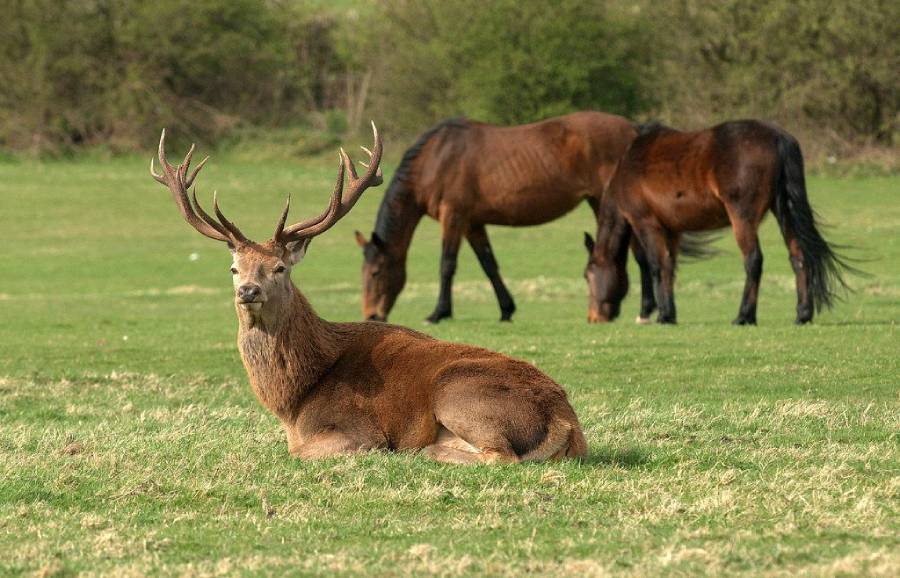
Deer do not automatically avoid horses. A deer’s response to a horse depends on whether it perceives the horse and the associated human activity as a threat. Deer that regularly encounter horses in pastures, ranches, or other areas with non-threatening horse traffic may tolerate their presence, while an unfamiliar horse or sudden close encounter can make a deer alert or cause it to move away.
For deer hunters, the horse itself is only one part of the situation. Horse scent, movement, noise, the presence of a rider, human scent, hunting pressure, and the deer’s previous exposure to horses can all influence its response. This means seeing deer remain near horses does not prove that horses are invisible or harmless to them, just as seeing a deer flee from one encounter does not prove that deer universally fear horses.
Understanding these differences matters when horses share the same land as deer or when hunters use horses to access hunting areas. This article explains when deer avoid horses, why some deer ignore them, whether horse scent causes alarm, how deer respond to riders, and how horse activity can affect deer movement and hunting strategy.
Do Deer Avoid Horses?
Deer do not consistently avoid horses simply because horses are present. Their response depends on whether the encounter signals danger. A deer may continue feeding near a familiar horse, stop and watch an approaching horse, move to cover, or flee when the horse gets too close. These responses represent different levels of threat assessment rather than a universal avoidance of horses.
Previous exposure is one of the main factors that determines the response. Deer living around farms, ranches, pastures, or properties where horses regularly travel can repeatedly encounter horses without being chased or harmed. When those encounters remain non-threatening, the presence of a horse becomes less useful as a warning signal. An unfamiliar horse entering an area with little regular horse activity creates a different situation because the deer has less experience indicating that the animal can be ignored.
The circumstances of the encounter also matter. Distance, movement, noise, human presence, wind direction, and hunting pressure can change how a deer responds to the same horse. A horse walking predictably along an established trail presents a different combination of signals from a horse and rider moving directly toward a deer’s bedding cover. For hunters, this distinction is important because a deer reacting to horseback activity may be responding to the entire disturbance rather than to the horse alone.
Avoidance also does not necessarily mean that deer permanently leave an area. A deer that moves away after detecting a horse may return after the disturbance ends. Hunters should therefore distinguish an immediate flight response from a longer-term change in habitat use. Horse activity becomes more relevant to hunting when encounters are frequent, occur close to important bedding or feeding locations, or become associated with human hunting pressure.
Are Deer Afraid of Horses?
Deer can become alarmed by horses, but horses do not automatically trigger the same response in every deer. Deer assess multiple signals during an encounter, including the horse’s proximity, direction of travel, speed, sound, scent, and any accompanying human activity. A horse that remains at a predictable distance can therefore produce a different response from one that suddenly approaches a deer.
An alarmed deer may stop feeding, raise its head, orient toward the disturbance, watch it closely, reposition itself, or leave the area. Fleeing represents a stronger response, but a deer does not need to run for the encounter to affect its behavior. A deer that stops feeding and focuses on a horse has already shifted attention toward evaluating a potential threat.
There is also no single distance at which all deer will flee from a horse. Assigning one universal number would ignore differences in habitat, visibility, previous exposure, individual behavior, and hunting pressure. A deer accustomed to seeing horses at a distance in an open pasture can tolerate circumstances that produce a stronger response from a deer encountering an unfamiliar horse in secluded cover.
Hunters should consequently evaluate the deer’s behavior rather than assume that the presence of a horse has either no effect or always causes deer to flee. The useful question is not only whether deer are afraid of horses, but what signals cause local deer to associate a particular horseback encounter with danger. That distinction becomes especially important in areas where deer encounter horses regularly.
Why Do Some Deer Ignore Horses?
Some deer ignore horses because repeated, non-threatening exposure can reduce their response to them. This process is known as habituation. When deer repeatedly see, hear, or smell horses without being chased or otherwise threatened, reacting strongly to every encounter provides little benefit. This helps explain why deer on farms, ranches, pastures, and properties with regular horse activity may continue feeding while horses remain nearby.
Habituation depends on the deer’s previous experience rather than simply the presence of livestock. A horse that follows a predictable routine through a pasture can become part of the deer’s normal environment. Deer may still detect the horse, but detection does not automatically lead to avoidance. The important distinction is between recognizing a stimulus and interpreting that stimulus as an immediate threat.
Deer may show similar tolerance around other livestock, including cattle, when those animals are consistently present without creating danger. However, tolerance toward livestock does not mean deer ignore every disturbance occurring around them. A change in movement, unusual noise, a close approach, or the appearance of a person can introduce new signals that cause the deer to become alert.
This distinction matters on hunting properties where horses are part of normal land use. A deer accustomed to horses may tolerate routine horse activity but react differently when that activity becomes associated with hunters. Habituation is context-specific, so familiarity with horses should not be treated as familiarity with every person or activity involving a horse.
Does Horse Scent Scare Deer Away?
Horse scent alone does not necessarily scare deer away. Deer can detect odors in their surroundings, but detecting an unfamiliar or animal odor and interpreting it as immediate danger are different processes. In areas where horses regularly occupy pastures or travel established routes, their scent can occur without a threatening event following it.
The context surrounding the scent is therefore more useful to hunters than the presence of horse odor by itself. Fresh horse scent along a frequently used ranch trail presents a familiar environmental cue for deer that routinely encounter horses there. The same deer may react more cautiously when that odor appears alongside unusual movement, noise, or human activity in an area where those disturbances are uncommon.
This also means hunters should not assume horse odor functions as a reliable cover scent. Adding horse scent does not remove the hunter’s human scent. A deer can encounter multiple odors from the same location, so introducing a familiar animal odor does not establish that human odor has been eliminated or made undetectable.
Does Human Scent on a Horse Make Deer More Alert?
Human scent associated with a horse can make the encounter more relevant to a deer than horse scent alone, particularly where deer associate people with hunting pressure. A ridden horse introduces more than one stimulus: the horse, rider, clothing, tack, movement, noise, and odors associated with human activity all occur together.
Wind direction becomes especially important in this situation. A hunter approaching on horseback may still place human odor downwind of the travel route. The presence of the horse does not change the basic problem that deer can receive scent information from the approaching hunter. Hunters should therefore manage wind and access routes rather than depend on the horse to conceal their presence.
Repeated experience can further strengthen the distinction. Deer living around people riding recreationally may encounter horse-and-rider combinations without negative consequences, while deer in a hunting area may experience similar activity alongside hunting pressure. The deer’s learned association with the complete encounter is more important than horse scent considered in isolation.
Do Deer React Differently to a Horse With a Rider?
Deer can react differently to a horse carrying a rider because the encounter includes human scent, movement, sound, and a different visual profile. A deer that tolerates horses in a pasture does not necessarily respond the same way when a person approaches on horseback. The deer evaluates the combined disturbance rather than responding only to the horse.
A rider changes several parts of the encounter at once. Human odor is added to horse odor, tack can create additional sounds, and the horse may move differently under the rider’s direction. The route also matters. A horse following a familiar trail at a steady pace creates a more predictable disturbance than a horse and rider leaving the trail and moving directly toward cover where deer are holding.
Deer do not need to identify a rider in the human sense for the rider to influence their behavior. They only need to detect that the approaching combination differs from the horses they normally encounter. Visual shape, direction of movement, sound, scent, and previous encounters can provide information that affects whether the deer continues its current activity, becomes alert, or leaves.
Dismounting can change the situation again because the horse and person become two separate sources of movement and scent. A deer that tolerated the combined horse-and-rider profile may react differently after detecting a person moving independently. For hunters, this means horseback access should not be treated as a method for making human presence undetectable. Wind direction, dismount location, noise, and the hunter’s final approach remain important.
Does Hunting Pressure Make Deer More Likely to Avoid Horses?
Hunting pressure can make deer more likely to react to horses when horseback activity becomes associated with hunters or other threatening disturbances. The important factor is the association between the stimulus and its consequence. Regular horse traffic that repeatedly ends without danger provides different information from horseback traffic that repeatedly precedes human pursuit or hunting activity.
For example, deer on a ranch may regularly see people riding horses while checking fences, moving livestock, or traveling established routes. When those encounters remain predictable and non-threatening, deer have less reason to abandon an area every time a horse appears. In a hunting context, repeated horseback approaches followed by hunters entering cover can create a different pattern of disturbance.
The location of that pressure also matters. Disturbance near bedding cover can have different consequences from routine horse traffic through an open pasture or established trail. Entering security cover introduces human scent, sound, and movement into an area deer use for refuge. Repeating that pattern gives deer more opportunities to associate a particular access route or activity with danger.
Hunters should therefore avoid treating deer responses to horses as fixed behavior. A horse tolerated on one property may cause a stronger response on another because the local deer population has experienced a different pattern of human activity. Even within the same property, deer may tolerate horses along familiar routes while becoming more cautious when horseback activity appears in locations where it normally does not occur.
This relationship also explains why local observation is more useful than assuming all deer respond identically to horseback hunting activity. Hunters can watch whether deer continue normal feeding or travel behavior around routine horse traffic, become alert when riders appear, or alter their movement after repeated disturbance. These observations help separate ordinary horse presence from horse activity that has become part of the area’s hunting pressure.
Do Horses Change Deer Movement in Hunting Areas?
Horses can temporarily change deer movement when their presence creates enough disturbance to make deer reposition or leave the immediate area. This does not mean a horse automatically pushes deer out of a hunting property. The effect depends on where the horse travels, how frequently horses use the area, whether deer are accustomed to them, and whether horse activity is associated with people or hunting pressure.
A single encounter and repeated disturbance should be treated differently. A deer that moves into cover after a horse passes may resume its previous movement after the disturbance ends. Repeated horse and human activity through the same bedding area, feeding location, or travel corridor creates a different situation because deer encounter the disturbance repeatedly. In that case, deer may adjust when or how they use that location rather than simply reacting to one passing horse.
Bedding areas deserve particular attention because hunters entering these locations can introduce more than horse disturbance. Horse movement, tack noise, ground disturbance, and human odor can occur together. A hunter who repeatedly rides close to bedding cover can therefore create a pattern that is different from routine horse traffic along a distant ranch road. The relevant hunting question is not simply whether a horse entered the property, but where the disturbance occurred relative to the places deer use.
Feeding areas can produce another response. Deer accustomed to horses sharing open agricultural or pasture environments may tolerate horses at distances that would not be expected during a sudden encounter in dense cover. Familiarity, visibility, and predictable movement give the deer more information with which to assess the encounter. A horse moving directly toward feeding deer can still cause them to leave even when horses are common on the property.
Do Deer Avoid Horse Trails?
Deer do not necessarily avoid horse trails simply because horses use them. A trail is more likely to influence deer behavior when it also carries frequent human disturbance or creates repeated encounters that deer associate with danger.
This distinction makes trail location important. An established horse trail that has been used routinely without hunting activity can become a predictable feature of the environment. A trail repeatedly used by hunters to enter the same hunting location creates a different pattern because deer can encounter human scent and disturbance along the route.
Hunters should consequently evaluate horse trails according to traffic frequency, timing, human activity, proximity to deer cover, and local hunting pressure. Finding horse tracks on a trail alone does not establish that deer have stopped using the surrounding area. Deer sign, trail-camera observations, and changes in local movement provide more useful evidence of how deer actually respond on a specific property.
Can Hunters Use Horses Without Spooking Deer?
Hunters can use horses for access without automatically spooking every deer in the area, but horseback travel does not eliminate the need for a low-disturbance approach. Horses can help hunters cover long distances or reach locations where horseback travel is already part of the normal environment. The advantage disappears when the approach introduces avoidable human scent, noise, or movement close to deer.
Route selection is one of the most important considerations. A predictable access route that avoids bedding cover can create less intrusive hunting pressure than riding directly through locations where deer are likely to be holding. Hunters should also consider wind direction before choosing the route because approaching on horseback does not prevent human odor from traveling downwind.
Dismount location should follow the same principle. There is no universal distance from a hunting spot at which every hunter should leave a horse. Terrain, vegetation, wind, visibility, the horse’s behavior, and proximity to bedding or feeding areas change the appropriate location. A quiet horse left behind terrain or cover presents a different disturbance from a restless horse positioned close to an active deer travel corridor.
Timing matters as well. Riding through a feeding area immediately before deer are expected to arrive can create unnecessary disturbance, while using an established access route farther from the target area can reduce direct interaction. The objective is not to make the horse invisible to deer. It is to prevent the access strategy from producing a level or pattern of disturbance that deer associate with immediate danger.
Can a Horse Help Hide Human Scent From Deer?
A horse should not be relied on to hide human scent from deer. Horse odor may add another scent to the environment, but adding an odor is different from removing, containing, or reliably masking the odor produced by the hunter.
This distinction is particularly important when planning a downwind approach. A hunter riding a horse can still produce a scent stream containing odors from the person, clothing, equipment, tack, and horse. Assuming that deer will detect only the horse can lead a hunter to ignore wind direction, which remains a fundamental variable in scent-based detection.
A better strategy is to treat the horse as an access tool rather than a scent-control tool. Hunters can select routes based on wind, avoid unnecessary travel through bedding cover, minimize disturbance near the hunting location, and dismount where the final approach can be completed without pushing scent toward likely deer positions. This approach does not depend on the assumption that horse scent will conceal the hunter.
Read more: Do Deer Avoid Cattle? What Hunters Should Know
When Are Deer Most Likely to Avoid Horses?
Deer are most likely to avoid horses when the encounter is unfamiliar, sudden, close, or associated with human pressure. The horse itself is only one part of the threat assessment. Distance, movement, noise, location, previous exposure, and the presence of a rider can combine to determine whether a deer ignores the encounter, becomes alert, moves away, or flees.
Unfamiliarity increases the importance of the encounter. Deer living on properties where horses regularly move through pastures and established trails have opportunities to experience those animals without negative consequences. Deer with little previous exposure to horses do not have the same history of non-threatening encounters. An unfamiliar large animal entering their immediate surroundings can therefore produce greater caution, particularly when it approaches directly.
Sudden and close encounters also create stronger disturbance than predictable movement at a distance. A horse appearing abruptly near bedding cover gives a deer less time and space to assess what is approaching. In contrast, a deer watching a horse travel along a familiar route across an open area can monitor its direction without immediately leaving. Predictability and distance help determine whether the horse becomes an immediate disturbance rather than merely another detected animal.
Human activity can increase the likelihood of avoidance further. A horse carrying a rider introduces human odor, additional movement, equipment noise, and a different visual profile. These signals become particularly relevant where deer experience regular hunting pressure. If horseback traffic repeatedly precedes hunters entering cover or pursuing deer, the complete horse-and-human encounter can become associated with danger.
The location of the encounter matters for the same reason. Horse activity along a routine ranch road is different from repeated movement through bedding cover, secluded travel corridors, or feeding areas immediately before deer normally use them. Hunters should pay particular attention when horseback access overlaps with areas where deer expect security.
There are therefore 5 main conditions that can increase deer avoidance of horses: unfamiliar horses, sudden encounters, close approaches, associated human activity, and repeated hunting pressure. None of these factors guarantees that a deer will flee, but together they explain why the same deer can tolerate routine horse activity in one situation and avoid it in another.
Should You Worry About Horses When Deer Hunting?
Hunters do not need to assume that horses will automatically ruin a deer hunting area. Horses are more likely to become a problem when their presence creates unfamiliar or repeated disturbance that deer associate with danger. Where horses are already part of the normal environment, local deer may tolerate routine horseback activity without abandoning the property.
The first factor to evaluate is how accustomed local deer are to horses. Farms, ranches, and hunting properties with regular horseback activity provide a different behavioral context from remote areas where deer rarely encounter domestic horses. Observing how deer respond to existing horse traffic provides more useful information than applying a universal assumption that deer either fear or ignore horses.
The second factor is the relationship between horses and people. Deer may tolerate a horse in a pasture yet become alert when a rider approaches, especially where riders are associated with hunting activity. Human scent, noise, unusual routes, and movement into security cover can turn an otherwise familiar stimulus into a more significant disturbance.
The third factor is hunting pressure. Repeatedly using the same horse route to approach a stand, blind, bedding area, or travel corridor can create a predictable pattern of human activity. Hunters should vary or manage access where appropriate, avoid unnecessary penetration into bedding cover, and use wind direction to keep human scent away from likely deer locations.
Horseback access is therefore best viewed as a hunting tool rather than a way to become invisible to deer. A horse can provide transportation without automatically spooking deer, but it does not eliminate human scent, erase hunting pressure, or guarantee that deer will tolerate a close approach. The most effective strategy is to account for local deer behavior, existing horse activity, wind direction, access routes, and the location of important deer habitat before deciding how to use horses on a hunt.