
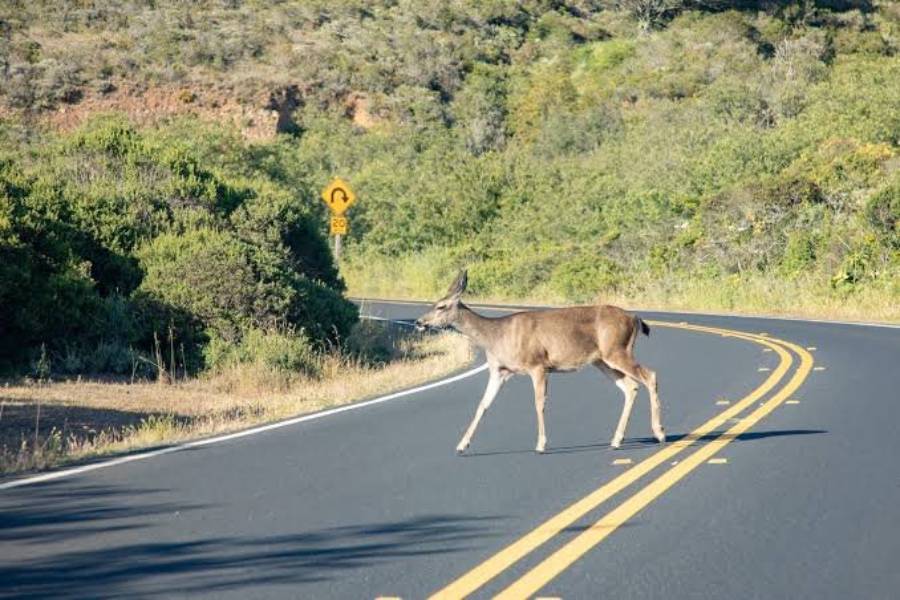
Yes, deer often cross roads at the same places because established trails and travel corridors repeatedly guide them toward suitable crossing points. Deer commonly travel between bedding areas, feeding areas, water sources, and secure cover using familiar routes. When a road intersects one of these routes, the same section of road can become a regular crossing point.
A repeated crossing does not mean the same deer will appear at the exact location at the same time every day. Crossing patterns change with food availability, seasonal habitat use, the rut, human activity, and hunting pressure. Bucks and does can also use the same travel corridor differently, especially during the breeding season. For hunters, the location of a crossing is therefore more predictable than the exact timing of deer movement.
An active road crossing can still provide valuable information about how deer move through an area. Fresh tracks, established trails, droppings, nearby cover, and repeated trail-camera observations can reveal whether deer regularly use a crossing and which direction they travel. Understanding these signs helps hunters trace a road crossing back to the larger travel corridor connecting bedding, feeding, and security cover.
Do Deer Cross Roads at the Same Place?
Deer often cross roads at the same locations because they repeatedly use established trails and travel corridors. A road does not usually determine where a deer travels. Instead, the road cuts across a route the deer already uses to move between bedding areas, feeding areas, water sources, and secure cover. When that travel route meets a road at a convenient point, repeated deer movement can create a recognizable crossing.
Deer are creatures of habitual movement, but a road crossing should be viewed as a recurring location rather than a fixed schedule. A trail that reaches the road through thick cover, follows favorable terrain, or provides an efficient route between two habitat areas can continue directing deer toward the same crossing. Multiple deer can also use the same trail, so tracks appearing repeatedly at one location do not necessarily belong to the same animal.
Using the same crossing location does not mean deer cross there at the same time every day. The location of an established travel corridor can remain relatively consistent while the timing and frequency of deer movement change. A deer might cross before daylight on one day, after dark on another, or avoid the crossing temporarily when human activity increases. For hunters, this distinction is important because finding a frequently used crossing confirms a movement route more reliably than it predicts the exact time a deer will appear.
The same principle applies to individual deer. A buck observed crossing a road once is not enough evidence to conclude that the buck follows that route consistently. Repeated tracks, fresh sign, a defined trail, or multiple trail-camera observations provide stronger evidence that the crossing belongs to an established movement pattern. Hunters should therefore evaluate the entire trail and surrounding habitat rather than treating a single road sighting as proof of predictable behavior.
Why Do Deer Keep Crossing Roads at the Same Places?
Deer keep crossing roads at the same places because specific locations provide efficient connections along established travel routes. Bedding areas, feeding areas, water, terrain, cover, and existing trails influence these routes. When these habitat features remain relatively stable, deer have a reason to continue traveling through the same section of the landscape and consequently crossing the road at similar points.
Bedding and feeding locations are particularly important because deer routinely move between places that provide security and places that provide food. For example, a deer bedding in dense woodland may use an established trail toward an agricultural field during a feeding movement. If a road separates the woodland from the feeding area, the point where that trail intersects the road can receive repeated use. The crossing is therefore a visible part of a larger bedding-to-feeding travel route, not an isolated feature.
Terrain can concentrate this movement even further. Features such as draws, saddles, creek bottoms, fence gaps, narrow strips of timber, and changes in topography can funnel deer through a limited area. A road intersecting one of these natural travel funnels has a stronger reason to develop a repeated crossing than a random section of road with no established trail or terrain feature directing deer toward it.
Cover also affects where deer approach and leave a road. Deer moving through concealed vegetation can remain protected until they reach the roadside, while open terrain may expose them for a greater distance. A crossing with usable cover on both sides can therefore fit an established travel corridor better than a nearby location surrounded by exposed ground. For a hunter, examining what lies beyond both sides of the road provides more information than examining the pavement alone.
Established trails combine these habitat factors into visible movement patterns. A heavily defined trail leading directly to a road suggests repeated traffic, particularly when it continues on the opposite side. The most informative crossing is therefore one that can be connected to the surrounding landscape: where the trail begins, where it leads, what habitat it connects, and why deer would repeatedly use that route.
How Predictable Is a Deer Road Crossing?
A deer road crossing can be predictable as a location without being predictable at an exact time. An established trail may direct deer through the same section of road repeatedly, but the frequency and timing of those crossings can change. Hunters should therefore separate location predictability from timing predictability when evaluating a crossing.
Location predictability is strongest when the crossing is part of a clearly established travel corridor. A defined trail that approaches the road, crosses it, and continues into suitable habitat on the opposite side provides stronger evidence than scattered tracks along a roadside. The surrounding landscape should also explain the movement. For example, a crossing that connects secure bedding cover with a feeding area has a clear function within a deer’s travel pattern.
Timing is less consistent because deer movement responds to changing conditions. Food availability, hunting pressure, human activity, seasonal habitat use, and breeding behavior can affect when deer travel. A crossing used regularly after dark may receive daylight movement under different conditions, while a crossing with frequent activity during one part of the season can become less active later. This means hunters should not assume that seeing a deer at a crossing at 7:00 p.m. once establishes a daily 7:00 p.m. pattern.
Repeated observations provide better evidence of predictability than a single encounter. Tracks and other fresh sign can confirm continued use, while trail-camera records can show frequency, direction of travel, and time of movement across multiple days. The strongest pattern exists when physical sign and repeated observations point to the same conclusion.
For hunting purposes, a road crossing is therefore best treated as evidence of a travel route. Once hunters establish that deer repeatedly use the location, the next question is not simply when deer will cross the road again. The more useful question is where the trail leads and what bedding, feeding, cover, or terrain feature is causing deer to travel through that location.
What Signs Show That Deer Regularly Cross a Road?
The strongest signs of a regularly used deer road crossing are a defined trail, repeated fresh tracks, droppings, vegetation disturbance, and consistent trail-camera activity. One track or one deer sighting confirms that a deer crossed the road, but it does not establish that the location is a habitual crossing. Multiple forms of recent evidence provide a stronger indication of repeated use.
A defined trail is one of the clearest starting points. Regular deer movement can create a visible path through grass, leaves, or low vegetation leading toward the road. Hunters should examine both sides because a trail that approaches the road and continues through suitable cover on the opposite side provides stronger evidence of a travel corridor than a trail that disappears at the roadside.
Fresh tracks add information about recent activity. Hunters should look for multiple sets of tracks rather than relying on a single print. Tracks occurring at different levels of freshness can indicate that deer have passed through the location repeatedly. Their orientation can also reveal the general direction of travel, which becomes more useful when compared with nearby bedding cover, feeding areas, or other habitat features.
Droppings and disturbed vegetation can strengthen the evidence, but each sign needs context. A few droppings show that deer were present; they do not independently establish a recurring road-crossing pattern. Likewise, disturbed vegetation becomes more meaningful when it follows a defined trail and appears alongside repeated tracks. The objective is to identify several pieces of evidence that support the same movement route rather than treating every deer sign as equal.
Trail cameras provide another way to test whether the crossing remains active. Repeated images from different dates can establish how frequently deer use the route, which direction they travel, whether bucks and does share the crossing, and whether activity occurs during daylight or primarily after dark. A camera can also reveal an important distinction that tracks alone cannot: several deer may be producing the sign at the crossing rather than one individual repeatedly using it.
Hunters should combine these observations before classifying a crossing as regular. A defined trail plus fresh sign plus repeated observations provides substantially stronger evidence of an active travel corridor than any single sign by itself. This approach prevents a one-time crossing from being mistaken for a dependable deer movement pattern.
What Causes Deer to Stop Using the Same Road Crossing?
Deer can stop using the same road crossing when hunting pressure, human activity, seasonal food changes, cover changes, or breeding behavior alters their normal travel route. An established crossing remains useful only while the conditions that created the route continue to favor deer movement through that location. A crossing that receives consistent traffic early in the season can therefore become less active or shift to another nearby trail later.
Hunting pressure is one of the most relevant changes for hunters. Repeated human presence near a trail can increase disturbance around a crossing and change how deer use the surrounding area. Scouting, frequent access, vehicles, and hunting activity can all add pressure. Deer do not necessarily abandon the entire travel corridor; they can change their timing, use thicker cover, or shift to a parallel trail that allows them to move through the same general area with less exposure.
Changes in food and cover can also redirect movement. A crossing may receive regular traffic while it provides an efficient route between bedding cover and a preferred food source. When that food source becomes less attractive or disappears, the reason for using the route weakens. Seasonal changes in crops, natural forage, mast, vegetation, and security cover can consequently make one crossing more active while another becomes less important.
Habitat changes can produce a similar effect. Logging, vegetation growth, flooding, construction, agricultural activity, or changes in available cover can alter the easiest or safest path through an area. Because a road crossing is only one point within a larger travel system, changes occurring hundreds of yards away can influence whether deer continue reaching the road at the same location.
Does the Rut Change Where Bucks Cross Roads?
The rut can change where bucks cross roads because breeding activity causes bucks to expand or alter their normal movement while searching for does. A buck that follows a relatively consistent bedding-to-feeding pattern before the rut may travel through additional areas once breeding behavior becomes a stronger influence on movement.
Doe travel patterns become particularly relevant during this period. A road crossing regularly used by does can also become useful evidence for hunters looking for buck movement because bucks may travel through areas where does concentrate. This does not mean every doe crossing automatically becomes a reliable buck crossing. It means the function of the travel corridor can change as breeding activity influences where and why bucks move.
The rut can also reduce the value of patterns established from a small number of earlier observations. A buck recorded repeatedly on one trail before breeding activity intensifies may expand its range and appear at crossings where it was previously absent. Hunters should therefore compare current sign and trail-camera observations with older patterns instead of assuming that a pre-rut crossing will maintain the same level of buck activity throughout the season.
Do Bucks and Does Use the Same Road Crossings?
Bucks and does can use the same road crossings when those crossings are part of travel corridors that serve both sexes, but they do not necessarily use them with the same frequency, purpose, or timing. A terrain funnel, established trail, or narrow strip of secure cover can direct multiple deer through the same location regardless of sex.
Shared crossings are especially logical when the surrounding landscape limits practical travel options. For example, a trail passing through a fence gap or narrow section of cover can concentrate movement from several deer. Tracks at such a crossing may therefore represent does, bucks, and younger deer rather than one animal following the route repeatedly. This is another reason hunters should avoid identifying an individual deer from crossing frequency alone.
Differences become more important when considering why the deer are traveling. Does can maintain movement associated with bedding, feeding, and security cover, while an individual buck may use a different route or move at different times. Seasonal behavior can widen this difference. A crossing that shows little buck activity during one period can receive additional buck traffic when breeding behavior changes movement patterns.
Trail-camera observations can help distinguish these patterns. Repeated images can show whether bucks and does use the crossing, which direction each deer travels, and whether their activity occurs during similar periods. This information turns a general deer crossing into a more specific picture of how different deer use the travel corridor.
For hunters, a doe crossing should not automatically be classified as either a buck crossing or a poor place to investigate for bucks. Its value depends on the surrounding travel system and current deer behavior. During the rut in particular, understanding where does regularly travel can provide useful context for interpreting changing buck movement.
How Can Hunters Identify an Active Deer Road Crossing?
Hunters can identify an active deer road crossing by confirming repeated fresh sign, a defined trail, consistent travel direction, and a clear connection to useful habitat. The goal is not simply to prove that a deer crossed the road. Hunters need to determine whether the crossing is part of an established travel corridor that deer continue to use.
Start with the trail itself. An active crossing often has a visible path approaching the road and continuing into cover on the opposite side. Repeated hoof traffic can flatten vegetation, disturb leaves, expose soil, or create a narrow path through grass. A trail becomes more significant when it continues away from the road rather than ending near the shoulder. This indicates that the crossing belongs to a larger movement route.
Freshness separates current movement from historical sign. Tracks with defined edges, recently disturbed leaves, fresh droppings, and new vegetation disturbance provide stronger evidence of recent use than faded tracks or an old trail with little current sign. Hunters should look for repeated evidence rather than one fresh track. Several sets of tracks combined with an established trail indicate recurring movement more strongly than a single deer print.
Travel direction provides the next piece of information. Hunters should examine where the trail goes on both sides of the road and compare it with surrounding bedding areas, feeding areas, thick cover, water sources, and terrain features. For example, a trail connecting dense daytime cover with an agricultural feeding area has an identifiable function. Knowing that function helps explain why deer use the crossing and whether the route is likely to remain relevant.
Trail cameras can confirm patterns that physical sign cannot fully reveal. Repeated observations can show which deer use the crossing, how frequently they appear, which direction they travel, and whether movement occurs during daylight or after dark. Several observations across different days provide stronger evidence than one photograph. Camera information is most valuable when it supports what tracks, trails, and habitat already indicate.
An active crossing should therefore be evaluated as part of the surrounding landscape. The strongest crossing is not necessarily the one with the most visible tracks at the road; it is the one where fresh sign, repeated use, and habitat structure consistently explain the same deer movement pattern. This distinction helps hunters separate an established travel corridor from a location deer use only occasionally.
Should Hunters Hunt Directly at a Deer Road Crossing?
Hunters should not automatically hunt directly at a deer road crossing just because deer use it regularly. A road crossing is primarily evidence of a travel route. The more valuable hunting information often lies farther along that route, where terrain, cover, bedding areas, feeding areas, and other habitat features concentrate deer movement.
A crossing can reveal where a travel corridor intersects a road, but the road itself may not provide the conditions needed for a productive hunting location. Human activity, vehicle traffic, limited cover, access problems, and legal or safety restrictions can reduce its usefulness. Hunters should first determine why deer are crossing there and then evaluate the surrounding trail within areas where hunting is lawful and safe.
Wind and access also matter when interpreting the route. A location with regular deer movement can lose hunting value when approaching it repeatedly disturbs the same cover deer use for security. Likewise, a position that places hunter scent across the travel route can affect how deer use the area. The objective is therefore not to get as close as possible to the road crossing, but to understand enough of the movement system to identify a suitable location without unnecessarily disrupting it.
A road crossing can be especially valuable as a starting point for scouting. Following the movement pattern away from the road can reveal where the trail joins another trail, passes through thicker cover, follows a terrain feature, or connects two important habitat areas. These locations can explain why the road crossing exists in the first place.
Should Hunters Follow a Deer Crossing Trail Into the Woods?
Hunters can follow a deer crossing trail into the woods during scouting to determine where the route leads, provided access is legal and scouting does not create unnecessary disturbance. The purpose is to understand the travel corridor rather than simply follow tracks until deer are encountered.
The first objective is to identify connections. A road crossing trail may lead toward bedding cover, a feeding area, a water source, or another established trail. It may also pass through a terrain funnel such as a draw, saddle, creek crossing, fence gap, or narrow band of cover. Finding these connections provides more information about deer movement than the road crossing alone.
Hunters should also watch for changes in trail definition. A single crossing trail can split into several weaker trails or merge with a heavily used route farther inside the habitat. A junction where multiple established trails converge can indicate that the road crossing represents only one branch of a larger movement network. Conversely, a trail that quickly becomes faint may indicate less consistent use than the roadside sign initially suggested.
Scouting pressure remains a constraint. Repeatedly walking an active trail, approaching secure bedding cover, or leaving scent throughout the travel corridor can add human disturbance to the area being evaluated. Hunters should collect enough information to understand the route without assuming that every section needs to be physically followed.
The useful sequence is road crossing → deer trail → travel corridor → habitat feature → movement purpose. Once hunters understand that sequence, the road crossing becomes more than a place where deer tracks reach pavement. It becomes evidence that helps explain how deer move through the surrounding hunting area.
Why Do Deer Cross Roads?
Deer cross roads primarily because roads intersect the travel routes they use to move between important parts of their habitat. The road is usually an obstacle along the route rather than the destination. Deer may cross while traveling between bedding areas, feeding areas, water sources, and secure cover.
The surrounding habitat helps explain why one section of road receives more deer traffic than another. Consider a road separating dense woodland from an agricultural field. Deer using the woodland for bedding and the field for feeding need to move between those areas, and an established trail may direct that movement across a specific section of road. Terrain features and cover can concentrate the route further, producing a crossing that receives repeated use.
Roads can also divide otherwise connected habitat. A deer trail may exist on both sides because the landscape features influencing deer movement extend beyond the road. Creek bottoms, ridges, draws, timber edges, and other natural travel features do not necessarily end where pavement begins. Deer following these features can consequently continue across the road before returning to cover.
For hunters, the important information is therefore not simply that deer cross a particular road. The useful question is what habitat or resource the deer are traveling toward on each side. Identifying that relationship can reveal whether the crossing belongs to a bedding-to-feeding route, a terrain funnel, a seasonal food pattern, or another recurring movement system.
Read more: Do Deer Use Fences as Travel Routes?
What Time of Day Do Deer Usually Cross Roads?
Deer can cross roads at different times throughout the day and night, so a regularly used crossing does not have one fixed crossing time. The timing depends on the deer using the route, the purpose of the movement, surrounding human activity, seasonal conditions, and the amount of security the location provides.
A crossing connected to feeding and bedding habitat can reflect the daily movement between those areas. However, seeing deer at a crossing during a particular period does not establish that they will return at the same time every day. A deer that crosses before dark on one occasion may use the same route after dark on another. The physical route can remain consistent even when its timing changes.
Human activity can further separate crossing location from crossing time. Vehicle traffic, nearby activity, scouting, and hunting pressure can influence when deer are comfortable moving through exposed areas. A crossing can therefore remain active while much of its use shifts away from the periods when hunters or drivers are most likely to observe deer.
Hunters can evaluate timing more accurately by collecting observations across multiple days rather than relying on one encounter. Trail-camera records are particularly useful because they can show whether activity repeatedly occurs within similar periods or varies substantially from day to day. When combined with fresh tracks and knowledge of the surrounding habitat, these observations provide a more complete picture of the crossing.
The key distinction is location consistency versus timing consistency. An established trail can make the location of a deer road crossing relatively repeatable, while the exact time of use remains variable. Hunters should therefore use crossing time as one part of a larger movement pattern rather than expecting deer to follow a precise daily schedule.
Are Deer Crossing Signs Placed Where Deer Actually Cross?
Deer crossing signs indicate areas where drivers may encounter deer, but they should not be treated as markers for an exact deer trail or a guaranteed crossing point. Their purpose is to warn road users about wildlife-crossing risk rather than identify a specific trail for hunters.
For scouting, physical evidence provides more useful information than the presence of a road sign. A defined trail reaching the road, fresh tracks, repeated sign on both sides, and consistent trail-camera observations provide direct evidence that deer currently use a location. A warning sign alone does not establish any of those conditions.
Hunters should therefore evaluate the habitat rather than assuming the sign identifies the best crossing. Look at how cover, terrain, feeding areas, bedding areas, and established trails connect across the road. A regular deer crossing becomes meaningful when those features explain why deer repeatedly move through the location.
Ultimately, deer often cross roads at the same places because their established travel routes repeatedly bring them back to those locations. The crossing itself is only one point within a larger movement system. Reading the trail beyond the road and connecting it with fresh deer sign, terrain, cover, bedding, and feeding habitat provides hunters with a more reliable understanding of where deer are traveling and why.