
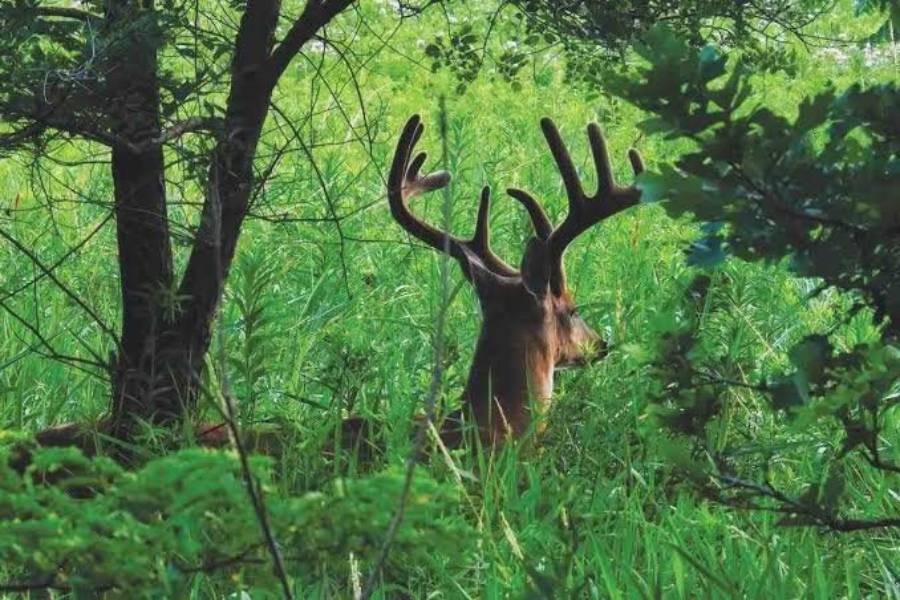
Deer often prefer thick cover because it provides security, concealment, and suitable bedding habitat, especially during daylight hours and in areas with regular hunting pressure. Dense brush, young forest growth, tall grass, cattails, and other forms of heavy vegetation can reduce a deer’s exposure to hunters, predators, and other disturbances. However, deer do not automatically choose the thickest vegetation available. Cover is most valuable when its location and structure also support bedding, travel, feeding, or escape.
A deer’s use of thick cover changes with time of day, season, hunting pressure, food availability, and reproductive activity. Deer may spend daylight hours in secure bedding cover before moving toward feeding areas in the evening. Mature bucks can use secluded cover differently from does and younger deer, while increased hunting pressure can make secure areas more important during hunting season. During the rut, normal movement patterns can change as bucks travel in search of does.
For hunters, the important question is therefore not simply whether thick cover exists. The goal is to determine which cover deer actually use, why they use it, and where they enter and leave it. Understanding these relationships makes it easier to identify bedding areas, travel routes, habitat transitions, and productive hunting locations.
Do Deer Prefer Thick Cover?
Deer prefer thick cover when it provides security, suitable bedding conditions, and protection from disturbance. Dense vegetation reduces how easily deer can be seen and approached, making these areas particularly useful for resting during daylight hours. However, vegetation density alone does not determine whether deer will use an area. Location, available food, nearby travel routes, terrain, wind conditions, and human activity also influence how valuable a patch of cover is.
Security is one of the main reasons thick cover attracts deer. A dense stand of young trees, brush, tall grass, or similar vegetation creates visual barriers between deer and potential threats. These barriers allow deer to remain concealed while resting and give them nearby escape routes when disturbed. This is why an isolated patch of extremely dense vegetation may receive less use than moderately thick cover positioned within a larger habitat that connects bedding areas with food and travel corridors.
Deer also use different types of habitat for different activities. Security cover provides concealment, bedding cover provides a suitable place to rest, and feeding habitat provides access to food. One location can serve more than one function, but it does not have to. For example, a deer may spend much of the day bedded in dense brush before traveling through more open timber toward an agricultural field or another feeding area near dusk.
For hunters, this distinction means the thickest area on a property is not automatically the best place to find deer. A more useful approach is to determine whether the cover contains beds, established trails, tracks, droppings, rubs, or other evidence of repeated deer use. The relationship between the cover and surrounding resources is equally important. Thick vegetation positioned between a bedding area and a major food source can influence deer movement differently from dense vegetation that is isolated from food, water, and established travel routes.
Why Do Deer Use Thick Cover?
Deer use thick cover primarily for security, concealment, bedding, escape opportunities, and protection from environmental conditions. These functions make dense vegetation valuable because deer must balance access to resources with the need to avoid threats. The importance of each function changes according to habitat conditions, season, time of day, and the amount of disturbance in the area.
Security cover limits exposure. Deer living in areas with hunters, hikers, vehicles, farm activity, or other recurring disturbances can use dense vegetation to put physical and visual barriers between themselves and the source of danger. Cover does not have to make a deer completely invisible to be useful. Brush, saplings, tall vegetation, and fallen timber can make approaching the animal more difficult while providing multiple directions for escape.
Thick cover can also support secure bedding. Deer spend substantial periods resting, so a bedding location needs more than vegetation alone. The surrounding structure must allow the animal to detect danger and leave when necessary. This helps explain why deer may bed near the edge of dense vegetation, within small openings, or at terrain features associated with cover rather than always occupying its deepest point. The functional quality of the cover matters more than vegetation density by itself.
Escape is another reason deer remain close to dense vegetation even when they are not directly inside it. A feeding or travel area adjacent to security cover allows a deer to reach concealment quickly after detecting danger. As a result, the relationship between open habitat and thick cover can be as important to hunters as the cover itself. An edge connecting dense bedding vegetation with a feeding area, for example, can concentrate movement without requiring a hunter to enter the bedding cover.
Environmental protection can add another function to dense habitat. Vegetation can alter wind exposure, shade, snow conditions, and the immediate environment around a bedding location. The value of these characteristics changes throughout the year, which is one reason deer do not necessarily use the same cover with the same intensity in every season.
The practical hunting implication is clear: look for thick cover that performs a specific function for deer rather than assuming all dense vegetation is equally attractive. Cover connected to bedding opportunities, escape routes, food, or established travel corridors provides stronger habitat context than thickness alone.
Do Deer Bed in Thick Cover During the Day?
Deer often bed in thick cover during the day because dense vegetation provides security and reduces exposure to disturbance. Daytime bedding allows deer to rest in locations where approaching hunters, predators, or other sources of disturbance are more difficult to detect visually from a distance. Thick brush, young timber, tall grass, and similar vegetation can all provide this function when they occur in the right location.
Deer do not need to bed in the deepest part of thick cover to benefit from it. A bedding site can be positioned along an edge, beside a small opening, on a terrain transition, or within moderately dense vegetation that provides both concealment and an effective escape route. The important feature is security rather than maximum vegetation density. A deer needs a location that reduces exposure while still allowing it to detect danger and leave the area when necessary.
The location of thick cover relative to feeding areas also affects its value as daytime bedding habitat. Cover located near established travel routes or between daytime bedding areas and evening food sources gives deer a practical way to remain concealed before moving to feed. Hunters may therefore find concentrated tracks and trails around the entrances and exits of bedding cover even when there is relatively little deer sign in nearby open habitat during daylight hours.
Several signs can indicate that deer are actually bedding in thick cover. Beds, tracks, droppings, repeatedly used trails, rubs, and entry or exit routes provide stronger evidence than vegetation density alone. A single track only confirms that a deer passed through an area, while multiple beds combined with established trails indicate more consistent habitat use. The distribution of these signs can also help determine whether deer are bedding deep inside the cover or primarily using its edges.
Do Mature Bucks Bed Deeper in Thick Cover?
Mature bucks can use secluded thick cover for bedding, particularly where avoiding human disturbance is important, but they do not always bed in the deepest cover available. Bedding selection depends on the security provided by the location as a whole. Dense vegetation is one component, while terrain, wind, escape routes, nearby food, and hunting pressure can also affect where a buck chooses to spend daylight hours.
A mature buck may use a small patch of cover that hunters routinely overlook instead of a large area of obvious dense vegetation. The location can be valuable because human traffic is limited, not because the vegetation is exceptionally thick. Conversely, a large patch of heavy cover may provide effective security when hunters avoid entering it because visibility is poor and movement is difficult.
Hunters should therefore avoid treating every dense patch as a mature buck bedding area. Repeated buck sign combined with secure bedding structure provides stronger evidence of buck use. Beds, larger tracks, rubs, trails, and observations from trail cameras can help establish whether a particular area is being used consistently rather than occasionally.
Does Hunting Pressure Push Deer Into Thicker Cover?
Hunting pressure can push deer toward thicker and more secure cover by increasing the perceived risk associated with exposed habitat. Repeated encounters with hunters, frequent access through bedding areas, vehicle traffic, and other disturbances can change where deer spend daylight hours and how they move between bedding and feeding locations.
The effect is especially important when deer have access to alternative habitat. An animal repeatedly disturbed in an exposed bedding area has an incentive to use locations where approaching threats are harder to detect or reach. Dense vegetation can provide that security by reducing visibility and making human movement more difficult. However, deer may also respond by using remote terrain, overlooked pockets of habitat, or areas with restricted human access. Thick vegetation is therefore one form of security cover rather than the only possible response to hunting pressure.
Hunting pressure can also affect when deer use exposed areas. Deer can reduce daylight exposure while continuing to visit feeding and travel areas during lower-risk periods. This creates an important distinction between deer leaving an area entirely and deer changing the timing of their movements. A food source may continue receiving substantial deer activity even when hunters rarely observe deer there during legal daylight hours.
Pressure near bedding cover can be particularly disruptive because hunters must approach the same habitat deer use for security. Walking through established bedding areas, repeatedly checking cameras, or using the same access route can introduce scent, noise, and physical disturbance. Deer can then alter bedding locations or travel patterns rather than continue using the area in the same way.
For hunters, the most valuable thick cover is often cover that combines security with predictable connections to food and travel routes. Instead of immediately entering dense vegetation, hunters can first identify trails leaving the cover, habitat transitions, funnels, and staging areas. This approach provides information about deer movement while reducing unnecessary disturbance inside potential bedding habitat.
When Do Deer Leave Thick Cover?
Deer leave thick cover when they need to feed, drink, breed, travel between habitat areas, or respond to changing conditions. Thick cover primarily provides security rather than every resource a deer needs. When bedding cover does not contain sufficient food or other resources, deer must move beyond it, creating predictable connections between secure habitat and feeding or travel areas.
Time of day strongly influences this movement. Deer that use thick vegetation as daytime security cover may remain there for much of the day before moving toward feeding areas as daylight declines. They do not necessarily travel directly from a bed into an open field. A deer can first move through dense vegetation, secondary cover, or a staging area before entering more exposed habitat. This gradual transition allows the animal to maintain security while approaching food.
Food availability determines where many of these movements lead. Agricultural crops, browse, mast-producing trees, and other seasonal food sources can draw deer away from bedding cover. When a preferred food source changes, the route deer use to leave thick cover can change as well. A trail that receives consistent traffic during one portion of the season can therefore become less important after the surrounding food supply changes.
Disturbance can cause deer to leave cover at less predictable times. A hunter entering a bedding area, farm equipment operating nearby, or another immediate threat can force deer to move during daylight. This movement differs from normal bedding-to-feeding travel because the animal is responding to danger rather than voluntarily moving toward a resource. Hunters should distinguish pressured escape routes from regular travel routes when interpreting tracks and trails around dense habitat.
Do Deer Leave Thick Cover More Often After Dark?
Deer can delay movement into exposed habitat until low-light or nighttime periods when they perceive greater risk during daylight. This pattern is especially relevant in areas receiving regular human or hunting pressure. A deer may remain active within secure cover before dark while postponing movement into open fields or other exposed areas until conditions feel safer.
This does not mean deer remain motionless in thick cover throughout the day. Movement can occur within bedding areas and between nearby patches of secure habitat without exposing the animal in open terrain. As a result, a hunter watching only a distant food source may see little daylight activity even though deer are moving inside surrounding cover.
The transition between thick cover and a feeding destination can therefore be more useful than the destination itself for locating daylight movement. A staging area, narrow trail, terrain funnel, or habitat edge positioned between bedding cover and food may intercept deer before they reach an open feeding area. The closer a location is to secure daytime cover, the earlier deer may reach it, but hunting closer to bedding habitat also increases the risk of disturbing deer.
Hunters should evaluate both movement timing and distance from security cover rather than assuming nighttime trail-camera activity means deer are completely nocturnal. For example, repeated nighttime photographs at a field edge may indicate that deer are beginning their movement much earlier inside adjacent cover. Identifying the route between the bedding area and camera location can provide more useful hunting information than continuing to monitor the field alone.
Does the Rut Make Bucks Leave Thick Cover?
The rut can cause bucks to leave their normal thick-cover patterns more frequently as they search for and follow receptive does. Breeding becomes a major behavioral driver, so a buck that normally spends much of its daylight time near secure bedding habitat may travel farther or use routes that receive less activity during other parts of the hunting season.
This change does not make security cover irrelevant. Thick vegetation can remain important because does use bedding and security habitat, and bucks searching for does can travel between these locations. A patch of dense cover that holds multiple doe bedding areas may therefore become part of a larger buck movement pattern during the rut rather than functioning only as an isolated buck bedding location.
Travel corridors connecting bedding areas become particularly relevant in this context. Terrain funnels, strips of cover, wooded transitions, creek corridors, and other routes can allow bucks to move between areas while limiting exposure. A hunter who understands how several bedding areas connect can therefore identify rut movement without assuming that bucks will simply abandon cover and wander randomly through open habitat.
Individual buck behavior can still vary. The rut increases the incentive to travel, but it does not eliminate a buck’s need for security. Hunting pressure, available cover, doe distribution, terrain, and the stage of the breeding period can all influence how far a buck moves and how much daylight exposure it accepts.
For hunters, the practical change during the rut is to expand attention beyond a single thick bedding area. Routes connecting secure cover, doe bedding locations, and travel funnels can become more valuable because bucks have a reason to move between them. Thick cover remains part of the habitat equation, but breeding activity changes how bucks use the surrounding landscape.
What Types of Thick Cover Do Deer Prefer?
Deer prefer thick cover that provides usable security, bedding opportunities, and access to surrounding resources rather than one specific type of vegetation. Brush, young forest growth, tall grass, cattails, conifers, and regenerating clear-cuts can all function as deer cover when their structure helps conceal deer and connects with the habitat they need for feeding and travel.
Young forest growth can provide effective cover because closely spaced saplings, shrubs, and low vegetation reduce visibility near ground level. Regenerating timber areas can also combine cover with browse, allowing deer to obtain food without immediately entering open habitat. However, the usefulness of these areas depends on their age and structure. As trees mature and the understory becomes more open, the same location may provide less concealment than it did during earlier stages of forest regeneration.
Tall grass, brush, and cattails can create a different form of security. Instead of relying on trees, these habitats conceal a deer’s body and make human movement through the area more difficult. Small dry areas, elevated ground, vegetation transitions, and established trails within these habitats can become particularly important because deer still need practical places to bed and move through dense vegetation.
Conifers and other dense evergreen stands can provide both concealment and environmental protection in appropriate habitats. Their value can increase when surrounding deciduous vegetation loses foliage or when winter conditions make protection from wind and snow more important. This illustrates why the best thick cover is determined by function and season, not simply by plant species or vegetation density.
Hunters should therefore evaluate the internal structure and surrounding landscape when examining dense cover. A patch that contains bedding opportunities and connects directly with travel routes or feeding habitat provides more useful context than an isolated patch of vegetation with little deer sign. Beds, tracks, trails, droppings, and rubs can then confirm whether deer actually use the cover.
Do Deer Prefer Thick Cover Near Food Sources?
Deer can favor thick cover near reliable food sources because it reduces the distance they must travel between secure daytime habitat and feeding areas. This combination gives deer access to two important resources within a relatively small area: security while resting and food when they become active.
The relationship is especially useful when thick cover connects to a feeding area through additional vegetation rather than ending abruptly at a large open space. Deer can leave a bedding location, travel through cover, pause in a staging area, and approach the primary food source as conditions become safer. The resulting pattern can be represented as bedding cover → travel route → staging area → food source.
Distance still matters. Thick cover directly beside food does not automatically contain deer if it lacks suitable bedding structure or receives frequent disturbance. Conversely, secure bedding cover located farther from food can remain attractive when deer have protected travel routes connecting the two areas. Hunters should therefore examine the complete relationship between security and food instead of selecting locations based only on proximity.
Food sources also change throughout the hunting season. Agricultural crops can be harvested, mast availability can rise or fall, and natural browse can change in quality. Deer movement can shift toward a different food source even while the bedding cover remains unchanged. An established trail leaving dense vegetation may consequently receive heavy use during one period and substantially less use later.
For hunters, habitat transitions between cover and food can provide valuable locations for observing this movement. The objective is to identify where deer can travel from security to food while minimizing exposure. Trails, funnels, inside corners, narrow strips of cover, and staging areas can reveal these routes without requiring a hunter to penetrate the center of a bedding area.
Does Deer Preference for Thick Cover Change by Season?
Deer use thick cover differently throughout the year because food availability, vegetation structure, weather, breeding activity, and hunting pressure change by season. A patch of vegetation that provides excellent concealment during summer may offer less security after leaf drop, while another habitat can become more valuable when colder weather increases the importance of environmental protection.
During summer, living vegetation can create abundant concealment across the landscape. Tall grasses, shrubs, crops, and leafy understory vegetation give deer more options for secure bedding and travel. This abundance can distribute deer across a wider range of cover instead of concentrating them in the few dense areas that remain available later in the year.
Fall changes both vegetation and deer behavior. Leaf drop can reduce concealment in mature hardwoods, while hunting activity can increase the value of areas that continue to provide security. Food availability also changes as crops are harvested and seasonal foods become available or disappear. Deer may retain the same general home range while shifting bedding and travel patterns toward cover that better matches current conditions.
The rut introduces another seasonal change because bucks have a stronger reason to move between areas occupied by does. Thick cover remains valuable, but connections between bedding areas can become more important than a single isolated patch. A buck may move through several areas of security cover while searching for receptive does, increasing the hunting value of funnels and travel corridors that connect them.
Winter can change cover selection again. Dense vegetation that reduces exposure to wind, snow, or other harsh conditions can provide environmental value in addition to concealment. Food availability can also become more concentrated, forcing deer to balance secure bedding locations against the energy required to reach dependable food.
For hunters, seasonal changes mean a location should not be judged only by deer sign found earlier in the year. Current food, current vegetation structure, hunting pressure, weather conditions, and fresh sign provide a stronger indication of whether deer are using a particular patch of thick cover now. The cover itself may remain physically present throughout the season while its value to deer changes substantially.
Should You Hunt Inside Thick Cover or Along Its Edge?
Hunting along the edge of thick cover is often the better starting point because it allows hunters to intercept deer movement without immediately disturbing secure bedding habitat. Deer commonly move between cover, travel corridors, staging areas, and food sources, so an edge can provide access to predictable movement while reducing the need to enter the cover itself. Hunting inside thick cover becomes more relevant when deer rarely reach those edges during legal shooting hours.
Edges are valuable because they create transitions between habitat types. A line where dense brush meets mature timber, a strip of cover connecting bedding habitat with a food source, or an inside corner beside heavy vegetation can concentrate travel. Deer can remain close to security while moving through these transitions, making them more useful than an arbitrary position along a straight habitat edge.
Hunting directly inside thick cover offers a different advantage: proximity to daytime deer activity. If deer consistently remain within security cover until after dark, a hunter positioned only at a distant field edge may encounter them too late. Moving closer to bedding cover can intercept deer earlier in their bedding-to-feeding movement. The trade-off is a greater risk of alerting deer through scent, sound, or movement.
Access should therefore influence the decision as much as deer sign. A productive location loses much of its value when reaching it requires walking through the bedding area or crossing the route deer are expected to use. Hunters should consider entry direction, exit direction, wind, vegetation, terrain, and expected deer movement before deciding how deeply to hunt the cover.
Fresh sign can help determine whether moving farther inside is justified. A heavily used trail disappearing into dense vegetation, multiple beds, fresh tracks, droppings, or rubs can indicate that important deer activity occurs beyond the visible edge. If the same trail produces daylight movement before deer reach an open area, hunting closer to the cover may provide an opportunity that an exposed food-source setup does not.
The best position is therefore not automatically inside or outside thick cover. Choose the location that intercepts predictable deer movement while causing the least disturbance to the security habitat deer depend on. In many situations, that means beginning at a transition or travel route and moving closer only when deer behavior provides a reason to do so.
Read more: Do Deer Avoid Freshly Cut Fields? Hunting Guide
How Can You Tell if Deer Are Using Thick Cover?
You can tell deer are using thick cover by finding multiple forms of fresh sign, especially beds, tracks, droppings, established trails, and rubs. Dense vegetation by itself only shows that security cover is available. Fresh deer sign shows that animals are actually entering, traveling through, or spending time in it.
Beds provide strong evidence that cover is being used for resting rather than simply crossed during travel. A deer bed typically appears as a compressed area of vegetation or leaf litter shaped by repeated body contact. Multiple beds concentrated within secure habitat can indicate a bedding area, while isolated beds require more context before hunters can determine how consistently the location is used.
Trails reveal how deer enter and leave the cover. A well-defined trail connecting dense vegetation with a food source, terrain funnel, or another patch of security cover can identify a repeated movement route. Hunters should follow the relationship between the trail and surrounding habitat rather than assuming every visible trail has equal hunting value. The direction of tracks and the location of nearby beds can provide additional context.
Droppings and tracks help establish recent presence. Fresh tracks on soft soil, mud, snow, or trail crossings can show where deer are moving, while concentrations of droppings can indicate areas where deer spend more time. Neither sign proves by itself that a location is a bedding area, but combining them with beds and established trails creates stronger evidence of repeated use.
Rubs can add information about buck activity. Rubbed trees near trails or bedding cover indicate that bucks have used the area, although a rub alone does not prove that a mature buck beds nearby. A cluster of fresh rubs associated with tracks, beds, and travel routes provides more useful context than one isolated rub.
Hunters should prioritize sign clusters rather than individual clues. For example, a dense patch containing beds, fresh tracks, droppings, and a heavily used trail leading toward food provides stronger evidence than a similar patch containing only one old track. This approach separates cover that merely looks attractive from cover that deer are currently using.
Where Should Hunters Look for Deer Around Thick Cover?
Hunters should look for deer where thick security cover connects with bedding areas, food sources, travel corridors, funnels, and habitat transitions. These locations combine the security deer prefer with the routes they need to reach other resources. Finding the relationship between these habitat features is more useful than simply locating the largest patch of dense vegetation.
Bedding exits are one high-value location. Trails leaving a secure bedding area can reveal the direction deer travel when becoming active. A trail leading toward a feeding area is particularly relevant when fresh tracks and repeated use confirm the pattern. Hunting the route rather than the bed itself can provide access to deer movement while reducing disturbance inside the bedding area.
Habitat transitions provide another location to investigate. Deer moving from thick brush into mature timber, from a swamp edge onto higher ground, or from security cover toward a field encounter natural changes in vegetation and terrain. These transitions can influence the route deer choose because they allow movement while maintaining proximity to cover.
Funnels can make these movements even more predictable. A narrow strip of usable cover, terrain restriction, creek crossing, gap between obstacles, or connection between two larger habitat blocks can reduce the number of practical routes available to deer. A funnel becomes more significant when it connects places deer already have a reason to visit, such as secure bedding cover and a dependable food source.
Staging areas between bedding cover and exposed feeding habitat also deserve attention. Deer can use these areas before entering an open field, especially when they are reluctant to expose themselves during daylight. Fresh sign in a staging area can indicate that deer reach the general feeding location before dark but delay entering the most exposed portion until later.
The strongest hunting location combines several relationships rather than relying on thick cover alone. Security cover identifies where deer can avoid disturbance, fresh sign confirms actual use, and nearby travel features show how deer move between bedding and other resources. A hunter who identifies all three has substantially more information than one who simply selects the thickest vegetation on the property.
Thick cover should therefore be treated as one component of a larger deer habitat system. Deer may prefer it for security and bedding, but their need to feed, breed, travel, and respond to seasonal conditions repeatedly brings them to its boundaries and connecting routes. Those relationships explain both why deer prefer certain patches of thick cover and where hunters are most likely to encounter them.