
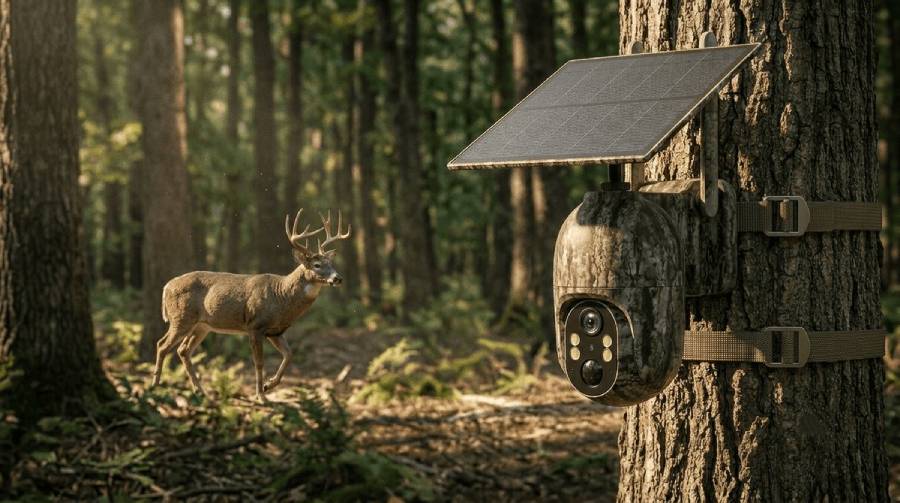
Deer can hear some sounds produced by trail cameras, particularly mechanical clicks and electronic noises generated when a camera detects movement or captures an image. However, hearing a trail camera does not mean a deer will automatically become frightened or avoid the area. Detection and behavioral response are separate processes, and a deer may hear a sound without treating it as an immediate threat.
Trail cameras can generate several types of noise depending on their design and components. A deer’s ability to detect these sounds depends on factors such as sound frequency, volume, distance from the camera, background noise, and the specific camera model. A deer that suddenly stops, looks toward a trail camera, or approaches it may have detected sound, but those behaviors alone do not prove that sound caused the reaction. Infrared illumination, human scent, the physical presence of the camera, and repeated human visits can also alert deer.
For hunters, the practical issue is therefore not simply whether deer can hear trail cameras. The more important question is whether camera noise contributes to alertness or avoidance that affects scouting and hunting. This article examines what sounds trail cameras make, what frequencies deer can hear, how deer respond to cameras, and how hunters can reduce trail camera detection.
Can Deer Hear Trail Cameras?
Deer can hear some trail camera sounds when those sounds fall within their hearing range and are loud enough to reach them. A trail camera is not completely silent simply because a hunter cannot hear it operating. Internal components can produce mechanical or electronic noise when the camera detects movement, switches operating modes, or captures an image.
Whether a deer actually detects that noise depends on the acoustic conditions at the camera site. Sound becomes weaker as the distance between the deer and camera increases, while wind, rain, moving vegetation, insects, and other environmental sounds can mask quieter camera noises. A deer standing several feet from a camera in a quiet area therefore encounters different detection conditions than a deer passing farther away during windy or rainy weather.
Hearing a trail camera is also different from being spooked by it. A deer can detect an unfamiliar sound and simply turn its head toward the source. It may also stop, investigate the area, become alert, or continue moving without an obvious response. Avoidance is a stronger behavioral outcome and should not be assumed from a photograph showing a deer looking directly at the camera. Sound is only one possible stimulus in that situation.
For hunters, this distinction matters when interpreting trail camera photos and videos. A buck staring toward a camera does not by itself prove that the buck heard the camera, nor does it prove that the camera changed its future movement. Camera noise, infrared illumination, human odor, the camera’s physical presence, and previous human activity around the site are separate factors that can contribute to detection. Evaluating the complete disturbance around a camera provides more useful hunting information than treating every visible deer reaction as evidence of camera noise.
What Sounds Do Trail Cameras Make?
Trail cameras can produce mechanical and electronic sounds during detection and image capture, although the type and intensity of noise vary by camera design. Hunters may notice a click from certain cameras, while other sounds can be faint enough that a person standing several feet away does not consciously notice them. A quiet camera should therefore be described in relation to its operating noise rather than assumed to be acoustically silent.
Mechanical noise can originate from moving components inside the camera. One relevant example is the mechanism associated with switching between daytime and nighttime imaging on camera designs that use movable internal components. Triggering and image-capture processes can also create audible clicks on certain models. Because camera construction differs, the presence of a noticeable click on one trail camera does not establish that every trail camera produces the same sound.
Electronic components create a second category of noise. Electrical circuits can produce high-frequency sounds during operation, and the acoustic characteristics can differ between camera models and operating states. This distinction is important because a sound that is difficult for a hunter to hear is not necessarily impossible for a deer to detect. Human perception alone is therefore an inadequate test for determining whether a particular trail camera is detectable by deer.
Camera noise must also be evaluated by frequency, intensity, and distance rather than frequency alone. A sound can fall within an animal’s hearing range but still be too weak to detect at a meaningful distance. Conversely, a relatively noticeable mechanical click occurring when a deer is close to the camera provides a stronger stimulus. The next step is therefore to compare these potential trail camera sounds with the frequencies deer are capable of hearing.
What Sound Frequencies Can Deer Hear?
Deer can hear a broad range of frequencies, including higher-frequency sounds that humans may hear poorly or not perceive at all. This difference matters when evaluating trail cameras because judging a camera as “silent” based only on human hearing does not establish that the camera is acoustically undetectable to deer.
Sound frequency is measured in hertz (Hz) or kilohertz (kHz), while sound intensity describes how strong that sound is. These two properties should not be treated as the same measurement. A camera may generate a frequency that falls within a deer’s hearing range, but the sound still needs sufficient intensity to reach the animal above environmental background noise. Hearing range establishes what a deer is physiologically capable of detecting; it does not establish the distance from which every trail camera can be heard.
The hunting environment further changes detection conditions. Wind moving through vegetation, flowing water, rain, insects, and other animals create background noise that can mask a weak camera sound. Distance also reduces sound intensity before it reaches the deer. As a result, a deer standing close to a camera on a quiet night has a better opportunity to detect a faint operating sound than a deer passing farther from the same camera under noisy conditions.
This explains why human listening tests have limited value when evaluating trail camera disturbance. A hunter who triggers a camera and hears nothing can reasonably conclude that the camera is quiet to that hunter from that position, but not that deer cannot hear it. A more useful assessment considers frequency, sound intensity, distance, ambient noise, and deer hearing ability together.
Can Deer Hear High-Frequency Sounds From Trail Cameras?
Deer may hear high-frequency sounds from a trail camera when the camera produces frequencies within their hearing range at sufficient intensity. The important qualification is that trail cameras differ in their acoustic output. It is therefore inaccurate to assume that every camera continuously produces a high-frequency sound that deer can hear.
High-frequency electronic noise can originate from electrical components while a device operates. Other sounds may occur only during a specific event, such as triggering, image capture, or a change between operating modes. These differences create distinct exposure patterns. A continuous electronic tone gives a deer a different acoustic stimulus from a brief mechanical sound that occurs only when the animal triggers the camera.
Frequency overlap alone does not prove that deer can hear a specific trail camera in the field. For example, identifying an electronic sound within the deer’s hearing range establishes biological plausibility, but detection also requires the sound to remain strong enough at the deer’s position. A weak high-frequency signal can become effectively undetectable as distance increases or environmental noise masks it.
Camera-specific testing is therefore more reliable than treating all trail cameras as acoustically identical. Differences in circuitry, internal components, operating modes, age, and construction can produce different acoustic signatures. One model producing detectable high-frequency noise does not demonstrate that another model produces the same frequency or intensity.
For hunters, the practical implication is straightforward: a trail camera that sounds silent to a person should not automatically be considered silent to deer, but neither should high-frequency noise be assumed to spook deer without evidence of a behavioral response. Hearing establishes detection. What matters for scouting and hunting is what the deer does after detecting the stimulus, which can range from briefly looking toward the camera to changing its movement around the location.
Do Trail Camera Sounds Spook Deer?
Trail camera sounds can alert deer, but hearing a camera does not automatically cause a deer to become spooked or abandon the area. The behavioral response can range from a brief head turn to heightened alertness or avoidance. For hunters, the important distinction is between a deer detecting an unusual stimulus and that stimulus becoming strong enough to alter its movement.
A deer that hears an unfamiliar camera sound may first orient toward its source. This response can include raising its head, rotating its ears, stopping movement, or looking directly toward the camera. These behaviors indicate that the animal detected something in its environment, but they do not identify sound as the cause by themselves. Light, human scent, movement, or the physical presence of the camera can produce similar reactions.
A deer looking directly at a trail camera is therefore not proof that it heard the camera. Trail camera photos provide evidence of where the animal was looking at the moment of image capture, not what sensory stimulus caused the reaction. For example, a deer facing a camera immediately after the trigger could have responded to an operating noise, noticed infrared illumination, detected human odor around the camera site, or simply looked toward an unfamiliar object.
The severity of the response matters more to hunters than the initial detection. A deer that pauses for several seconds and then resumes its normal route presents a different hunting consequence from a deer that repeatedly approaches the location cautiously or begins avoiding it. Hunters should therefore examine a sequence of images and repeated visits rather than interpreting one photograph of an alert deer as evidence that the camera spooked it.
Repeated exposure can also change how deer respond to a trail camera. A stimulus that does not produce a negative consequence can become less important to an animal after repeated exposure. This process can explain why deer sometimes continue using feeding areas, trails, or other locations despite the presence of a camera. However, habituation should not be assumed for every deer or every camera location because the complete disturbance includes more than camera sound.
The hunting context is particularly important. A camera positioned in an area with regular human or equipment activity presents a different environmental change from one placed close to a secluded bedding area. In the second situation, the camera itself and the hunter’s visits to install or check it introduce unusual stimuli into an area where deer may encounter less human disturbance.
For this reason, hunters should evaluate behavioral change rather than camera detection alone. Consistent changes in approach direction, increased vigilance, reduced visits, or avoidance provide more useful information than a single instance of a deer staring at the lens. Even then, the behavior should not automatically be attributed to sound because trail camera disturbance can involve several sensory cues at the same time.
Are Mature Bucks More Likely to Avoid Trail Cameras?
Mature bucks may display cautious behavior around trail cameras, but camera avoidance does not demonstrate that mature bucks can hear trail cameras better than younger deer. Hearing ability and behavioral response are separate variables. A buck can detect the same stimulus as another deer yet respond differently because of its previous experiences and the conditions surrounding the camera site.
This distinction prevents a common interpretation error in trail camera scouting. Suppose a younger buck repeatedly walks close to a camera while an older buck approaches the same location cautiously or changes direction. The observation shows a difference in behavior. It does not establish that the older buck detected an acoustic frequency the younger buck could not hear.
Previous exposure provides one possible mechanism for different responses. A mature buck has experienced more hunting seasons than a young deer and therefore has had more opportunities to encounter hunters, human scent, equipment, vehicles, and other disturbances. An unfamiliar sound or object occurring alongside human odor can consequently provide multiple cues rather than one isolated signal. The available source materials do not provide evidence that allows this behavioral difference to be quantified specifically for mature bucks and trail camera noise.
Hunting pressure can also make the camera location more important than the camera alone. Frequent trips to retrieve SD cards, replace batteries, reposition the camera, or clear vegetation introduce human odor and physical disturbance. If deer subsequently reduce their use of that location, the camera’s sound cannot be isolated as the cause without controlling for those additional factors.
Hunters targeting mature bucks should therefore focus on reducing the complete disturbance associated with trail camera use. The practical objective is not to make a camera theoretically impossible for a buck to detect. It is to minimize unnecessary sound, scent, visual exposure, and human intrusion so that scouting equipment is less likely to influence the behavior the hunter is trying to observe.
Can Deer Hear Cellular Trail Cameras?
Deer may hear sounds produced by cellular trail cameras, but the cellular transmission itself should not be assumed to create an audible sound that deer can detect. Cellular cameras still contain imaging sensors, electronic circuits, infrared systems, and other internal components that can generate mechanical or electronic noise. The relevant question is therefore whether a specific cellular camera produces detectable acoustic output during operation.
A cellular trail camera differs from a conventional SD-card camera primarily in how captured images or videos are transmitted. After recording an image, a cellular model can send the file through a mobile network instead of requiring the hunter to retrieve the memory card. This transmission capability does not establish that deer can hear the cellular signal. Radio-frequency communication and acoustic sound are different physical phenomena, so the presence of a cellular modem alone is not evidence of an audible cue.
The components involved in image capture remain more relevant to deer hearing. A cellular camera may produce a mechanical click or electronic noise when it triggers, changes operating states, or captures an image, depending on its design. As with conventional trail cameras, the acoustic signature is model-specific rather than an inherent characteristic of every cellular camera. The provided source materials do not establish a universal sound level or frequency for cellular trail cameras, so a precise detection distance cannot be stated from those materials.
Cellular cameras can nevertheless provide an indirect advantage when hunters want to reduce disturbance. Because images can be transmitted remotely, hunters may need fewer physical trips to the camera to retrieve SD cards. Fewer visits can reduce human scent and physical intrusion around a trail, scrape, feeding area, or other monitored location. For a hunter concerned about influencing deer behavior, reducing these visits can be more practically important than focusing exclusively on whether the camera produces a faint operating sound.
Can Deer Detect Trail Cameras Without Hearing Them?
Deer can potentially detect a trail camera through visual cues, human scent, or the physical presence of the device even when camera noise is not the stimulus. This matters because a visible reaction in trail camera footage cannot reliably be attributed to hearing unless other detection pathways have been excluded.
Can Deer See the Red Glow From a Trail Camera?
A visible red glow from some infrared trail cameras provides a potential visual cue that is separate from camera noise. Low-glow and no-glow cameras differ in how noticeable their infrared illumination is, so camera type can affect the visual stimulus presented when an image is captured at night.
A deer that looks toward a camera immediately after nighttime activation may therefore be responding to something associated with illumination rather than sound. This is one reason a photograph of a deer staring directly into the lens cannot establish that the animal heard the camera. Multiple stimuli can occur close together when the camera triggers.
No-glow technology is intended to reduce visible illumination during nighttime photography, making it relevant when hunters want to minimize visual disturbance. However, no-glow does not mean undetectable. Changing the illumination system does not remove human scent, physical camera visibility, operating noise, or disturbance created when a hunter enters the area.
Can Human Scent Make Deer Avoid a Trail Camera?
Human scent around a trail camera can provide deer with a detection cue independently of any sound produced by the device. Hunters leave odor while carrying equipment, attaching a camera to a tree, adjusting its position, changing batteries, retrieving SD cards, and walking to and from the site.
This creates an important problem when interpreting apparent camera avoidance. For example, if a buck uses a trail regularly before camera installation but becomes more cautious afterward, the change does not prove that the buck heard the camera. Installation introduced both the device and recent human activity at approximately the same time.
Repeated camera checks can renew this disturbance. Every trip creates another opportunity to leave scent and disturb vegetation around the location. This effect is particularly relevant when monitoring areas where hunters are trying to minimize intrusion, such as routes associated with bedding cover.
Cellular cameras can help address this specific problem because remote image transmission reduces the need to retrieve memory cards manually. The advantage concerns reduced human intrusion, not proof that cellular cameras themselves are acoustically invisible to deer.
Can Deer Notice the Physical Presence of a Trail Camera?
A trail camera is a new physical object in a deer’s environment, so its position and visibility provide another possible detection pathway. A camera mounted prominently at deer eye level presents a different visual situation from one positioned less conspicuously and integrated with the surrounding environment.
Physical placement also affects how hunters interpret deer reactions. A deer approaching directly toward the camera may notice the device, detect scent around the mounting location, respond to camera activation, or react to a combination of these stimuli. Without controlled evidence, assigning the behavior exclusively to sound creates a causal conclusion that the observation does not support.
For hunting purposes, trail camera detection should therefore be treated as a multi-sensory problem involving sound, light, scent, physical presence, and human intrusion. Sound remains relevant to the original question of whether deer can hear trail cameras, but reducing sound alone does not make a camera invisible to deer.
Read more: Can Deer Smell Blood? What Hunters Should Know
How Can Hunters Make Trail Cameras Less Noticeable to Deer?
Hunters can make trail cameras less noticeable to deer by reducing the combined effects of sound, visual exposure, human scent, and repeated human intrusion. Focusing only on camera noise addresses one detection pathway while leaving several others unchanged. A quiet camera can still influence deer behavior if it is highly visible, produces noticeable illumination, or requires frequent visits that leave fresh human scent.
Camera selection is the first factor. Hunters concerned about sound should favor models with minimal mechanical movement and low operating noise during triggering and image capture. However, manufacturers do not always provide standardized acoustic measurements that allow hunters to compare trail cameras by sound frequency or intensity. A camera advertised as fast, discreet, or no-glow should therefore not automatically be considered acoustically silent. No-glow describes the illumination system rather than every sensory signal produced by the camera.
Camera placement can reduce the likelihood that deer encounter the device at extremely close range. Distance matters because sound intensity decreases as it travels away from its source. Placement also determines how prominent the camera appears within the animal’s normal travel path. Hunters should avoid creating unnecessary visual disturbance simply to obtain a perfectly centered image when a less intrusive position can still cover the required detection zone.
Camera angle is another practical consideration. Pointing a camera directly into the face of an approaching deer can place the animal close to the device while the camera activates. Positioning the unit to monitor movement across or at an angle to a travel route can reduce direct interaction with the camera while still capturing useful scouting information. The exact placement should remain dependent on the terrain, detection range, target area, and specifications of the individual camera.
Reducing human scent around the camera is equally important because sound is not the only way deer can detect a change at the site. Installation requires a hunter to approach the location, handle the camera and mounting surface, and potentially disturb surrounding vegetation. Battery changes, SD-card retrieval, repositioning, and vegetation maintenance repeat that intrusion. A deer reacting after camera installation may consequently be responding to recent human presence rather than to camera noise.
Hunters can reduce this disturbance by completing necessary camera work efficiently and avoiding unnecessary visits. The objective is to minimize how frequently fresh human odor and physical disturbance are introduced into the monitored area. This is particularly relevant around locations where maintaining low hunting pressure is a priority.
Cellular trail cameras can reduce physical intrusion because hunters can receive images remotely instead of visiting the camera solely to retrieve an SD card. This does not prove that cellular cameras are quieter than conventional models. Their practical advantage in this context is that remote transmission can remove one reason for repeatedly entering the area.
Nighttime illumination should also be considered when selecting a camera. A no-glow infrared model can reduce the visible cue associated with some low-glow systems, making it useful when minimizing visual disturbance is important. However, switching to no-glow does not eliminate operating noise, scent contamination, camera visibility, or human activity. Hunters should treat it as one component of a broader low-disturbance setup rather than a complete solution.
The most effective approach is therefore to manage four primary sources of trail camera disturbance: sound, light, scent, and human intrusion. A hunter gains little by eliminating one stimulus while repeatedly introducing another. Camera selection, placement, and checking strategy should work together to collect useful scouting information while minimizing changes to the environment being monitored.
Should Hunters Worry About Deer Hearing Trail Cameras?
Hunters should consider trail camera noise a possible source of deer detection, but they should not assume that hearing a camera automatically causes deer to avoid it. The available evidence and behavioral observations require a distinction between hearing a stimulus, recognizing its source, becoming alert, and changing future movement. These are separate outcomes rather than interchangeable signs of camera disturbance.
A deer that turns its ears, raises its head, stops, or looks toward a trail camera may have detected something unusual. That observation alone cannot identify camera noise as the cause. The animal may also have detected infrared illumination, human odor, the physical device, or another environmental stimulus. A single trail camera photograph therefore provides insufficient evidence to determine which sensory pathway caused the reaction.
For hunters, repeated behavioral patterns are more useful than isolated reactions. A deer that looks toward a camera and continues using the same route provides a different scouting signal from one that repeatedly approaches cautiously, changes direction near the camera, or stops appearing at the location after installation. Even in the second situation, hunters should evaluate human intrusion and scent before attributing the change exclusively to sound.
The practical goal is not to make a trail camera impossible for deer to detect. It is to prevent the scouting process from unnecessarily changing the behavior being measured. Hunters can work toward that goal by using low-disturbance equipment, choosing less intrusive camera positions, reducing visible nighttime illumination where appropriate, limiting scent contamination, and minimizing trips to camera locations.
Deer can hear some sounds associated with trail camera operation, but total camera disturbance matters more to hunters than sound alone. Treating sound, light, scent, camera presence, and human intrusion as connected factors provides a stronger strategy for collecting trail camera data without unnecessarily influencing deer behavior.