
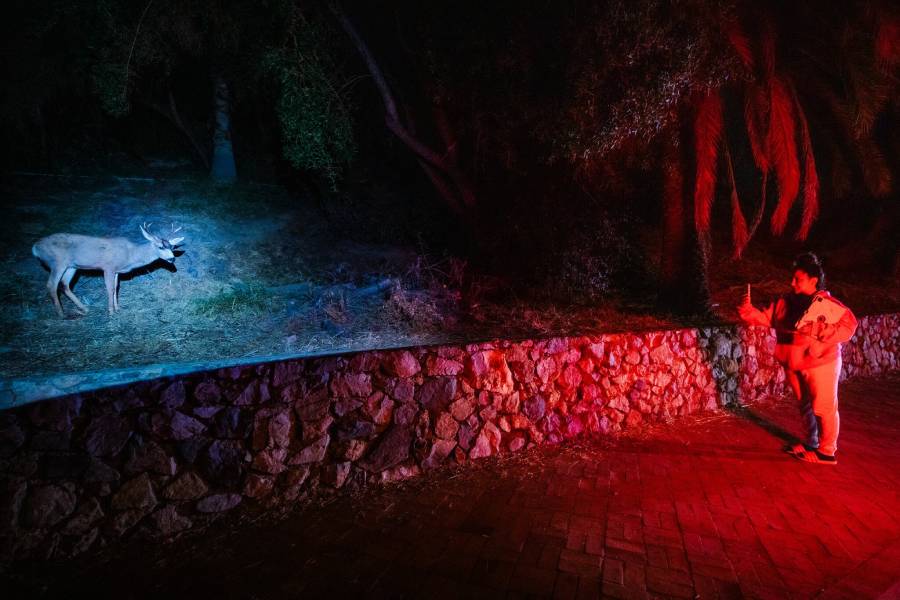
Deer can see red light at night, but red light is less visually prominent to them than shorter-wavelength colors such as blue. Deer have dichromatic color vision, meaning their eyes process a narrower range of colors than human eyes. As a result, longer red wavelengths do not appear to deer the same way they appear to humans. However, this does not mean a red hunting light is invisible to deer.
A deer can still detect illumination from a red flashlight or headlamp, especially when the light is bright, moves suddenly, or creates a noticeable change in the surrounding environment. This distinction matters for hunters because detecting a light and recognizing its color are separate visual processes. A deer may notice that an area has become brighter without perceiving the beam as the vivid red color a human sees.
Deer are also highly adapted to low-light conditions. Their eyes contain features that increase visual sensitivity around dawn, dusk, and at night, so using red light does not eliminate the possibility of detection. To determine how useful red light is for hunting, it is necessary to examine deer color vision, nighttime eyesight, behavioral responses to artificial light, and how red compares with green, blue, and white light.
Can Deer See Red Light at Night?
Deer can detect red light at night, but their eyes are less sensitive to long red wavelengths than human eyes are. This means a red flashlight or headlamp does not become invisible to a deer simply because the beam is red. The animal can still detect the illumination, particularly when the light is bright enough to create a noticeable contrast with the surrounding darkness.
The key distinction is between detecting light and perceiving its color. A hunter sees a red LED as distinctly red because the human visual system contains three types of cone cells that support trichromatic color vision. Deer have a different visual system, so the same wavelength does not produce the same color experience. For hunting purposes, this means the useful question is not only whether a deer can identify the color red, but whether it can detect the light source or the environmental change created by that light.
Red light occupies the longer-wavelength portion of the visible spectrum. Deer visual sensitivity is stronger toward shorter wavelengths, particularly the blue portion of the spectrum, while sensitivity declines toward longer wavelengths. Consequently, red illumination tends to be less visually prominent to deer than colors to which their eyes are more sensitive. This biological difference is the main reason red lights are used for certain hunting activities after dark.
Red light should therefore be considered less visually prominent to deer, not invisible to deer. A sufficiently intense beam can still illuminate vegetation, terrain, equipment, or a hunter and create changes that a deer can detect. Distance also matters because the amount of illumination reaching an animal or nearby surfaces decreases as the distance from the light source increases.
Beam movement creates another detection cue. Sweeping a red flashlight rapidly across a dark area changes brightness and contrast across the scene. A deer does not need to perceive the beam as vivid red to notice that visual change. For this reason, wavelength is only one factor affecting whether a deer notices a hunting light; brightness, distance, beam movement, exposure duration, and surrounding light conditions also influence detection.
Why Do Deer See Red Light Differently From Humans?
Deer see red light differently from humans because deer have dichromatic color vision, while humans normally have trichromatic color vision. Dichromatic vision relies on two primary types of cone photoreceptors for color discrimination. Human color vision normally uses three. This difference changes which portions of the visible spectrum each species can distinguish most effectively.
Cone cells are primarily responsible for color discrimination under conditions with sufficient light. The photoreceptors in a deer’s visual system do not provide the same sensitivity to long red wavelengths as the human visual system. As a result, colors that appear strongly red or orange to a hunter are not represented with the same color contrast to a deer. Shorter wavelengths, particularly toward the blue end of the visible spectrum, are more visually significant to deer.
This difference also explains why human perception is a poor standard for judging how conspicuous hunting equipment will appear to deer. A color that looks extremely bright to a hunter does not necessarily have the same visual prominence to the animal. Conversely, an object or light that appears relatively unobtrusive to a human can be more noticeable when its wavelengths correspond closely with areas of greater deer visual sensitivity.
Rods perform a different function from cones. Rods provide high sensitivity in low-light environments but do not provide detailed color discrimination. Deer possess visual adaptations that favor performance during low-light periods, which is particularly relevant around dawn and dusk. Their ability to function effectively in dim conditions therefore does not mean they see a wider range of colors at night. Low-light sensitivity and color discrimination are separate capabilities.
For hunters, the practical consequence is straightforward: choosing red illumination takes advantage of differences in deer spectral sensitivity, but it does not remove every visual cue associated with using a flashlight. A hunter still needs to control the intensity and movement of the beam because a deer’s visual system can detect changes in light even when the wavelength itself is relatively difficult for the animal to discriminate.
How Well Can Deer See at Night?
Deer can see effectively in low-light conditions because their eyes are adapted to gather and use limited available light. This gives deer a substantial visual advantage during dawn, dusk, and other dim conditions when human vision becomes less effective. However, strong nighttime vision does not mean deer can distinguish every color equally well. Light sensitivity and color discrimination are different visual functions.
Rods are a major part of this low-light capability. Rod photoreceptors are highly sensitive to limited illumination and are more useful for detecting shapes, contrast, and movement than for identifying colors. Deer vision places greater emphasis on these low-light signals, allowing an animal to detect changes in its surroundings when detailed color information is limited. For a hunter using a red light, this means reduced sensitivity to red wavelengths does not eliminate the deer’s ability to notice illumination, contrast, or movement.
The tapetum lucidum also contributes to nighttime vision. This reflective layer behind the retina redirects light through the photoreceptors, giving available light another opportunity to stimulate them. It is also responsible for the characteristic eye shine seen when artificial light reaches a deer’s eyes at night. Combined with other adaptations of the deer eye, the tapetum lucidum improves visual performance when ambient light is scarce.
Movement is particularly important in hunting situations. A deer can notice movement without needing to identify the exact color of the moving object or light. Sweeping a red beam across vegetation, repeatedly switching a headlamp on and off, or moving through an illuminated area creates changes in contrast that provide additional visual cues. A stationary, low-intensity red light and a rapidly moving bright red beam therefore should not be treated as equivalent simply because both use red wavelengths.
This distinction explains why red light should not be viewed as a way to make a hunter visually undetectable. Its advantage comes primarily from being less prominent within the deer’s color sensitivity than more detectable wavelengths. Hunters still need to manage light intensity, movement, direction, and exposure time when approaching or operating around deer after dark.
Does Red Light Spook Deer at Night?
Red light does not automatically spook deer, but a deer can notice red illumination and react to it. Whether the animal becomes alert or leaves the area depends on more than the color of the beam. Light intensity, sudden changes in illumination, movement, distance, previous exposure, and other nearby disturbances can all affect the response.
It is important to separate five stages: seeing, detecting, noticing, reacting, and spooking. Detecting illumination means the visual system registers a change. Noticing means that change receives the animal’s attention. A behavioral reaction can include looking toward the source, changing posture, stopping movement, or becoming more vigilant. Spooking represents a stronger response in which the deer retreats or leaves. A detected red light therefore does not necessarily produce a flight response.
A dim red headlamp used carefully at a distance creates a different visual stimulus from a powerful red spotlight directed toward an animal. Greater intensity increases the amount of illumination reaching the environment and can create stronger contrast against dark surroundings. The advantage of red wavelengths does not cancel the effect of increasing brightness. Hunters should therefore avoid interpreting “deer are less sensitive to red” as permission to use unlimited light intensity.
What Makes Deer More Likely to Notice a Red Light?
Five main factors can make red light more noticeable to deer: brightness, distance, beam movement, sudden illumination, and exposure duration. These factors determine how large a visual change the light creates rather than changing the wavelength itself.
Brightness increases the strength of the visual stimulus, while shorter distance increases the amount of illumination reaching the animal and surrounding surfaces. Beam movement creates changing patterns of light and shadow. Sudden illumination produces an abrupt contrast with the previous environment, and prolonged exposure gives the deer more opportunity to detect and respond to the change.
For example, slowly using a low-output red headlamp while moving toward a tree stand creates a different detection scenario from sweeping a high-output red flashlight repeatedly across an open field. Both lights are red, but their intensity, movement, direction, and environmental effects differ substantially. Red wavelength can reduce visual prominence, while careful light handling reduces the additional cues that may cause a deer to notice the hunter.
Can Deer See Red, Green, Blue, and White Light Differently?
Deer see red, green, blue, and white light differently because their visual system is not equally sensitive across the visible spectrum. Deer have dichromatic vision, and their color sensitivity is stronger toward shorter wavelengths than toward longer red wavelengths. For hunters, this means the color of an artificial light can influence how visually prominent that illumination is to deer.
Blue light falls within a portion of the spectrum to which deer are relatively sensitive. As a result, blue wavelengths can create stronger visual signals for deer than long-wavelength red light. This difference is important when selecting lights or equipment for use around deer. A light that appears less intense to a hunter should not automatically be assumed to be less noticeable to deer because human and deer spectral sensitivity differ.
Green light requires more context. Deer do not process green in exactly the same way humans do, and the visibility of a green hunting light cannot be determined from its color name alone. Its wavelength, output intensity, distance from the animal, and surrounding illumination all contribute to detection. Therefore, the practical comparison between green and red must account for both spectral sensitivity and the strength of the light source.
White light is also different because white illumination contains a broad range of visible wavelengths rather than representing one narrow wavelength band. A white flashlight can therefore provide visual information across portions of the spectrum that deer detect effectively. It also tends to produce substantial illumination and contrast when used in a dark environment, making wavelength sensitivity only one part of the detection equation.
The practical comparison can be summarized as follows:
| Light | Deer perception | Relative hunting consideration |
|---|---|---|
| Red | Less sensitive in the long-wavelength region | Useful when reducing visual prominence is the priority |
| Green | Detectable; perception differs from human green vision | Visibility depends on wavelength and intensity |
| Blue | Deer are relatively sensitive to shorter wavelengths | More visually significant to deer than long red wavelengths |
| White | Contains multiple visible wavelengths | Can create strong illumination and environmental contrast |
Red is therefore useful around deer because of reduced sensitivity to longer wavelengths, not because deer are incapable of detecting a red light source. The brightness and handling of the flashlight remain important regardless of color.
What Color Light Is Hardest for Deer to See?
Long-wavelength red light is among the least visually prominent visible light for deer because their color vision is less sensitive toward the red end of the spectrum. This makes red a practical choice when a hunter needs visible illumination while trying to minimize visual disturbance.
The wording “hardest to see” requires an important distinction. A color can be harder to discriminate without being invisible. Reduced photoreceptor sensitivity can make a wavelength less visually prominent without preventing the animal from detecting illumination produced by the light. These differences explain why saying “deer cannot see red” is too absolute.
Brightness can also overcome some of the practical advantage gained from choosing a less prominent wavelength. A powerful red light illuminating a large area can produce obvious changes in brightness, shadows, and contrast. The deer may detect these environmental changes even if its visual system does not perceive the beam as the vivid red color seen by a human.
For hunting applications, hunters should therefore evaluate wavelength and intensity together. Choosing red addresses spectral sensitivity, while controlling brightness, beam movement, and direction addresses other visual signals that can reveal a hunter’s presence. Red light provides an advantage only when those factors are managed appropriately.
How Should Hunters Use Red Light Around Deer at Night?
Hunters should use red light at the lowest practical brightness, keep the beam controlled, and minimize unnecessary movement when operating around deer at night. Red wavelengths are less visually prominent to deer than shorter wavelengths, but the light itself is not invisible. Effective use therefore depends on both the color of the light and how the hunter handles it.
The first principle is to use only enough brightness to complete the immediate task. A low-output red headlamp may provide sufficient illumination for following a trail, locating equipment, or preparing at a stand. Increasing output beyond what is necessary illuminates more vegetation and terrain, producing greater contrast against the dark environment. That additional visual change can make the light easier for a deer to detect even though the wavelength remains red.
The second principle is to control beam direction. A red light used to illuminate the ground in front of a hunter creates a different visual stimulus from a beam directed toward a deer. Keeping the beam confined to the immediate working area reduces the amount of surrounding terrain being illuminated. Hunters should also avoid repeatedly sweeping the beam across open areas when a stationary or downward-facing light provides enough visibility.
The third principle is to minimize abrupt beam movement. Rapidly scanning a red flashlight from side to side produces changing areas of light, shadow, and contrast. Because deer are capable of detecting movement effectively in low-light conditions, these changes provide additional visual cues even when the animal has limited sensitivity to the wavelength itself.
The fourth principle is to limit exposure time. Leaving a red light running continuously when it is no longer needed creates unnecessary illumination. Using it deliberately for navigation or equipment handling and reducing it when the task is complete limits the visual disturbance around the hunter.
When Should Hunters Use a Red Headlamp or Flashlight?
A red headlamp or flashlight is most useful when a hunter needs limited visible illumination for navigation, equipment handling, or other tasks in darkness while reducing the prominence of the light to deer. Common applications include walking toward a tree stand, moving around a hunting blind, organizing gear, and navigating a trail before or after daylight.
When walking to a tree stand, a red headlamp has the practical advantage of keeping both hands free. The hunter can direct a low-output beam toward the trail rather than scanning surrounding vegetation. This approach combines the lower prominence of longer red wavelengths with controlled beam direction and reduced environmental illumination.
Red light can also be useful when handling equipment around a stand or blind. Tasks such as finding gear or checking equipment require enough illumination for the hunter to see nearby objects but do not necessarily require a powerful white beam. Keeping the red light focused on the immediate working area reduces unnecessary illumination outside that area.
Tracking after dark requires a different consideration. The least conspicuous light to deer is not automatically the best light for identifying every detail on the ground. A hunter may need sufficient color contrast and brightness to distinguish tracks, terrain, vegetation, or other visual evidence. Light selection should therefore match the task rather than assuming red is optimal for every nighttime activity.
Hunters should also avoid treating red illumination as a substitute for other concealment practices. A deer can receive information from movement, sound, scent, and changes in its surroundings in addition to light. Red light addresses only part of the visual-detection problem.
Finally, artificial-light rules must be considered separately from deer vision. Whether a red flashlight can be used while approaching a hunting location, tracking, locating wildlife, or taking an animal depends on the applicable hunting regulations. A biological advantage does not determine whether a particular use of artificial light is legally permitted.
Read more: Best Deer Hunting Caliber: How to Choose the Right One
Is Infrared Light the Same as Red Light for Deer?
Infrared light is not the same as visible red light. Red light belongs to the visible portion of the electromagnetic spectrum, while infrared begins beyond the long-wavelength boundary of visible light. This distinction matters for hunters because a red LED flashlight and an infrared illuminator are different light sources even though both may be used with nighttime hunting equipment.
A red flashlight produces visible illumination that a hunter can see without an electronic viewing device. As discussed above, deer have lower sensitivity toward long red wavelengths than toward shorter wavelengths, but this does not make visible red illumination completely undetectable. A sufficiently bright red beam can still alter brightness and contrast in the surrounding environment.
An infrared illuminator serves a different purpose. Infrared illumination is commonly paired with compatible night-vision equipment because the device can use wavelengths that human eyes do not normally perceive as visible illumination. Hunters should therefore avoid treating claims about deer perception of visible red light as evidence for how deer perceive infrared wavelengths. Visible red and infrared need to be evaluated separately because they occupy different wavelength ranges and interact differently with visual systems and optical equipment.
This distinction also affects equipment selection. A red headlamp is designed to provide visible light for tasks such as navigating a trail or handling gear. An infrared illuminator is designed to support compatible imaging equipment. Thermal imaging is different again: a thermal device detects infrared radiation associated with heat rather than simply functioning as a conventional red flashlight.
For the question “can deer see red light at night,” the relevant subject is therefore visible red illumination. Infrared becomes relevant only when comparing red hunting lights with night-vision or other nighttime observation systems.
Is It Legal to Use Red Light for Deer Hunting at Night?
The legality of using red light for deer hunting depends on the hunting laws where the activity takes place. There is no single rule that applies to every state, province, country, species, season, or hunting activity. A hunter should therefore verify the current regulations issued by the wildlife authority responsible for the specific hunting location.
Artificial-light regulations can also distinguish between different activities. Using a headlamp to navigate before daylight, using artificial illumination while tracking an animal, shining a light to locate wildlife, and using a light while taking an animal are not necessarily treated as the same activity. A regulation that permits one use should not be interpreted automatically as permission for another.
Species restrictions are another important consideration. Rules applying to predators, invasive animals, or other game species do not automatically apply to deer. Hunters should check regulations specifically covering deer, artificial light, legal hunting hours, hunting methods, and nighttime activity rather than relying on a general statement that a particular light color is legal.
The biological question and legal question must therefore remain separate. A red light being less visually prominent to deer does not make its use legal for taking deer at night. Before using red or any other artificial illumination in a hunting situation, check the latest regulations published by the relevant wildlife agency for the jurisdiction, season, species, and intended activity.