
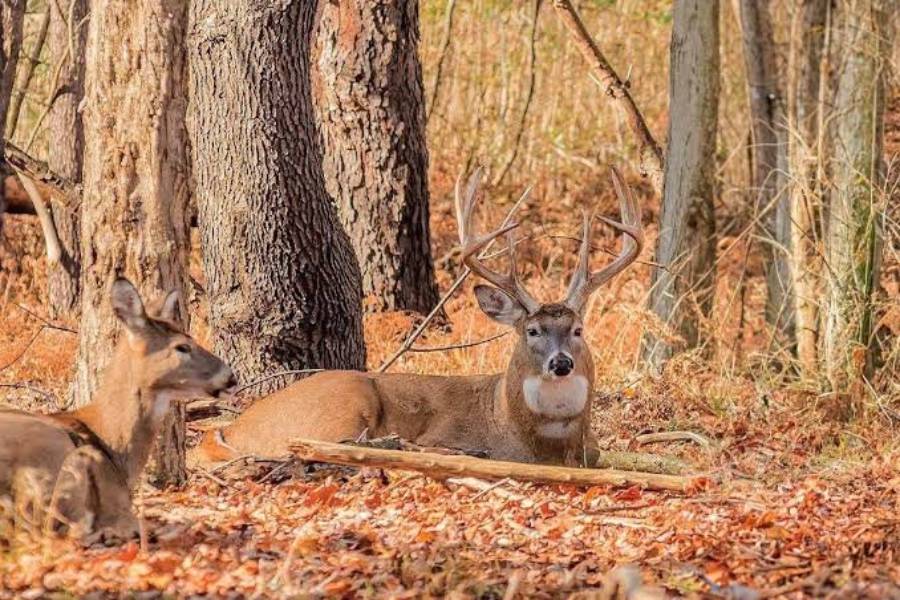
Deer bedding areas can be identified by 7 primary signs: visible ground depressions, flattened vegetation, deer hair, tracks, droppings, concentrated trails, and secure surrounding cover. A single track or pile of droppings does not confirm that deer regularly bed in a location. Stronger evidence comes from finding several signs together, especially clearly defined beds connected to established trails and fresh deer sign.
A deer bedding area is a location where deer lie down to rest, ruminate, and remain concealed for extended periods. The exact appearance changes with habitat and terrain. A bed in tall grass may leave an obvious oval patch of compressed vegetation, while a bed on a wooded ridge may appear as a shallow depression in leaves. Bucks and does can also use bedding cover differently, making surrounding terrain, trails, wind direction, and security cover important when evaluating a potential location.
Hunters can narrow the search by first identifying likely bedding habitat on aerial and topographic maps, then confirming those locations through physical evidence in the field. The key is to distinguish places deer merely travel through from areas they repeatedly use for bedding. This guide explains each of the 7 primary signs, the terrain and cover associated with bedding, and how to confirm an active deer bedding area while minimizing unnecessary disturbance.
How Can You Identify a Deer Bedding Area?
You can identify a deer bedding area by looking for 7 primary signs: visible beds, flattened vegetation, deer hair, tracks, droppings, concentrated trails, and secure surrounding cover. The strongest identification comes from finding several of these signs in the same location. A single deer track confirms that a deer passed through an area, but a defined bed combined with hair, tracks, and established entry or exit trails provides stronger evidence of bedding activity.
The first sign is a visible deer bed. When a deer repeatedly lies in one location, its body presses grass, leaves, or other ground vegetation into a recognizable resting spot. The second sign is flattened vegetation, which can make frequently used beds stand out from the surrounding cover. These two signs provide direct physical evidence because they are created by the deer lying on the ground rather than simply walking through the area.
Three additional signs—deer hair, tracks, and droppings—help confirm that the depression was made or used by deer. Hair may remain within the bed or on nearby vegetation. Tracks can reveal how deer enter and leave the location, while droppings indicate deer have spent time in the immediate area. None of these signs should be treated as conclusive on its own because deer also leave tracks, hair, and droppings along travel routes and feeding areas.
The final two signs are concentrated trails and secure cover. Bedding areas often connect to recognizable entry and exit routes that deer use to move between resting cover and other parts of their range. The surrounding habitat also matters because deer select bedding locations partly according to the security and environmental conditions available there. Thick vegetation, terrain changes, and limited exposure can therefore help a hunter determine whether several physical signs belong to an actual bedding area.
The most reliable approach is to evaluate these signs as a group. A visible bed with fresh deer sign and established trails leading into suitable cover provides much stronger evidence than isolated tracks or droppings. This distinction prevents hunters from confusing a travel corridor with a location deer use for extended periods of rest.
What Does a Deer Bed Look Like on the Ground?
A deer bed usually looks like an oval or elongated depression where leaves, grass, or other vegetation have been compressed by the deer’s body. Its exact appearance depends on the ground surface, vegetation, weather, and how frequently deer use the location. Beds in grassy habitat can be obvious because the vegetation is pressed flat, while beds on a forest floor can be more difficult to distinguish from naturally disturbed leaves.
Look at the entire shape rather than searching for an exact measurement. A deer does not create a perfectly uniform outline every time it lies down, and different deer vary in body size. The surface underneath the deer also changes the appearance of the bed. Tall grass can produce a clearly defined flattened patch, whereas dry leaves, pine needles, or bare soil may show a shallower depression with less distinct edges.
The material inside the depression provides additional evidence. Flattened grass oriented differently from the surrounding vegetation, compressed leaves, exposed soil, or deer hair can strengthen the identification. Nearby tracks are especially useful because they connect the suspected bed with an identifiable deer sign. For example, an oval depression in leaves alone is ambiguous, but the same depression containing deer hair with hoofprints immediately beside it provides a stronger combination of evidence.
Freshness should also be judged from multiple clues rather than from the bed’s shape alone. Recently compressed vegetation may remain flattened before gradually recovering, while recently disturbed leaves or soil may contrast with the surrounding ground. Fresh tracks, droppings, hair, and other current deer activity around the bed provide additional context.
Multiple beds can provide another important clue. Finding several bed-shaped depressions concentrated within the same patch of secure cover suggests repeated or group bedding activity more strongly than finding one unexplained depression. Hunters should still examine tracks, trails, hair, droppings, and surrounding habitat before deciding how actively deer are using the location.
The key difference between a possible deer bed and a confirmed bedding area is supporting evidence. The shape tells you where an animal may have rested; deer-specific signs and repeated bedding evidence tell you whether the location is actually part of a deer bedding area.
Why Is Flattened Vegetation a Sign of Deer Bedding?
Flattened vegetation is a sign of deer bedding because the weight of a resting deer compresses grass, weeds, leaves, and other ground cover beneath its body. When the surrounding vegetation remains upright but one concentrated area is pressed close to the ground, the contrast can reveal where a deer has been lying. Repeated use can make the bed more defined and easier to recognize during scouting.
The pattern matters more than flattened vegetation alone. A suspected deer bed should form a concentrated body-sized depression rather than a long strip of damaged vegetation. Grass pressed down along a continuous line is more consistent with a travel route, while a localized oval or elongated patch is more consistent with a resting location. Finding several similar depressions within the same patch of cover provides additional evidence that deer are bedding there.
Ground conditions determine how obvious this sign will be. Beds in tall grass and dense herbaceous vegetation can produce clearly compressed patches because the surrounding plants remain noticeably taller. Beds under timber can be subtler because leaves, pine needles, and sparse vegetation do not retain the same defined shape. In these locations, hunters need to rely more heavily on the depression itself and supporting deer sign.
Flattened vegetation should not be used as the only evidence because weather, people, livestock, and other wildlife can also compress plants. Examine the suspected bed for deer hair and then inspect the surrounding ground for tracks, droppings, and trails. Flattened vegetation becomes stronger evidence of deer bedding when its shape and location correspond with multiple deer-specific signs.
What Deer Sign Should You Look for Around a Bedding Area?
The 3 most useful supporting deer signs around a suspected bedding area are hair, tracks, and droppings. These signs help determine whether a ground depression or patch of flattened vegetation was actually used by deer. Their value increases when several signs occur around identifiable beds rather than appearing separately across a large area.
Deer hair is particularly useful when it is found inside a suspected bed. Hair can be left behind when the deer’s body contacts the ground or surrounding vegetation while resting. Finding hair inside a correctly shaped depression strengthens the connection between the physical bed and a deer. Hair elsewhere in the habitat provides less certainty because deer can lose it while traveling through cover.
Tracks provide information about both deer presence and movement around the bedding location. Look for hoofprints immediately beside beds and on trails entering or leaving the surrounding cover. Several tracks associated with defined beds and repeated travel routes provide stronger contextual evidence than an isolated hoofprint. A deer track proves deer presence, but it does not by itself prove bedding activity. Deer leave tracks while moving between bedding areas, feeding areas, water sources, and other locations.
Track direction can also help reveal how the bedding area connects with the surrounding habitat. A hunter who finds defined beds inside secure cover can follow the visual direction of nearby trails from a distance to determine likely entry and exit routes. When those trails connect the beds with habitat edges, staging cover, or feeding locations, they help establish the bedding area’s role within a larger deer movement pattern.
Droppings provide another supporting sign, but their location must be interpreted carefully. Deer can defecate in bedding habitat as well as while feeding or traveling, so droppings alone cannot distinguish a bedding area from other areas of deer activity. Their evidentiary value becomes greater when they occur beside identifiable beds together with tracks, hair, and established trails.
The concentration of sign is therefore more useful than any single clue. For example, one pile of droppings beside a trail shows deer activity but provides little information about where the deer rested. A compressed bed containing hair, with hoofprints beside it, droppings nearby, and a defined trail leaving the cover creates a much stronger chain of evidence.
Use hair, tracks, and droppings to confirm a suspected bed rather than to locate bedding areas independently. The bed itself provides evidence of resting behavior, while the surrounding deer sign helps identify the animal responsible and shows whether the location forms part of an established pattern.
What Do Deer Trails Around Bedding Areas Look Like?
Deer trails around bedding areas typically form entry and exit routes that connect secure bedding cover with staging areas, feeding areas, water sources, and other parts of a deer’s range. The most useful bedding-related trails are not simply the widest trails in the woods. Hunters should look for trails that converge near identifiable beds or disappear into dense cover containing other bedding signs.
Trail location provides important context. A well-worn trail across an open field may indicate regular deer movement without revealing where deer bed. A narrower trail entering thick vegetation becomes more relevant when beds, tracks, hair, or droppings occur inside that cover. Several trails converging around a concentrated group of beds provide stronger evidence because the physical resting locations and movement routes support the same conclusion.
Entry and exit trails can also reveal how deer use the bedding area in relation to surrounding habitat. A trail leaving bedding cover toward a food source may form part of an evening movement route, while another route may connect the same bedding cover with additional security habitat. Hunters can use these connections to understand the sequence of movement from bedding area to staging cover to feeding area rather than treating each deer trail as an isolated feature.
The amount of trail use should be evaluated together with freshness. Tracks of different ages, repeated hoofprints, disturbed vegetation, and other current sign can indicate recurring movement. However, heavy trail use does not automatically mean a trail leads to a bed. Feeding locations and major travel corridors can also contain concentrated tracks and well-defined trails.
Avoid following every trail directly into thick cover during scouting. Once a trail points toward a suspected bedding location, examine the surrounding habitat and look for direct bedding evidence before moving farther into the cover. This approach can provide enough information to identify the bedding area’s boundary without unnecessarily walking through its center.
A bedding trail is best identified by what it connects to, not by its appearance alone. Trails that converge on visible beds and secure cover have a stronger relationship with bedding activity than trails supported only by frequent tracks.
What Type of Cover Do Deer Use for Bedding?
Deer use bedding cover that provides security, concealment, and protection from surrounding environmental conditions. Thick brush, tall grass, dense young vegetation, timber cover, and habitat transitions can all provide suitable bedding locations when their structure allows deer to rest while remaining protected from disturbance.
Security cover is especially useful when identifying likely bedding habitat. Dense vegetation can limit visibility from outside the area and make human access more difficult. This creates locations where deer can spend extended periods resting without remaining exposed. For a hunter scouting unfamiliar ground, isolated patches of dense cover surrounded by more open habitat are therefore logical places to investigate for beds and supporting deer sign.
Tall grass and thick low vegetation can also preserve obvious physical beds. When a deer lies down, its body compresses the vegetation and creates a visible depression. This makes grassy bedding cover easier to evaluate than some wooded locations, where beds may leave only subtle disturbances in leaves or forest litter. The habitat changes the appearance of the evidence, but the identification process remains the same: find a potential bed and confirm it with additional deer sign.
Habitat transitions deserve attention because they place different types of cover close together. An edge between mature timber and thick young growth, for example, can combine easier travel with nearby concealment. Hunters should not assume every habitat edge is a bedding area. Instead, transitions should be treated as high-priority scouting locations where physical signs can confirm actual deer use.
Food and water can influence the broader location of bedding cover, but proximity alone does not identify a bed. Deer move between resources and secure resting locations, creating trails that connect different habitat components. A food source with abundant tracks may represent feeding activity, while thick cover nearby may contain the actual beds. Following the relationship between these locations is more useful than assuming deer bed directly beside food or water.
Hunting pressure and other disturbance can also change which cover provides security. A location that appears suitable based on vegetation alone may receive regular human traffic, while a less obvious patch can provide greater isolation. For this reason, hunters should evaluate cover together with access, trails, terrain, and physical deer sign rather than ranking bedding habitat solely by vegetation density.
Suitable cover predicts where deer are likely to bed, while physical beds and supporting deer sign confirm where bedding actually occurs. This distinction is important during scouting because thick cover is common in many hunting areas, but only part of that cover may receive consistent bedding use.
What Terrain Features Help You Find Deer Bedding Areas?
Terrain features such as ridges, points, benches, slopes, and habitat transitions can help hunters narrow down where to search for deer bedding areas. These features do not confirm bedding by themselves. Their value is that they reduce a large hunting property into specific locations where cover, movement routes, and terrain advantages make field scouting more efficient.
Ridges and ridge points are useful starting locations because they create defined terrain that can be identified both on a topographic map and in the field. Rather than searching an entire ridge, hunters can examine points, changes in elevation, nearby cover, and trails that connect the ridge with surrounding habitat. A ridge point containing secure cover becomes more significant when tracks or trails converge near a visible bed.
Benches provide another terrain feature worth checking. A bench is a relatively level section interrupting an otherwise sloping hillside. Because it creates flatter ground within steeper terrain, hunters can identify it on contour maps and then inspect it for bedding evidence. A bench with no deer sign remains only a potential bedding location; a bench containing compressed beds, tracks, droppings, and established trails provides much stronger evidence.
Slopes should be evaluated in relation to the surrounding terrain rather than treated as bedding locations by default. Changes in slope, small shelves, points, and transitions between steep and moderate ground create specific places that can be checked during scouting. Cover remains important because a terrain feature with little security may be less useful than a nearby location where vegetation and topography work together.
Terrain transitions can also concentrate deer movement. A transition may occur where a ridge drops toward lower ground, where a slope meets a creek bottom, or where one habitat type meets another across changing elevation. These changes create identifiable boundaries that hunters can compare with tracks and trails. When several movement routes lead from a transition into secure cover, the surrounding area becomes a stronger bedding candidate.
The practical method is to use terrain to create a scouting shortlist rather than to declare a bedding location from the map. Terrain predicts where a deer bed may occur; physical bedding evidence confirms whether deer actually use that location. This distinction prevents hunters from assuming that every point, bench, or ridge automatically holds deer.
How Can You Find Deer Bedding Areas on a Map?
You can find potential deer bedding areas on a map by identifying secure cover on aerial imagery and terrain features on topographic maps, then comparing the two before scouting the locations in person. Mapping cannot confirm an active bed because it does not provide the physical evidence found on the ground. It is most useful for narrowing dozens of possible locations into a smaller set of high-priority scouting areas.
What Should You Look for on an Aerial Map?
Look for dense or isolated cover, habitat transitions, field edges, vegetation changes, and the relationship between secure cover and nearby resources on an aerial map. Differences in vegetation are often easier to recognize from overhead imagery than from a topographic map because aerial images show the physical structure of the landscape.
Start by locating patches of cover that differ from their surroundings. For example, a small area of dense young vegetation surrounded by mature timber creates an obvious habitat change. A brushy section bordering an agricultural field creates another transition worth examining. These locations do not automatically contain beds, but they reduce the amount of ground that needs to be inspected.
Next, consider how potential bedding cover connects with other parts of the property. Look for possible travel routes between secure cover, feeding locations, water, and larger habitat blocks. This creates a broader picture of how deer could move through the landscape. A potential bedding location becomes more relevant when its surrounding habitat also provides practical movement connections.
Aerial scouting should ultimately produce specific locations to verify in the field. Once there, hunters need to find beds, flattened vegetation, tracks, hair, droppings, or trails before classifying the location as a bedding area.
What Should You Look for on a Topographic Map?
Look for ridges, ridge points, benches, slopes, elevation changes, and other terrain transitions when searching for potential deer bedding areas on a topographic map. Contour lines reveal landforms that may be difficult to recognize from aerial imagery alone and allow hunters to evaluate terrain before entering the property.
Contour patterns can first be used to identify major ridges and the points extending from them. Hunters can then look for changes in contour spacing that indicate differences in slope. Wider spacing generally represents gentler terrain, while tighter contour spacing represents steeper ground. This makes it possible to identify flatter sections, changes in slope, and potential benches that deserve closer inspection.
The strongest map-based approach combines topographic information with aerial imagery. A terrain feature becomes a higher-priority scouting location when it overlaps with suitable cover. For example, identifying a bench on a topographic map is useful, but identifying a bench positioned inside or beside secure cover provides a more specific location to investigate.
Map scouting should end with field confirmation rather than a final assumption. Select the most promising terrain-and-cover combinations, plan how to approach them, and then search for direct bedding evidence. Aerial imagery shows where suitable cover may exist, topographic maps show how the land is shaped, and physical deer sign determines whether the location is actually being used for bedding.
How Does Wind Direction Affect Where Deer Bed?
Wind direction can influence where deer bed because moving air carries scent and changes how deer receive information about their surroundings. For hunters, wind should be evaluated together with terrain, cover, trails, and physical bedding evidence rather than used as a standalone method for locating beds.
The effect of wind becomes easier to evaluate after a potential bedding area has already been identified. Note the position of individual beds relative to surrounding cover and open terrain, then compare those positions with likely wind exposure. Repeated beds positioned in similar locations can reveal more than a single isolated depression because they indicate how deer have repeatedly used that part of the terrain.
Terrain can modify how air moves through a bedding area. Ridges, points, slopes, valleys, and other elevation changes affect local airflow, while temperature differences can produce thermal movement. As a result, the wind experienced at a bed may differ from the general wind direction observed in a more exposed location. Hunters should therefore evaluate conditions at the specific terrain feature rather than relying only on a regional wind direction.
Wind also matters when approaching a suspected bedding area. Entering from a direction that carries human scent toward bedding cover can disturb deer before the hunter reaches the physical beds. This disturbance can make subsequent observation less representative of normal deer movement. Mapping the terrain, identifying likely bedding cover, and considering the approach direction before field scouting can reduce unnecessary intrusion.
Use wind as supporting context for understanding a bedding location, not as proof that deer bed there. A favorable terrain-and-wind combination identifies a location worth investigating, while beds, hair, tracks, droppings, and associated trails provide the physical evidence needed to confirm deer use.
How Can You Tell a Buck Bedding Area From a Doe Bedding Area?
Buck and doe bedding areas can sometimes be distinguished by the number and arrangement of beds, surrounding deer sign, cover, terrain, and repeated patterns of use, but one bed alone does not reliably identify the sex of the deer that made it. Hunters should evaluate multiple clues before labeling a location as a buck or doe bedding area.
What Does a Buck Bedding Area Look Like?
A suspected buck bedding area may contain an isolated bed or a small number of beds positioned within secure cover and connected to distinct entry and exit routes. The surrounding context is more informative than bed size alone. Terrain position, cover, tracks, nearby rubs when present, and repeated observations can strengthen the case that a particular location is being used by a buck.
An isolated bed deserves attention when it occurs in a location that also provides security and established deer movement. For example, a single defined bed on a terrain feature inside thick cover carries more information when a trail consistently connects it with the surrounding habitat. Finding one large depression without additional sign provides much weaker evidence.
Tracks can add context, but they should also be interpreted conservatively. A hunter can use hoofprints to confirm deer presence and identify travel direction, but a track beside a bed does not automatically establish the animal’s sex or age. Combining bedding patterns with other field evidence provides a more reliable assessment than making the determination from one oversized track or bed.
Repeated observations provide stronger confirmation. Trail-camera information, seasonal scouting observations, or consistent sign associated with the same location can help determine how a suspected buck bed fits into the animal’s movement pattern. This is especially useful when scouting a location over time rather than making a conclusion during one visit.
What Does a Doe Bedding Area Look Like?
A suspected doe bedding area is more likely to contain multiple beds grouped within the same general area when does and accompanying deer are bedding together. Several depressions of different sizes concentrated within suitable cover can therefore indicate group bedding, although the beds still need supporting evidence before the location can confidently be associated with does.
The arrangement of beds provides useful context. Several beds positioned close to one another suggest that multiple deer have rested within the same patch of cover. Tracks of different sizes, established trails, droppings, and repeated observations can strengthen this interpretation. In contrast, several old depressions accumulated over time do not necessarily mean multiple deer were bedding there simultaneously.
Group bedding can also produce a broader network of movement around the location. Multiple entry and exit trails or concentrated tracks may reflect repeated use by several deer. Hunters can compare these movement patterns with nearby feeding habitat and security cover to understand how the bedding location functions within the surrounding area.
Do not distinguish buck and doe bedding areas from bed size alone. A stronger identification combines bed arrangement, tracks, surrounding sign, terrain, cover, movement patterns, and repeated observations. The objective is to build multiple pieces of evidence pointing toward the same conclusion rather than assign a deer to every bed based on one physical characteristic.
Read more: Can Deer Hear a Safety Harness? What Hunters Should Know
How Can You Confirm a Deer Bedding Area Without Disturbing It?
You can confirm a deer bedding area with less disturbance by combining map scouting, edge inspection, physical deer sign, trail analysis, and remote observation before entering the center of the bedding cover. The objective is to collect enough evidence to establish that deer regularly bed there without unnecessarily walking through the location and altering normal deer movement.
Start with aerial imagery and topographic maps to identify the likely boundaries of the bedding cover. Mark terrain features, dense vegetation, habitat transitions, nearby food sources, and potential travel routes before entering the property. This preparation reduces the amount of ground that needs to be searched and provides specific locations where physical evidence is more likely to occur.
Approach the suspected bedding area from its edge and inspect accessible trails before moving into the cover. Tracks, droppings, hair, and trails entering dense vegetation can support the bedding hypothesis without requiring immediate inspection of every suspected bed. When visible beds can be confirmed from the edge or from a low-impact approach, additional intrusion may provide little useful information.
Wind direction should be considered before entering the area because human scent carried toward bedding cover can alert deer before visual contact occurs. Terrain can complicate airflow, so hunters should evaluate the specific approach route rather than relying entirely on a general wind forecast. Noise, visibility, and the amount of vegetation disturbed during entry also affect how intrusive a scouting trip becomes.
Trail cameras or observation from outside the bedding cover can provide additional evidence when their use is appropriate for the location and local regulations. Repeated deer movement into or out of the suspected cover helps connect physical beds with current activity. Observation is particularly valuable when the hunter needs to determine whether a bedding area is still active without repeatedly entering it.
Walking directly into a bedding area provides more physical information but also creates more disturbance. It is most useful when detailed scouting information is worth that trade-off, rather than as the default method for every suspected location. The appropriate level of intrusion depends on the purpose and timing of the scouting trip.
Confirm the bedding area with the least intrusive evidence necessary for your hunting objective. Maps identify potential locations, edge sign establishes deer presence, physical beds establish resting behavior, and repeated movement or observation helps determine whether the area remains active.
What Signs Give the Strongest Evidence of an Active Deer Bedding Area?
The strongest evidence of an active deer bedding area is a combination of identifiable beds, fresh deer sign, established entry and exit trails, and repeated deer activity within suitable cover. Evidence becomes more reliable when independent signs point to the same conclusion instead of relying on one track, dropping, or ground depression.
Strong evidence begins with physical beds. A defined depression containing compressed vegetation or disturbed ground directly indicates that an animal rested there. Deer hair within the depression and hoofprints immediately around it help establish that the bed was made by a deer. Fresh droppings and tracks associated with the same location add further evidence of recent use.
Established trails strengthen the identification when they connect directly with the bedding cover. Several trails converging around beds indicate a relationship between resting locations and repeated movement. The evidence becomes stronger again when recent tracks occur on those trails and remote observation or trail-camera activity shows deer repeatedly entering or leaving the cover.
Moderate evidence consists of likely beds combined with suitable habitat and limited supporting sign. For example, several oval depressions inside thick cover with a trail nearby justify further investigation, but they provide less certainty when fresh tracks, hair, droppings, or repeated deer activity are absent. The location may be a bedding area that is used infrequently, seasonally, or was used more heavily in the past.
Weak evidence includes isolated tracks, scattered droppings, attractive-looking cover, or a promising terrain feature without physical beds. Each clue can identify a location worth scouting, but none independently demonstrates bedding behavior. A ridge point with thick vegetation is potential bedding habitat until direct deer sign establishes actual use.
Freshness also changes the value of the evidence. Old beds demonstrate previous bedding activity but do not establish that deer currently use the location. Combining recent tracks, current trail activity, fresh supporting sign, and repeated observations provides a better assessment of present use than relying on the existence of old depressions alone.
The identification process can therefore be reduced to a simple evidence hierarchy: terrain and cover predict potential bedding locations; physical beds establish resting activity; multiple fresh deer signs and repeated movement provide the strongest evidence of an active deer bedding area. Using this hierarchy allows hunters to separate promising habitat from locations deer are actually using.