
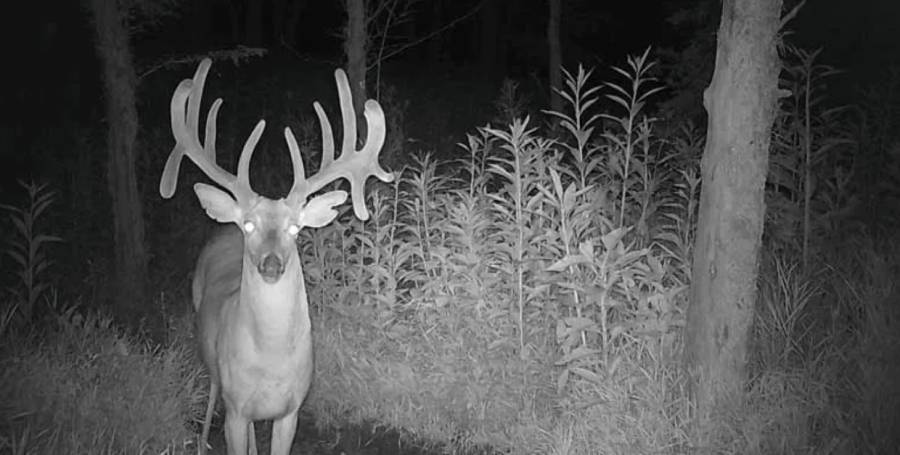
Yes, deer can see some types of trail camera flash, but how noticeable the flash is depends on the technology used. White-flash trail cameras produce visible light that deer can detect, while red-glow or low-glow infrared cameras emit a faint red light from their LEDs when taking nighttime photos. No-glow cameras use infrared technology designed to minimize visible light, making their flash much harder for deer to notice.
Seeing a trail camera flash, however, does not automatically mean a deer will become spooked or avoid the area. Detection and behavioral response are different. A deer may notice a flash or camera without showing an avoidance response, while repeated exposure, human scent, camera placement, and hunting pressure can provide additional cues that affect its behavior.
For hunters, this distinction matters when choosing between white-flash, red-glow, and no-glow trail cameras. Understanding what deer can see, how their vision works at night, and how they respond to different camera technologies helps determine which flash type is better suited to low-disturbance scouting. This article explains those differences and how they apply when monitoring deer, including mature bucks.
Can Deer See Trail Camera Flash?
Deer can see the flash from some trail cameras, particularly cameras that produce white light or a visible red glow at night. The amount of light a deer can detect depends on the flash system rather than simply whether the camera is labeled as an infrared trail camera. White-flash, red-glow, and no-glow cameras produce different visual stimuli when triggered, so they do not have the same likelihood of being noticed.
The key distinction is between the infrared light used for nighttime imaging and any visible light produced by the camera’s LEDs. A trail camera can use infrared illumination while still producing a faint visible glow at the LED array. This is why hunters should not assume that every infrared trail camera is invisible to deer. Red-glow cameras are an important example: the infrared illumination is used for nighttime images, but the LEDs can visibly glow red when activated.
A deer noticing that light also does not prove that the flash will spook it. Visual detection describes whether the animal can perceive a stimulus, whereas a behavioral response describes what it does afterward. A deer might look toward a camera, pause, continue walking, leave the immediate area, or eventually avoid the location. Those responses can also be influenced by other cues around the camera, including human scent and repeated disturbance.
For hunting purposes, trail camera flash should therefore be evaluated in two stages: how visible the flash is to deer and how deer respond after detecting it. White flash creates the most obvious visible-light event of the three major systems. Red-glow cameras reduce that visible signature but do not eliminate it. No-glow cameras are specifically designed to minimize visible illumination and are therefore the logical option when reducing visible camera detection is the priority.
What Types of Trail Camera Flash Can Deer See?
There are 3 main trail camera flash systems hunters need to distinguish: white flash, red-glow infrared, and no-glow infrared. Their differences matter because each system illuminates nighttime subjects differently and creates a different level of visible stimulus at the camera.
Can Deer See White Flash From a Trail Camera?
Yes, deer can see white flash from a trail camera because it produces visible light. A white-flash camera illuminates a nighttime scene in a way comparable to a conventional camera flash, creating an abrupt change from darkness to bright light when the camera is triggered.
This makes white flash fundamentally different from infrared illumination. Instead of attempting to conceal the illumination outside the relevant visible range, white-flash cameras deliberately illuminate the subject with visible light. The benefit is the ability to capture color nighttime images on cameras designed for this purpose, but the trade-off for hunters is a much more noticeable flash event.
The important hunting question is not whether a deer is physically capable of noticing white flash; it is what the deer does after noticing it. A visible flash provides a clear stimulus, but the resulting reaction can range from little apparent concern to an avoidance response. Flash visibility alone therefore should not be treated as proof that every photographed deer has been spooked.
Can Deer See Red-Glow Trail Camera Flash?
Deer can notice the faint red glow produced by a red-glow trail camera when its infrared LEDs activate. These cameras, also called low-glow cameras, use infrared illumination for nighttime imaging but can produce a visible red appearance at the LED array during activation.
This distinction explains why describing a red-glow camera simply as “invisible infrared” is misleading. The camera uses infrared technology, but the LED array itself can still provide a visible cue. The glow is substantially different from the bright illumination of a white-flash camera, yet a deer looking toward the camera can potentially notice that localized red light.
Red-glow technology therefore represents a compromise for deer scouting. It reduces the conspicuous visible flash associated with white-flash systems without attempting to eliminate visible glow to the extent of a no-glow camera. Hunters concerned about camera detection should consider this difference particularly in locations where deer repeatedly pass close to the camera.
Can Deer See No-Glow Trail Camera Flash?
No-glow trail cameras are designed to produce far less visible illumination than white-flash or red-glow cameras, making their nighttime flash much harder for deer to detect visually. These systems are also commonly described as black-flash or invisible-flash trail cameras.
The practical advantage is the absence of the obvious white burst or red LED glow associated with the other two systems. This makes no-glow technology particularly relevant when the goal is to reduce the camera’s visual signature around frequently used deer travel routes or other locations where hunters want minimal visible disturbance.
No-glow should not, however, be interpreted as meaning the entire trail camera is undetectable to deer. It describes the illumination system, not every cue produced by the camera setup. A deer can potentially encounter the physical camera itself or other signs associated with its installation and maintenance. For that reason, choosing no-glow flash addresses one detection pathway—visible illumination—but does not replace careful camera placement and low-intrusion scouting practices.
Can Deer See Infrared Trail Camera Flash?
Deer are less likely to detect the infrared illumination itself than the visible glow produced by some infrared trail camera LEDs. For hunters, the important distinction is not simply whether a camera uses infrared technology, but what wavelength it uses and whether the LED array creates visible light when the camera takes a nighttime photo or video.
Infrared trail cameras commonly use illumination around 850 nm or 940 nm. Cameras using approximately 850 nm infrared are generally categorized as red-glow or low-glow cameras because their LED array can produce a faint red glow while operating. Cameras using approximately 940 nm infrared are commonly marketed as no-glow or black-flash cameras because the illumination system produces much less visible glow. This technological difference explains why two cameras described as “infrared” can have noticeably different visual signatures in the field.
For deer scouting, 850 nm and 940 nm should therefore not be treated as interchangeable flash systems. An 850 nm camera can expose its location through the red glow generated during activation, especially when a deer is close to the unit or looking toward it. A 940 nm no-glow camera minimizes this particular visual cue, making it more appropriate when reducing visible disturbance is more important than using a red-glow system.
Claims that deer can directly see specific infrared wavelengths require stronger evidence than the fact that deer react to an infrared trail camera. A deer looking at or moving away from an IR camera does not establish that it saw the infrared wavelength itself. The animal could have detected visible LED glow, the physical camera, human scent, sound, or another environmental change associated with the setup. For hunters, the more defensible conclusion is that no-glow technology reduces visible illumination, but it does not make a trail camera completely undetectable to deer.
How Does Deer Vision Affect Their Ability to See Trail Camera Flash?
Deer vision makes changes in light and visual stimuli relevant at night, but their visual system does not perceive the environment exactly as human vision does. Deer are adapted to function effectively under low-light conditions, which is important because whitetails are especially active around dawn, dusk, and during nighttime periods. A trail camera activating in those conditions introduces a new visual stimulus into an environment where the animal is already navigating with limited ambient light.
Deer color vision also differs from human color vision. Whitetails are generally described as dichromatic rather than trichromatic like humans, meaning their color perception is based on a different set of cone photoreceptors. This distinction matters when discussing trail camera flash because a color that appears obvious to a hunter does not necessarily appear identical to a deer. However, differences in color perception should not be confused with an inability to detect light, brightness, movement, or contrast.
Low-light vision is particularly relevant to trail cameras. A deer moving through a dark travel corridor can encounter an abrupt white flash, a localized red LED glow, or almost no visible illumination depending on the camera system. White flash creates the clearest visual change because it illuminates the scene with visible light. Red-glow cameras create a smaller and more localized visual cue at the LED array, while no-glow systems are designed to minimize that cue.
This is why flash type matters more to a hunter than the broad label “night-vision trail camera.” The useful comparison is the complete illumination system: its wavelength, whether the LEDs visibly glow, how conspicuous the activation is in darkness, and how close deer travel to the camera. These attributes determine the visual stimulus presented to the animal more accurately than the word “infrared” alone.
Deer vision also explains only one part of camera detection. Even a trail camera with minimal visible illumination remains a foreign object in the animal’s environment. A deer can potentially respond to the camera or its surroundings without ever seeing a flash. Separating these detection pathways is essential when evaluating whether a particular camera actually changes deer behavior.
Does Trail Camera Flash Spook Deer?
Trail camera flash can alert or startle a deer, but seeing a flash does not mean the deer will automatically become spooked or avoid the area. There are several levels of response between detecting a camera flash and changing long-term movement patterns. A deer can notice the light, look toward the camera, pause, leave the immediate location, or begin avoiding that location. These behaviors should not be treated as equivalent evidence of disturbance.
The first response is detection. A white flash or visible red glow gives a deer a visual stimulus that was not present before the camera triggered. The deer may orient its head or eyes toward the source without leaving. This reaction shows that something attracted its attention, but it does not demonstrate avoidance. A deer that looks directly at a trail camera in one image and continues along the same route afterward has reacted differently from a deer that abruptly changes direction and stops using the location.
A stronger response occurs when the stimulus causes the deer to leave or alter its immediate behavior. Even then, a single reaction does not establish long-term camera avoidance. Long-term disturbance requires a behavioral change that persists beyond the individual camera encounter, such as repeatedly avoiding the immediate camera location or changing how the area is used. Hunters should therefore be cautious about concluding that every deer looking at a camera has been “spooked.”
Mature bucks deserve particular attention because hunters often use trail cameras specifically to determine their movement patterns. A mature buck looking toward a camera is evidence that it detected a stimulus, not proof that the flash permanently changed its movement. Flash type is also only one variable. Human scent left while installing or checking the camera, repeated visits to the site, and the physical position of the camera can introduce additional cues. Separating these factors is necessary before attributing a behavioral change specifically to flash.
Repeated exposure can also produce different responses between individual deer and locations. A deer that repeatedly encounters the same non-threatening stimulus may stop responding strongly to it, while another animal may remain cautious. For this reason, hunters should evaluate trail-camera images as a sequence rather than interpreting one photograph in isolation. Repeated head turns toward the camera, abrupt departures, reduced subsequent appearances, or consistent route changes provide more behavioral information than a single image of a deer staring at the lens.
Is Red Glow or No Glow Better for Deer Hunting?
No-glow trail cameras are the better choice when minimizing visible flash around deer is the primary goal, while red-glow cameras remain suitable when a faint visible LED glow is acceptable. The practical difference comes from how conspicuous each illumination system is when activated at night.
Red-glow cameras commonly use infrared illumination around 850 nm and can display a faint red light at the LED array. This glow is much less conspicuous than a conventional white flash, but it still creates a visible cue at the camera. A deer passing close to the unit and facing it therefore has a greater opportunity to notice the activation than it would with a no-glow system.
No-glow cameras commonly use illumination around 940 nm and are designed to minimize visible glow from the LED array. Their main hunting advantage is therefore straightforward: they remove or substantially reduce one of the visual cues that can reveal a trail camera’s presence at night. This characteristic makes no-glow cameras particularly relevant for hunters trying to minimize visible disturbance around frequently used deer routes or locations where repeated monitoring is necessary.
The choice should not be based on flash visibility alone. Hunters also need to consider the imaging performance and specifications of the individual camera because red-glow and no-glow describe illumination technologies rather than the total quality of the camera. Trigger performance, detection range, nighttime image quality, battery use, and the intended monitoring distance can differ between individual models.
For low-disturbance deer scouting, the decision is simpler. Choose no-glow when minimizing visible illumination has the highest priority. Choose red-glow when a faint visible LED signature is acceptable and the characteristics of that particular camera better fit the scouting location. Neither technology eliminates the need to control the other ways deer can detect a trail-camera setup.
What Trail Camera Flash Is Least Likely to Spook Deer?
No-glow flash is the trail camera flash type least likely to create a visible stimulus that alerts deer. Compared with white flash and red-glow infrared systems, no-glow cameras are designed to minimize visible illumination when capturing nighttime images. This makes them the preferred option when a hunter’s main objective is reducing the visual signature of a camera.
The advantage comes from the illumination system. White-flash cameras create an obvious burst of visible light, while red-glow cameras can produce a faint red glow at the LED array. No-glow cameras, commonly associated with infrared illumination around 940 nm, substantially reduce that visible glow. A deer passing a no-glow camera therefore receives less visible evidence that the camera has activated.
However, “least visible” and “least likely to spook deer” are not exactly the same claim. Flash is only one stimulus associated with a trail camera. Deer can encounter scent, sound, the physical camera, or human disturbance around the site. A hunter who replaces a red-glow camera with a no-glow model but repeatedly walks through a bedding area to check it has reduced one potential source of detection while leaving another source of disturbance in place.
For this reason, no-glow flash is most useful as part of a low-intrusion scouting strategy rather than as a standalone solution. Hunters should combine a low-visibility flash with careful placement and limited disturbance around the camera site. This approach reduces multiple opportunities for deer to associate the location with an unfamiliar stimulus.
Can Deer Detect a Trail Camera Without Seeing the Flash?
Yes, deer can potentially detect a trail camera without seeing its flash because flash is only one cue associated with the camera setup. Four relevant detection pathways are human scent around the site, camera sound, the physical presence of the camera, and repeated human intrusion while installing or checking it. These factors are important when a deer appears to react to a no-glow camera despite receiving little visible illumination from its flash.
Can Deer Smell Human Scent Around a Trail Camera?
Human scent around a trail camera can provide deer with a cue that a person recently entered the area. Installing a camera requires a hunter to approach the site, handle equipment, attach the unit, adjust its position, and then leave. Checking a conventional SD-card camera can repeat that disturbance each time images are retrieved.
This distinction matters when interpreting apparent camera avoidance. A deer that changes behavior around a trail-camera location has not necessarily detected the camera’s flash. The animal may instead be responding to evidence associated with the hunter’s visit. Flash and human intrusion therefore need to be treated as separate variables when evaluating trail-camera effects.
The location also changes the practical importance of scent. Entering a frequently used travel corridor and entering a sensitive bedding location do not create the same scouting situation. Hunters trying to minimize disturbance should consider not only what the camera detects but also how often they must physically enter the area to operate it.
Can Deer Hear a Trail Camera Trigger?
A trail camera can produce operational sounds, but the amount of sound depends on the individual camera and its components. It is therefore inaccurate to assume that every deer looking toward a camera heard the trigger, just as it is inaccurate to assume that every reaction was caused by flash.
The useful hunting principle is to separate sound from light as potential stimuli. If a deer reacts around a no-glow camera, the reaction alone does not identify which cue it detected. The animal may have noticed the camera itself, residual scent around the setup, a sound associated with operation, or another environmental stimulus occurring at the same time.
Camera-specific performance matters here. Hunters concerned about minimizing detection should evaluate the actual behavior of a model rather than assuming that the flash specification describes every aspect of its operation.
Can Deer Notice the Physical Trail Camera?
Deer can potentially notice the physical presence of a trail camera even when its nighttime illumination produces little visible glow. A trail camera remains a new object attached to a tree, post, or other structure in an environment the deer regularly uses.
Placement determines how prominent that object is. A camera positioned directly at deer eye level and facing an approaching animal presents a different visual situation from one positioned less conspicuously while still covering the target area. Distance also matters because deer passing immediately beside the camera have more opportunity to encounter the unit itself than animals photographed farther away.
This is another reason no-glow should not be interpreted as “invisible camera.” No-glow describes the flash system, not the visibility of the camera body. Hunters seeking a low-disturbance setup need to consider both factors.
Can Frequent Camera Checks Make Deer Avoid an Area?
Frequent camera checks increase human intrusion around a trail-camera site and can undermine the advantage gained from using a less visible flash. Every visit can involve walking through the surrounding habitat, approaching the camera, handling equipment, and leaving fresh evidence of human activity.
This becomes especially relevant in locations hunters want to keep minimally disturbed. Repeatedly entering a sensitive area simply to retrieve images introduces a factor unrelated to whether the camera uses white flash, red glow, or no glow. A hunter evaluating camera disturbance should therefore consider the entire monitoring process rather than flash technology in isolation.
Reducing unnecessary site visits is one way to limit this intrusion. The practical objective is not to make the trail camera literally undetectable; it is to reduce the number and intensity of unfamiliar cues associated with the setup. No-glow illumination addresses visible flash, while careful placement and less intrusive camera management address additional detection pathways.
Read more: Do Deer Sleep Standing Up or Lying Down?
Where Should You Place a Trail Camera to Reduce Deer Disturbance?
Place a trail camera where it can monitor deer movement without forcing frequent human entry into the area or putting the camera directly in a deer’s normal line of travel. Flash type matters, but placement determines how close deer come to the camera, how conspicuous the unit is, and how much disturbance hunters create while installing and checking it.
Camera angle is one consideration. Positioning a camera so deer do not consistently approach it head-on can reduce the prominence of the camera and its illumination system. This is particularly relevant for red-glow cameras because an approaching deer has a greater opportunity to face the LED array when the camera triggers. A position that captures deer crossing the detection area can reduce direct exposure while still documenting movement.
Distance also affects the encounter. Placing a camera immediately beside a heavily used trail creates close-range opportunities for deer to encounter the camera body, visible LED glow, or other cues around the setup. The appropriate distance depends on the camera’s detection and illumination capabilities, so hunters should position the unit far enough to reduce unnecessary close encounters while keeping deer within its effective detection and imaging range.
The access route to the camera can be as important as the camera’s exact position. A technically well-hidden no-glow camera still requires human intrusion if the hunter repeatedly walks through the area to retrieve images or maintain the unit. Where possible, choose a location that can be accessed without repeatedly crossing the primary deer travel route or disturbing the area being monitored.
Sensitive locations require additional consideration. Bedding areas can provide valuable information about deer movement, but entering them repeatedly to manage a camera can conflict with the goal of low-disturbance scouting. Travel corridors and other locations that can be monitored from a less intrusive access route may provide a better balance between collecting useful information and minimizing human presence.
The objective is therefore not simply to hide the camera. Effective low-disturbance placement reduces three things: visible exposure of the camera, close encounters with the equipment, and unnecessary human intrusion. Combining these placement principles with no-glow illumination addresses more potential detection cues than changing flash type alone.
Should You Use No-Glow Trail Cameras Around Mature Bucks?
No-glow trail cameras are a suitable choice around mature bucks when minimizing visible camera illumination is the priority. Their primary advantage is straightforward: the flash system produces substantially less visible glow than white-flash or red-glow alternatives, removing one obvious nighttime stimulus from the scouting setup.
This advantage is especially relevant when a hunter wants repeated information from the same location. Trail-camera scouting depends on observing movement over time, so minimizing unnecessary stimuli can be more useful than judging the setup from a single photograph. A mature buck looking directly at a camera does not by itself establish that the animal has been spooked, but reducing conspicuous camera cues remains a logical precaution when low intrusion is the objective.
No-glow technology does not make careless camera use harmless. A no-glow camera can minimize visible flash while the hunter still introduces human scent, repeated site visits, or a conspicuously positioned camera. These factors remain separate from the illumination system. Changing to 940 nm no-glow technology addresses the flash component without automatically addressing the rest of the setup.
Hunters should therefore evaluate mature-buck camera setups as a complete system. Use a low-visibility flash when appropriate, position the camera so it is not unnecessarily prominent, choose an access route that limits disturbance, and avoid entering the site more often than necessary. The goal is to collect useful movement information while introducing as few unfamiliar cues as practical.
For the original question—can deer see trail camera flash?—the answer ultimately depends on the flash type. Deer can see the visible illumination from white-flash cameras and can potentially notice the red LED glow produced by red-glow infrared cameras. No-glow cameras are designed to minimize visible illumination and are therefore the strongest choice when reducing visible flash is the main hunting objective. The camera itself, however, can still be detected through other cues, which is why flash selection and low-intrusion scouting should be used together.