
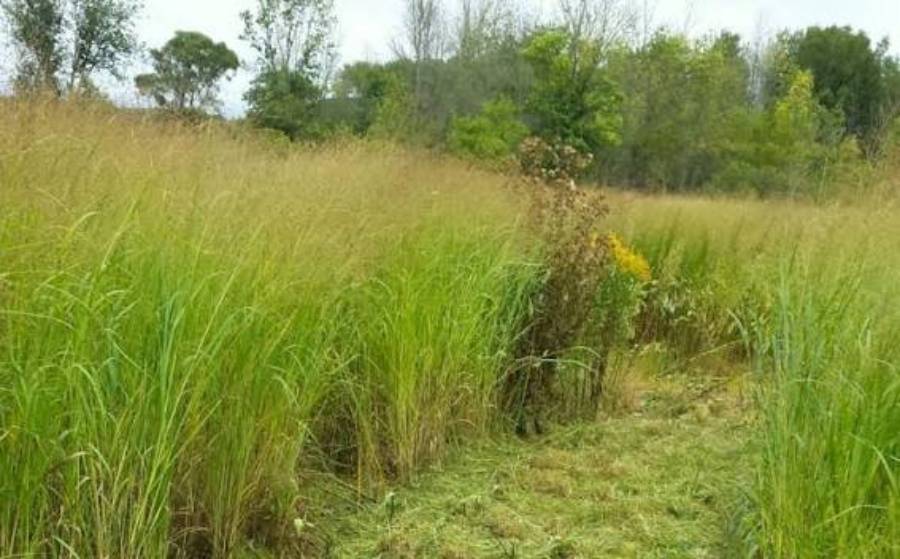
The best warm-season grasses for deer habitat include switchgrass, big bluestem, Indiangrass, little bluestem, and mixtures of native warm-season grasses. These grasses can provide tall, persistent vegetation that gives white-tailed deer bedding cover, fawning cover, visual screening, and secure travel routes. The best choice depends on the habitat function you want the planting to perform rather than simply which grass grows tallest.
Warm-season grasses are especially valuable when their structure complements other vegetation on a hunting property. A dense stand of switchgrass, for example, can create screening and security cover, while a diverse mixture of native grasses and forbs can provide more varied structure. Grass height, stem density, winter persistence, plant diversity, soil conditions, and stand location all influence how useful a planting becomes for deer.
Warm-season grasses should therefore be selected as a habitat management tool rather than simply as a food source for deer. A productive deer property combines grass cover with other habitat components, including woody cover, browse, natural forage, mast-producing plants, and feeding areas. This guide compares the leading warm-season grasses for deer habitat and explains how to select, establish, position, and maintain them according to specific deer management and hunting objectives.
What Are the Best Warm-Season Grasses for Deer Habitat?
The 5 best warm-season grass options for deer habitat are switchgrass, big bluestem, Indiangrass, little bluestem, and native warm-season grass mixtures. Each option serves a different habitat function, so the best choice depends on whether the primary goal is bedding cover, visual screening, fawning cover, secure travel, or greater plant diversity. Hunters should evaluate grasses by their structure and habitat function rather than selecting a species based only on maximum height.
Switchgrass is one of the strongest options when dense, tall, persistent cover is the primary objective. Mature stands can create substantial visual obstruction that helps separate deer from roads, neighboring properties, open fields, and hunter access routes. Its upright structure can also remain useful after the growing season, making switchgrass particularly relevant when a property needs screening or security cover during fall and winter. A dense switchgrass planting, however, should not automatically replace diverse native vegetation across an entire property. Its greatest value comes from placing it where its specific structural characteristics solve a habitat problem.
Big bluestem provides tall cover while fitting naturally into more diverse native grass communities. Rather than relying on one species to create uniform vegetation, land managers can combine big bluestem with other native grasses and broadleaf plants to produce variations in height, density, and ground-level structure. This makes big bluestem useful where the objective is to develop larger habitat areas instead of creating only a narrow visual screen. The vegetation growing between and around the grass stems also matters because deer habitat depends on the complete plant community, not grass height alone.
Indiangrass is another tall native warm-season grass that works well as part of a mixed deer habitat planting. Its vertical structure adds cover while allowing managers to build stands containing multiple grass species and associated forbs. This combination can produce more structural variation than a uniform single-species planting. For deer managers, Indiangrass is therefore most relevant when the objective is a diverse native stand that provides cover without making every part of the planting structurally identical.
Little bluestem provides a shorter and less uniform structure than the tallest warm-season grasses, which makes it useful when habitat diversity is more important than maximum screening height. It can occupy portions of a native planting where different vegetation heights and densities are desirable. Little bluestem should not be considered inferior simply because it does not create the same tall wall of vegetation associated with dense switchgrass. Deer habitat contains multiple structural layers, and shorter native grasses can contribute to that variation when combined with taller grasses, forbs, and woody vegetation.
Native warm-season grass mixtures are often the better strategy when the goal is overall habitat diversity rather than a single cover function. A mixture can combine species such as big bluestem, Indiangrass, and little bluestem while leaving room for beneficial native forbs. The resulting stand can provide different vegetation heights, stem densities, and forms of cover within the same habitat area. This approach is especially relevant for larger habitat projects where bedding, fawning, movement, and plant diversity need to coexist.
The best selection therefore changes with the management objective. Switchgrass is particularly useful for dense screening and security applications, while diverse native warm-season grass mixtures are better suited to creating structurally varied habitat. Big bluestem and Indiangrass contribute tall structure within mixed stands, while little bluestem contributes another vegetation layer. A hunting property can also use more than one strategy—for example, dense grass along a screening route and a more diverse native mixture within larger habitat blocks.
What Makes a Warm-Season Grass Good for Deer Habitat?
A warm-season grass is valuable for deer habitat when it provides the right combination of vegetation height, usable density, structural persistence, and plant diversity for a defined habitat objective. Maximum grass height alone does not determine habitat quality. A stand must create useful cover while remaining part of a vegetation community that deer can use for bedding, movement, and seasonal security.
Height primarily determines how effectively a grass stand creates vertical and visual cover. Taller grasses can obscure sight lines between deer and external disturbances, which makes them useful around open areas, access routes, and habitat edges. Height becomes more valuable when stems remain upright instead of collapsing soon after the growing season. For a hunting property, this persistence matters because deer still need security cover during fall and winter when hunting pressure and seasonal vegetation changes can alter how exposed an area feels.
Density must be evaluated together with height because the densest possible stand is not automatically the best deer habitat. Extremely dense vegetation can create an effective visual barrier, but habitat areas have different requirements from screening strips. Bedding and fawning habitat benefit from protective vegetation, while the surrounding plant community also needs structural variation and usable space. This is why the same grass planting strategy should not be applied automatically to every acre of a property.
Structural persistence determines how long the grass continues performing its cover function. A grass that reaches substantial height during summer but loses most of its upright structure later in the year provides a different habitat value from vegetation that remains standing into the hunting season. Managers should therefore evaluate warm-season grasses across the entire period when deer are expected to use the area rather than judging a planting only at peak summer growth.
Plant diversity provides the fourth major attribute. Grasses primarily contribute structure, while forbs and other vegetation can add additional habitat functions within and around a grass stand. Removing every non-grass plant to produce a visually uniform field can reduce the structural and botanical diversity that makes native habitat useful. A deer habitat planting should therefore be managed according to its intended function, not according to the appearance expected from a lawn or agricultural monoculture.
These 4 attributes explain why there is no universal warm-season grass that is best for every location on a hunting property. A tall, dense planting may be appropriate for a screening strip, while a mixed stand containing grasses and forbs may be more appropriate for a larger habitat block. The best warm-season grass is the one whose structure matches the specific habitat function required at that location.
Which Warm-Season Grass Is Best for Each Deer Habitat Goal?
The best warm-season grass depends on whether the habitat goal is bedding, screening, fawning cover, or secure deer movement. Switchgrass is particularly useful where dense vertical structure and visual screening are priorities, while mixtures containing big bluestem, Indiangrass, little bluestem, and native forbs are better suited to habitat areas where structural diversity is the main objective. Selecting grass by habitat function prevents land managers from using the same planting strategy across areas that serve different purposes.
| Deer habitat goal | Grass strategy | Primary function |
|---|---|---|
| Bedding cover | Tall grass or diverse native mixture | Security and concealment |
| Screening cover | Dense switchgrass or similar tall stand | Visual obstruction |
| Fawning cover | Diverse native grass and forb mixture | Protective, varied vegetation |
| Travel corridors | Tall, strategically placed grass | Secure movement |
| General habitat improvement | Native warm-season grass mixture | Structural diversity |
For bedding cover, vegetation structure is more important than selecting one grass species by name. Deer need sufficient concealment to use an area with a sense of security, but maximum stem density is not always desirable throughout an entire bedding area. Tall grasses such as switchgrass can contribute substantial cover, while mixed native stands can provide variations in vegetation height and density. The appropriate strategy depends on what vegetation already surrounds the site and whether the manager is trying to create a concentrated security zone or a larger, more diverse habitat block.
For screening cover, switchgrass is one of the strongest choices because its value comes from creating tall visual obstruction. Screening has a narrower objective than general habitat improvement: it reduces visibility through a specific strip of vegetation. Hunters can use this function where deer would otherwise see movement near access routes, field edges, food plots, or other exposed portions of a hunting property. In this situation, a relatively uniform stand can be useful because the management objective is consistent visual coverage rather than maximum plant diversity within the strip.
For fawning cover, a diverse native grass community is generally more appropriate than treating maximum grass density as the primary target. A mixture of grasses, forbs, and other herbaceous vegetation creates multiple layers of structure instead of a uniform wall of stems. Tall native grasses contribute concealment, while shorter vegetation and broadleaf plants increase variation within the stand. This makes plant-community structure a more useful selection criterion than choosing a single grass solely because it reaches the greatest mature height.
For travel corridors, warm-season grasses are most useful when their location creates continuity between existing habitat components. A strategically positioned strip can provide visual security between wooded cover, bedding areas, feeding areas, and other locations deer already use. Grass selection should therefore follow corridor design. Tall, persistent vegetation is more valuable when visual screening is required, while a broader mixed stand can be appropriate where the corridor is intended to function as habitat rather than simply as a narrow screen.
The same hunting property can use multiple grass strategies because each area can have a different habitat objective. A manager might use switchgrass for screening along an exposed access route while establishing a diverse native grass mixture within a larger bedding or fawning area. Matching the planting to its intended function produces a more coherent habitat plan than selecting one grass species and planting it everywhere.
Should You Plant Switchgrass or a Native Grass Mix for Deer?
Plant switchgrass when dense, relatively uniform cover is the primary objective; plant a native warm-season grass mix when structural and plant diversity are more important. Neither strategy is universally superior for deer habitat because switchgrass and mixed stands solve different habitat-management problems.
A switchgrass stand is particularly useful when a land manager needs a predictable vertical barrier. Its tall growth can make it suitable for screening exposed areas, separating deer habitat from disturbance, or adding security structure where existing vegetation is insufficient. This concentrated function also means switchgrass can occupy relatively specific locations instead of becoming the default planting across an entire hunting property. For example, a manager could use it along a field edge or access route where the principal requirement is reducing visibility through the vegetation.
A native warm-season grass mix is better suited to areas where the objective extends beyond visual screening. Combining grasses such as big bluestem, Indiangrass, and little bluestem can create differences in plant height and structure within the same stand. Associated native forbs can further diversify the vegetation community. This type of planting is therefore better aligned with larger habitat areas intended to provide several functions rather than a single uniform barrier.
The distinction also affects management. A screening stand is evaluated primarily by whether it continues to obstruct visibility at the place and time it is needed. A diverse habitat stand must be evaluated more broadly, including its vegetation structure, plant composition, seasonal cover, and the presence of other useful plants. Managing a mixed stand as if its goal were to maximize grass density can work against the reason the mixture was planted in the first place.
Switchgrass and native mixtures can also be complementary rather than competing choices. A property can use a dense switchgrass planting where screening is required and transition into a mixed native stand where broader habitat diversity is desirable. This arrangement assigns each vegetation type a specific function and creates a stronger connection between habitat design and deer movement.
The decision should therefore begin with the habitat problem, not the seed species. Choose switchgrass when the location requires concentrated vertical cover and screening. Choose a native warm-season grass mixture when the location requires varied vegetation structure and broader habitat value. Use both when different portions of the property have different functions.
Where Should You Plant Warm-Season Grasses on a Hunting Property?
Warm-season grasses should be planted where they improve security cover, connect existing habitat, screen exposed areas, or strengthen the transition between bedding and feeding locations. The best locations include the edges of bedding areas, exposed field borders, routes between major habitat components, and areas where hunter movement needs to remain concealed. Placement matters as much as grass species because a productive stand in the wrong location may provide little practical habitat or hunting value.
Bedding areas are one of the most logical places to incorporate warm-season grasses when existing cover is limited. Tall grasses can increase visual obstruction around open or semi-open areas and make them more secluded from surrounding disturbance. A manager does not need to convert the entire bedding area into dense grass. Instead, grass can complement shrubs, young woody growth, forbs, and other vegetation that already provides horizontal and vertical structure. For example, tall grass positioned along an exposed side of an existing bedding area can increase visual security without replacing the vegetation deer already use.
Warm-season grasses can also improve the edges around food plots, but their primary function there is cover rather than food. Open food plots can expose deer as they approach a feeding area, particularly where there is an abrupt transition from woods to short vegetation. Adding tall grass along selected edges can create a more gradual transition and reduce visibility from exposed directions. The planting should not surround every food plot automatically because managers still need to consider deer entry routes, prevailing winds, hunting locations, and hunter access.
Travel routes are another useful location because tall vegetation can connect habitat components that would otherwise be separated by exposed ground. A strip of warm-season grass between bedding cover and a feeding area, for example, can add visual security along part of that movement route. The grass does not force deer to follow a specific path, but strategic placement can make an exposed portion of the property more secure. Wider mixed native stands can serve as habitat themselves, while narrower dense stands are better suited to concentrated screening functions.
Field edges and other abrupt habitat boundaries can also benefit from warm-season grasses. Grass can create an intermediate vegetation layer between short agricultural vegetation or food plots and taller wooded cover. This transition increases structural variation across the property instead of maintaining a hard boundary between two vegetation types. Big bluestem, Indiangrass, little bluestem, other native plants, and forbs can be incorporated where habitat diversity is the goal, while denser grass stands can be reserved for areas requiring greater visual obstruction.
The most effective placement strategy is therefore based on function. Identify where deer lack security, where open ground interrupts otherwise connected cover, and where human activity is unnecessarily visible. Warm-season grasses can then be positioned to address those specific weaknesses instead of being planted simply because unused acreage is available.
Can Warm-Season Grass Be Used as a Hunting Access Screen?
Yes. Tall warm-season grass can be used as a hunting access screen when it creates enough visual obstruction between a hunter’s route and areas used by deer. This application is especially relevant along exposed field edges, access trails, parking approaches, and routes leading toward hunting locations.
An access screen works by reducing visual exposure rather than making the hunter undetectable. Deer can still respond to scent, sound, and direct disturbance, so grass screening does not replace careful entry and exit planning. Its specific function is to remove or reduce a direct line of sight. A tall, persistent stand is therefore more useful for this purpose than a shorter planting that provides diverse habitat but limited visual obstruction.
Switchgrass is particularly relevant to this application because it can be managed for relatively tall, concentrated cover. A screening strip can be placed between an access route and a food plot, field, or other area where deer may be present when a hunter enters the property. The screen should solve a defined visibility problem rather than simply follow every access trail. Existing terrain, woodland, shrubs, and other vegetation may already provide sufficient concealment in some locations.
Access screens also demonstrate why different grass strategies can coexist on one hunting property. A manager can use a denser stand for a narrow screening function while maintaining a more diverse mixture of native grasses and forbs in adjacent habitat areas. This approach connects grass selection directly to hunting objectives instead of treating all warm-season grass acreage as the same type of habitat.
How Do You Establish Warm-Season Grass for Deer Habitat?
To establish warm-season grass for deer habitat, define the habitat objective, control competing vegetation, select species suited to the site, prepare an appropriate planting surface, seed at the correct time, and manage competition during establishment. Native warm-season grasses can develop into valuable deer cover, but they should not be expected to produce a mature habitat stand immediately after planting.
The first step is controlling existing vegetation because established plants can compete with new grass seedlings for sunlight, water, nutrients, and growing space. This is particularly important when converting an existing field dominated by vegetation that is not part of the planned habitat. Site preparation should focus on reducing this competition rather than repeatedly disturbing the soil without a defined purpose. The specific preparation method depends on existing vegetation, soil conditions, planting method, and the grass species or mixture being established.
Seed selection should follow the habitat objective identified before planting. A land manager creating a narrow visual screen has different requirements from one establishing a diverse native habitat block. Switchgrass may fit the first objective, while a mixture containing big bluestem, Indiangrass, little bluestem, and appropriate native forbs can fit the second. Soil characteristics, moisture conditions, sunlight, climate, and geographic suitability must also be considered because a species cannot provide reliable deer cover if it is poorly adapted to the planting site.
Planting timing and technique should then follow the requirements of the selected species and region. Native warm-season grasses differ from conventional lawn grasses in their establishment characteristics, so seed depth, seedbed conditions, and planting method affect success. Regional guidance is important at this stage because planting dates and recommended seeding practices change with climate and site conditions. A land manager should use locally appropriate recommendations rather than applying one planting date or seeding rate to every property.
The establishment period also requires realistic expectations. A newly seeded field should be evaluated by successful establishment and developing plant composition rather than by whether it immediately resembles a mature stand. Competition control may remain necessary while desired grasses and associated vegetation develop. Management decisions during this period should protect the long-term habitat objective instead of prioritizing a uniform appearance during the first growing season.
Establishment is successful when the resulting vegetation performs the function for which it was planted. A screening area should eventually provide sufficient visual obstruction, while a habitat mixture should develop useful structural variation rather than simply maximum grass density. The final measure of success is functional deer habitat, not the appearance of a perfectly uniform grass field.
How Do You Maintain Warm-Season Grass for Deer Habitat?
To maintain warm-season grass for deer habitat, manage competing vegetation, preserve useful plant diversity, prevent excessive woody encroachment, and periodically disturb the stand when its structure no longer meets the habitat objective. Maintenance should focus on how deer use the vegetation rather than on keeping the field visually uniform. A stand intended for screening requires different management from a diverse bedding or fawning area.
Mowing can be a management tool, but routine mowing is not the goal of native deer habitat. Cutting vegetation changes height, density, accumulated plant material, and the amount of sunlight reaching lower-growing plants. Those changes can be useful when a stand has become structurally unsuitable, but frequent mowing can remove the tall cover the planting was intended to provide. Managers should therefore mow to achieve a defined vegetation response rather than because the field appears overgrown.
Woody encroachment should also be managed according to the purpose of the site rather than eliminated automatically. Shrubs and young trees change a grass-dominated field as plant succession progresses. Excessive woody growth can eventually reduce the warm-season grasses a manager is trying to maintain, particularly when shade increases. However, woody vegetation can also contribute valuable deer cover and browse. The management objective is therefore to maintain the desired habitat structure, not to remove every woody plant from every native grass stand.
Competition from undesirable vegetation requires similar judgment. Plants that suppress establishment or displace the desired habitat community may require control, but not every broadleaf plant growing between grasses is a weed from a deer-management perspective. Native forbs can increase botanical and structural diversity within a warm-season grass stand. Eliminating them simply to create a pure grass field can work against the habitat objective when the area is intended to provide diverse cover rather than a uniform screen.
Maintenance should also vary across the hunting property. A narrow switchgrass screen may be managed to preserve dense vertical structure, while a larger native habitat block may be managed for a mixture of grasses, forbs, and patches of other vegetation. Applying one management prescription to both areas would ignore their different functions. The condition of the vegetation and the intended deer use should determine when intervention is necessary.
How Does Prescribed Fire Affect Warm-Season Grass and Deer Habitat?
Prescribed fire can reset vegetation structure, remove accumulated dead plant material, influence woody vegetation, and stimulate changes in a native warm-season grass community. Its habitat value comes from changing vegetation conditions rather than from simply burning a field on a fixed schedule.
Fire can alter the balance between grasses, forbs, and woody plants by changing competition and exposing the soil surface to additional sunlight. The resulting vegetation response can create different heights and densities across a habitat area. These changes matter for deer because a property containing vegetation at different stages of growth can provide more structural variation than one in which every acre is maintained in the same condition.
Timing and frequency affect the vegetation response, so prescribed fire should be connected to a specific management objective. A manager trying to suppress excessive woody encroachment may have a different objective from one trying to change the composition or structure of an established native stand. Prescribed fire is therefore a habitat-management process, not a universal requirement for every warm-season grass planting.
Fire also requires planning, appropriate conditions, legal compliance, suitable equipment, and qualified personnel. Landowners without prescribed-fire experience should work with local natural-resource professionals or trained burn practitioners rather than treating burning as routine grass maintenance. The ecological objective should be established before deciding whether prescribed fire is an appropriate tool.
Read more: Best Timber Cuts for Deer Habitat: 5 Methods Compared
What Are the Most Common Mistakes When Planting Warm-Season Grass for Deer?
The 5 most common strategic mistakes are choosing grass before defining the habitat goal, creating unnecessarily dense stands, eliminating beneficial forbs, failing to control competition during establishment, and managing every part of the property the same way. Each mistake results from treating warm-season grass as a crop to establish rather than as one component of a functional deer habitat.
The first mistake is selecting a species before deciding what the planting needs to accomplish. A hunter who needs a visual screen has a different objective from a land manager developing a large bedding and fawning area. Selecting switchgrass, big bluestem, Indiangrass, little bluestem, or a mixture should come after defining that function. This prevents species popularity from replacing site-specific habitat planning.
The second mistake is assuming that greater grass density always produces better deer cover. Dense vegetation is useful when visual obstruction is the objective, but a diverse habitat area needs more than a wall of grass stems. Differences in height, open space, broadleaf vegetation, and surrounding woody cover create additional structural conditions. Managers should therefore evaluate whether deer can use the stand rather than measuring success only by how thick the grass appears.
The third mistake is removing beneficial forbs simply because they are not grasses. A native warm-season grass planting does not need to resemble a clean agricultural monoculture to function as deer habitat. Forbs and other desirable herbaceous plants can contribute plant diversity and additional structure between grass clumps. Weed control should target vegetation that conflicts with establishment and habitat objectives rather than every plant outside the seeded grass species.
The fourth mistake is underestimating competition during establishment. Existing vegetation can occupy the light, moisture, nutrients, and growing space required by young warm-season grasses. Planting desirable seed without adequately addressing this competition can produce a weak or inconsistent stand. Site preparation and early management are therefore part of establishment, not optional steps after seeding.
The fifth mistake is managing every grass planting with the same prescription. A screening strip, bedding area, field edge, travel corridor, and diverse habitat block perform different functions. They do not require identical vegetation height, density, species composition, or disturbance. A stronger habitat plan assigns each area a purpose and manages its vegetation according to that purpose.
Avoiding these 5 mistakes keeps grass management connected to the central objective: creating vegetation that deer can actually use while supporting the hunting and habitat goals of the property. The appearance of the planting is secondary to its function.
Are Warm-Season Grasses Enough to Create Good Deer Habitat?
No. Warm-season grasses are one component of good deer habitat, not a complete habitat system by themselves. They can provide bedding structure, security cover, fawning cover, screening, and protected movement, but white-tailed deer also depend on other vegetation and habitat resources. A hunting property becomes more functional when warm-season grass stands complement woody cover, natural browse, forbs, mast-producing plants, feeding areas, and reliable water sources.
Woody vegetation provides functions that grass alone cannot replace. Shrubs, young trees, regenerating woodland, and other low woody growth can provide both concealment and browse. Mature woodland adds another vegetation layer and can supply hard and soft mast where suitable tree species are present. For this reason, converting every available opening into a dense warm-season grass stand can reduce habitat diversity rather than improve it. Grass should occupy locations where its structural characteristics fill an existing habitat need.
Natural forage should also remain part of the habitat plan because warm-season grasses are primarily valuable for their structure in this context. Native forbs, browse, agricultural crops, food plots, and mast can provide feeding opportunities at different times of the year. A diverse native grass stand can support this broader system by allowing useful herbaceous vegetation to occur among the grasses instead of managing the entire area as a pure grass monoculture.
The spatial relationship between these resources is also important. A high-quality grass stand located far from other usable habitat does not automatically make the surrounding property equally productive. Deer must move among bedding areas, security cover, feeding locations, wooded habitat, and water. Warm-season grasses provide greater habitat value when they strengthen the connections between these existing resources. A grass strip can screen an exposed movement route, for example, while a larger mixed stand can add bedding and fawning structure beside woody cover.
Habitat diversity also explains why different parts of a hunting property should look different. One location may require dense switchgrass to block visibility, another may benefit from a mixture of big bluestem, Indiangrass, little bluestem, and forbs, while another should remain in shrubs or young woody growth. These vegetation types perform different functions but can contribute to the same deer habitat system.
The best warm-season grass strategy is therefore not to maximize grass acreage but to place the right vegetation in the right location for a defined purpose. Use switchgrass where dense, persistent screening or security structure is needed. Use diverse native warm-season grass mixtures where broader structural diversity is the objective. Preserve complementary forage and woody vegetation where those resources already provide value. This habitat-first approach makes warm-season grasses part of an integrated deer management plan rather than treating grass establishment as the final objective.