
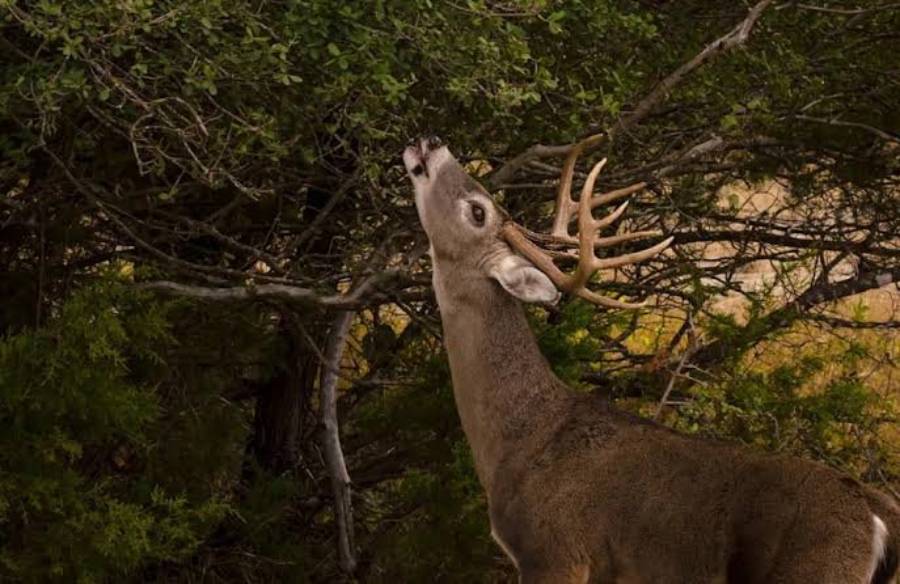
The best natural browse for whitetail deer includes greenbrier, blackberry, raspberry, dogwood, sumac, wild grape, honeysuckle, poison ivy, maple, and other tender woody or broadleaf vegetation available within a deer’s home range. Whitetails primarily browse leaves, young shoots, buds, tender stems, and twigs because these plant parts provide accessible nutrition throughout much of the year.
Browse preference changes with season, plant growth, habitat, and the availability of competing food sources. Fresh spring growth and leafy summer vegetation provide abundant forage, while woody stems and buds become more important when green vegetation declines. During fall, natural browse can compete with higher-energy foods such as acorns, soft mast, and agricultural crops. This means a plant that receives heavy browsing in winter may receive less attention when preferred foods are abundant.
For hunters, identifying the best browse requires more than knowing which plants whitetails can eat. Freshly clipped shoots, repeated browsing, tracks, droppings, trails, and nearby bedding cover provide stronger evidence that deer are actively using a food source. Understanding these relationships helps hunters identify productive feeding areas, interpret deer movement, and determine where natural browse fits into a whitetail’s seasonal feeding pattern.
What Is the Best Natural Browse for Whitetail Deer?
The best natural browse for whitetail deer includes greenbrier, blackberry, raspberry, dogwood, sumac, wild grape, honeysuckle, poison ivy, maple, and other locally preferred woody or broadleaf plants. Whitetails browse the leaves, tender shoots, buds, stems, and twigs of these plants rather than consuming every part equally. Young plant growth is particularly important because it places accessible vegetation within a deer’s feeding range.
There is no single browse species that ranks as the best food for whitetails in every habitat. Plant availability changes across the whitetail’s geographic range, while seasonal growth determines which plant parts are accessible at a given time. A deer living in a dense eastern woodland encounters a different browse community than one occupying agricultural edges, young forests, or old fields. The practical definition of good browse therefore combines preference with local availability.
Food competition also changes the value of natural browse. Whitetails may feed heavily on leafy vegetation when new growth is abundant, then shift part of their feeding activity toward acorns, fruits, or agricultural crops when those foods become available. As green vegetation declines, buds and woody growth become more important. Hunters should therefore evaluate browse according to current deer use rather than assuming a preferred plant will attract deer equally throughout the year.
The most useful browse is also located where deer can repeatedly access it. Low-growing shrubs, vines, young trees, and regenerating vegetation place edible plant material within reach. For a hunter, an abundant plant species becomes significantly more meaningful when its leaves or shoots show fresh browsing and the surrounding area contains tracks, droppings, trails, or other evidence of repeated deer activity.
Which Natural Browse Plants Do Whitetail Deer Prefer?
Whitetail deer prefer browse plants that provide accessible leaves, shoots, buds, and tender woody growth, with greenbrier, blackberry, raspberry, dogwood, sumac, wild grape, honeysuckle, poison ivy, and maple among the important plants hunters can learn to recognize. The exact species available varies by region, so hunters should treat these plants as important examples rather than a universal ranking.
Greenbrier is particularly useful to recognize because its vines and leafy growth can occur in dense cover, woodland edges, and disturbed areas. Deer browse accessible leaves and tender growth, allowing patches of greenbrier to function as both a potential food source and a scouting clue. A hunter who finds abundant greenbrier should inspect individual plants for clipped or missing growth instead of assuming that the presence of the plant proves current feeding activity.
Blackberry and raspberry provide another recognizable group of natural browse. Their leaves and tender shoots grow in openings, edges, disturbed ground, and other locations where sunlight reaches the vegetation. These environments can combine food with nearby security cover. Repeatedly browsed plants near trails or bedding-cover transitions provide more useful hunting information than untouched plants scattered across an area.
Dogwood and sumac add woody browse to the food available within suitable habitat. Deer can use accessible leaves and tender growth during the growing season and browse woody portions as conditions change. Their value depends on the species present, growth stage, season, and alternative foods. Hunters should consequently examine actual browse pressure before treating either plant as a reliable feeding destination.
Wild grape vines provide leaves and tender growth that deer can browse where the vines occur within reach. Vine-covered edges and thickets can also form part of a larger feeding complex containing shrubs, forbs, and young woody vegetation. Finding several preferred browse plants together is more informative than finding a single isolated plant because a diverse feeding area gives deer multiple food choices within a relatively small space.
Whitetails also browse poison ivy, despite the plant being undesirable for human contact. Its presence creates an important distinction between deer food and hunter safety: vegetation that is useful to a whitetail is not necessarily vegetation a hunter should handle. Correct plant identification therefore matters when examining browse sign in the field.
Maples can contribute leaves, buds, shoots, and twigs within a whitetail’s browsing range, particularly where young trees or regeneration keep plant material close to ground level. Mature trees place most foliage beyond reach, while seedlings, saplings, sprouts, and low branches make the same plant group more accessible. This illustrates why plant structure and growth stage can matter as much as species identity.
Honeysuckle requires additional context because the name covers different plants, and some non-native honeysuckles are invasive. Deer feeding on an invasive plant does not make planting or spreading that species a sound habitat-management practice. Hunters should distinguish between identifying vegetation deer already use and intentionally managing land to produce appropriate native browse.
The following comparison provides a practical way to organize the main browse groups without treating preference as identical across every whitetail habitat.
| Natural browse | Parts commonly browsed | Where hunters may encounter it | Scouting value |
|---|---|---|---|
| Greenbrier | Leaves and tender growth | Thickets, edges, woodland cover | Check accessible growth for fresh browsing |
| Blackberry and raspberry | Leaves and shoots | Openings, edges, disturbed areas | Look for repeated use near cover |
| Dogwood | Leaves and tender woody growth | Woodland and edge habitat | Inspect low growth for browse pressure |
| Sumac | Leaves and accessible growth | Open and disturbed habitat | Evaluate use alongside nearby deer sign |
| Wild grape | Leaves and tender vine growth | Edges and thickets | Look for browsing within mixed vegetation |
| Poison ivy | Leaves and accessible growth | Woodlands and edges | Identify visually and avoid unnecessary contact |
| Maple | Leaves, buds, shoots, and twigs | Young forest and regenerating woodland | Focus on seedlings, saplings, and sprouts |
| Honeysuckle | Leaves and tender growth | Thickets and edges | Identify the species before considering management |
For hunting purposes, fresh browse pressure is more informative than a plant list alone. A theoretically preferred species that shows no current use provides limited evidence about present deer movement. Freshly browsed plants concentrated near trails, cover, or other deer sign indicate that whitetails are not merely capable of eating the vegetation but are actively incorporating it into their current feeding pattern.
What Parts of Plants Do Whitetail Deer Browse?
Whitetail deer browse five main plant parts: leaves, tender shoots, buds, young stems, and twigs. The specific part consumed depends on the plant species, growth stage, season, and accessibility. During periods of active plant growth, deer have greater access to soft leaves and shoots. When green vegetation becomes scarce, woody buds and twigs make up a larger share of the browse available above ground.
Leaves provide an abundant source of browse during the growing season because shrubs, vines, seedlings, saplings, and other low vegetation place foliage within reach. Deer do not use all leaves equally. Plant species, maturity, chemical composition, and the availability of alternative foods influence whether a plant receives heavy browsing or remains largely untouched. Hunters should therefore look for evidence of consumption rather than judging a feeding area solely by the amount of green vegetation present.
Tender shoots and young stems are another important component of natural browse. New growth is softer than mature woody material and develops at the ends of branches, vines, and regenerating plants where deer can reach it. This is one reason recently disturbed habitat can provide valuable browse: sunlight reaching ground level encourages new vegetation and increases the amount of accessible growth.
Buds and twigs become especially relevant after deciduous plants lose their leaves. The edible material available to deer has not disappeared simply because the growing season has ended. Deer can continue browsing the ends of accessible woody plants, including buds and small twigs. Heavy use of these plant parts can make winter browse pressure easier to recognize because repeated feeding changes the appearance of branch tips.
Natural browse should not be treated as another name for every food whitetails consume. Browse primarily refers to woody and broadleaf plant material such as leaves, shoots, stems, buds, and twigs, while a whitetail diet can also include forbs, mast, fruits, fungi, grasses, and agricultural crops. Acorns, for example, are an important natural food where available, but an acorn is mast rather than woody browse. Maintaining this distinction makes it easier for hunters to understand why deer can shift food sources without completely abandoning browse.
The height of edible vegetation also determines whether browse is practically available. A mature tree can produce large quantities of foliage without placing much of it within reach, whereas seedlings, saplings, stump sprouts, vines, and shrubs concentrate plant material closer to the ground. For this reason, the structure of vegetation can matter as much as the presence of a preferred plant species when evaluating a potential feeding area.
What Natural Browse Do Whitetail Deer Eat in Each Season?
Whitetail deer shift their natural browse from fresh leaves and shoots in spring and summer toward a greater reliance on persistent vegetation, buds, stems, and woody twigs as green growth declines in fall and winter. Seasonal preference is driven by both plant availability and competing foods. Hunters should consequently identify what is currently edible rather than relying on a browse pattern observed several months earlier.
What Natural Browse Do Whitetail Deer Eat in Spring?
Whitetail deer browse emerging leaves, tender shoots, new stems, and other fresh vegetation during spring. Spring green-up increases the amount of soft plant material available at browsing height after winter has limited deer to a narrower range of foods.
Regenerating shrubs, vines, seedlings, and other low-growing plants can become important as their new growth emerges. Plants such as greenbrier, blackberry, raspberry, and other locally available browse species may receive attention when tender growth becomes accessible. The exact species differ by habitat and geographic region, making local browse pressure more useful than a universal spring plant ranking.
Spring also creates useful scouting conditions because hunters and land managers can observe which plants receive early browsing. Comparing browsed plants with similar untouched vegetation helps identify local preferences. Repeated use around edges, young forest, thickets, and disturbed habitat can reveal areas where deer have access to both food and nearby cover.
What Natural Browse Do Whitetail Deer Eat in Summer?
Whitetail deer browse leaves, tender stems, vines, shrubs, and actively growing vegetation throughout summer. The growing season generally provides a wider selection of accessible plant material than winter, so deer can be more selective about which plants and plant parts they consume.
Greenbrier, blackberry, raspberry, wild grape, dogwood, sumac, and other locally preferred plants can contribute to this summer food base where they occur. The key hunting consideration is not simply vegetation abundance. A dense area of summer growth can contain both heavily selected plants and species deer rarely touch, making visible browse pressure essential for identifying the plants deer actually prefer.
Summer food can also be dispersed across the landscape. When suitable vegetation is widespread, one isolated browse patch may exert less influence over deer movement than it would during a period of limited food availability. Hunters evaluating summer habitat should therefore consider the combination of food, security cover, bedding areas, water, and travel routes rather than treating browse as an isolated attraction.
What Natural Browse Do Whitetail Deer Eat in Fall?
Whitetail deer continue browsing leaves, vines, shrubs, stems, and available woody growth during fall, but the importance of browse changes when acorns, fruits, crops, and other seasonal foods become available. Fall therefore demonstrates why the presence of preferred browse does not guarantee concentrated feeding activity.
Acorns are a clear example of this food competition. Where productive oak trees make mast readily available, deer can redirect feeding activity toward acorns even when browse remains nearby. Agricultural landscapes create another alternative when crops or crop residues provide accessible food. The result is a seasonal shift in relative food value rather than a complete disappearance of browse from the diet.
Hunters should respond by checking browse for current use. A greenbrier patch that showed substantial summer browsing may become less informative when a nearby oak flat is dropping acorns. Conversely, fresh browsing can remain valuable where mast production is poor or alternative foods are limited. Current feeding sign should determine hunting relevance, not the reputation of a plant species alone.
What Natural Browse Do Whitetail Deer Eat in Winter?
Whitetail deer rely more heavily on accessible woody browse, including buds, twigs, stems, and persistent vegetation, during winter as green leaves and other seasonal foods decline. Winter reduces the number of available food choices, increasing the importance of woody plants that keep edible material above snow or exposed near ground level.
Young trees, shrubs, vines, sprouts, and other low woody vegetation can provide this accessible material. Deer may repeatedly remove the ends of twigs and shoots, creating visible browse pressure in heavily used locations. The plants receiving the greatest use still vary by region because winter vegetation in one part of the whitetail range can differ substantially from vegetation available elsewhere.
Winter browse should not automatically be interpreted as preferred food. A plant can receive heavy winter browsing because better alternatives are scarce rather than because it is the most nutritious or preferred food available throughout the year. This distinction is important when hunters compare winter feeding areas with spring or summer patterns.
Concentrated winter browsing can nevertheless provide useful scouting information. When fresh browsing occurs alongside tracks, droppings, trails, and suitable security cover, the combined evidence indicates repeated deer use more strongly than plant identification alone. Hunters can use that pattern to determine which portions of a property are currently supplying accessible natural food.
How Can Hunters Identify Preferred Deer Browse?
Hunters can identify preferred deer browse by looking for fresh feeding damage on plants and confirming it with tracks, droppings, trails, beds, or repeated browsing nearby. Plant identification tells a hunter what deer are capable of eating, while fresh browse pressure shows what deer are actually using. The second signal is more valuable when determining current feeding activity.
Start with the growing tips of shrubs, vines, seedlings, and saplings within a deer’s reach. Browsed vegetation commonly shows missing leaves, shoots, buds, or twig ends. Hunters should compare these plants with nearby examples of the same species. When multiple plants show similar fresh damage at accessible heights, the pattern provides stronger evidence of deer feeding than a single damaged branch.
Freshness matters because old browse does not necessarily describe current deer movement. Recently exposed plant tissue generally looks different from older damage that has dried and weathered. New growth appearing around previously damaged portions can also indicate that browsing occurred earlier in the growing season. A hunter trying to select a current feeding location should prioritize recent use over accumulated damage from previous months.
Browse pressure provides another layer of information. High browse pressure occurs when deer repeatedly remove accessible plant growth from an area, while low browse pressure leaves most available growth untouched. A patch containing hundreds of potential browse plants but little feeding damage may have less immediate hunting value than a smaller patch showing repeated use.
Plant damage alone should not determine a hunting location because other animals and environmental factors can damage vegetation. Hunters can strengthen the interpretation by looking for several deer signs in the same area. Tracks show physical movement, droppings indicate deer have spent time nearby, established trails reveal repeated travel, and beds can connect the feeding area to security cover. Several matching signs create a stronger behavioral picture than browse damage by itself.
The distribution of browsing can also reveal how deer move through habitat. Heavy feeding concentrated along one edge of a thicket, for example, can indicate that deer consistently enter or leave the food source from that side. Browsed vegetation distributed along a trail can show feeding during movement rather than at one concentrated destination. Hunters can use these patterns to identify travel routes between bedding cover and feeding areas.
A useful scouting sequence is therefore identify the plant, confirm fresh browsing, measure how widespread the browsing is, locate additional deer sign, and determine how the feeding area connects to cover and travel routes. This process prevents hunters from choosing locations simply because a known deer food is present.
Where Should Hunters Look for Natural Deer Browse?
Hunters should look for natural deer browse in forest edges, clear-cuts, young forests, thickets, old fields, logging areas, and transitions around bedding cover where sunlight and disturbance produce accessible plant growth. These habitats often place leaves, shoots, vines, shrubs, seedlings, and woody growth within browsing height.
Forest edges are productive places to inspect because two vegetation communities meet within a relatively narrow zone. More sunlight can reach plants along an edge than under a closed forest canopy, supporting shrubs, vines, forbs, and young trees. Edges can also connect feeding habitat with thicker cover, allowing deer to browse while remaining close to areas that provide security.
Clear-cuts and recently logged areas can produce substantial natural browse as vegetation regenerates. Removing or reducing the overstory allows more sunlight to reach the forest floor, stimulating seedlings, stump sprouts, shrubs, vines, and other early growth. Much of this vegetation develops at a height deer can reach, creating a concentrated layer of potential food.
The age of a clear-cut matters. Immediately after disturbance, usable vegetation may still be limited. As regeneration develops, accessible browse can increase substantially. Later, young trees can grow above browsing height and the canopy can begin reducing vegetation closer to the ground. Hunters should therefore evaluate the current structure of a cut rather than assuming every logged area provides the same amount of food.
Young forests create similar conditions when regeneration keeps woody vegetation within reach. Seedlings, saplings, sprouts, shrubs, and vines can provide both browse and dense structure. This combination matters because whitetails do not select feeding habitat based on food alone. An area that combines edible vegetation with security cover can allow deer to feed without traveling far into exposed terrain.
Thickets are another location worth inspecting, particularly when preferred vines and shrubs grow around their margins or openings. Dense vegetation can function as security cover while accessible growth supplies food. Hunters should avoid assuming that the thickest vegetation automatically contains the most browse. Instead, they should examine edges, openings, trails, and other locations where deer can physically reach and move through the vegetation.
Old fields and abandoned openings can develop a mixture of forbs, shrubs, vines, and woody regeneration as succession progresses. Although not every plant in an old field qualifies as browse, the mixture can create several natural food sources within the same feeding area. Woody encroachment around field margins can become particularly useful when deer browse young growth while staying close to cover.
Logging roads, utility openings, and other disturbed corridors can also produce low vegetation because additional sunlight reaches the ground. Their hunting value depends on vegetation composition, human activity, surrounding cover, and evidence of deer use. A green corridor without browse pressure or other deer sign should not be treated as productive merely because its vegetation looks abundant.
Transitions near bedding cover deserve particular attention. Browse located between secure bedding habitat and a major feeding destination can allow deer to feed while traveling rather than moving directly from one location to another. A hunter may find clipped vegetation, tracks, and trails along these transitions even when the area does not resemble a conventional feeding field.
Sunlight is one of the common mechanisms connecting these browse-rich habitats. A closed canopy limits the amount of light reaching ground-level vegetation. Openings created by natural disturbance, timber management, field abandonment, or edge habitat allow more light to reach the lower vegetation layer. Increased low growth can then place more potential browse within a whitetail’s reach.
For hunters, however, the best browse habitat is not necessarily the area containing the greatest amount of vegetation; it is the area where suitable vegetation and current deer use overlap. A clear-cut filled with potential browse but showing little fresh sign provides weaker evidence than an edge with concentrated browsing, tracks, trails, and nearby security cover. Scouting should therefore progress from habitat identification to plant identification and finally to confirmation of current deer activity.
How Can Browse Pressure Help Hunters Locate Whitetail Deer?
Browse pressure helps hunters locate whitetail deer by showing where deer are actively feeding rather than simply where edible plants grow. Hunters should prioritize concentrations of fresh browsing supported by tracks, droppings, trails, or nearby bedding cover. These combined signs provide stronger evidence of current deer activity than the presence of a preferred browse species alone.
The distinction between browse availability and browse pressure is important. Browse availability describes the amount of edible vegetation deer can reach within an area. Browse pressure describes how intensively deer have consumed that vegetation. Two locations can contain similar amounts of greenbrier, blackberry, young maple, or other browse while receiving very different levels of deer use.
Hunters can compare browse pressure by examining multiple plants of the same species across an area. A few clipped shoots on one plant provide limited information. Repeatedly browsed tips across a patch indicate more consistent feeding. When the heaviest browsing occurs close to established trails or thick security cover, the location becomes more relevant for determining how deer move between bedding and feeding habitat.
Fresh browse can also help hunters narrow down large areas of apparently suitable habitat. A clear-cut, young forest, or old field may contain acres of potential deer food. Scouting every portion equally is inefficient. Instead, hunters can identify where browsing becomes concentrated and then examine those locations for tracks, droppings, trails, rubs, beds, or other deer sign. This process turns a broad food source into a smaller area of probable deer activity.
The location of browse pressure within the habitat can provide additional information. Heavy browsing near dense cover may indicate that deer are feeding close to security habitat before entering more exposed areas. Browsing along a defined trail can indicate feeding during travel. Concentrated feeding at one patch can indicate a destination food source, particularly when surrounding vegetation receives substantially less use.
Browse pressure must still be interpreted according to freshness. Old feeding damage proves deer used the vegetation at some point, but it does not establish current use. Seasonal changes in food availability can cause deer to reduce feeding on one plant and concentrate on another source. Hunters should give greater weight to recent browsing when trying to predict current movement.
Repeated scouting can make browse pressure even more informative. A patch that continues to show new feeding damage after previous browsing demonstrates ongoing use. In contrast, a location with extensive old damage but little new browsing may represent a food source that was more valuable during an earlier season. This difference is especially important when food availability changes rapidly during spring green-up or fall mast production.
The strongest browse-based hunting location combines four signals: preferred vegetation, fresh browse pressure, additional deer sign, and a logical connection to security cover. No single signal proves when deer will appear, but their overlap provides a stronger basis for choosing a hunting location than plant identification alone.
Should Hunters Focus on Browse When Acorns and Crops Are Available?
Hunters should continue monitoring natural browse when acorns and crops are available, but they should not assume browse remains the dominant food source. Whitetail feeding patterns respond to the foods currently available within their home range, so the relative importance of browse can decline when alternative food sources receive heavier deer use.
Acorns can significantly change local feeding patterns during fall where producing oak trees are available. Natural browse may remain abundant, but deer can spend more feeding time around mast-producing areas. A hunter who continues focusing on a summer browse pattern without checking nearby oaks may overlook a seasonal shift in deer activity.
Agricultural foods can create a similar change. Corn, soybeans, cereal grains, and other crops can provide concentrated feeding opportunities in agricultural landscapes. Their availability can influence when and where deer leave cover, particularly when fields are positioned close to bedding habitat. Natural browse remains part of the surrounding food system, but its value as a hunting destination must be evaluated relative to these competing foods.
The relationship is not simply browse versus acorns or browse versus crops. Deer can use several food sources within the same feeding cycle. A whitetail may browse vegetation while moving through cover and later reach a concentrated mast or agricultural food source. Natural browse can therefore function as both a destination food and a secondary food source along a travel route.
This behavior gives hunters a reason to examine browse between bedding cover and major feeding areas. Freshly browsed vegetation along a transition can reveal a route deer use while approaching an oak flat or agricultural field. Such locations may be particularly useful for understanding movement because they connect feeding behavior with cover rather than treating each food source as an isolated destination.
Food availability can also change quickly. Acorn production varies among individual trees and locations, agricultural crops are harvested, fruits disappear, and green vegetation matures or dies back. When a concentrated food source declines, deer can redistribute feeding activity toward other available foods. Hunters who continue checking natural browse can detect these changes through renewed browse pressure.
This is why current deer sign should outweigh assumptions about which food source is theoretically best. A productive oak stand does not deserve priority when few acorns are available or deer sign is absent. Likewise, an agricultural field is less meaningful when deer are feeding heavily elsewhere. Fresh tracks, droppings, trails, and browse pressure show how deer are responding to the food conditions that exist at that time.
Hunters should consequently think of whitetail food sources as a changing network rather than a fixed ranking. Natural browse, acorns, other mast, fruits, and agricultural foods rise or fall in relative importance as availability changes. Following those changes allows hunters to adjust scouting locations instead of relying on a feeding pattern established earlier in the season.
Why Does Whitetail Deer Browse Preference Change by Location?
Whitetail deer browse preference changes by location because plant availability, habitat composition, seasonal conditions, and competing food sources differ across the whitetail’s range. A browse species that receives heavy use in one area may be absent, scarce, or less attractive in another. Hunters should therefore identify local feeding patterns rather than treating any national list of deer browse as a fixed ranking.
Plant availability creates the most immediate constraint. Whitetails cannot select a preferred species when that plant does not grow within their home range. Forest type, soil conditions, moisture, sunlight, disturbance, and local climate influence which shrubs, vines, trees, and other vegetation occur in an area. These differences create distinct browse communities even between properties within the same broader region.
Habitat structure further changes what deer can reach. A mature forest with a closed canopy can contain suitable tree species while producing relatively little accessible vegetation near ground level. A nearby clear-cut or young forest can contain seedlings, sprouts, shrubs, vines, and low branches from similar plant communities but place substantially more plant material within browsing height. The second habitat can therefore provide more usable browse even when both areas contain desirable species.
Local food competition also affects preference. Deer living around agricultural land can have access to crops that forest-dominated deer do not encounter. Whitetails occupying productive oak habitat may shift feeding activity when acorns become available, while deer in areas with poor mast production must rely on a different combination of foods. Browse preference observed in isolation can therefore be misleading unless hunters consider the entire local food system.
Season amplifies these geographic differences. Spring green-up does not occur at the same time across the whitetail’s range, and winter conditions vary considerably between locations. The vegetation available to a deer during a mild winter differs from the food accessible where snow or prolonged cold reduces ground-level forage. The same browse species can consequently have different seasonal importance in different environments.
Deer density and browsing history can change the vegetation itself. Repeated feeding can reduce the amount of preferred growth available within reach, forcing deer to use alternative plants or move to other feeding locations. An area with intense browse pressure can therefore develop a different food pattern from a similar habitat supporting fewer deer.
For hunters, these variables lead to one practical rule: use browse lists to identify candidate plants, then use local browse pressure to determine actual preference. Greenbrier, blackberry, dogwood, sumac, wild grape, maple, and other known browse plants provide starting points for scouting. Fresh feeding damage and surrounding deer sign determine which of those plants currently matter on a specific property.
Read more: Best Cover Crops for Deer Food Plots: 6 Top Crops
Does Better Natural Browse Improve Whitetail Deer Habitat?
Better natural browse improves whitetail habitat when it increases accessible food while maintaining the cover and vegetation diversity deer need throughout the year. The greatest habitat value comes from producing useful vegetation within a broader habitat structure rather than maximizing a single browse species.
Accessible food is the first benefit. Mature vegetation can contain substantial plant biomass without placing much of it within a whitetail’s reach. Young forest, regenerating openings, shrubs, vines, seedlings, and sprouts move a larger portion of vegetation into the browsing zone. This gives deer more opportunities to consume leaves, shoots, buds, stems, and twigs without depending on one concentrated food source.
Natural browse can also occur within or beside security cover. This relationship separates browse-rich habitat from exposed feeding areas. Dense young vegetation, thickets, and regenerating forest can provide both edible growth and visual cover. Deer can consequently satisfy part of their feeding requirements while remaining close to protective habitat.
Plant diversity strengthens this food system because individual species do not provide equal value throughout the year. One plant may produce tender leaves during the growing season, another may retain accessible vegetation later in the year, and woody species can provide buds or twigs after leaves disappear. A habitat containing several useful plant groups gives deer more feeding options as seasonal availability changes.
Natural browse also complements rather than replaces other whitetail foods. Acorns, fruits, forbs, crops, and planted food sources can contribute to the diet when available, while browse provides another layer of food distributed through the habitat. A property containing several food types gives deer alternatives when one source declines.
For hunters, improved browse can make deer use of a property easier to interpret when feeding vegetation is connected with bedding and travel cover. Browse concentrated along transitions, young forest edges, or routes between secure cover and other feeding areas can produce identifiable patterns of use. Fresh browsing combined with tracks, droppings, and trails can then reveal where deer repeatedly feed and travel.
However, more vegetation does not automatically mean better deer habitat. Habitat quality depends on usable vegetation, not total plant growth. A dense stand dominated by plants deer rarely browse can offer different food value from a diverse stand containing preferred species at accessible heights. Likewise, improving food while eliminating security cover can change how deer use the area.
The objective is therefore not to produce the greatest possible amount of browse. It is to create or maintain a diverse habitat where suitable browse occurs at accessible heights and connects naturally with cover, travel corridors, and other seasonal food sources. This approach treats natural browse as one functional component of whitetail habitat rather than as an isolated feeding feature.
How Can Landowners Increase Natural Browse for Whitetail Deer?
Landowners can increase natural browse for whitetail deer by allowing more sunlight to reach ground-level vegetation, encouraging native regeneration, maintaining early successional habitat, and managing vegetation so edible growth remains within browsing height. The objective is to increase naturally occurring leaves, shoots, buds, stems, and twigs rather than simply adding another concentrated food source.
Sunlight is one of the primary factors controlling how much vegetation develops near ground level. A mature woodland with a closed canopy can shade the forest floor enough to limit shrubs, vines, seedlings, sprouts, and other low-growing plants. Reducing canopy density in appropriate locations can increase light penetration and stimulate vegetation where deer can reach it. The result depends on the plants already present, site conditions, and how the area responds after disturbance.
Timber harvests, selective canopy management, and other forms of disturbance can create this response by opening portions of the forest. Regenerating areas can produce young trees, stump sprouts, vines, shrubs, and other vegetation at accessible heights. These areas may provide both food and thicker cover as regeneration develops, which can increase their functional value within whitetail habitat.
Landowners should also maintain different stages of vegetation rather than allowing every opening to mature at the same time. Early successional habitat changes as plants grow. A productive young opening can eventually develop taller woody vegetation and a denser canopy, reducing the amount of edible growth available near the ground. Maintaining a mixture of vegetation ages helps keep some portion of the property in a browse-producing stage.
Native plant diversity should be favored over creating a stand dominated by one browse species. A diverse browse community gives whitetails multiple food options as plant growth and seasonal availability change. Shrubs, vines, young woody plants, and other native vegetation can contribute different leaves, shoots, buds, and stems throughout the year. Diversity also prevents habitat management from depending on one species whose availability or attractiveness may be temporary.
Existing browse pressure can help determine where management is working. Landowners can compare similar plants inside different portions of a property and observe where deer repeatedly remove new growth. Heavy browsing shows that vegetation is being used, while abundant untouched plants may indicate that the available species are less preferred or that deer are concentrating elsewhere. Monitoring the response over time provides more useful information than assuming additional vegetation automatically creates better browse.
Excessive browsing also deserves attention. When deer repeatedly consume preferred plants faster than those plants can replace their growth, the composition and structure of the vegetation can change. Preferred species may become less available while less-used vegetation persists. Habitat evaluation should therefore consider both the amount of browse produced and whether preferred plants can continue regenerating under existing browsing pressure.
Landowners should avoid introducing an invasive plant simply because deer are known to eat it. Honeysuckle illustrates why deer preference and habitat-management value are separate questions. A plant can provide browse while creating broader vegetation-management problems. Encouraging suitable native vegetation provides a better framework than deliberately spreading an invasive species for deer food.
Natural browse management is also different from establishing a food plot. Natural browse management modifies existing habitat to produce accessible vegetation, while a food plot intentionally establishes selected forage in a defined area. Both can influence deer feeding, but they create different food distributions and habitat structures. Natural browse can occur throughout edges, thickets, regenerating forest, openings, and travel cover rather than concentrating all feeding activity in a planted field.
The most useful management locations connect browse with other habitat requirements. Producing young vegetation beside bedding cover, along habitat transitions, or between secure cover and established feeding areas can give deer access to food while they travel. From a hunting perspective, these connections can also make feeding patterns easier to identify through browse pressure, tracks, droppings, and trails.
Landowners should ultimately manage natural browse as part of the entire whitetail habitat rather than as a stand-alone food project. The strongest browse program combines accessible native vegetation, multiple stages of plant growth, adequate security cover, seasonal food diversity, and evidence that deer are actually using the resulting vegetation. This approach keeps natural browse available across more of the property while supporting the feeding and movement patterns hunters can observe during scouting.