
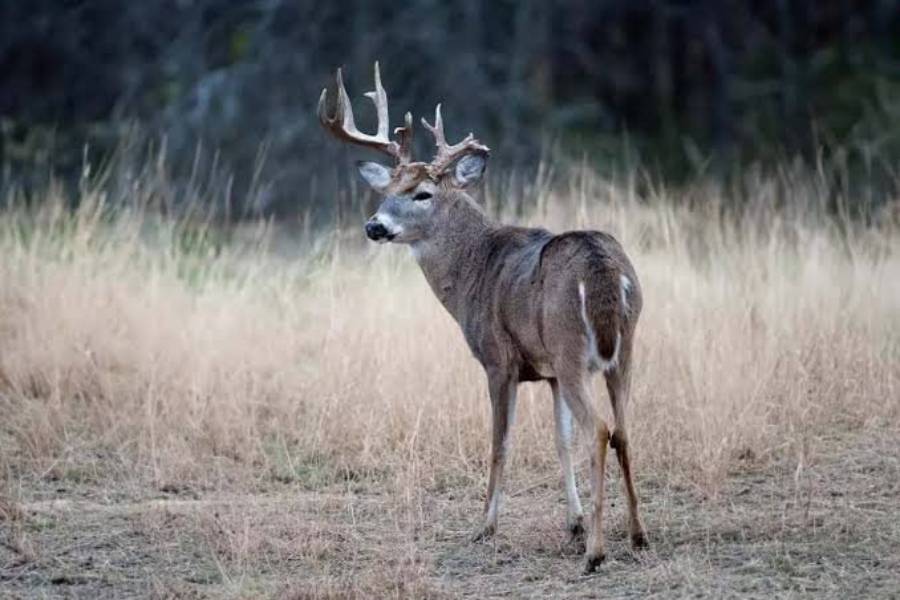
Bucks break their antlers mainly because hardened antlers are exposed to strong physical forces during fights, sparring, rubbing, and collisions with trees or other hard objects. Fighting between bucks is one of the most direct causes of broken tines and beams, especially during the rut when males compete more aggressively for access to does. Antlers are strong structures, but twisting, impact, and leverage can exceed what a tine or main beam can withstand.
Fighting is not the only way a buck can damage an antler. A buck can strike or catch its antlers on trees, branches, dense brush, fences, and other obstacles while moving through its habitat. The location and timing of the damage also matter. Breaking part of a hardened antler is different from injuring an antler while it is still growing in velvet or damaging the pedicle from which the antler develops.
A broken antler also should not be confused with a shed antler. Breakage results from physical damage, whereas shedding is part of the buck’s annual antler cycle. For hunters, understanding this distinction helps explain why a familiar buck may suddenly appear on a trail camera with a missing tine or shortened beam and whether that damage is likely to affect its future antler growth.
Why Do Bucks Break Their Antlers?
Bucks break their antlers when physical force exceeds the structural strength of a tine or main beam. The main causes are fights with other bucks, collisions with hard objects, antlers becoming caught or twisted, and repeated physical stress. These forces become especially relevant after the antlers have finished growing and hardened into solid bone.
A buck’s antlers are built to withstand substantial physical contact. Mature bucks use them for sparring and fighting, which involves pushing, twisting, and applying pressure against another set of antlers. Strength does not make an antler unbreakable. A force concentrated on one tine creates a different load than pressure distributed across the entire rack. A tine caught between another buck’s antlers can therefore snap while most of the rack remains intact.
Antler shape also affects how force is distributed. Long tines project away from the main beam and provide leverage when struck or twisted. The main beam is thicker, but sufficient impact or torque can break it as well. Existing damage can create another weak point that fails during a later fight or collision.
For hunters, the resulting damage can range from a missing tine to a substantial portion of one side of the rack being broken away. This explains why trail-camera photographs may show the same buck with a complete rack early in the season and an obviously damaged rack later.
Which Parts of a Buck’s Antler Are Most Likely to Break?
Tines and sections of the main beam can break when they receive enough concentrated impact or twisting force. The exact break point depends on the shape of the rack, the direction of the force, and where contact occurs.
Tines are particularly exposed because they extend outward from the main beam. During a fight, one tine can become trapped against or between another buck’s antlers. Continued pushing or a sudden change in direction then places considerable leverage on that point. The result can be a cleanly broken tine while the main beam remains intact.
A broken main beam represents more extensive antler damage. The beam has greater mass than an individual tine, so breaking it requires substantial stress or an existing weak point. Damage near the antler base also needs to be distinguished from an ordinary broken tine or beam because trauma involving the pedicle can have consequences beyond the appearance of the current rack.
Do Bucks Break Their Antlers When Fighting?
Yes, bucks can break their antlers while fighting because antler-to-antler combat creates impact, compression, twisting, and leverage. The risk becomes greatest when the racks lock together and one buck pushes or turns while part of the other buck’s antler remains trapped.
Bucks use their antlers as physical tools during competition. Two bucks can lower their heads, make antler contact, push against each other, and change direction while maintaining pressure. A rack is therefore subjected to forces coming from several directions rather than a single straight impact. A tine positioned at an unfavorable angle can become a leverage point and snap under that load.
Sparring can also produce antler damage, although sparring and an intense rut fight are not identical interactions. Sparring allows bucks to test one another with antler contact, while serious competition can involve harder pushing and more aggressive movement. In both situations, breakage becomes possible when enough force is concentrated on a vulnerable part of the rack.
A broken antler does not prove that a buck recently won or lost a fight. Hunters may observe a buck with a missing tine after the animal has been involved in combat, but the appearance of the rack alone does not establish the exact event that caused the break. Trees, fences, dense cover, and other physical obstacles provide alternative mechanisms for antler damage.
Why Are Bucks More Likely to Break Antlers During the Rut?
Bucks are more likely to break antlers during the rut because competition for breeding opportunities increases aggressive encounters between males. Bucks that spend more time challenging, sparring with, and fighting other bucks expose their antlers to more impacts and twisting forces. More antler-to-antler contact creates more opportunities for a tine or beam to break.
Testosterone is closely associated with the seasonal behavioral changes that occur around the rut. As breeding activity increases, bucks become more focused on locating does and competing with rival males. Dominance encounters can escalate from posturing and assessment to direct physical contact. When two bucks lower their heads and engage, their antlers can collide and lock together while both animals continue applying force.
The direction of that force is important. Antlers may tolerate pressure when the load is distributed across several contact points, but a tine trapped at an unfavorable angle can receive concentrated stress. A sudden turn, push, or attempt to disengage can then place enough leverage on the tine to break it. Similar forces can damage part of the main beam when the impact is sufficiently strong.
Rut-related activity can also expose bucks to hazards beyond direct combat. Bucks travel, chase does, move through cover, and interact with their surroundings during this period. A buck seen with a complete rack earlier in the hunting season may therefore appear later with a broken tine or beam. The timing makes fighting a plausible explanation, but a broken antler alone does not prove that another buck caused the damage.
Can Bucks Break Their Antlers Without Fighting?
Yes, bucks can break their antlers without fighting another buck. Trees, branches, dense brush, fences, and other hard obstacles can place enough impact or twisting force on an antler to damage a tine or beam.
Antler damage depends on how the rack contacts an object. A direct collision can create sudden impact, while an antler caught between branches or another obstacle can experience leverage as the buck continues moving. A projecting tine that becomes trapped while the animal turns its head can receive concentrated force at its base. The antler can then break even though no other deer is involved.
Dense cover creates another opportunity for physical contact. Bucks regularly move through wooded and brushy habitat where their racks must pass between branches and vegetation. Most contact does not result in a broken antler, but the risk increases when a tine catches on a rigid object or the animal moves with enough momentum to produce a strong impact.
For hunters, this means a broken rack should be treated as evidence of physical damage rather than automatic evidence of a fight. The location and appearance of the break can provide useful observations, but they do not reliably identify the exact event that caused it.
Can Rubbing Trees Cause a Buck to Break an Antler?
Rubbing can contribute to antler damage when a tine or beam receives enough mechanical stress, but normal rubbing does not mean a buck will break its antlers. Bucks rub their antlers and forehead against trees as part of seasonal behavior, creating the rubs that hunters commonly use as buck sign.
During normal rubbing, the buck moves its head and rack against the trunk and surrounding branches. The antlers may contact the tree repeatedly without breaking because hardened antlers are capable of handling substantial physical stress. The situation changes when part of the rack becomes caught or force is concentrated at an unfavorable angle.
Tree rubbing should therefore be separated from accidental collision or entanglement. A buck deliberately rubbing a tree, a tine becoming wedged between rigid branches, and a buck striking an obstacle while moving all create different mechanical conditions. Each can involve the same antler, but the amount and direction of force determine whether the rack remains intact or breaks.
Are Some Buck Antlers More Likely to Break Than Others?
Some buck antlers are more susceptible to breakage because antler shape, development, existing damage, and the type of force applied determine how much stress a rack can withstand. Two bucks exposed to similar physical contact do not necessarily experience the same damage because their racks differ in tine length, beam structure, contact angle, and previous wear or injury.
Antler geometry affects how mechanical force travels through the rack. A long tine creates greater leverage when its tip is pushed sideways than when force is applied closer to its base. Main beams are thicker and carry more mass, but they can still fail when subjected to sufficient impact or twisting. This is why a buck can lose one tine while the rest of its rack remains intact.
A buck’s age should not be used by itself to predict whether an antler will break. Age influences antler development, body size, and behavior, but breakage still requires a mechanical event or structural weakness. A large, mature buck can break a tine during an intense fight, while a smaller buck may retain an undamaged rack throughout the season.
Nutrition is relevant because antlers are living, developing tissue before they become hardened bone. Adequate nutrition supports normal antler development, but hunters should not assume that every broken antler indicates a nutritional or mineral deficiency. A normally developed antler can still break when physical force exceeds its structural limits.
The stage of antler development is another important distinction. Growing antlers covered in velvet differ biologically from fully hardened antlers. Damage during the velvet stage can affect developing tissue and influence the final shape of the rack, whereas a break occurring after the antler has hardened is primarily damage to the existing bone structure.
Does a Broken Antler Hurt a Buck?
A broken antler can hurt a buck when the injury involves living tissue, but breaking part of a fully hardened antler is different from damaging a growing velvet antler or the pedicle. The location and developmental stage of the injury determine its biological significance.
While antlers are growing, they are covered by velvet and supplied with blood vessels and nerves that support rapid development. An injury at this stage can damage living tissue, cause bleeding, and interfere with normal antler formation. The resulting rack may develop an abnormal shape or retain visible evidence of the earlier injury after the antlers harden.
Once antler growth is complete, the velvet is shed and the mature antler consists of hardened bone. A break through the hardened portion of a tine or beam is therefore different from cutting into actively growing velvet tissue. Hunters should distinguish a broken hardened tine from trauma that extends to the antler base, pedicle, or surrounding tissue.
Pedicle damage is more significant because the pedicle is the permanent structure on the skull from which an antler grows. Trauma in this area can involve living tissue and may influence subsequent antler development. A buck missing the end of a tine and a buck suffering an injury at the antler base should therefore not be treated as equivalent cases.
A damaged rack can also change how the antlers function during later encounters. Losing a tine or part of a beam changes the geometry of the rack and the points at which it contacts another buck’s antlers. However, a broken antler alone does not establish that a buck is unhealthy, unable to compete, or subordinate to other bucks. Those conclusions require additional evidence about the animal’s physical condition and behavior.
Will a Buck’s Broken Antler Grow Back?
A broken portion of a hardened antler does not grow back during the same antler cycle. If a buck breaks a tine or part of its main beam after the antler has hardened, that section remains missing until the buck sheds the entire antler and grows a new one during the next annual cycle.
This happens because hardened antlers are no longer actively growing. Antler growth takes place earlier in the cycle while the developing bone is covered with velvet and supplied with blood vessels and nerves. Once growth finishes, the antler mineralizes, the velvet is shed, and the hardened rack remains essentially fixed in shape. Breaking three inches from a tine in this stage does not trigger new bone growth from the broken end.
The situation changes after the annual shedding process. A buck eventually casts its old antlers at the pedicles and begins developing a new set. A buck that broke a tine or beam during the previous season can therefore grow a complete rack again the following year. The previous break does not mean the corresponding tine must remain broken or missing on the next set of antlers.
Hunters using trail cameras should account for this annual reset when identifying individual bucks. A distinctive broken tine can be a useful visual characteristic during the current antler cycle, but that characteristic may disappear when the buck develops its next rack. Body characteristics, movement patterns, other antler features, and repeated photographs provide additional information for identifying the same deer across seasons.
Can Pedicle Damage Affect Future Antler Growth?
Pedicle damage can affect future antler development because new antlers grow from the pedicles rather than from the ends of the previous rack. This makes an injury at the antler base fundamentally different from a tine breaking farther up a hardened antler.
The pedicle is a permanent structure attached to the skull. Each annual antler develops from this base. Trauma that damages the pedicle or surrounding growth tissue can therefore interfere with the point from which subsequent antlers develop. Depending on the injury, later antler growth may show abnormal development rather than returning to the previous shape.
A simple broken tine does not provide evidence that the pedicle has been damaged. Hunters should distinguish between a visible break along a tine or beam and a more serious injury involving the antler base. The first affects the current rack, while the second has greater potential to influence future antler development.
This distinction also explains why seeing the same buck with an abnormal rack in consecutive years requires more careful interpretation. Repeated abnormalities may justify considering previous injury or other developmental factors, whereas a single broken tine during one hunting season can result simply from physical damage to that year’s hardened antler.
Read more: Why Do Bucks Lose Weight During the Rut?
What Is the Difference Between a Broken Antler and a Shed Antler?
A broken antler results from physical damage, while a shed antler separates naturally from the pedicle as part of a buck’s annual antler cycle. The two processes can both leave a buck with less antler, but their causes and biological mechanisms are different.
Breakage normally removes only part of the rack. For example, a buck may lose the tip of a tine, an entire tine, or a section of its main beam after fighting or striking an obstacle. The remaining portion of the antler stays attached to the pedicle until it is eventually shed.
Shedding removes the antler at its base. Seasonal hormonal changes lead to weakening of the connection between the antler and pedicle, allowing the complete antler to separate. The buck later begins another growth cycle and develops a new antler from the pedicle.
The appearance of the recovered antler can therefore provide hunters with an important clue. A naturally shed antler includes the antler base where it separated from the pedicle, whereas a broken piece represents only the portion that fractured away from the rack. Finding a broken tine in the woods is not the same as finding a complete shed.
Understanding this distinction is particularly useful for hunters who monitor bucks across the hunting season and into the shed-hunting period. A buck missing part of its rack during the rut may have suffered antler breakage, while a buck that later loses an entire side may simply have begun its normal shedding cycle.
What Can Hunters Learn From a Buck With a Broken Antler?
Hunters can use a broken antler as a temporary identifying feature for tracking an individual buck during the same antler cycle. A missing tine, shortened main beam, or distinctive break can make one buck easier to distinguish from other deer in trail-camera photos and field observations. However, the broken antler alone does not reliably reveal the buck’s age, health, dominance, or the exact cause of the damage.
Trail cameras are particularly useful when determining when an antler break occurred. For example, a series of photographs may show a buck with an intact rack in early October and the same buck missing a tine later in the rut. That sequence establishes a time window for the damage. It does not prove the tine was broken in a fight unless photographs, direct observation, or other evidence documents the event.
Hunters can strengthen identification by combining the broken antler with other visible characteristics. These include the shape of the opposite antler, tine arrangement, body characteristics, scars, and other distinctive physical features. Location and repeated movement patterns can provide additional context when several similar bucks use the same hunting property.
A broken antler should not be used as a stand-alone method for estimating age. Antler damage indicates that physical damage occurred; it does not establish how old the buck is. Young and mature bucks can both damage their racks. Age estimates require other indicators rather than an assumption that a heavily broken rack belongs to an older buck that has experienced more fights.
The same limitation applies to dominance. A buck with a broken tine may have been involved in a fight, but the damaged antler does not reveal whether that buck won or lost the encounter. It may also have broken the antler against a tree, branch, fence, or another obstacle. Treating the rack as physical evidence rather than a complete behavioral history prevents hunters from drawing conclusions that the antler itself cannot support.
Broken antlers can nevertheless provide useful information when evaluating trail-camera history throughout a season. A sudden change in a familiar rack helps hunters separate photographs taken before and after the damage and follow that buck’s subsequent movements. The feature remains most useful until the current antlers are shed and replaced.
Can Hunters Identify the Same Buck by a Broken Antler?
Yes, hunters can use a distinctive broken antler to help identify the same buck during the current antler cycle. A missing G2, broken beam tip, or another recognizable break creates a visual marker that can be compared across trail-camera images and field observations.
Identification is stronger when multiple characteristics match. For example, a hunter may compare the broken tine with the opposite side of the rack, remaining tine configuration, body characteristics, and recurring photographs from the same area. Several matching features provide better evidence than relying on one damaged point alone.
The usefulness of the broken antler decreases across annual antler cycles. Once the buck sheds its current rack, the missing tine or broken beam disappears with it. The next set of antlers develops from the pedicles, and its configuration may differ from the previous rack. Hunters attempting to identify that buck the following season should therefore compare additional characteristics rather than expecting the same break to appear again.
A broken antler also does not automatically make a buck a poor hunting target. Rack damage changes the appearance of the current antlers, not necessarily the overall condition of the deer. Hunters managing or selecting bucks should separate temporary antler damage from evidence about age, body condition, and long-term antler development. This distinction is especially important when a healthy buck breaks a tine or beam late in the season after developing an otherwise complete rack.