
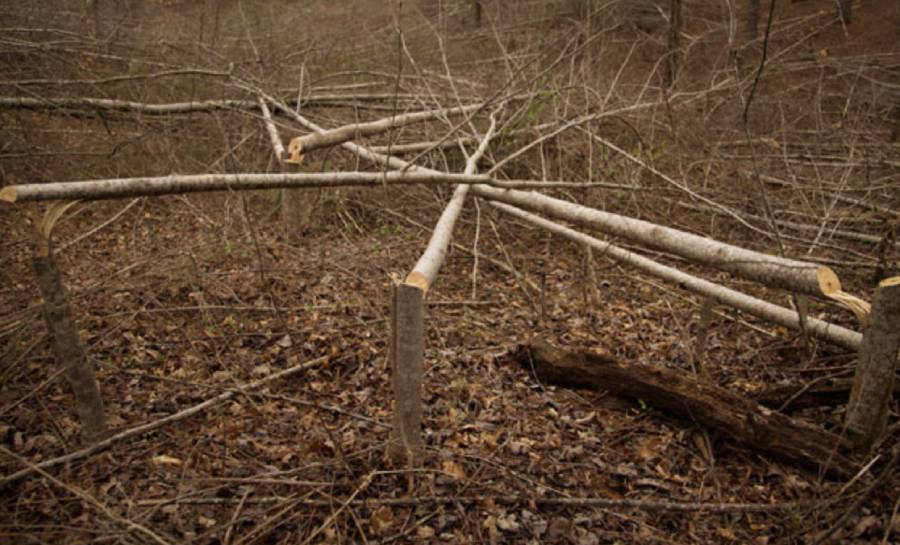
The best timber cuts for deer habitat are clearcuts, patch cuts, selective cuts, shelterwood cuts, and timber stand improvement (TSI), but the right method depends on the existing forest and the habitat conditions a landowner wants to create. A timber harvest improves deer habitat primarily by changing forest structure. Removing part or all of the overstory allows more sunlight to reach the forest floor, which can stimulate grasses, forbs, shrubs, woody browse, and tree regeneration that white-tailed deer use for food and cover.
Clearcuts and patch cuts create the greatest canopy disturbance and can produce dense early successional vegetation that provides both browse and security cover. Selective cuts retain more mature trees while opening portions of the canopy, while shelterwood cuts remove the overstory in stages to encourage regeneration beneath remaining trees. TSI and thinning provide another option when the goal is to improve an existing timber stand rather than conduct a larger harvest.
The best choice therefore depends on whether the property needs more forage, bedding cover, young forest, mature mast-producing trees, or a combination of these habitat components. This guide compares the major timber-cutting methods by their effects on canopy structure, understory growth, regeneration, bedding cover, and their practical value on a deer hunting property.
What Are the Best Timber Cuts for Deer Habitat?
The 5 best timber cuts for deer habitat are clearcuts, patch cuts, selective cuts, shelterwood cuts, and thinning or Timber Stand Improvement (TSI). Each method changes the amount of sunlight reaching the forest floor, the density of new vegetation, and the balance between mature timber and young cover. Clearcuts and patch cuts generally create the strongest shift toward early successional habitat, while selective cuts, shelterwood cuts, and TSI retain more of the existing forest structure.
Clearcutting removes most or all of the overstory within a defined area. The resulting canopy opening allows substantially more sunlight to reach the ground and creates conditions for grasses, forbs, shrubs, stump sprouts, and young trees to establish or expand. As regeneration becomes dense, the same area can provide both browse and visual cover for deer. A clearcut is therefore most useful when a property has extensive closed-canopy timber but lacks young forest and dense understory vegetation.
Patch cutting uses the same basic disturbance mechanism on smaller, distributed areas. Instead of removing the overstory across one large block, a landowner creates multiple openings within or around existing timber. This produces a mixture of young regeneration and mature forest across a relatively short distance. For a hunting property, that arrangement can increase habitat diversity by placing feeding, bedding, transition cover, and mature timber closer together.
Selective cutting removes individual trees or groups of trees while retaining a substantial portion of the overstory. Its habitat effect depends on how much canopy is actually opened. Removing a few merchantable trees from a closed stand may produce little understory response, while a harvest designed to create meaningful canopy gaps can increase sunlight and vegetation at ground level. Selective cutting is therefore better suited to properties where retaining mature forest structure is an important objective alongside increasing understory growth.
Shelterwood cutting removes the overstory in stages rather than during a single harvest. Some mature trees remain temporarily while increased light encourages regeneration beneath them. This method can combine forest regeneration with short-term retention of selected overstory trees, making it different from both a full clearcut and a lighter selective harvest.
Thinning and Timber Stand Improvement modify an existing stand by removing selected trees that interfere with specific forest or habitat objectives. TSI can release desirable trees, change canopy density, influence understory conditions, and improve stand composition without requiring a conventional commercial harvest. Its value for deer depends on the treatment intensity and the vegetation that responds afterward.
| Timber cutting method | Canopy change | Primary habitat result | Best suited for |
|---|---|---|---|
| Clearcut | Very high | Young regeneration, browse, dense cover | Creating early successional habitat |
| Patch cut | High within selected patches | Young cover distributed among mature timber | Increasing habitat diversity |
| Selective cut | Low to moderate, depending on intensity | Canopy gaps with mature-tree retention | Balancing understory growth and mature forest |
| Shelterwood cut | Moderate to high in stages | Regeneration beneath retained overstory | Regenerating a stand gradually |
| Thinning / TSI | Variable | Changes stand composition and structure | Improving an existing timber stand |
No single timber cut is best for every deer property. A property dominated by mature closed-canopy forest may benefit from aggressive canopy disturbance, while a property that already contains substantial young cover may gain more from improving selected mature stands. The correct timber cut should therefore be matched to the habitat component that is currently limited rather than chosen solely because one cutting method is considered good for deer.
Why Does Cutting Timber Improve Deer Habitat?
Timber cutting improves deer habitat by increasing sunlight at ground level and changing forest structure, which can increase forage, woody browse, regeneration, and protective cover. The habitat benefit comes primarily from the vegetation response after trees are removed rather than from the act of cutting trees itself. A harvest that removes trees without producing the desired understory or regeneration response does not automatically create high-quality deer habitat.
A dense overstory intercepts a large portion of incoming sunlight before it reaches the forest floor. Reducing that canopy gives existing plants and new regeneration greater access to light. The resulting vegetation can include grasses, forbs, shrubs, stump sprouts, brambles, and young woody stems, depending on the forest type, seed bank, soils, climate, browsing pressure, and trees already present. These plants place more deer forage within browsing height than vegetation located in the mature canopy.
The same regeneration can change the physical structure of the habitat. As young trees, shrubs, and other vegetation become denser, they create horizontal and vertical screening near ground level. Deer can use this vegetation as bedding and security cover because it reduces visibility through the stand. A timber cut can therefore provide two habitat functions at the same time: edible vegetation supplies forage, while dense plant structure supplies concealment.
Timber cutting can also create early successional habitat inside landscapes dominated by mature forest. Early successional habitat develops after a disturbance resets vegetation growth and allows young plants to occupy the site. Its value changes as the stand ages. Freshly disturbed ground, rapidly developing browse, dense young regeneration, and later canopy development represent different stages of the same succession process, so a timber cut does not provide identical deer habitat indefinitely.
For hunting-property management, this mechanism makes canopy disturbance and vegetation response more important than the name of the cutting method alone. Two selective cuts can produce different habitat outcomes if one opens enough canopy to stimulate dense understory growth while the other leaves the stand largely shaded. Likewise, the value of a clearcut depends on what regenerates, where the cut is located, and how the surrounding forest complements the new cover. The best timber management strategy therefore starts with a specific habitat objective and uses the cutting method needed to produce that vegetation and forest structure.
Is Clearcutting Good for Deer Habitat?
Clearcutting is good for deer habitat when the property needs more early successional vegetation, woody browse, and dense security cover. Removing most or all of the overstory creates a major canopy opening, allowing sunlight to reach vegetation that was previously shaded. The resulting regeneration can transform a mature, open-understory timber stand into a much denser habitat containing food and cover within reach of white-tailed deer.
The primary benefit comes from the vegetation that develops after the harvest. Increased sunlight can stimulate stump sprouts, shrubs, forbs, brambles, and young trees, depending on the plant community and site conditions. Deer can browse leaves, shoots, and stems from this new growth while it remains within their feeding zone. This makes a regenerating clearcut fundamentally different from a mature forest where much of the living plant material may be located above browsing height.
Clearcuts can also develop into effective bedding and security cover as regeneration becomes dense enough to restrict visibility. A mature timber stand with an open understory may allow a hunter or predator to see for a considerable distance, while dense young vegetation creates visual screening closer to ground level. Deer can use that structure for daytime bedding, escape cover, and protected movement. For a hunting property that already contains food sources but lacks secure daytime cover, creating young forest can address a habitat component that food plots alone do not provide.
The habitat value of a clearcut changes as the vegetation matures. Immediately after logging, the site does not have the same cover structure it may develop during subsequent growing seasons. Regeneration then increases in height and density before eventually developing into a young stand whose expanding canopy can begin reducing vegetation near the ground. Clearcutting should therefore be viewed as the start of a forest succession cycle rather than a permanent habitat condition.
Clearcutting also involves trade-offs. Removing the overstory eliminates mature-tree structure within the harvested area and can temporarily remove mast-producing trees if those trees are included in the cut. A property already dominated by young forest may gain less from creating another large block of similar habitat than a property dominated by mature closed-canopy timber. The objective is not to maximize the number of trees removed; it is to create the forest structure currently missing from the property.
For this reason, a clearcut is most useful when substantial canopy removal is necessary to create young, regenerating habitat. The size, shape, location, retained trees, surrounding cover, regeneration objectives, and long-term forest plan determine whether a particular clearcut improves the property as a whole. A forester can incorporate these variables into a harvest prescription instead of treating every mature stand as a candidate for complete removal.
Are Patch Cuts Better Than Large Clearcuts for Deer Habitat?
Patch cuts can be better than one large clearcut when the objective is to distribute young cover throughout a hunting property while retaining mature timber between harvested areas. A patch cut removes most or all of the overstory within smaller defined areas. Its biological mechanism is similar to a clearcut, but its smaller footprint creates a different spatial arrangement of mature forest and regenerating vegetation.
The main advantage is habitat diversity within a shorter distance. Several patches can create young regeneration beside older timber rather than concentrating all young habitat in one large block. A deer moving across the property can encounter dense cover, browse, mature forest, and transition zones within the same general area. This arrangement is particularly relevant when the existing property consists primarily of one age class and the management objective is to create greater structural diversity.
Patch cutting also creates more interfaces between different vegetation structures. The boundary between dense regeneration and taller timber forms a transition where cover conditions, sunlight, and plant communities change over a relatively short distance. These transitions can influence how deer feed, bed, and move through the landscape. However, creating edge is not automatically beneficial in every location; the surrounding habitat and the amount of existing fragmentation must also be considered.
Placement determines whether patch cuts function as part of a coherent habitat plan. A patch positioned near existing secure cover may expand a larger bedding complex, while another positioned between bedding and feeding habitat may influence the amount and arrangement of cover along a movement route. Multiple patches can also be distributed across a property so that different areas enter different stages of forest succession over time. This prevents the entire young-forest component from aging simultaneously.
Patch cuts are not automatically superior to larger clearcuts. A larger cut may be more appropriate when a property needs a substantial block of early successional habitat or when forest-regeneration objectives require a larger treatment area. Small patches can also fail to produce the intended habitat if they are too heavily shaded by surrounding trees or if regeneration is poor. The correct scale must match both forestry requirements and the desired habitat response.
For deer management, the decision between a patch cut and a larger clearcut should therefore be based on how much young habitat the property needs and where that habitat should occur. Large clearcuts concentrate disturbance and regeneration, while patch cuts distribute those conditions among retained timber. Neither approach is universally better; the better cut is the one that fills the property’s existing habitat deficiency while supporting its long-term forest-management plan.
Is Selective Timber Cutting Good for Deer Habitat?
Selective timber cutting can improve deer habitat when enough trees are removed to increase sunlight at ground level while retaining mature trees that provide useful forest structure and food. Unlike a clearcut, a selective cut leaves a substantial portion of the overstory intact. This makes it useful when the management objective is to increase understory vegetation without converting the entire treated area into young forest.
The habitat response depends heavily on cutting intensity. Removing scattered trees creates canopy gaps, but small openings may allow only limited sunlight to reach the forest floor. A more intensive treatment can produce a stronger response from shrubs, forbs, sprouts, and tree regeneration. For deer habitat, the important variable is therefore not simply whether a stand has been selectively harvested but whether the remaining canopy allows enough light to produce the desired vegetation.
Selective cutting also allows landowners to retain trees with specific habitat functions. Mature mast-producing trees can continue providing seasonal food, while selected overstory trees preserve vertical structure within the stand. At the same time, removing competing or undesirable trees can direct growing space toward retained trees and increase light availability below them. This combination can be valuable on properties where both mature forest and understory vegetation are management priorities.
However, a light commercial harvest should not automatically be considered a deer habitat improvement project. A harvest focused primarily on removing valuable merchantable trees may leave enough canopy to suppress substantial understory development. It can also remove desirable habitat trees without creating the dense regeneration needed for browse or security cover. A habitat-focused selective cut should start with a defined forest and wildlife objective rather than simply identifying trees that can be sold.
Selective cutting generally creates less dramatic young cover than a clearcut because more overstory remains. This can be an advantage when a property already has adequate early successional habitat but needs additional understory growth within mature timber. It can be a disadvantage when the primary deficiency is dense bedding cover. In that situation, larger canopy openings, patch cuts, or another regeneration treatment may produce the required structure more effectively.
The choice between selective cutting and clearcutting therefore depends on the desired post-harvest condition. Use selective cutting when retaining significant mature forest structure is part of the objective; use a more intensive regeneration cut when creating dense young forest is the primary objective. Existing stand composition, regeneration potential, and surrounding habitat should determine how much canopy is removed.
How Does Shelterwood Cutting Improve Deer Habitat?
Shelterwood cutting can improve deer habitat by opening the canopy enough to encourage forest regeneration while temporarily retaining selected overstory trees. Instead of removing the entire mature canopy during one operation, the shelterwood system removes trees in stages. This creates a transitional forest structure in which new vegetation develops beneath or between remaining mature trees.
The increase in sunlight is central to the habitat response. Reducing overstory density gives seedlings and other understory plants greater access to light, water, and growing space. As regeneration develops, deer can gain additional browse within reach and greater vegetation density near ground level. The retained overstory can continue contributing forest structure during the regeneration process until the management plan calls for additional removal.
Shelterwood cutting differs from a typical selective cut because the treatment is designed around regeneration of the next stand rather than the indefinite retention of an unevenly opened canopy. The remaining trees serve a specific silvicultural purpose during establishment. Depending on the forest type and prescription, later harvest entries can remove additional overstory after adequate regeneration has developed.
For deer habitat, this staged process can provide a mixture of mature-tree structure and developing vegetation during part of the regeneration period. That combination may be useful when a landowner wants a stronger regeneration response than a light selective cut provides but does not want to remove the entire overstory at once. The exact wildlife benefit still depends on how much light reaches the ground and which plants establish after treatment.
A shelterwood cut is not automatically better than a clearcut. Shelterwood is more appropriate when successful forest regeneration benefits from temporarily retaining selected overstory trees, while a clearcut is more appropriate when the desired regeneration system calls for removing the existing overstory in one main treatment. These are forestry decisions as well as wildlife decisions, so tree species, stand age, site conditions, regeneration requirements, and future harvest entries must be considered.
For a hunting property, shelterwood cutting is most valuable when its forestry objective and deer-habitat objective support each other. The treatment should establish the next forest stand while also creating useful browse and cover during regeneration. Using a shelterwood solely because it leaves some mature trees misses the primary purpose of the method; the retained trees and subsequent removals should be part of a planned regeneration system.
How Does Timber Stand Improvement Help Deer Habitat?
Timber Stand Improvement (TSI) helps deer habitat by removing selected trees to improve stand composition, increase growing space for desirable trees, and modify the amount of sunlight reaching understory vegetation. Unlike a commercial timber harvest, TSI is primarily defined by a management objective rather than timber revenue. The treatment can target trees that compete with desirable species, suppress regeneration, or prevent the stand from developing the structure needed for wildlife and forestry goals.
The effect of TSI on deer habitat depends on treatment intensity. Removing a limited number of competing trees can release desirable mast-producing or timber trees without dramatically changing ground-level vegetation. A more intensive treatment that creates larger canopy openings can increase sunlight and stimulate shrubs, forbs, sprouts, and young trees. These plants can provide browse within reach of deer while denser regeneration can add screening and security cover.
TSI is particularly useful because a landowner can manage different habitat functions within the same stand. Some trees can be retained for mast, future timber, diversity, or structural cover while others are removed to create growing space and sunlight. The objective is not to remove as many low-value trees as possible. Each removal should contribute to a defined future condition for the stand.
TSI also works differently from a clearcut or patch cut. Clearcuts intentionally reset a stand across a defined area and encourage a new age class, while TSI generally modifies the structure and composition of an existing stand. A hunting property may therefore use both approaches in different locations: regeneration cuts can create dense young forest, while TSI can improve portions of the remaining timber.
Which Trees Should You Cut for Better Deer Habitat?
Cut trees that conflict with the specific habitat and forest-management objectives established for the stand rather than removing trees according to one universal species list. A tree can be undesirable because it suppresses a more valuable tree, occupies growing space needed for regeneration, contributes little to the intended stand composition, or maintains excessive canopy closure where additional understory growth is needed.
For example, a poorly formed tree growing directly into the crown of a desirable mast-producing tree may be a candidate for removal because reducing competition gives the retained tree additional crown space. In another part of the property, several stems may need to be removed together because the objective is not crown release but the creation of a canopy opening large enough to stimulate regeneration. The same cutting rule should not be applied automatically to both situations.
Tree selection should also account for what will replace the removed canopy. Cutting trees does not guarantee that desirable deer forage or cover will develop. Existing seedlings, invasive plants, browsing pressure, soils, shade from adjacent trees, and the local plant community can influence the response. A treatment that opens the canopy but produces undesirable vegetation may fail to accomplish the intended habitat objective.
For this reason, tree removal should follow a defined sequence: identify the desired future stand, determine which existing trees support that condition, identify the trees preventing it, and then select the treatment needed to change the stand. This approach connects each cut to a measurable forestry or habitat function instead of treating tree removal itself as the objective.
Which Trees Should You Keep for Better Deer Habitat?
Keep trees that provide valuable mast, browse, cover, diversity, regeneration potential, or long-term stand structure when those functions match the property’s habitat plan. Retention decisions are as important as removal decisions because a timber treatment determines both what disappears from the stand and what remains to influence future forest conditions.
Mast-producing trees can be particularly valuable because their nuts or fruits provide seasonal food without requiring the landowner to maintain an artificial feeding area. However, species alone should not determine retention. Individual tree health, crown condition, productivity, competition, site suitability, and the abundance of similar trees across the property all affect the value of retaining a particular tree.
Landowners should also retain structural diversity where it supports the management objective. A property composed entirely of one forest condition provides fewer habitat choices than a landscape containing mature timber, regenerating cuts, dense cover, and transitional vegetation. Retaining selected trees or groups of trees can preserve mature components while nearby treatments create younger vegetation.
The practical objective is therefore not to divide every tree into a simple “good for deer” or “bad for deer” category. Tree selection should create the desired combination of food, cover, regeneration, and future forest structure. A consulting forester or qualified wildlife professional can evaluate the existing stand and develop a prescription that connects individual tree decisions with both long-term timber management and deer-habitat objectives.
How Big Should a Timber Cut Be for Deer Habitat?
There is no single timber cut size that produces the best deer habitat on every property. The appropriate acreage depends on the total property size, existing forest age classes, surrounding habitat, regeneration goals, and whether the cut is intended primarily to create forage, bedding cover, or a larger block of young forest. Cut size should therefore be determined by the habitat condition the property lacks rather than by applying the same acreage target to every hunting property.
Smaller cuts allow young vegetation to be distributed among existing timber. For example, several patch cuts can create multiple pockets of regeneration instead of concentrating all new growth in one location. This arrangement can be useful when the management objective is to increase structural diversity across a property while retaining substantial mature forest. Each patch creates a local canopy opening where increased sunlight can stimulate vegetation close to ground level.
Larger cuts create a more extensive block of regeneration. This approach can be appropriate when a property contains large areas of mature closed-canopy forest and lacks substantial young cover. A larger regeneration area can eventually provide a more continuous block of dense vegetation rather than a series of small openings surrounded by mature trees. However, increasing cut size also increases the amount of existing overstory removed at one time, so the effect on mast trees, mature cover, timber value, and adjacent habitat must be considered before harvest.
The surrounding landscape also changes how a specific acreage functions. A timber cut located within a landscape already dominated by young forest does not add the same habitat diversity as the identical cut placed within an extensive mature forest. Likewise, a small property surrounded by neighboring clearcuts has different habitat needs from a similar-sized property surrounded by closed-canopy timber. The useful question is therefore not simply “How many acres should I cut?” but “How much of this property needs to be in regenerating forest to correct its current habitat deficiency?”
Cut dimensions should also support forest regeneration. Very small openings can remain influenced by shade from surrounding trees, while larger openings create different light and growing conditions. Tree species, site quality, regeneration method, and management objectives affect the appropriate opening size. For this reason, acreage decisions should be coordinated with a forester rather than based solely on a hunting-property formula.
A long-term plan can also divide timber cuts across different years instead of treating the entire desired acreage at once. For example, separate areas can be harvested at different stages so the property contains regeneration of different ages. As one cut develops into taller young timber, another treatment can create a newer stage of vegetation. This approach maintains greater age-class diversity than allowing every young stand on the property to mature on the same schedule.
Where Should You Cut Timber to Improve Deer Habitat?
Timber cuts should be placed where new forage and dense cover correct gaps in the property’s existing habitat structure. The best location depends on the relationship between mature timber, existing bedding cover, feeding areas, terrain, travel cover, neighboring properties, and other habitat features. Placement should be planned at the property and landscape level rather than selecting a convenient stand without considering what surrounds it.
Existing bedding cover is one important reference point. A property with limited secure cover may benefit from placing a regeneration cut where it expands an existing cover complex or creates a new block of dense vegetation. As young stems and shrubs develop, the treated area can increase visual screening and give deer additional places to bed. The value comes from adding cover where cover is deficient, not simply from positioning a timber cut beside an area where deer already bed.
Feeding areas provide another spatial consideration. Food plots, agricultural fields, mast-producing timber, and natural browse can function as food sources, while regenerating timber can add both forage and cover between these destinations. Placing young cover in relation to feeding habitat can reduce abrupt transitions from secure vegetation into exposed areas and create more complex habitat between bedding and feeding locations.
Terrain should influence placement because vegetation structure and topography operate together. Ridges, benches, draws, slopes, creek systems, and other terrain features can affect access, forest composition, moisture, and how deer travel through a property. A timber prescription that ignores terrain may create desirable vegetation in a location that does not integrate well with the rest of the habitat or with practical forestry operations.
Neighboring habitat is equally important. Deer use landscapes that extend beyond individual property boundaries, so the habitat immediately outside a hunting property can change what should be created inside it. If neighboring land already provides extensive young cover, retaining or improving mature forest components may add greater diversity. If surrounding properties consist mainly of mature closed-canopy timber, creating regenerating forest can supply a habitat condition that is comparatively scarce in the local landscape.
Logging roads and skid trails should be treated as secondary features of the timber operation rather than the primary reason for determining harvest placement. After logging, these openings can influence access, vegetation, and movement through the property. Their final use should be planned carefully because the same trail that improves management access can also increase human intrusion into areas intended to function as secure deer cover.
The best timber-cut location connects forest management with a specific habitat objective. First identify whether the property lacks forage, young cover, mature forest, regeneration, or a balanced distribution of these components. Then place the harvest where the resulting vegetation will complement existing habitat. This prevents timber cutting from becoming a collection of isolated openings and turns each harvest area into part of a larger deer-habitat system.
How Long Does a Timber Cut Improve Deer Habitat?
A timber cut can improve deer habitat for years, but the type and amount of habitat it provides change continuously as the forest regenerates. Timber harvesting begins a succession process rather than creating a permanent habitat condition. The treated area progresses from recently disturbed ground to herbaceous and woody regeneration, then to dense young forest, and eventually toward a developing canopy that can reduce sunlight and vegetation near ground level.
The first stage begins immediately after the canopy is opened. Logging disturbs the site and changes light conditions, but a newly harvested area does not instantly provide the dense security cover associated with an established young forest. Its value depends on the vegetation already present and the speed and composition of regeneration. Increased sunlight can support grasses, forbs, shrubs, stump sprouts, brambles, and tree seedlings that provide forage as vegetation develops.
The next stage occurs as woody regeneration increases in height and stem density. During this period, the same plants can provide both browse and physical screening. Dense young stems reduce visibility through the stand and can create bedding and security cover while leaves, shoots, and other accessible vegetation remain available as food. A regenerating timber cut can therefore transition from an area dominated by forage opportunities into one that combines food with increasingly dense cover.
Habitat conditions change again as young trees grow and their crowns occupy more space. Increasing canopy closure reduces the amount of sunlight reaching lower vegetation. The understory can become less productive or less dense as the stand advances beyond its early successional stages. The area may still provide useful forest habitat, but it no longer offers the same combination of low-growing forage and dense young vegetation that characterized earlier stages.
For this reason, the habitat lifespan of a timber cut should be measured by succession stage rather than a universal number of years. Forest type, tree growth rate, soils, climate, cut intensity, regeneration, deer browsing pressure, and subsequent management all influence how quickly the vegetation changes. A fixed statement such as “a timber cut is best for deer for X years” can be misleading when these variables differ substantially among properties.
Long-term deer habitat management can address this progression by maintaining multiple forest age classes across the property. Instead of allowing every regeneration area to begin and mature simultaneously, landowners can stagger treatments where forestry objectives allow. One area may contain recent regeneration, another may provide dense young cover, and another may remain mature timber. This creates structural diversity while preventing the property’s entire early successional component from disappearing at the same time.
Timber cuts should therefore be treated as part of a continuing forest-management cycle. Monitoring regeneration after the harvest helps determine whether the treatment is producing the intended browse, cover, and future stand. As the cut ages, additional forestry or habitat treatments can be considered based on the new stand condition rather than an arbitrary schedule.
When Should You Cut Timber for Deer Habitat?
The best time to cut timber for deer habitat depends on the forest-regeneration objective, site conditions, wildlife considerations, logging access, and the silvicultural system being used. There is no single month or season that is best for every deer property because timber stands differ by region, tree species, soils, weather, terrain, and the type of regeneration a landowner wants to establish.
Regeneration should be one of the first considerations. A timber harvest determines the conditions under which the next vegetation community develops, so timing can be connected to how desirable trees and understory plants regenerate on a specific site. Existing seedlings, seed production, sprouting response, competing vegetation, and the selected silvicultural method can all affect when a forester recommends conducting different stages of a harvest.
Ground conditions also affect logging operations. Heavy equipment must move trees through the stand using skid trails, landings, and access routes. Wet or unsuitable soil conditions can increase the potential for rutting, compaction, and other site disturbance. Frozen or dry ground can provide better operating conditions in certain regions, but the appropriate timing depends on local climate, soils, terrain, and the equipment being used.
Wildlife objectives add another layer to the decision. Cutting activity creates temporary human and equipment disturbance, while the vegetation response after the operation produces the longer-term habitat change. A hunting-property manager should distinguish these two effects. Short-term disturbance during logging is temporary; the resulting changes in sunlight, regeneration, browse, and cover can influence the property for much longer.
Hunting season alone should therefore not determine the harvest schedule. Delaying a necessary forest treatment solely to avoid short-term changes in deer activity can conflict with regeneration requirements or favorable logging conditions. Conversely, operational timing can sometimes be adjusted when multiple suitable windows exist. The correct decision balances forest health and regeneration with wildlife and hunting objectives instead of allowing one short-term consideration to control the entire prescription.
Regional differences make professional forestry input especially important for timing decisions. A harvest prescription appropriate for one forest type may not produce the same regeneration in another. Tree species composition, invasive vegetation, disease, local markets, seasonal access, and state forestry requirements can further affect when work should occur.
Choose timber-cutting timing according to the desired future stand first and hunting convenience second. Once the habitat objective is established, a forester can determine which harvest method and operational window are most likely to create the intended regeneration while protecting the site. This keeps the timber cut focused on long-term deer habitat rather than short-term changes in hunting conditions.
Can Prescribed Fire Improve a Timber Cut for Deer Habitat?
Prescribed fire can improve a timber cut for deer habitat when fire is compatible with the forest type and is used to maintain or stimulate the vegetation conditions created by canopy management. Timber cutting and prescribed burning perform different functions. Cutting primarily changes canopy structure and light availability, while prescribed fire changes vegetation at or near ground level. When the two treatments are compatible, they can be used together to influence understory composition and maintain open growing conditions.
Timber removal increases the amount of sunlight reaching the forest floor, but additional light does not guarantee that desirable deer forage will dominate the site. The vegetation response depends on the plants already present, seed sources, soil conditions, browsing pressure, and subsequent disturbance. Prescribed fire can alter this response by reducing accumulated plant material, suppressing certain woody stems, and stimulating new growth from fire-adapted vegetation where local ecological conditions support burning.
The combination can be especially relevant when the objective is to prevent an opened stand from quickly returning to dense woody growth that shades lower vegetation. Repeated disturbance can maintain a different vegetation structure than timber harvesting alone. This creates a management sequence in which timber cutting establishes the desired canopy condition and later treatments maintain or modify the understory as the stand develops.
Prescribed fire is not appropriate for every timber stand. Forest type, tree species, fuel conditions, weather, topography, season, smoke management, nearby structures, and local regulations affect whether burning is suitable. Fire can also damage desirable trees when the prescription, timing, or execution does not match the stand. The decision to burn should therefore be based on ecological and forestry objectives rather than the assumption that fire automatically improves deer habitat.
A prescribed burn also requires a specific operational plan. Firebreaks, weather parameters, fuel conditions, ignition strategy, smoke considerations, personnel, equipment, and contingency procedures must be addressed before ignition. Landowners who lack the required training and resources should work with qualified prescribed-fire professionals and follow applicable state and local requirements.
For deer management, prescribed fire should be treated as a follow-up vegetation-management tool rather than a substitute for a timber prescription. Timber cutting determines how much overstory remains, while fire can help influence what happens below that overstory in suitable ecosystems. The strongest habitat result occurs when both treatments are selected for a defined vegetation objective.
Read more: Best Habitat Projects for Small Hunting Properties
What Are the Most Common Timber Cutting Mistakes for Deer Habitat?
There are 7 common timber cutting mistakes that can prevent a harvest from producing the intended deer habitat: cutting without a habitat objective, removing valuable habitat trees indiscriminately, opening too little canopy, ignoring regeneration, relying on one harvest permanently, ignoring the surrounding landscape, and prioritizing short-term hunting setups over long-term forest management. Each mistake disconnects tree removal from the habitat condition the property actually needs.
The first mistake is cutting without a defined habitat objective. “Improve deer habitat” is too broad to function as a timber prescription. A landowner should identify whether the stand needs more woody browse, dense bedding cover, young forest, mature mast production, regeneration, or a different combination of these components. The desired future condition determines whether a clearcut, patch cut, selective harvest, shelterwood treatment, or TSI is appropriate.
The second mistake is removing valuable habitat trees indiscriminately. Trees differ in their contribution to mast production, stand diversity, cover, regeneration, and future forest structure. Removing trees only because they have commercial value can reduce one habitat component without creating another of equal or greater value. Tree retention should therefore be planned alongside tree removal.
The third mistake is opening too little canopy to produce the desired vegetation response. A lightly thinned stand may look substantially different after logging while still allowing insufficient sunlight to reach the forest floor for dense regeneration. This is particularly important when the objective is bedding or security cover. The required canopy disturbance should be determined by the desired post-treatment vegetation rather than by how visually noticeable the harvest appears.
The fourth mistake is ignoring regeneration after the harvest. The habitat value of a timber cut comes largely from what grows afterward. Desirable tree seedlings, shrubs, forbs, brambles, competing vegetation, and invasive plants can respond differently to the same increase in sunlight. Monitoring the treated area allows the landowner to determine whether the actual vegetation response matches the original objective and whether additional management is required.
The fifth mistake is treating one timber harvest as a permanent deer-habitat solution. Regenerating stands change as trees become taller, stem density changes, and canopy closure increases. A cut that provides abundant low vegetation and dense cover during one succession stage will not maintain identical conditions indefinitely. Long-term management requires monitoring forest development and creating or maintaining different age classes where appropriate.
The sixth mistake is ignoring habitat beyond the harvested stand. Deer do not use a timber cut independently from the surrounding landscape. Existing mature timber, young cover, agricultural fields, food plots, terrain, neighboring properties, and other habitat features determine what the new cut adds to the area. Creating more young forest where young forest is already abundant may provide less benefit than retaining or improving a habitat type that is scarce locally.
The seventh mistake is designing timber management primarily around a short-term hunting setup. A harvest can affect deer movement and hunting access, but these effects should not override forest regeneration and habitat objectives. Placing cuts solely to influence a stand location or travel route can produce a poor long-term forest layout. Habitat structure should be established first; hunting strategy can then be adapted to the resulting landscape.
Avoiding these 7 mistakes requires one consistent principle: define the desired habitat condition before deciding which trees to cut. The cutting method, intensity, acreage, location, retained trees, and follow-up treatments should all support that condition. This turns timber harvesting from a one-time disturbance into a planned component of long-term deer and forest management.
Which Timber Cut Should You Choose for Your Deer Hunting Property?
Choose a timber cut according to the habitat condition your deer hunting property lacks: use clearcuts for substantial young-forest regeneration, patch cuts for distributed pockets of young cover, selective cuts for retaining more mature forest structure, shelterwood cuts for staged regeneration, and TSI or thinning for improving an existing stand. The best method is the one that creates a missing habitat component while supporting the long-term development of the forest.
Choose a clearcut when the primary objective is to convert a defined area of mature timber into regenerating young forest. Removing the overstory creates the strongest change in light conditions and gives new vegetation an opportunity to develop across the harvested area. This approach fits properties that contain extensive closed-canopy timber but lack early successional vegetation, accessible browse, or dense young cover.
Choose a patch cut when similar regeneration is needed but should be distributed across several smaller areas. Patch cutting allows mature timber to remain between young stands and can create multiple vegetation age classes when cuts are completed at different times. This approach is useful when habitat diversity across the property is a greater priority than creating one continuous block of regeneration.
Choose a selective cut when retaining substantial mature forest structure is part of the objective. Removing selected trees can increase light penetration while preserving other trees for mast, stand diversity, future timber, or structural value. The treatment must open enough canopy to produce the desired understory response; simply removing scattered merchantable trees does not guarantee meaningful habitat improvement.
Choose a shelterwood cut when the forest-regeneration plan calls for establishing the next stand beneath a partially retained overstory. The staged removal process provides more light for regeneration while selected mature trees remain temporarily. Shelterwood cutting should be selected because it fits the regeneration requirements of the stand, not simply because a landowner prefers to leave some mature trees after harvest.
Choose TSI or thinning when the existing stand needs improvement rather than complete regeneration. Removing selected competitors can release desirable trees, modify canopy density, improve stand composition, and create additional growing space. More intensive TSI can also increase ground-level sunlight and vegetation, but its habitat effect depends on how much the stand is actually changed.
| Property objective | Timber cut to consider | Primary habitat change |
|---|---|---|
| Create substantial young forest | Clearcut | Maximum canopy opening and regeneration |
| Distribute young cover across the property | Patch cut | Multiple localized regeneration areas |
| Retain more mature timber | Selective cut | Canopy gaps with overstory retention |
| Establish regeneration beneath retained trees | Shelterwood cut | Staged canopy removal and regeneration |
| Improve an existing timber stand | TSI / thinning | Improved composition and variable canopy opening |
A property can also benefit from more than one timber-cutting method because deer require multiple habitat components rather than one uniform forest condition. One portion of a property might contain a regenerating clearcut, another could contain patch cuts of different ages, and selected mature stands could receive TSI. The resulting combination provides greater structural diversity than managing every acre with the same treatment.
The final decision should begin with four factors: existing stand conditions, the habitat component that is currently limited, the desired future forest, and the surrounding landscape. These factors determine whether the property needs more young regeneration, mature-tree retention, understory vegetation, bedding cover, or a different distribution of existing habitat.
Timber management should also remain a forestry decision as well as a hunting decision. Tree species, regeneration requirements, soils, invasive vegetation, timber value, access, and future stand development can change the appropriate prescription. A consulting forester can evaluate these conditions and translate the habitat objective into specific recommendations for trees to remove, trees to retain, harvest intensity, opening size, and follow-up management.
For most deer hunting properties, the goal is not to find one universally “best” timber cut but to create the right mixture of forest conditions. Timber cutting produces the greatest habitat value when each harvest has a defined purpose and when young regeneration, dense cover, mature timber, food resources, and future forest development are managed as parts of the same habitat system.