
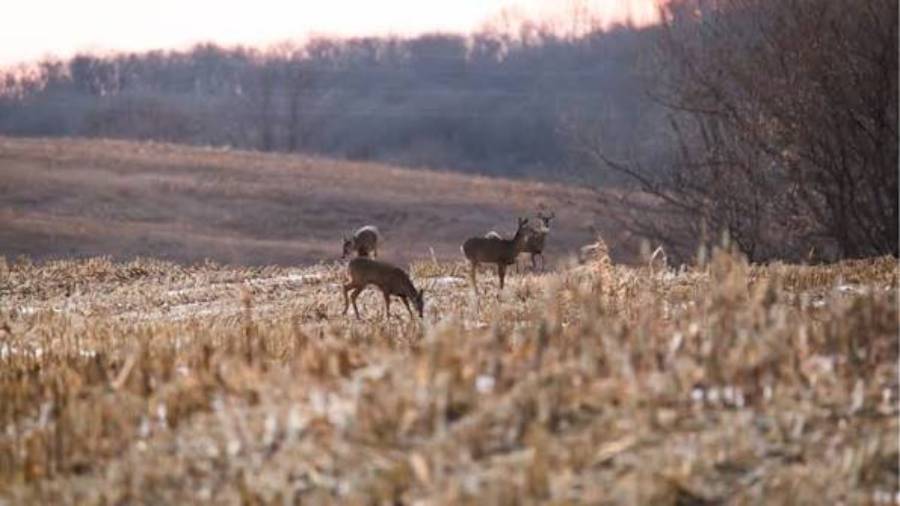
Crop harvest can change deer movement quickly because it alters three things whitetails use to make daily travel decisions: food, security cover, and human disturbance. A field that held standing corn or soybeans before harvest may offer less concealment afterward, while spilled grain or unharvested residue can keep the same area attractive as a feeding destination. At the same time, combines, trucks, and increased farm activity can temporarily disrupt established travel patterns.
To predict where deer will move next, hunters should not assume that deer simply leave a harvested field. The better approach is to identify what changed and then locate the nearest remaining food source, secure bedding cover, and low risk route connecting the two. Permanent features such as timber edges, creek bottoms, fence rows, brush lines, and terrain pinch points often become more important once crop cover disappears.
Fresh tracks, active trails, droppings, and trail camera activity can then confirm whether the predicted route is actually being used. Weather, rut activity, and hunting pressure must also be considered because each can modify the pattern created by harvest. The goal is to build a repeatable movement pattern before choosing a stand location.
How Can You Predict Deer Movement After Crop Harvest?
You can predict deer movement after crop harvest by identifying what changed in the field, locating the best remaining food and security cover, mapping the routes between them, and confirming those routes with fresh deer sign. Harvest changes the landscape faster than many natural events, so movement patterns that worked several days earlier can become less useful once a field is cut.
There are 5 main steps for predicting post-harvest deer movement. First, identify what the harvest removed, such as standing corn that previously provided both food and concealment. Second, locate the most attractive remaining food source, including waste grain, standing crops, acorns, browse, or nearby food plots. Third, find the closest secure bedding cover. Fourth, map the lowest-risk routes connecting that cover to food. Fifth, verify the prediction with fresh tracks, droppings, active trails, or repeated trail-camera detections.
The first step is to compare the property before and after harvest. A standing crop can hide deer while they feed, travel, and in some situations bed inside the field. Once that crop is removed, the field becomes more exposed. Deer that previously crossed open ground under crop cover may begin using timber edges, brush lines, creek bottoms, fence rows, or other permanent cover instead. The key question is not simply where deer used to travel, but which travel options still provide security after the field changes.
The second step is to identify where food value remains. A harvested field is not automatically an abandoned field because grain and crop residue can remain after machinery passes through. At the same time, deer may shift toward a competing food source if it offers more calories or safer access. For example, deer may continue feeding in a harvested cornfield with substantial waste grain, while another herd may move toward acorns in nearby timber if mast is abundant.
The third and fourth steps connect food to security cover. Deer movement becomes easier to predict when hunters identify the likely start and end points of a daily route. A useful model is bedding cover → staging cover → travel corridor → feeding area. If a harvested field becomes exposed, deer may spend more time inside adjacent cover before entering the field, especially during daylight. That makes the route between bedding cover and the field more important than the field itself.
The fifth step is confirmation. A predicted route should not be treated as reliable until current evidence supports it. Fresh tracks crossing a ditch, repeated camera detections at the same field entrance, or newly used trails along a timber edge provide stronger information than sign created before harvest. The most useful post-harvest prediction is therefore not based on a single feature. It combines habitat change, current resources, likely travel routes, and fresh evidence.
Why Does Crop Harvest Change Deer Movement?
Crop harvest changes deer movement because it can alter food availability, remove security cover, and introduce human disturbance at the same time. These three changes affect where deer feed, where they feel safe, and which routes they use between feeding and bedding areas.
Food distribution is the first major change. Before harvest, crops such as corn and soybeans can concentrate feeding activity inside or along agricultural fields. After harvest, that food becomes less evenly distributed. Some areas may contain waste grain or unharvested plants, while others provide little remaining forage. Deer respond to this new distribution by favoring the parts of the landscape where food remains most accessible.
The effect becomes more important when another food source is available nearby. For example, a harvested cornfield may continue attracting deer because of spilled grain, but a strong acorn crop can pull movement toward oak timber instead. The hunter therefore needs to compare food sources rather than assume the harvested field remains the primary destination.
Cover loss is the second major change. Standing crops can provide visual security that allows deer to travel through areas that would otherwise feel exposed. Corn is especially important because mature plants can create enough concealment for deer to move within the field without remaining visible for long distances. When that cover disappears, travel behavior may shift toward permanent habitat features.
This change can make timber edges, drainage ditches, creek bottoms, brush lines, fence rows, and narrow strips of vegetation more important. These features provide concealment or reduce the amount of open ground deer must cross. A route along the edge of standing corn may lose much of its value after harvest, while a nearby brushy drainage can become the safer alternative.
Human disturbance is the third major factor. Combines, tractors, trucks, and farm workers create noise, movement, and scent during harvest. Deer can temporarily avoid areas receiving intense activity, but the disturbance itself does not always explain the long-term movement pattern. Once machinery leaves, the more important question becomes whether the field still provides food and whether deer can reach it from secure cover.
Hunters should therefore separate temporary disturbance from permanent habitat change. A deer may avoid a field while machinery is operating and return after the activity stops. In contrast, a deer that previously relied on standing corn for concealment may permanently change its route after the crop is removed because the security structure no longer exists.
The practical result is that crop harvest creates a new movement problem rather than a simple increase or decrease in deer activity. Hunters need to reassess three variables: where deer can eat, where they can remain concealed, and how they can travel between those locations with the least exposure. Those three variables form the foundation for predicting where deer will move next.
Where Do Deer Go After a Crop Field Is Harvested?
Deer usually move toward the closest combination of secure cover, remaining food, and low-risk travel routes after a crop field is harvested. They do not automatically abandon the field. Instead, harvest changes how deer use the field and the surrounding habitat because food may remain while concealment disappears.
The first place to check is the nearest permanent security cover. Standing crops can temporarily function as concealment, particularly when vegetation is tall and dense. Once that cover is removed, deer need another location where they can bed, stage, or travel without remaining exposed. Adjacent timber, thick brush, CRP, overgrown fence rows, creek bottoms, cattails, and other dense vegetation can become more important after harvest.
Distance matters when evaluating replacement cover. A secure bedding area 100 yards from the harvested field is generally more relevant to immediate post-harvest movement than comparable cover half a mile away when deer have no reason to travel the additional distance. Hunters should therefore begin with the closest suitable cover and work outward only when fresh sign does not support the initial prediction.
The next variable is food. A harvested field can remain a feeding destination when waste grain, missed plants, or other edible crop material remains available. This means a field that looks empty to a hunter can still provide enough food to attract deer. The important question is not whether the crop has been harvested but how much feeding value remains compared with surrounding food sources.
Alternative food can completely change the prediction. Acorns, standing crops on neighboring farms, food plots, browse, and other seasonal foods may draw deer away from the harvested field. For example, deer using a cornfield before harvest may continue visiting it for waste grain, but abundant acorns inside secure timber can reduce the need to enter the open field during daylight. In that situation, movement may concentrate deeper inside the woods even though deer still visit the agricultural field after dark.
Hunters should therefore map at least 3 locations after harvest: the primary security cover, the strongest current food source, and the likely route connecting them. This creates a more useful movement model than simply watching the harvested field. If the former feeding destination remains attractive but cover disappears, the field entrance, staging cover, or connecting corridor may become more valuable than the center of the field.
Terrain can further narrow the likely route. Deer moving from secure cover toward food may favor a creek crossing, brushy drainage, inside corner, fence opening, narrow strip of timber, or another feature that limits exposure. The more open the harvested landscape becomes, the easier it can be to eliminate routes that offer little concealment.
A hunter should then verify the predicted route with current evidence. Fresh tracks entering the field, droppings near staging cover, newly used trails, and repeated camera detections provide stronger evidence than tracks or trails created while the crop was still standing. Post-harvest scouting should therefore focus on current use rather than historical use.
Will Deer Still Feed in a Harvested Field?
Yes, deer can continue feeding in a harvested field when enough waste grain or other edible crop material remains and the field can be accessed without excessive risk. Harvest removes the standing crop structure, but it does not necessarily remove every food source.
Cornfields provide a clear example. Combines can leave kernels, broken ears, and missed plants behind. These food items can continue attracting deer after the field has been cut. However, the deer may approach the same food differently because they no longer have standing corn for concealment.
This difference between feeding destination and travel behavior is important. A deer may continue using the same field while changing the route, timing, or entry point it uses to reach that field. Before harvest, it may travel through standing vegetation. After harvest, it may remain inside timber or brush longer and enter the exposed field closer to darkness.
A harvested field becomes less important when competing food is more attractive or safer. For example, deer may spend more time around acorns inside timber when mast is abundant because they can feed without leaving cover. A neighboring field with standing crops can create the same effect. Hunters should compare the remaining food in the harvested field with every realistic alternative within the local home range.
Fresh sign provides the final answer. Tracks concentrated around spilled grain, repeated evening camera activity, or active trails entering the field indicate continued feeding use. A lack of recent sign suggests that deer have shifted toward another destination. The field’s appearance alone is not enough to determine whether it still matters.
How Soon Can Deer Movement Change After a Field Is Harvested?
Deer movement can begin changing as soon as harvest alters food, cover, or disturbance, but a reliable new pattern may take longer to identify. Hunters should avoid assuming that every deer will respond within a fixed number of hours or days because the response depends on what changed and what alternatives are available nearby.
Post-harvest movement can be understood in 3 stages: disturbance, reassessment, and repeatable movement. Separating these stages helps hunters avoid reacting too quickly to temporary behavior.
The disturbance stage occurs while combines, trucks, tractors, and workers are active in or around the field. Deer may temporarily avoid the immediate area because of noise, movement, scent, or direct human presence. Movement observed during this period does not necessarily represent the pattern deer will use once farming activity stops.
The reassessment stage begins when deer encounter the changed landscape. Food may still be available, but familiar cover may be gone. A route that previously passed through standing crops can become exposed, forcing deer to test another edge, drainage, fence row, or strip of timber. Deer may also investigate other feeding areas if the harvested field has lost much of its food value.
The third stage is the one hunters should target: repeatable movement. A useful hunting pattern exists when deer repeatedly use the same general route, entry point, staging area, or feeding destination under similar conditions. One set of tracks or one trail-camera photo proves presence, but it does not prove a dependable pattern.
Hunters can test repeatability by combining several observations. For example, fresh tracks at the same crossing on multiple mornings, repeated camera detections along one field entrance, and evening movement through the same staging area provide stronger evidence than a single encounter. Direction of travel also matters because it can reveal whether deer are moving from bedding cover toward food or returning toward bedding.
Timing should be evaluated together with location. A route that consistently produces deer after legal shooting light may confirm where deer are traveling without providing a practical hunting opportunity. In that case, the hunter should trace the route backward toward staging or security cover rather than abandoning the movement prediction entirely.
The strongest post-harvest strategy is therefore to avoid making a stand change based on the first reaction to harvest. Confirm where deer are moving, determine whether the movement repeats, and then decide whether the pattern occurs at a huntable time and location. This prevents short-term farm disturbance from being mistaken for a permanent change in deer behavior.
How Does Corn Harvest Change Deer Movement?
Corn harvest can change deer movement sharply because it removes a major source of concealment while leaving enough waste grain to keep the field attractive as a feeding area. The result is often a change in how deer approach, cross, and leave the field rather than a complete abandonment of the area.
Before harvest, standing corn can provide both food and security cover. Mature corn is tall enough to conceal deer moving through the field, and dense rows can reduce visibility from roads, field edges, and neighboring properties. Deer may therefore use routes that would be too exposed if the field were bare.
After harvest, that concealment disappears. A route that once passed through standing corn may suddenly cross hundreds of yards of open ground. Deer using the same general feeding area may respond by shifting toward timber edges, brush lines, drainage ditches, fence rows, creek bottoms, or narrow strips of permanent vegetation.
This creates an important distinction between food location and travel location. Harvested corn can still contain kernels, broken ears, and other waste grain, so the field may remain a feeding destination. However, deer may enter it from a different location because the safest route has changed.
Hunters should first identify where standing corn previously allowed concealed movement. Then compare those routes with the permanent cover that remains after harvest. If a former trail crossed the middle of the field, it may lose value. If another trail follows a wooded edge before entering the field at a corner, that route may become more attractive because it minimizes exposure.
The closest security cover deserves particular attention. Deer that once bedded or staged in standing corn may shift toward adjacent timber, brush, CRP, cattails, or other dense cover. This can compress movement into a smaller number of connections between bedding cover and the harvested field.
For example, consider a cornfield bordered by timber on the west side and open pasture on the east side. Before harvest, deer may approach from several directions because standing corn provides concealment once they reach the field. After harvest, movement may concentrate along the timber edge because the eastern approach requires crossing open ground.
Waste grain can keep that pattern active well after the combine leaves. Hunters should therefore avoid assuming that cutting corn destroys the hunting opportunity. A better question is: Which secure route now provides the easiest access to the remaining food?
Fresh tracks can answer that question quickly. Tracks entering a harvested field from one corner, a heavily used trail along a brush line, or repeated trail-camera detections at a timber opening can indicate where the new route has formed.
Timing also matters. Deer may still feed in the harvested field while delaying entry until later because the field is more exposed. A hunter who previously watched deer enter the standing corn well before dark may begin seeing the same deer reach the open field after shooting light. That shift does not necessarily mean the feeding pattern disappeared. It may mean the staging area moved closer to secure cover.
The practical post-harvest model for corn is therefore:
security cover → concealed approach → staging area → harvested corn
Hunters who identify each part of that route can predict movement more accurately than hunters who focus only on the location of the waste grain.
How Does Soybean Harvest Change Deer Movement?
Soybean harvest changes deer movement primarily by altering food availability and exposing a field that previously offered more vegetation and visual cover. The effect can be substantial, but soybean fields should not automatically be treated the same as cornfields because their structure and seasonal feeding value differ.
The first variable to evaluate is remaining food. Soybean fields can lose much of their feeding value after harvest, but missed plants, spilled beans, and unharvested areas may still attract deer. The importance of those leftovers depends on what other food is available within the surrounding habitat.
A harvested soybean field may remain valuable when alternative food is limited. The same field may lose deer activity quickly when nearby acorns, standing corn, food plots, browse, or unharvested crops provide a better feeding option. Hunters therefore need to compare the harvested soybean field against competing food sources rather than evaluate it in isolation.
The second variable is exposure. Harvest removes vegetation and increases visibility across the field. Deer that previously entered through several locations may begin favoring approaches that keep them closer to permanent cover.
Edges where timber, brush, ditches, or fence rows meet the field can become particularly useful for predicting movement. A deer can remain concealed longer by following one of these features before entering the field instead of crossing an open boundary far from cover.
The strongest post-harvest soybean routes often connect 3 elements: secure bedding cover, a concealed travel feature, and a current food source. The food source does not have to be the harvested soybean field itself. If deer shift toward acorns in the timber or standing crops on neighboring ground, the most important travel route may move away from the soybean field entirely.
This is why hunters should re-scout rather than continue hunting the best pre-harvest trail by default. A trail that produced regular movement before the field was cut may become secondary once food distribution changes. Fresh tracks and recent camera activity should determine whether the route is still active.
For example, assume deer previously traveled from bedding cover through a soybean field toward another feeding area. After the soybeans are harvested, that crossing becomes exposed. Deer may begin following a nearby creek bottom for most of the route and enter open ground only near their destination. The bedding area may remain unchanged, but the travel corridor changes because the risk associated with the old route has increased.
Hunters should also avoid attributing every soybean-field change to harvest. Seasonal food preferences, acorn availability, rut activity, weather, and hunting pressure can alter movement at the same time. If deer stop using a field after harvest, the correct explanation may involve several variables rather than the harvest event alone.
The most reliable prediction comes from comparing food before harvest, food after harvest, permanent security cover, and fresh movement evidence. If the harvested field still provides food and lies close to secure cover, deer may continue using it. If food value drops and a better feeding source exists nearby, movement is more likely to shift toward that alternative.
For hunters, the key difference is simple: do not ask only whether deer still use the harvested soybean field. Ask which food source is now strongest, which secure cover supports it, and which route allows deer to travel between the two with the least exposure.
Which Terrain Features Help Predict Deer Travel After Harvest?
The most useful terrain features after crop harvest are the ones that let deer move between security cover and food while reducing exposure. Once standing crops disappear, permanent landscape features such as timber edges, drainage ditches, creek bottoms, fence rows, brush lines, inside corners, and narrow pinch points can become easier to identify and more important to deer travel.
Harvest simplifies the landscape. Before harvest, standing crops can provide multiple concealed routes across a field. After harvest, much of that concealment disappears. Deer may then concentrate movement along the remaining features that still provide cover, terrain protection, or a direct connection between bedding and feeding areas.
Inside corners are useful because they often bring timber, brush, and field edges together in one location. Deer moving along cover can reach the field while minimizing the distance they spend in open ground. An inside corner becomes more valuable when fresh tracks, active trails, or repeated camera detections show that deer are actually using it after harvest.
Field edges can also concentrate movement, but hunters should not treat every edge equally. A straight, exposed field edge with little adjacent cover may offer less security than an edge connected to brush, timber, or a drainage. The best edges usually connect two resources rather than simply mark the boundary between a field and another habitat type.
Drainage ditches, creek bottoms, and grassy waterways can provide another set of predictable routes. These features often cross otherwise open agricultural ground and can give deer a lower, more concealed travel path. A shallow drainage with brush along both sides may function as a connector between a bedding area and a harvested field even when the surrounding field offers little cover.
Fence rows and brush lines can serve a similar function. After harvest, these narrow strips may become some of the only remaining linear cover across open ground. Deer can follow them while remaining closer to concealment than they would be when crossing the center of a bare field.
Terrain elevation can also influence route selection. Saddles, low gaps, draws, benches, and subtle depressions can reduce visibility or create easier travel between two areas. These features become more useful when they connect permanent cover to a food source rather than existing as isolated terrain features.
Hunters should evaluate terrain by asking one question: Does this feature help deer move from security cover to food with less exposure? A visually attractive ditch or corner has limited value when it does not connect important resources. The strongest post-harvest routes usually combine cover, direction, and destination.
Which Pinch Points Connect Bedding Cover to Remaining Food?
The best post-harvest pinch points are narrow travel areas that connect secure bedding cover with the most attractive remaining food source. They matter because harvest can remove several alternative routes and force deer movement through a smaller number of predictable locations.
A useful way to identify a pinch point is to map the route as bedding cover → staging cover → pinch point → feeding area. Bedding cover provides daytime security. Staging cover lets deer pause before entering a more exposed area. The pinch point concentrates travel. The feeding area provides the destination.
For example, a strip of timber only 30 yards wide between a bedding thicket and a harvested cornfield can function as a pinch point when open ground lies on both sides. Deer have several theoretical options, but the narrow timber connection may provide the safest route. Fresh tracks and a defined trail through that strip would strengthen the prediction.
Field corners can form another type of pinch point when two cover edges converge. A deer traveling along either edge can reach the same entry location, creating a natural concentration of movement. This becomes especially important after standing crop cover is removed because deer have fewer concealed options for entering the field.
Creek crossings, gaps in fences, narrow brush strips, and low points between two open areas can also create post-harvest pinch points. The key is not the feature itself but the way it constrains movement. A fence gap matters only when deer are already traveling along that fence. A creek crossing matters only when it connects two areas deer currently use.
Hunters should rank pinch points by three factors: proximity to security cover, connection to current food, and fresh evidence of use. A pinch point near bedding cover may provide earlier daylight movement, while one directly on the field edge may produce more activity after dark.
How Can Fresh Deer Sign Confirm Post-Harvest Movement?
Fresh tracks, droppings, active trails, rubs, scrapes, and repeated trail-camera detections can confirm whether a predicted post-harvest route is actually being used. The most important distinction is between current sign and historical sign because harvest can make a previously productive trail irrelevant within a short period.
Tracks are one of the clearest forms of current movement evidence. Fresh tracks crossing a harvested field, entering a timber edge, or following a ditch show where deer have recently traveled. Direction can matter as much as presence. Tracks leading from cover toward a field can help identify an evening route, while tracks pointing back toward bedding cover may reveal morning movement.
Track concentration provides additional information. One set of tracks proves that a deer passed through. Multiple tracks of different sizes or repeated tracks along the same path suggest more consistent use. Hunters should pay particular attention to locations where several tracks converge because these areas may identify a newly established travel corridor.
Droppings can help confirm use of staging and feeding areas. Fresh droppings near a field entrance, inside cover adjacent to the field, or around remaining grain indicate that deer are spending time in that location rather than simply passing through. Older droppings have less value when the habitat changed during harvest.
Active trails should also be reassessed. A wide, worn trail may look promising, but it can represent months of use from before the crop was harvested. Hunters should look for recent tracks, disturbed leaves, exposed soil, bent vegetation, or other signs that show the trail is still active under the new conditions.
Rubs and scrapes can add information during the appropriate seasonal period. A fresh rub along a travel corridor or an active scrape near a field edge can indicate current buck use. However, these signs should support a broader movement prediction rather than replace evidence from tracks, trails, or camera activity.
The timing of sign matters because post-harvest conditions change quickly. Sign found immediately after harvest may reflect the first reaction to disturbance. Sign that continues to appear over several days provides stronger evidence of a repeatable route.
Hunters should also compare sign with the habitat logic behind the prediction. Fresh tracks along a brushy drainage connecting bedding cover to a harvested cornfield make sense because the route provides concealment and access to food. Fresh tracks in the middle of an exposed field may confirm that deer crossed there, but they do not automatically identify the most reliable hunting location.
The strongest confirmation comes from multiple evidence types. For example, a predicted field entrance becomes more credible when it contains fresh tracks, active trail use, and repeated camera detections moving in the same direction. When several signals agree, the route is more likely to represent a current pattern rather than a one-time movement event.
Post-harvest scouting should therefore follow a simple rule: predict with habitat, confirm with fresh sign, and hunt only after the two agree. This prevents hunters from relying on routes that were productive before harvest but no longer fit the current food, cover, and security conditions.
How Should You Use Trail Cameras After Crop Harvest?
Use trail cameras after crop harvest to test specific movement predictions, not simply to confirm that deer are still on the property. The best camera locations are places where remaining food, security cover, and likely travel routes intersect.
A camera becomes more useful when it answers a clear question. For example, a hunter may predict that deer will leave a harvested cornfield through a timber corner because the standing crop no longer provides concealment. A camera placed at that corner can confirm whether the route is active, which direction deer travel, and when movement occurs.
Camera locations that worked before harvest may need to change. A camera overlooking a trail through standing corn can lose value once the crop is removed because the route itself may disappear. Instead of leaving every camera in its pre-harvest position, hunters should reposition them toward field entrances, staging cover, creek crossings, drainage ditches, pinch points, and cover transitions.
Field entrances are useful when deer continue feeding in the harvested field. A camera can show whether deer still use the same entrance or have shifted toward a location with better cover. If several entrances exist, camera data can help identify which one produces the most consistent movement.
Staging areas deserve equal attention. Deer may remain inside cover until close to darkness after harvest makes the field more exposed. A camera placed 50 to 100 yards inside cover can reveal movement that a field-edge camera misses. If mature bucks repeatedly reach the field after dark but appear inside staging cover before sunset, that information can directly influence stand placement.
Pinch points are another high-value camera location. A narrow timber strip, creek crossing, fence opening, or brush-lined drainage may concentrate deer that previously had multiple routes through standing crops. Cameras placed at these locations can determine whether harvest has actually compressed movement into a more predictable corridor.
Hunters should also consider direction of travel. A photo of a deer does more than prove presence when the camera angle shows whether the animal is moving toward food or back toward bedding. Repeated evening movement toward a harvested field suggests a feeding route, while consistent morning travel in the opposite direction can help locate the bedding side of the pattern.
What Trail-Camera Data Shows a Reliable New Movement Pattern?
A reliable post-harvest movement pattern requires repeated detections that show similar location, direction, and timing rather than a single photograph. One camera event confirms that a deer passed through. Several similar events begin to reveal a pattern.
There are 4 useful signals to evaluate. The first is repeated use of the same location. If deer appear at the same creek crossing, timber corner, or field entrance across several observations, the route has more predictive value than a location producing one isolated detection.
The second signal is consistent direction. Deer repeatedly moving toward the field in the evening and toward cover in the morning provide evidence of a bedding-to-feeding relationship. This directional pattern is more useful for hunting decisions than random movement in both directions throughout the day.
The third signal is timing. A route becomes more valuable when movement occurs within legal shooting light. A field-edge camera may show frequent deer activity at night, but that does not automatically make the field edge the best stand location. Hunters can use the timing difference to work backward toward staging cover where deer appear earlier.
The fourth signal is repetition under similar conditions. If the same route produces movement on several evenings with comparable wind, temperature, or pressure conditions, confidence in the pattern increases. The goal is not to find a condition that guarantees movement but to identify whether the route remains useful across repeated observations.
Hunters should avoid overreacting to one mature buck photo. A single appearance may represent exploration, rut-related travel, or an unusual response to disturbance. Repeated detections provide stronger evidence that the buck or deer group has incorporated the route into its current movement pattern.
Camera data should therefore be used as a confirmation layer. Habitat predicts where deer should move. Fresh sign shows whether the route is active. Trail cameras reveal who is using it, when they are using it, and whether the movement repeats enough to hunt.
How Do Weather, the Rut, and Hunting Pressure Affect Post-Harvest Movement?
Weather, the rut, and hunting pressure can modify or override the movement pattern created by crop harvest, so hunters should not attribute every change in deer activity to the field being cut. Harvest changes habitat, but deer movement remains the result of several interacting factors.
Weather can change when deer use a post-harvest route without changing the route itself. Temperature shifts, wind, precipitation, and passing fronts can alter the timing and intensity of movement. A harvested field may still provide attractive food, but deer may reach it earlier or later depending on current conditions.
Wind has an additional effect because deer use scent while traveling through exposed areas. A route that connects bedding cover to food may be physically efficient but receive less use under a wind direction that exposes deer to unfamiliar scent or makes the route feel less secure. Hunters should therefore compare camera activity and fresh sign across different wind conditions before treating one route as permanent.
The rut can produce an even larger change, especially in buck movement. Outside peak breeding activity, feeding and bedding relationships often provide a useful framework for predicting travel. During the rut, bucks may leave established food-oriented routes to search for does, check bedding areas, follow doe groups, or travel between cover units.
This means a buck that stops appearing on a harvested-field route has not necessarily abandoned the area because of harvest. His movement objective may have changed. Does can still maintain more predictable feeding patterns while bucks increase travel between doe concentrations.
Hunters should separate food-driven movement from breeding-driven movement when interpreting post-harvest observations. For example, repeated doe activity at a harvested cornfield can keep the area important during the rut even if mature bucks no longer follow the direct bedding-to-food route. Bucks may instead approach from downwind cover or travel along parallel routes while scent-checking the field.
Hunting pressure can change the pattern again. Deer may continue using the same food source but shift the timing of their arrival, avoid exposed routes, or increase their use of thicker cover after repeated encounters with hunters. A route that produces consistent daylight activity before pressure increases may become primarily nocturnal afterward.
Access pressure matters as much as stand location. Walking across a feeding field, crossing an active trail, or entering close to bedding cover can disrupt the movement pattern a hunter is trying to exploit. This is especially important after harvest because the loss of crop cover can make both deer and hunters more visible.
The interaction between harvest and hunting pressure can be easy to misread. Suppose a field is harvested on Monday and deer stop appearing at the field edge by Wednesday. If hunters also entered the area repeatedly on Tuesday and Wednesday, crop harvest may not be the only cause. The change could result from increased exposure, human scent, or altered access patterns.
A better approach is to treat post-harvest movement as a model with several variables. Harvest explains changes in food and cover. Weather helps explain daily timing. The rut helps explain breeding-related travel. Hunting pressure helps explain avoidance and reduced daylight use.
Hunters should compare all 4 variables before moving a stand. If habitat suggests deer should still use a route but cameras show only nighttime activity, pressure or exposure may be the problem. If buck movement becomes unpredictable while does remain consistent, rut behavior may explain the difference. If several deer suddenly change timing around a weather shift, the route may still be valid even though movement hours changed.
The most accurate post-harvest prediction therefore comes from separating the cause of each change. Use crop harvest to predict where movement should reorganize, then use weather, rut phase, and hunting pressure to explain when and how strongly deer use the new route.
Read more: How to Hunt Deer Around Beaver Ponds: Complete Guide
How Should You Choose a Stand Location After Crop Harvest?
Choose a stand location that intercepts a confirmed travel route between security cover and the current food source without forcing your access through the same route deer are using. The best post-harvest setup is not automatically the field edge. Stand placement should depend on where deer move during legal shooting light, how exposed the field has become, and whether the hunter can enter and exit without disturbing bedding or feeding areas.
Start by identifying where the current route fits within the bedding-to-feeding sequence. A useful movement model is bedding cover → staging cover → travel corridor → field entrance → feeding area. The closer a stand moves toward bedding cover, the greater the chance of intercepting deer earlier. However, the risk of disturbing deer also increases as the hunter moves deeper into security cover.
Field-edge setups work best when deer consistently reach the edge during daylight. Fresh tracks, repeated evening observations, or trail-camera detections before the end of legal shooting time provide evidence that an edge can produce a huntable opportunity. In this situation, moving farther into cover may create unnecessary risk.
A field edge becomes less effective when deer consistently arrive after dark. The deer may still be using the harvested field, but increased exposure can cause them to remain in cover longer before stepping into the open. Hunters should then trace the route backward toward staging cover rather than abandon the feeding pattern.
Should You Hunt the Field Edge or Move Closer to Cover?
Hunt the field edge when deer reach it consistently during daylight, and move toward staging cover when repeated evidence shows that deer remain inside cover until after shooting light. This decision should be based on movement timing rather than preference for one stand type.
For example, suppose a camera on a harvested cornfield records a buck entering between 30 and 45 minutes after sunset on several evenings. A second camera 80 yards inside timber records the same buck before sunset. The field remains part of the movement pattern, but the huntable location is closer to the staging area.
Moving toward cover does not mean pushing directly into a bedding area. The objective is to shorten the distance between the hunter and daylight movement while preserving the route. A stand that is 50 yards too deep and alerts bedded deer can destroy the pattern more quickly than a conservative setup that intercepts movement later.
Wind direction should eliminate unsuitable stand locations before the hunt begins. A stand may sit directly on the best trail and still be unusable when the wind carries scent toward bedding cover, a staging area, or the expected approach route. Hunters should evaluate both the prevailing wind at the stand and how terrain or vegetation can redirect scent near the ground.
The relationship between deer direction and hunter scent is especially important after harvest because open fields provide fewer barriers between deer and the hunter. A deer approaching along a timber edge may remain concealed visually while still detecting scent that drifts across its route.
Entry and exit routes should be planned with the same care as the stand itself. Avoid crossing the active deer trail before the hunt, walking through the primary feeding area when deer may already be nearby, or entering so close to bedding cover that deer detect the approach.
Low-impact access often uses terrain and cover that conceal the hunter. Creek beds, ditches, tree lines, hills, and field features can reduce visibility and limit how much scent spreads across the core movement area. The best access route is not necessarily the shortest route. It is the route that reaches the stand while affecting the fewest places deer currently use.
Evening exits deserve particular attention around harvested fields. Deer may enter the feeding area while a hunter remains in the stand. Climbing down and walking directly across the field can educate multiple deer at once. When possible, the exit plan should avoid pushing feeding deer back toward their bedding cover.
Stand selection after harvest should therefore be based on four pieces of information: confirmed route, daylight timing, usable wind, and low-impact access. A location that meets only one or two of these conditions may look promising but remain difficult to hunt consistently.
What Are the Most Common Mistakes When Predicting Deer Movement After Harvest?
The 6 most common mistakes are assuming deer completely abandon harvested fields, relying on old trails, ignoring residual food, overlooking replacement cover, attributing every movement change to harvest, and moving a stand before confirming the new pattern. Each mistake comes from treating harvest as a simple event instead of a change in the relationship between food, cover, travel, and risk.
The first mistake is assuming that deer leave as soon as a field is harvested. A field can lose most of its standing cover while still providing waste grain or other edible material. Deer may continue visiting the same feeding destination but approach from a different route or arrive later because the field is more exposed. Hunters who abandon the area immediately can miss a productive post-harvest pattern.
The second mistake is relying on a trail because it was heavily used before harvest. Historical use proves that the route mattered under previous conditions, not that it remains the best route after the landscape changes. A trail through standing corn can lose value once the corn is gone because the concealment that supported the route has disappeared. Fresh tracks, recent trail use, or camera activity should determine whether the trail remains relevant.
The third mistake is ignoring residual food. Harvest does not create the same feeding conditions in every field. One cornfield may contain enough waste grain to remain attractive, while another may offer little food after the combine passes. Hunters should inspect what actually remains instead of judging the field only by whether it has been cut.
The fourth mistake is overlooking replacement security cover. If standing crops previously allowed deer to bed, stage, or travel under concealment, the removal of those crops can increase the importance of nearby timber, brush, CRP, creek bottoms, fence rows, and other permanent cover. Hunters who focus only on the field can miss the habitat feature that now controls daylight movement.
The fifth mistake is blaming harvest for every change in movement. Weather, rut activity, alternative food sources, neighboring farm activity, and hunting pressure can change deer behavior at the same time. For example, a buck disappearing from a field-edge camera during the rut may be traveling between doe groups rather than responding directly to harvest. The cause should match the evidence before the hunter changes strategy.
The sixth mistake is moving a stand too quickly. One fresh track, one camera photo, or one deer sighting shows that movement occurred, but it does not establish a repeatable pattern. Premature stand changes can add scent and pressure before the hunter understands how deer are using the new landscape.
A stronger approach is to require agreement between several signals. The habitat should provide a logical reason for the route, fresh sign should show current use, and camera data or repeated observations should confirm timing. When these signals point to the same corridor, confidence in the prediction increases.
Hunters should also avoid changing several variables at once. Moving the stand, changing access, relocating cameras, and hunting a different wind immediately after harvest can make it difficult to identify which change affected the outcome. A more controlled approach is to observe the habitat change first, test the most likely route, and adjust only when current evidence contradicts the prediction.
The central rule is simple: do not hunt the memory of the pre-harvest property. Hunt the food, cover, routes, and movement evidence that exist now. Crop harvest can erase some patterns, strengthen others, and create new travel opportunities. The hunter who updates the movement model after the landscape changes has a better chance of identifying where deer will travel next.