
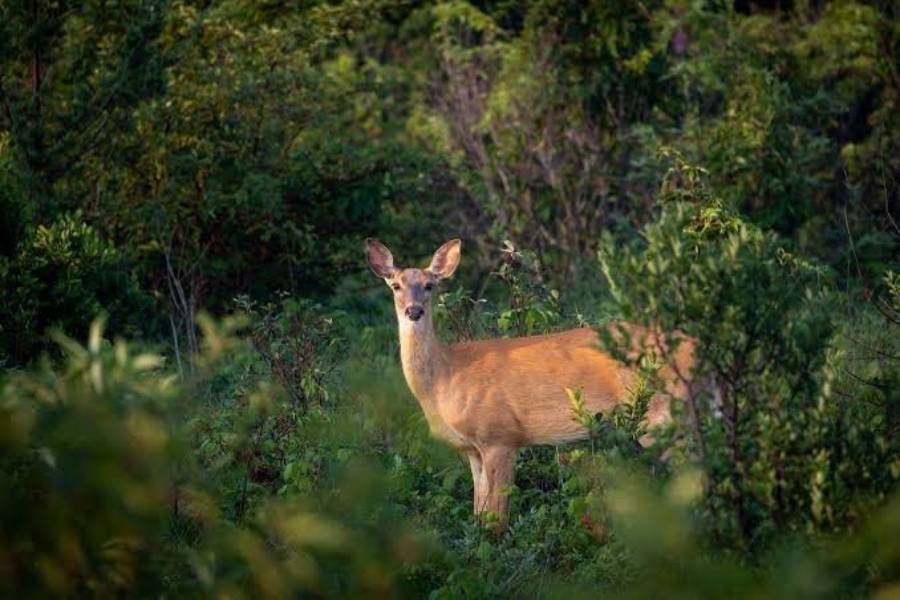
Yes, deer travel through pine forests, especially when pine stands provide secure cover or connect bedding and feeding areas. Deer do not use every pine forest equally. Their movement depends on the density and age of the pine stand, available understory vegetation, nearby food sources, terrain, seasonal conditions, and human pressure. A dense stand may function primarily as bedding or security cover, while an open stand may serve as a travel corridor between more productive habitats.
For hunters, the presence of pine trees alone is therefore not a reliable indicator of deer activity. The more useful question is how a pine forest fits into the surrounding habitat. Deer trails may concentrate along pine and hardwood transitions, clearcuts, logging roads, terrain funnels, and routes connecting feeding areas with secure bedding cover. These patterns can also change during the rut, periods of heavy hunting pressure, cold weather, or snow.
Understanding why deer enter pine forests and where they travel within them helps hunters distinguish productive habitat from pine acreage with little current deer use. This guide explains how deer use pine forests for travel, cover, bedding, and feeding, as well as how to identify the routes deer are actively using.
Do Deer Travel Through Pine Forests?
Yes, deer regularly travel through pine forests when those forests provide cover, food access, bedding habitat, or a practical route between areas they use. A pine forest is not automatically a destination for deer, but it can become an important part of their daily movement pattern. Deer may cross a pine stand while moving from daytime bedding cover to an evening feeding area, use dense pines as security cover, or follow established trails through the stand to reach another habitat type.
The amount of deer movement depends heavily on the structure of the pine forest. Dense young pines can provide visual cover that makes deer feel secure, while mature pine stands with an open forest floor may offer less bedding cover and limited browse. A mature stand can still function as a travel corridor when it lies between two areas deer regularly use. For example, deer moving between a hardwood ridge and an agricultural field may repeatedly cross the same pine stand even when they spend little time feeding inside it.
Surrounding habitat is therefore more useful for predicting deer movement than the presence of pine trees alone. A pine stand bordered by hardwoods, clearcuts, brush, fields, creek bottoms, or other productive habitat creates transitions that deer can incorporate into their travel routes. Terrain also matters because ridges, saddles, drainage crossings, and other natural funnels can concentrate movement within otherwise large blocks of timber.
Hunters should distinguish between a pine forest that deer simply cross and one where deer spend substantial time. A travel corridor may contain defined trails and tracks but relatively little feeding or bedding sign. A bedding area is more likely to combine security cover with nearby trails and suitable resting locations. Recognizing this difference helps explain whether deer are moving toward food, returning to bedding cover, or merely passing through the stand.
Why Do Deer Travel Through Pine Forests?
Deer travel through pine forests for 3 primary reasons: secure cover, access to food, and movement between bedding and feeding areas. The importance of each reason changes with the structure of the pine stand and the habitat surrounding it. A dense stand beside an open feeding area can function differently from an older pine forest with little understory vegetation.
Secure cover is one reason deer enter and travel through pine stands. Dense branches and vegetation can reduce visibility and provide concealment from people and other disturbances. This makes suitable pine cover valuable along routes deer use during daylight or when hunting pressure pushes them away from exposed locations. However, density matters. A pine stand that is too open to provide security cover may have a different movement pattern from thick young pines nearby.
Food access creates another reason for deer movement. Deer do not need to feed heavily on pine trees for a pine forest to influence their route. A stand can lie between bedding cover and food sources such as hardwood browse, young vegetation, clearcuts, mast-producing trees, or agricultural fields. Deer may therefore leave relatively little feeding sign inside the pine stand while producing obvious trails through it. In this situation, the pine forest functions as the connection rather than the destination.
Movement between bedding and feeding areas creates especially predictable travel patterns. Deer need routes that connect locations used for different daily activities, and pine cover can form part of those routes when it provides security or convenient passage. A trail entering thick pines from a feeding area, for example, becomes more meaningful when it continues toward suitable bedding cover. Hunters can use this relationship to evaluate deer trails based on where they connect rather than assuming every visible trail has the same hunting value.
The key relationship is bedding area → travel corridor → feeding area. Pine forests can occupy any part of this sequence, but their hunting value changes according to their role. Determining whether a pine stand provides bedding, food, or simply a protected route gives hunters a stronger basis for predicting where deer will travel through it.
Where Do Deer Travel in Pine Forests?
Deer travel most predictably through parts of pine forests that provide cover, easy passage, or direct connections between bedding and feeding areas. Productive routes can occur along forest edges, habitat transitions, logging roads, openings, ridges, saddles, creek crossings, and other terrain funnels. These features matter because deer movement is rarely distributed evenly across an entire pine forest.
Forest edges and habitat transitions can concentrate deer movement because they connect two different types of cover or food. A boundary between mature pines and young growth, for example, gives deer access to the security of the timber while placing them close to more abundant browse. Similar transitions occur where pines meet hardwoods, clearcuts, fields, creek bottoms, or brush. Hunters should examine these boundaries for trails that run parallel to the edge as well as trails that cross from one habitat type into another.
Logging roads and openings can also influence travel because they create paths with less physical resistance than dense vegetation. Deer may walk on, beside, or across these features when the route leads toward bedding cover, food, or another frequently used destination. A logging road should not be treated as a productive deer route by default, however. Frequent vehicle traffic, hunters, or other human activity can reduce daylight use and cause deer to shift into adjacent cover.
Terrain can make deer movement more predictable even when the surrounding pine forest appears uniform. Saddles provide lower crossing points between higher areas, while ridges can create efficient routes through uneven ground. Creek crossings, narrow strips of usable cover, steep terrain, and changes in vegetation can also create funnels that restrict the number of practical routes available. When a visible deer trail intersects one of these terrain features, the combination provides stronger evidence of a consistent travel route than the trail alone.
Hunters can evaluate a potential route by identifying what lies at both ends of it. A trail connecting thick bedding cover with a feeding area has a clear behavioral function. A trail disappearing into hundreds of acres of similar pines provides less information until its destination is identified. Mapping bedding cover, food, water, terrain, and habitat transitions therefore makes individual trails easier to interpret.
Do Deer Bed in Pine Forests?
Yes, deer bed in pine forests when the stand provides sufficient security cover and a suitable location for resting. Dense pine stands can restrict visibility and conceal bedded deer, making them useful as daytime cover. Pine forests are not equally suitable for bedding, however, because stand age, tree spacing, understory density, terrain, nearby food, and human disturbance determine how much security a particular location provides.
Young, dense pine stands can offer substantially different bedding conditions from mature open stands. Closely spaced trees and thick understory vegetation create visual barriers that help isolate deer from surrounding disturbance. In contrast, mature pines with high canopies and an open forest floor may allow long sight lines and provide little ground-level concealment. Deer can still bed in mature timber, but the presence of pine trees alone does not make an area secure bedding habitat.
Location within the stand also matters. Bedding cover becomes more useful when deer can reach food and other habitat requirements without making unnecessary movements through exposed areas. For example, thick pines positioned near a clearcut, hardwood feeding area, or field can allow deer to remain concealed during the day before moving toward food. Trails leaving such cover can therefore become important hunting clues, especially when several routes converge near a habitat transition.
Weather can change the value of pine bedding cover as well. Evergreen canopies and dense vegetation can reduce exposure to wind and precipitation in certain conditions, while slope direction and terrain influence the actual protection available at ground level. Hunters should evaluate the complete bedding location rather than assuming every thick pine stand provides the same environmental advantage.
Finding suspected bedding cover also changes how surrounding trails should be interpreted. A heavily used trail leading away from secure pine cover toward food has a different function from a random trail crossing the middle of a stand. Hunters who identify both the bedding area and the destination can better understand the direction of deer movement and select observation or hunting locations without unnecessarily entering the bedding cover itself.
Do Deer Feed in Pine Forests?
Yes, deer feed in pine forests when the forest provides accessible browse, young vegetation, or other preferred food sources, but mature pine stands with sparse understory often provide limited feeding opportunities. The feeding value of a pine forest depends more on the vegetation growing within and around the stand than on the pine trees themselves. Hunters should therefore evaluate available forage rather than assuming that all pine forests attract feeding deer.
Understory vegetation is one of the strongest indicators of feeding potential. Sunlight reaching the forest floor can support shrubs, broadleaf plants, vines, grasses, and young woody growth that deer can browse. Dense mature canopies reduce the amount of sunlight reaching the ground, which can limit this vegetation. Two pine stands located close together can therefore have very different feeding value when one has a productive understory and the other has a relatively bare forest floor.
Clearcuts, thinned stands, and young pine growth can create better feeding conditions because increased sunlight encourages new vegetation. Fresh woody growth and low-growing plants provide browse at a height deer can reach. These areas can become particularly valuable when they border thicker pine cover because deer can move between security cover and food without crossing large expanses of exposed terrain.
A pine stand can still contain substantial deer movement even when it provides little food. Deer may travel through mature pines to reach hardwood areas, agricultural fields, clearcuts, or other feeding locations. In this case, hunters may find established trails but relatively little evidence of browsing within the stand. This distinction helps separate a feeding destination from a travel corridor.
The location of food relative to cover is therefore more useful than food availability alone. A productive feeding area positioned beside secure pine bedding cover can create a short and repeatable movement route. Food located farther away may produce longer travel corridors through the timber. Hunters who identify both ends of this relationship can determine why deer are using a particular trail instead of relying only on the amount of sign at one location.
When Do Deer Travel Through Pine Forests?
Deer can travel through pine forests throughout the day, but the timing and intensity of movement change with feeding schedules, bedding behavior, season, weather, breeding activity, and hunting pressure. Morning and evening movements can be especially important where pine stands connect established bedding and feeding areas, while daylight movement inside secure cover can occur at other times.
During a typical bedding-feeding movement cycle, deer leaving feeding areas may travel toward secure cover during the morning, while deer leaving bedding areas may begin moving toward food later in the day. The exact timing is not fixed. Distance between bedding and feeding locations, habitat security, weather, human disturbance, and individual deer behavior can shift movement earlier or later. Hunters should use local sign and observations rather than treating sunrise and sunset as universal movement times.
Seasonal changes also alter how deer use pine habitat. Changes in available food can redirect travel from one feeding area to another, creating new routes or reducing activity on trails that were productive earlier in the season. Falling temperatures, vegetation changes, and hunting activity can also increase the importance of secure cover. A trail with heavy early-season use may therefore become less important when the food source at its destination changes.
Cold and snowy conditions can further influence route selection. Deer conserve energy by avoiding unnecessary movement, so established trails and terrain that allow efficient travel can become more important when movement through deep snow requires greater effort. Pine cover may also provide shelter from certain weather conditions, but its value depends on canopy density, wind exposure, terrain, and the structure of the individual stand. Hunters should look for concentrated tracks after snow rather than assuming deer will use every evergreen stand for thermal cover.
Do Deer Use Pine Forests Differently During the Rut?
Yes, deer movement through pine forests can change during the rut because bucks expand or alter their normal travel patterns while searching for receptive does. Routes associated with doe bedding areas, feeding areas, and habitat transitions can become particularly relevant because bucks may travel through these locations while checking for does.
Rut movement does not eliminate the importance of habitat structure. Thick pine cover, terrain funnels, edges, and established travel corridors can still influence where bucks move. A narrow route connecting multiple areas used by does can have greater hunting value than an isolated trail simply because buck movement increases during the breeding period.
Rubs and scrapes can provide additional evidence of buck activity during this period, but neither sign should be interpreted in isolation. A rub line located along a defined trail between bedding areas provides more movement context than a single rub without associated tracks, trails, or habitat features. Combining rut sign with terrain and known doe activity gives hunters a clearer explanation for why a buck might travel through a specific part of the pine forest.
The most useful approach is to treat the rut as a change in deer movement rather than a replacement for normal habitat analysis. Pine forests that already connect cover, doe bedding areas, feeding habitat, and natural funnels can remain important during the rut because the underlying travel structure still directs deer through the landscape.
How Does Hunting Pressure Change Deer Movement in Pine Forests?
Hunting pressure can change when and where deer travel through pine forests by pushing them toward thicker cover, less disturbed routes, and periods with lower human activity. Deer that repeatedly encounter hunters, vehicles, or foot traffic can adjust their movement rather than abandon an entire area. For hunters, this means a heavily used trail does not necessarily remain equally productive after hunting pressure increases.
Dense pine cover can become more important when deer seek security away from disturbance. Thick stands reduce visibility and can provide routes that allow deer to move without spending long periods in exposed habitat. As pressure increases around open woods, field edges, logging roads, and obvious access points, deer may shift more of their movement toward interior cover or secondary trails. The most convenient route for a hunter is therefore not always the route deer prefer under pressure.
Human access can help explain these changes. Logging roads, maintained trails, parking areas, and easy ridge access can concentrate hunters in predictable locations. A deer trail close to one of these features may show substantial historical use but limited daylight activity after repeated disturbance. In contrast, a less obvious trail that passes through thicker vegetation and avoids frequent human traffic may provide greater security.
Timing can change along with route selection. Deer can continue using a pressured area while shifting a larger portion of their activity away from periods when people are present. This is why tracks and other fresh sign can confirm that deer still use a location without proving they routinely travel there during legal shooting hours. Hunters need to distinguish current deer use from huntable deer movement.
The practical response is to evaluate deer movement together with hunting access. Identify where people normally enter, which roads and trails receive repeated traffic, where dense security cover begins, and which alternate routes connect the same bedding and feeding areas. This approach explains how hunting pressure interacts with the existing habitat rather than treating pressure as an isolated factor.
How Can You Find Deer Travel Routes in a Pine Forest?
Find deer travel routes in a pine forest by combining fresh deer sign with terrain, habitat transitions, bedding cover, and feeding destinations. A visible trail is only the starting point. Hunters gain more useful information by determining how recently deer used the route, where the route leads, and why deer would repeatedly choose it.
Begin with the structure of the habitat. Identify thick pine cover that could provide bedding or security, then locate nearby feeding habitat such as clearcuts, young growth, hardwood areas, or fields. Next, examine the terrain between those locations. Saddles, ridges, creek crossings, narrow strips of cover, edges, and other funnels can reduce the number of practical routes available to traveling deer. Trails passing through these features deserve closer examination because the surrounding landscape provides a reason for repeated movement.
A single trail should not automatically be classified as an important hunting location. Determine its direction and connect it to identifiable destinations. For example, a trail leaving dense pines, crossing a habitat edge, and continuing toward an active feeding area has a clearer function than a trail that disappears into similar timber in both directions. Following the broader habitat relationship helps distinguish purposeful travel corridors from less predictable movement.
What Deer Signs Should You Look for in Pine Forests?
The 5 primary deer signs to look for in pine forests are trails, tracks, droppings, rubs, and scrapes. Each sign provides different information, and multiple fresh signs in the same location create stronger evidence of current deer activity than one isolated sign.
Trails show repeated movement but do not reveal timing by themselves. A wide, obvious trail can exist long after its heaviest period of use. Look for recently disturbed leaves or pine needles, fresh tracks, broken vegetation, and other current sign along the route. Several trails converging at a terrain funnel or habitat transition can also indicate that the landscape is concentrating movement.
Tracks provide more immediate information about travel direction and recent use. Soil, mud, sand, creek crossings, and snow can preserve tracks better than a forest floor covered with dry pine needles. A sequence of tracks can help determine whether deer are entering thick cover, leaving it, or traveling parallel to an edge. Repeated tracks from multiple deer provide more context than a single isolated print.
Droppings confirm deer presence and can become more informative when their location matches another habitat feature. Droppings concentrated near bedding cover, for example, carry different contextual value from scattered droppings along a travel corridor. Hunters should combine them with trails, tracks, and habitat structure instead of using droppings alone to select a hunting location.
Rubs indicate that bucks have used an area, while groups or lines of rubs can help reveal how buck activity relates to a travel route. Scrapes can also identify areas of breeding-season activity. Their hunting value increases when they occur along established trails, habitat transitions, funnels, or routes connecting areas deer already use. One isolated rub or scrape provides less movement information than several related signs within a clear habitat pattern.
Freshness is critical when evaluating all 5 signs. The best deer travel route is not necessarily the trail with the most visible sign accumulated over time; it is a route with current sign and a clear reason for deer to keep using it. A combination of fresh tracks, recent droppings, active trails, and suitable habitat provides stronger evidence than an impressive but old rub or a heavily worn trail with no recent activity.
Hunters should ultimately be able to answer 3 questions about a route: Where are the deer coming from, where are they going, and why are they using this path? When the answers correspond to bedding, food, security cover, terrain, or another identifiable habitat need, the trail becomes much easier to interpret and hunt effectively.
Where Should You Hunt Deer in a Pine Forest?
The best places to hunt deer in a pine forest are travel routes where bedding cover, feeding habitat, terrain funnels, and habitat transitions concentrate deer movement. A pine stand is too broad a feature to determine a hunting location by itself. Hunters should identify why deer are using a specific part of the forest and position themselves along routes that connect areas deer need.
Edges between pine stands and other habitat types are strong starting points. A transition from mature pines to young growth, hardwoods, clearcuts, brush, or agricultural land creates a defined change in cover or food availability. Deer may travel parallel to these boundaries or cross them while moving between security cover and feeding areas. Fresh tracks, trails, droppings, rubs, or scrapes can help identify which portions of a long edge receive current use.
Routes between bedding and feeding areas provide another logical hunting location. Once a bedding area and a food source have been identified, hunters can examine the habitat between them for established trails and terrain features that restrict movement. A saddle, creek crossing, narrow strip of cover, or vegetation transition can reduce several possible routes to one or two practical paths. This concentration makes deer movement easier to predict than movement across a large, uniform pine stand.
Hunting directly inside bedding cover creates a different risk. Moving too close to a bedding area can introduce scent, noise, and visual disturbance into the location deer use for security. Repeated disturbance can alter the very movement pattern a hunter is attempting to use. A route outside the core bedding area can provide access to traveling deer while reducing unnecessary intrusion into secure cover.
Logging roads and easy-access trails require similar evaluation. These features may contain deer tracks because they offer convenient movement, but they can also receive substantial human traffic. Hunters should look beyond the most obvious trail and examine nearby cover for secondary routes deer can use when disturbance increases. The relationship between deer access and hunter access is especially important in pressured pine forests.
Wind and access should also influence the final location. A productive travel corridor loses much of its hunting value when reaching it requires crossing the same route deer use or moving through their bedding cover. Hunters should favor locations that allow entry and exit while minimizing disturbance to the expected deer movement pattern.
The strongest hunting location therefore combines current deer sign, a clear travel purpose, a movement-concentrating feature, and practical hunter access. Finding all 4 factors in the same part of a pine forest provides more useful evidence than selecting a location because it contains the largest trail or the thickest pine cover.
Do Whitetail Deer and Mule Deer Use Pine Forests Differently?
Whitetail deer and mule deer can both travel through pine forests, but their use of pine habitat differs with the landscapes and habitat structures each species occupies. Pine cover should therefore be evaluated as one component of the surrounding landscape rather than treated as habitat that produces the same movement pattern for every deer species.
Whitetail deer movement can be closely associated with habitat edges and relatively short transitions among bedding cover, feeding areas, agricultural land, hardwoods, brush, and timber. Where pine stands occur within this habitat mosaic, whitetails may use them for bedding, security, or protected travel. A pine stand located between thick bedding cover and an agricultural field, for example, can function as part of a repeatable travel route.
Mule deer frequently occupy landscapes where movement is influenced by larger terrain features and seasonal habitat changes. In areas containing conifers, their routes can interact with slopes, ridges, draws, elevation changes, openings, and seasonal ranges. Hunters evaluating mule deer movement should therefore consider the pine forest together with the broader terrain rather than relying primarily on a single forest edge or short bedding-to-feeding corridor.
These differences do not create a universal rule that whitetails prefer pine forests while mule deer avoid them, or the reverse. Forest structure, food, security, terrain, season, and surrounding habitat determine whether a particular pine stand is useful to deer. Species identification provides context, but the physical characteristics of the location still explain why deer are traveling through it.
For hunters, the practical distinction is the scale at which the landscape should be read. A whitetail hunting location may become clear by analyzing a relatively compact relationship among bedding cover, food, and a pine transition. A mule deer location may require examining a wider system of terrain and seasonal movement before the role of a particular pine stand becomes clear. In both cases, fresh deer sign should confirm that the predicted route is currently being used.
Read more: Do Deer Use Logging Clearcuts? Hunting Guide
Are All Pine Forests Good Deer Habitat?
No, not all pine forests are good deer habitat. A pine forest becomes useful to deer when its structure and surrounding landscape provide one or more resources deer need, including security cover, bedding habitat, accessible food, or efficient travel routes. A large stand of pine trees with little understory and few nearby food sources can support less deer activity than a smaller stand connected to several productive habitat types.
Stand age is one factor that changes habitat quality. Young pine stands can contain dense ground-level cover and early vegetation that provide security and browse. As the trees mature and the canopy closes, less sunlight can reach the forest floor, reducing understory growth. An older stand may still provide travel opportunities or environmental cover, but its function can differ substantially from that of younger pines.
Canopy and understory conditions should therefore be evaluated together. A pine forest with thick overhead cover but a nearly bare forest floor may offer limited browse and ground-level concealment. A stand containing shrubs, young woody growth, vines, and other vegetation can provide both cover and food. Hunters walking through a pine forest should examine what exists at deer level rather than evaluating habitat quality only by looking at the trees above them.
The surrounding landscape is equally important. Pine stands adjacent to hardwoods, brush, clearcuts, fields, creek bottoms, or other habitat types can become part of a larger system of bedding, feeding, and travel areas. A stand isolated from useful food or cover may receive less consistent use. In contrast, a relatively ordinary pine stand can become important when it provides the safest connection between two high-value areas.
Human disturbance can further separate productive pine habitat from apparently suitable but lightly used habitat. Frequent vehicles, logging activity, recreation, and hunting pressure can affect when deer enter an area and which routes they choose. Thick cover away from common access points may receive greater daylight use than similar habitat located beside a heavily traveled road.
Hunters should consequently judge pine forests by function rather than tree type. The relevant question is not simply whether an area contains pines. It is whether those pines contribute food, security, bedding opportunities, efficient travel, or a useful connection to another habitat deer need.
What Makes One Pine Forest Better for Deer Than Another?
A pine forest is better for deer when it combines 6 habitat factors: security cover, bedding opportunities, available food, useful terrain, habitat transitions, and manageable human disturbance. No single factor guarantees heavy deer use. The strongest habitat occurs when several of these attributes overlap and give deer practical reasons to remain in or repeatedly travel through the area.
Security cover determines whether deer can use a location while limiting exposure. Dense vegetation, visual barriers, and protected interior areas can increase the value of a pine stand, particularly where surrounding habitat is more open. Security becomes even more relevant under hunting pressure because deer can shift toward routes and locations that reduce encounters with people.
Bedding opportunities add another reason for deer to spend time within the stand. Suitable bedding habitat needs more than trees; it requires a location where deer can rest while maintaining an acceptable level of security. When bedding cover occurs near food, the routes connecting the two resources can become repeatable movement corridors.
Food determines whether deer need to feed within the pine forest or travel elsewhere. Stands with productive understory, young growth, clearcuts, or nearby feeding habitat provide more opportunities than closed-canopy forests with little vegetation at ground level. Even a pine stand with poor forage can have substantial hunting value when it lies between secure bedding cover and a dependable food source.
Terrain determines where that movement becomes concentrated. Saddles, ridges, creek crossings, slopes, narrow cover, and similar features can channel deer through particular sections of a large forest. A habitat transition crossing one of these terrain features can create a more defined travel route because both vegetation and topography influence movement at the same location.
Habitat transitions increase diversity within the landscape. Boundaries between pines and hardwoods, young growth, clearcuts, brush, or fields place different resources close together. These transitions can also provide hunters with identifiable locations where trails and fresh sign can be evaluated instead of attempting to cover an entire block of uniform timber.
Human disturbance completes the habitat picture because suitable cover and food do not guarantee predictable daylight movement. Roads, access trails, repeated hunter activity, and other disturbances can alter how deer use otherwise productive habitat. A pine forest with secure areas away from frequent human activity can provide movement opportunities that a similarly structured but heavily disturbed stand does not.
For hunters, these 6 factors provide a practical way to compare pine forests. Prioritize pine stands where cover, bedding, food, terrain, transitions, and low-disturbance travel routes overlap, then confirm the prediction with fresh deer sign. Trails, tracks, droppings, rubs, and scrapes show whether deer are actually using the habitat, while the surrounding landscape explains why they are there.
A pine forest should ultimately be viewed as part of a deer movement system rather than as an isolated habitat type. Deer travel through pine forests when those forests help them reach food, remain concealed, bed securely, or move efficiently through the landscape. Understanding that relationship allows hunters to identify the sections of pine forest that matter instead of treating every acre of pines as equally productive.