
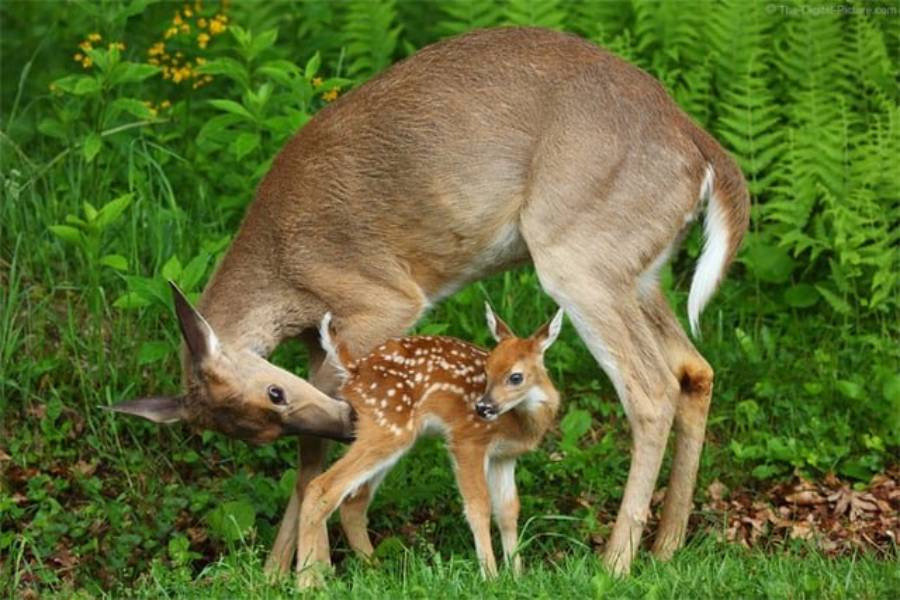
Yes, deer recognize their offspring, especially while a doe is raising and nursing dependent fawns. A mother deer forms a close bond with her fawns soon after birth and uses sensory cues such as scent, vocalizations, and repeated contact to identify and communicate with them. Fawns also learn to recognize their mother, which helps them respond when she returns to nurse or signals them to follow.
This mother-offspring relationship does not mean a doe and her fawns remain together constantly. During the first weeks of life, a doe regularly leaves her fawns hidden in vegetation while she feeds elsewhere. This behavior reduces activity around the fawn’s bedding location and helps keep the young deer concealed from predators. As fawns grow, they spend more time moving with their mother, but their dependence gradually decreases through weaning and later stages of development.
For hunters, understanding this relationship helps explain why a doe may appear alone even when she has living fawns nearby. Doe-fawn associations also influence how hunters interpret deer movement, repeated trail-camera sightings, and family groups observed in the field. Understanding how deer recognize their offspring therefore requires separating three related behaviors: recognition, maternal care, and the amount of time a doe and her fawns physically remain together.
Do Deer Recognize Their Own Offspring?
Deer recognize their own offspring during the period when the mother is actively caring for her fawns. This recognition allows a doe to direct nursing, grooming, protection, and communication toward the young deer associated with her. The bond develops through repeated interactions beginning shortly after birth rather than simply because two deer remain physically close to each other.
Recognition is particularly important because a doe and her newborn fawns do not remain together continuously. Young fawns spend substantial periods concealed in cover while their mother moves away to feed and perform other activities. The doe must therefore relocate and interact with her offspring after periods of separation. For a hunter observing deer from a stand, blind, or trail camera, seeing a doe without a fawn does not establish that she has no dependent offspring nearby.
Offspring recognition and maternal care are related but separate behaviors. A doe recognizing a fawn does not mean she will remain beside it throughout the day, and physical separation does not mean the maternal bond has ended. This distinction becomes increasingly important as fawns mature because their movement, feeding behavior, and independence change over time.
Recognition should also not be interpreted as evidence that deer maintain permanent human-like family relationships. The practical biological function is strongest while offspring depend on maternal care. As that dependency decreases, the behavioral relationship between the doe and her offspring also changes. Hunters should therefore interpret doe-fawn associations according to the fawn’s developmental stage and season rather than assuming that a recognizable family unit will always travel together.
How Does a Doe Recognize Her Fawn?
A doe recognizes her fawn through multiple sensory and behavioral cues, with scent and vocal communication contributing to mother-offspring identification and contact. Repeated nursing, grooming, close contact, and communication give the mother opportunities to become familiar with her offspring. These cues work together rather than requiring the doe to identify her fawn by appearance alone.
Scent is especially relevant because deer rely heavily on olfaction to obtain information about their environment and other deer. Close physical interactions expose the doe to the individual odor associated with her offspring. Grooming and nursing repeatedly bring the mother into direct contact with the fawn, strengthening the sensory association between the two. Recognition by scent is also consistent with the broader importance of odor in deer communication and behavior.
Vocal communication provides another way for a doe and fawn to maintain contact. Fawns produce calls that can trigger responses from their mothers, while does also vocalize when communicating with young. Vocal cues become particularly useful when vegetation or terrain prevents the animals from maintaining visual contact. A hunter may therefore hear doe-fawn communication without immediately seeing both deer.
Location provides additional context but should not be confused with individual recognition. A doe can return to areas where she has left a young fawn concealed, particularly during the early hiding stage. Returning to the same bedding or hiding area helps the mother relocate the fawn, while scent, vocalization, and close interaction provide additional information once contact is re-established.
For hunters, these mechanisms explain why doe-fawn behavior cannot always be interpreted from a single observation. A lone doe crossing a food plot may later return toward cover containing a fawn, while repeated trail-camera observations can reveal associations that one photograph cannot. The absence of a visible fawn is therefore evidence only that the fawn was not observed at that moment, not that the doe could not recognize or locate her offspring.
Do Fawns Recognize Their Mothers?
Fawns recognize their mothers through repeated contact, scent, vocal communication, and nursing interactions. This recognition develops during the period when young deer depend on the doe for milk, protection, and guidance. Recognizing the mother allows a fawn to respond appropriately when the doe returns after a period of separation and helps maintain the mother-offspring relationship during early development.
Vocal communication is particularly useful when a doe and fawn are separated by vegetation or distance. A fawn can produce calls to communicate with its mother, while the doe uses her own vocalizations during mother-young interactions. These signals allow the pair to communicate without remaining within visual range at all times. This matters during the early hiding stage, when a fawn may remain concealed while its mother is elsewhere.
Scent and close physical contact provide additional recognition cues. Nursing repeatedly places a fawn close to its mother, while grooming and other direct interactions create frequent opportunities for both animals to become familiar with each other’s odor. Deer have a highly developed sense of smell, so olfactory information plays an important role in interactions between individuals as well as in detecting food, predators, and other environmental signals.
For hunters, fawn recognition helps explain why a young deer may react quickly when its mother changes direction, approaches a bedding area, or communicates with it. However, following behavior alone does not prove that two deer are mother and offspring. Deer can occur in social groups, particularly groups involving females and young deer. Repeated interactions provide stronger evidence of a doe-fawn association than a single observation of two deer traveling together.
How Long Does a Doe Recognize Her Fawn?
A doe’s relationship with her fawn is strongest while the fawn depends on maternal care, but recognition and dependence do not necessarily end at the same moment. During early life, the doe provides milk and maintains frequent contact with her offspring. As the fawn grows, it consumes more solid food, becomes more mobile, and relies less on nursing. The relationship therefore changes gradually rather than ending on a single day.
Weaning represents an important transition in this process. A weaned fawn no longer depends on its mother for milk, but ending nursing does not automatically erase the familiarity created through months of close association. The young deer may continue traveling, feeding, or bedding within a social group that includes its mother after nutritional dependence has decreased.
The relationship changes further as a fawn approaches the yearling stage. Recognition should not be treated as equivalent to permanent association. A doe may remain familiar with older offspring even when the animals no longer behave as a tightly connected mother-fawn pair. Their patterns of association are influenced by age, sex, season, social structure, and dispersal behavior.
This distinction is useful when interpreting deer movement during hunting season. A hunter may observe an adult doe with young deer during one period and see those animals separated at another time. The change does not by itself show that the deer have stopped recognizing one another. Instead, it may reflect increasing independence and changes in how frequently related deer travel together.
For this reason, there is no useful field rule that says a doe stops recognizing her offspring at one exact age. The more reliable distinction is between recognition, maternal dependence, and continued association. Maternal dependence decreases as the fawn matures, while physical association can continue or change according to the deer’s developmental and social circumstances.
When Do Fawns Stop Staying With Their Mothers?
Fawns gradually stop depending on their mothers as they mature, but there is no single point when every young deer permanently leaves its mother. The transition begins as fawns become more mobile, shift from milk toward solid food, and spend increasing amounts of time moving with the doe rather than remaining concealed. Later, weaning reduces nutritional dependence, while age, sex, season, and dispersal behavior determine how long offspring continue associating with their mother.
During the earliest stage of life, a fawn can spend considerable time separated from its mother. This separation should not be mistaken for independence. The doe leaves the young deer concealed while she feeds and moves elsewhere, then returns for nursing and other maternal interactions. A hunter who sees a doe traveling alone during this period may therefore be observing normal maternal behavior rather than a doe that has already separated permanently from its offspring.
Weaning changes the type of relationship between the doe and fawn rather than immediately ending their association. Once a young deer obtains its nutritional needs from forage instead of milk, it no longer needs to remain close to the doe for nursing. However, mother and offspring can continue feeding, traveling, or bedding within the same social group. This is why older fawns may still be observed with adult does even though they are capable of feeding independently.
Sex becomes increasingly relevant as offspring approach the yearling stage. Male and female offspring do not necessarily follow identical dispersal and social patterns. Young bucks are more likely to separate from their natal area as they mature, while female offspring can maintain closer associations with related females. As a result, a group of does observed by hunters can include related females from more than one generation rather than only unrelated adult deer occupying the same area.
Seasonal changes can also alter how often a hunter sees a doe and her offspring together. Changes in food availability, breeding behavior, cover, hunting pressure, and individual movement can separate deer that were previously observed together. A change in physical association does not demonstrate a loss of recognition. It shows that the social and survival requirements of the young deer have changed as it matures.
For hunters, the most useful approach is to evaluate doe-fawn relationships through repeated observations rather than one encounter. Trail-camera sequences, recurring feeding patterns, bedding-area activity, and repeated sightings can provide more context about whether deer consistently associate with one another. A single image of a doe alone or a yearling traveling separately cannot establish when the mother-offspring relationship ended.
The distinction between recognition, dependence, and association is therefore essential. Recognition concerns whether one deer can identify another; dependence concerns whether the offspring still requires maternal care; association concerns whether the two animals continue spending time together. These three processes can change at different rates, which explains why a fawn can become independent without immediately disappearing from its mother’s social environment.
What Does a Doe Do If She Cannot Find Her Fawn?
A doe may search, vocalize, and return to locations associated with her fawn when the two become separated. These behaviors help re-establish contact, particularly while the fawn is still dependent on maternal care. However, hunters should distinguish an unexpected separation from the routine periods when a doe intentionally leaves a young fawn concealed while she feeds or moves elsewhere.
Temporary separation is a normal part of early fawn behavior. A young fawn relies heavily on concealment and remains relatively inactive while its mother is away. The doe later returns to nurse and interact with it. Because the pair can spend significant periods apart, a hunter may observe the mother repeatedly without seeing the fawn that is using nearby cover.
A different behavioral pattern may occur when a doe expects to find a fawn but cannot re-establish contact. The doe can revisit areas associated with the missing fawn and use vocal communication while attempting to locate it. The intensity and duration of this behavior can vary with the fawn’s age, level of dependence, circumstances of separation, and the individual deer. Observing a doe return to one location several times can therefore provide useful context, but it does not prove by itself that a fawn has died or disappeared permanently.
Hunters should also avoid assigning human motives to these behaviors. A doe returning to an area, calling, or remaining nearby demonstrates maternal and contact-seeking behavior, but an isolated field observation cannot establish complex emotional states. The stronger interpretation is behavioral: the doe is responding to cues, locations, and routines associated with dependent offspring.
Repeated observation provides more information than a single encounter. A trail camera that records a doe entering the same area at similar times, for example, may reveal a movement pattern that is invisible from one photograph. When a fawn later appears with the same doe, the sequence provides stronger evidence that earlier solitary movement was part of normal doe-fawn behavior rather than permanent separation.
Will a Doe Return to the Area Where She Left Her Fawn?
A doe can return to the area where she left a concealed fawn because temporary mother-fawn separation is part of normal early-life behavior. The mother does not need to remain beside a newborn continuously to maintain maternal care. Instead, she can leave the immediate hiding area and return periodically to nurse and interact with her offspring.
This behavior has a survival function. A very young fawn depends on concealment, limited movement, and suitable cover to reduce its exposure while the mother is elsewhere. If the doe remained constantly beside the hiding location, her movement and presence could make the area more conspicuous. Separation therefore does not indicate rejection; it can be part of the strategy that keeps a dependent fawn concealed.
For hunters, this creates an important distinction between where a doe is observed and where her fawn is located. A doe seen feeding in an opening, crossing a trail, or moving through timber may have a fawn concealed somewhere else within her activity area. Following the doe’s direction of travel can provide clues about her movement pattern, but one observation is insufficient to identify a specific fawn bedding location.
Repeated travel can provide stronger evidence. Trail-camera photographs showing the same doe regularly moving toward and away from particular cover can indicate that the area is important to her routine. The timing, direction of travel, accompanying deer, and changes across multiple observations provide more useful information than the presence or absence of a fawn in one image.
Hunters should therefore avoid using a lone doe sighting as proof that the doe has no fawn. The fawn may be concealed, temporarily separated, outside the hunter’s field of view, or increasingly independent depending on its age. Interpreting the sighting correctly requires combining the deer’s behavior with season, habitat, repeated observations, and the developmental stage of the offspring.
Why Do Hunters Sometimes See a Doe Without Her Fawn?
Hunters can see a doe without her fawn because mother deer and their offspring do not remain together continuously. A lone doe sighting can result from temporary separation, a concealed fawn, increasing fawn independence, or differences in the movement of individual deer. The absence of a visible fawn therefore does not establish that the doe has no living offspring.
Temporary separation is especially relevant when fawns are young. During the early hiding stage, a doe can move away to feed while the fawn remains concealed in vegetation. The mother later returns to nurse and interact with the young deer. This creates periods when hunters may repeatedly encounter the doe but never see the fawn, particularly when dense cover limits visibility.
Increasing independence creates another explanation as the season progresses. Older fawns become more mobile, consume solid food, and no longer need to remain close to their mother for nursing. A doe and an older fawn can use the same general area without entering a field, food source, trail, or camera location at exactly the same time. Their temporary separation becomes less informative as the offspring matures.
Differences in movement also affect what a hunter observes. A hunter sees only the deer that pass through a limited field of view during a particular period. A fawn could remain behind cover, take another route, or arrive several minutes later. Seeing one member of a doe-fawn pair without the other is therefore an observation of that moment, not evidence that their association has ended.
Seasonal and environmental conditions can further change visibility. Food availability, cover, human activity, breeding behavior, and hunting pressure can alter where and when deer move. These factors can make an established doe-fawn association less obvious even when both animals continue using the same broader area.
Hunters can interpret lone-doe sightings more accurately by comparing multiple observations. Note whether young deer appear later, whether the same doe repeatedly uses a particular route, and whether the association changes over several weeks. This longitudinal pattern provides more information about doe-fawn behavior than assuming family status from a single encounter.
Read more: Do Deer Mourn Other Deer? What Hunters Should Know
What Can Trail Camera Photos Reveal About Doe and Fawn Behavior?
Trail camera photos can reveal repeated doe-fawn associations, movement timing, travel direction, and changes in family-group behavior when observations are collected over time. Their primary advantage is repetition. Instead of relying on one encounter from a stand, hunters can compare multiple records from the same location across days or weeks.
A sequence of photographs can show whether a particular doe regularly appears with one or more fawns. Even when the animals do not enter the frame together, repeated appearances close in time can provide additional behavioral context. A doe photographed first and young deer photographed shortly afterward, for example, offers more information than either photograph viewed independently.
Trail cameras can also reveal how an association changes as fawns mature. Early observations may show a doe traveling separately while young fawns remain difficult to detect. Later images may show the fawns accompanying her more frequently as they become mobile. As independence increases, the timing between appearances can change again. These patterns help hunters distinguish developmental changes from the assumption that a fawn has suddenly disappeared.
A trail camera cannot reliably establish a biological mother-offspring relationship from appearance alone. Deer sharing a photograph are not automatically a family, and deer photographed separately are not automatically unrelated. Stronger interpretations come from repeated associations, consistent timing, identifiable physical characteristics, behavior, and observations collected across multiple dates.
Camera placement also affects the behavior a hunter is able to document. A camera positioned near a feeding area may show different associations from one monitoring a travel corridor or cover edge. The resulting images represent deer using that specific location rather than a complete record of everything those animals do throughout their home range.
For this reason, trail-camera evidence is most useful as a behavioral timeline. Hunters can compare dates, times, accompanying deer, direction of movement, and recurring individuals to identify patterns. Repeated observations can support an interpretation of doe-fawn association, but a single trail-camera image should not be treated as proof of either motherhood or separation.
Does Hunting Pressure Change Doe and Fawn Behavior?
Hunting pressure can change when, where, and how visibly does and fawns move, but it does not mean a doe loses the ability to recognize her offspring. The important distinction is between offspring recognition and observable movement. Hunters may see fewer doe-fawn associations after human activity increases because deer adjust their behavior, not because the mother-offspring relationship has necessarily changed.
Human presence can influence how deer use an area. Repeated hunter access, vehicle activity, scent, noise, and encounters with people can make deer less likely to use exposed locations under the same conditions as before. A doe that regularly entered an open feeding area with young deer may shift her timing or use more secure cover when disturbance increases. As a result, the family group can become more difficult for hunters to observe.
Changes in movement timing can create the same effect. Deer that were visible during daylight may increase their use of an area during lower-light or nighttime periods after repeated disturbance. A hunter relying primarily on daylight sightings could therefore conclude that a doe or her fawns have left the property even though trail-camera records show continued use at different times.
Hunting pressure can also make doe-fawn associations less obvious when individual deer respond differently to disturbance. A doe and an increasingly independent fawn do not need to make identical movement decisions. One deer may enter an opening while another remains in cover, or they may pass the same location at different times. These differences become easier to observe as fawns mature and their dependence on the doe decreases.
Trail-camera history can help distinguish a behavioral shift from disappearance. Hunters can compare activity before and after increased human pressure by examining changes in appearance time, travel direction, frequency, and group composition. If the same identifiable doe continues using an area but begins appearing at different times or through different travel routes, the pattern provides evidence of changed movement rather than automatically indicating that she abandoned the area.
Hunters should also avoid using hunting pressure as a universal explanation for every change in doe-fawn sightings. Food sources, available cover, weather, breeding activity, fawn development, and seasonal movement can change at the same time. A useful interpretation requires comparing several observations rather than assigning a behavioral change to one factor without supporting evidence.
The key distinction remains recognition versus visibility. A hunter’s ability to observe a doe with her fawn depends on where both deer move, when they move, and whether they enter the hunter’s field of view together. Offspring recognition is a separate biological relationship. Therefore, seeing a doe and fawn together less frequently under hunting pressure does not demonstrate that the doe no longer recognizes her offspring.