
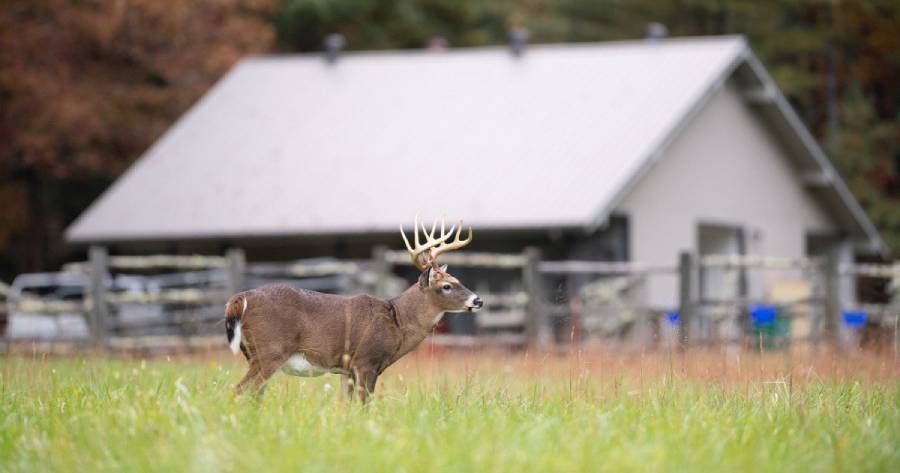
Creating a deer sanctuary on a small property starts with one priority: give deer a secure area where human disturbance stays low throughout the hunting season. A property does not need hundreds of acres to provide meaningful sanctuary habitat. Even when deer regularly cross neighboring land, a well-placed refuge can give them a reason to bed, travel, and spend more daylight hours on your property.
The effectiveness of a small-property deer sanctuary depends less on acreage alone and more on how the habitat is arranged. Dense security cover, protected bedding areas, nearby food and water, predictable travel routes, and controlled hunter access work together to make an area feel safe. Poor placement can have the opposite effect. A sanctuary that forces hunters to cross bedding cover, sends human scent through the refuge, or requires frequent maintenance can increase pressure instead of reducing it.
This guide explains how to choose the right sanctuary location, decide how much acreage to protect, improve security and bedding cover, manage food and water, reduce human intrusion, and hunt around the sanctuary without destroying its value. The goal is not to keep deer permanently inside a small property. The goal is to create secure habitat that deer consistently choose to use.
What Is a Deer Sanctuary on a Small Hunting Property?
A deer sanctuary is a low-disturbance area where deer can bed, hide, and spend daylight hours with minimal human intrusion. Its primary purpose is security. Food, water, and bedding cover can improve the area, but none of those features creates a true sanctuary if hunters regularly walk through it or disturb deer inside it.
A sanctuary differs from a food plot because the two areas serve different functions. A food plot concentrates feeding activity, while a sanctuary protects deer when they are most vulnerable to disturbance. Deer may enter a food plot for a short period and then leave, but a secure sanctuary gives them a place to remain during daylight hours when hunting pressure is higher.
A bedding area can exist inside a sanctuary, but the two terms are not identical. A bedding area is simply a location deer use to rest. A sanctuary is a management decision that protects one or more bedding areas, travel routes, and surrounding cover from unnecessary human activity. Thick young timber, brush, native grasses, shrubs, and other forms of horizontal cover can all contribute to that security when they reduce visibility and make deer less exposed.
On a small hunting property, the sanctuary should function as the part of the property deer can use without repeatedly encountering people. For example, a landowner may hunt the edge of thick cover while leaving the interior untouched throughout most of the season. In that layout, the interior provides security while the edge creates opportunities to intercept deer moving between bedding cover and feeding areas.
Can You Create an Effective Deer Sanctuary on a Small Property?
Yes, a small property can provide an effective deer sanctuary even when it is much smaller than a deer’s total home range. The objective is not to confine deer within property boundaries. The objective is to make part of the property secure enough that deer repeatedly choose to use it for bedding, cover, or daylight travel.
Small-acreage management works because landowners can influence specific habitat conditions even when they cannot control the entire landscape. The 4 most important variables are security cover, human disturbance, hunter access, and the location of food or travel routes. Improving these factors can make a small property more valuable to deer than a larger neighboring area that experiences frequent disturbance.
A small property becomes less effective when every acre is treated as huntable ground. Frequent scouting, stand changes, camera checks, habitat work, and direct approaches to bedding cover can expose deer to repeated human presence. Because the property is small, a single access route may affect a large percentage of the available habitat. Protecting one concentrated refuge can therefore be more useful than spreading human activity evenly across the entire property.
The correct goal is to increase daylight use, not to keep the same deer on the property 24 hours a day. A buck may bed in the sanctuary during part of the day, travel onto neighboring land at night, and return when conditions remain secure. Likewise, does may use protected bedding cover while feeding elsewhere. A successful sanctuary gives deer one strong reason to return: an area where disturbance is consistently lower than in the surrounding landscape.
How Much of a Small Property Should Be Used as a Deer Sanctuary?
The right sanctuary size is the amount of land you can protect from routine human intrusion without sacrificing the access needed to hunt the rest of the property effectively. There is no single percentage that works for every 5-, 10-, or 20-acre parcel because sanctuary size depends on existing cover, neighboring habitat, food locations, property shape, and hunter access.
On very small properties, one compact sanctuary is usually more functional than several disconnected refuge pockets. A single block of thick cover gives deer a larger continuous area where they can bed and move without repeatedly encountering edges, access trails, or human scent. Dividing limited acreage into several tiny sanctuaries can reduce usable security because each refuge becomes easier to disturb from surrounding activity.
A 5- to 10-acre property requires the strictest trade-off between sanctuary space and huntable space. The landowner should first protect the best existing security cover rather than forcing a predetermined acreage target. For example, if the thickest 2-acre section is also the only location where deer can bed without seeing regular human activity, protecting that area may create more value than distributing habitat improvements throughout the entire parcel.
A 10- to 20-acre property gives the hunter more flexibility to separate sanctuary habitat from food, stand locations, and access routes. Additional acreage can create a buffer between deer bedding cover and hunting activity, but the same principle still applies: sanctuary effectiveness depends on security, not simply size. A poorly accessed 8-acre sanctuary can receive more disturbance than a carefully protected 3-acre sanctuary.
The surrounding landscape also changes how much sanctuary habitat is necessary. If neighboring properties already contain large blocks of secure bedding cover, your acreage may function primarily as feeding or travel habitat. If surrounding properties experience heavy hunting pressure and lack thick cover, even a relatively small protected refuge can become disproportionately valuable during daylight hours.
Where Should You Put a Deer Sanctuary on a Small Property?
Put a deer sanctuary where deer can remain secure and where hunters can reach stands without walking through, scenting, or visually exposing the refuge. Existing thick cover is usually the best starting point because improving naturally secure habitat requires less disturbance than trying to build a sanctuary in an open area from scratch.
Evaluate 5 factors before choosing the location: existing cover, human activity, property boundaries, hunter access, and nearby feeding or travel habitat. The best location combines as many of these advantages as possible. For example, an overgrown section that already contains dense brush may look ideal, but it becomes a poor sanctuary if the only route to every hunting stand passes directly through it.
Regular human activity should remain away from the sanctuary whenever possible. Houses, barns, driveways, equipment sheds, walking trails, livestock activity, and frequently used access roads can reduce the security value of nearby cover. Deer can tolerate predictable human activity in some settings, but a sanctuary intended for hunting should minimize unpredictable intrusion into the area where deer are expected to bed.
Property boundaries require special attention on small acreage. A sanctuary placed directly beside neighboring land can work well when adjacent habitat provides additional cover and low pressure. The same location can perform poorly when neighboring hunters regularly approach the boundary or hunt immediately beside the refuge. Because deer do not recognize property lines, sanctuary design should account for what exists beyond your deeded acreage.
Food and travel habitat should also influence placement. A sanctuary positioned near a reliable feeding area can create a predictable bedding-to-feeding pattern, but hunters need a way to intercept that movement without crossing the secure cover. The objective is to create a layout in which deer can leave the sanctuary naturally while the hunter approaches from a different direction.
Should a Deer Sanctuary Be in the Center or Along the Property Edge?
A central sanctuary is generally easier to buffer from outside disturbance, while an edge sanctuary can connect your property to larger blocks of neighboring cover. Neither position is automatically better because the correct choice depends on access and the surrounding landscape.
A sanctuary near the center of a property can provide separation from roads, neighboring hunters, and boundary activity. It may also allow hunting locations to be positioned around multiple sides of the refuge. The disadvantage is access. If every stand requires the hunter to circle, cross, or send scent toward the central cover, the location can make the property difficult to hunt without educating deer.
An edge sanctuary works best when it connects directly to secure habitat beyond the property line. For example, a thick 3-acre section on your property may function as part of a much larger bedding complex when it borders unmanaged timber or dense vegetation next door. This increases the amount of connected security cover available to deer even though you control only a small portion of it.
The weakness of an edge sanctuary is dependence on neighboring land use. Logging, farming activity, new access roads, or increased hunting pressure next door can quickly change how deer use that edge. A small-property hunter should therefore choose sanctuary placement based not only on current deer sign but also on which location can remain secure under predictable hunting and access conditions.
The strongest layout is the one that protects the sanctuary while preserving a clean hunting route around it. If hunters can enter and leave stands without crossing bedding cover, exposing themselves visually, or allowing scent to blow into the refuge, the sanctuary can continue functioning even while the surrounding property is hunted.
What Type of Cover Does a Deer Sanctuary Need?
A deer sanctuary needs dense horizontal cover that limits visibility, conceals bedding deer, and allows them to move short distances without feeling exposed. Tall trees alone do not create this security. The most valuable cover is usually vegetation that fills the space from ground level to several feet high, because that is the zone where deer need visual separation from people, roads, fields, and other sources of disturbance.
There are 4 main forms of cover that can improve a small-property sanctuary: woody regeneration, native shrubs, tall grasses, and low evergreen cover where the local climate supports it. Young saplings, blackberry thickets, dogwood, sumac, briars, switchgrass, and similar vegetation can create visual screening when they grow densely enough. The specific plant species matters less than the structure it creates. A 2-acre block of dense regeneration can provide more functional security than a larger mature woodland with an open understory where a person can see 100 yards through the timber.
Horizontal cover works because it reduces both visual exposure and perceived risk. Deer are more likely to use areas during daylight when surrounding vegetation prevents them from being easily seen from access roads, field edges, neighboring properties, or hunter approaches. Dense cover also gives deer multiple escape routes, which is important on small properties where disturbances may originate only a short distance away.
Timber management can improve a sanctuary when mature forest has become too open at ground level. Selective canopy reduction can allow additional sunlight to reach the forest floor, which encourages grasses, shrubs, forbs, and young woody growth. That new vegetation can increase both security cover and natural browse. The goal is not simply to cut trees. The goal is to change the vertical structure of the habitat so the understory becomes thicker and more useful to deer.
Habitat work should be concentrated rather than spread evenly across the property. If every part of a small parcel is opened, cleared, planted, or regularly maintained, deer lose the contrast between secure habitat and areas used by people. A better layout keeps the sanctuary thick and difficult to see through while maintaining more controlled openings around food sources, access routes, or stand locations.
Techniques such as hinge cutting should be treated as specific habitat tools rather than automatic solutions. Cutting or partially cutting trees can add temporary horizontal structure in suitable locations, but poor execution can create blocked travel, unsafe conditions, or unnecessary disturbance. Existing natural regeneration should be preserved whenever it already provides the desired density.
Screening cover around the sanctuary can also protect the interior without occupying the entire refuge. Dense vegetation along access roads, field margins, and entry routes can prevent deer from seeing hunters approach. For example, a narrow strip of tall grass or shrubs between an access trail and bedding cover can reduce visual disturbance even when the hunter passes within a relatively short distance.
The best cover therefore serves 3 functions at the same time: it hides deer, blocks human visibility, and creates secure movement within the sanctuary. When those conditions exist, cover becomes more than habitat structure; it becomes the physical foundation of the sanctuary.
Does a Deer Sanctuary Need a Bedding Area?
Yes, secure bedding habitat is one of the most important functions of a deer sanctuary because deer need a place to remain protected during daylight hours. A sanctuary without suitable bedding cover may still function as travel habitat, but it gives deer less reason to stay on the property for extended periods.
A useful bedding area combines concealment, escape options, comfortable ground conditions, and a favorable position relative to food and travel routes. Deer often select beds where they can detect danger through sight, scent, or sound while remaining partially hidden. Thick vegetation around the bed increases security, but the immediate bedding location does not need to be completely impenetrable. Deer still need enough space to lie down, stand, and leave quickly when disturbed.
The structure around a bedding area matters more than simply finding flattened vegetation or existing beds. A single bed does not automatically identify high-value sanctuary habitat. Deer may lie down temporarily in many locations. Consistent bedding use is more important because it indicates that the area repeatedly satisfies security and habitat needs.
Improving an existing bedding area should focus first on protecting what already works. If deer are consistently bedding in a section of thick cover, unnecessary clearing can reduce its value. The first management action is often to reduce human traffic rather than alter vegetation. A hunter who enters the bedding area repeatedly to inspect beds, check cameras, or scout trails can eliminate the security advantage the area originally provided.
Where bedding cover is too open, habitat improvements can increase horizontal density around the area. Selective timber work can stimulate regeneration, while shrubs, grasses, or existing young growth can be protected from unnecessary mowing or clearing. These changes create concealment around potential beds without requiring artificial bedding locations to be built throughout the sanctuary.
Bedding areas should also connect naturally with travel routes. Deer need a secure way to leave bedding cover and reach feeding areas, water, or neighboring habitat. A sanctuary surrounded by open ground can force deer to expose themselves immediately after leaving the bed. Dense transition cover extending from the bedding area can create more secure daylight movement and make deer more likely to use the sanctuary before dark.
On a small hunting property, bedding habitat should remain difficult for the hunter to reach but easy for the deer to leave. This relationship is critical. If the best stand location requires walking directly through bedding cover, the sanctuary design conflicts with the hunting strategy. If the hunter can remain outside the bedding core and intercept deer along predictable exit routes, the sanctuary provides both security for deer and more controlled hunting opportunities.
Should You Put Food Inside a Deer Sanctuary?
Food can improve a deer sanctuary, but security should remain the sanctuary’s primary function. A food source does not make an area a sanctuary by itself. Deer may visit a productive food plot at night and avoid it during daylight if the surrounding cover receives regular human pressure. On a small hunting property, food works best when it complements secure bedding habitat instead of replacing it.
There are 3 practical ways to position food around a sanctuary: inside the sanctuary, directly outside it, or farther away as a destination feeding area. Each layout changes deer movement differently. Food inside the sanctuary can give deer access to forage without requiring them to leave secure cover, while food outside the sanctuary creates movement between bedding and feeding areas that hunters may be able to intercept.
Placing food inside the sanctuary has one major advantage: deer can feed while remaining within protected habitat. Natural browse, mast-producing trees, forbs, shrubs, and regenerating woody vegetation are especially useful because they provide food without requiring frequent human maintenance. A sanctuary that contains both secure bedding cover and natural forage gives deer fewer reasons to leave during daylight.
The disadvantage appears when the food source requires repeated maintenance. Planting, spraying, mowing, fertilizing, checking equipment, or accessing a food plot can introduce human scent and activity into the exact area that is supposed to remain undisturbed. On small acreage, those intrusions can affect a large percentage of the sanctuary at once.
Food outside the sanctuary often creates a better hunting layout. Deer can bed securely in the refuge and then travel toward food during the afternoon or evening. That movement creates a predictable transition zone between bedding and feeding habitat. A hunter can position outside the sanctuary and hunt the route without entering the bedding core.
The distance between bedding and food should fit the property rather than follow a universal number. On a small parcel, the entire movement pattern may occur within only a few acres. What matters is whether deer can leave the sanctuary through cover and whether the hunter can approach a stand without crossing that route or contaminating the bedding area with scent.
Natural food should also be considered before adding a dedicated plot. Acorns, browse, agricultural crops, fruit trees, native forbs, and woody regeneration can already provide substantial forage. If those resources exist near secure cover, improving the sanctuary may require protecting existing habitat rather than creating another managed opening.
Should a Food Plot Be Inside or Outside a Deer Sanctuary?
A food plot should usually be outside the sanctuary when the goal is to create huntable movement, while food inside the sanctuary is more useful when the priority is reducing deer movement into exposed areas. The correct layout depends on how the property will be hunted and maintained.
An outside food plot creates separation between bedding and feeding habitat. Deer leave the sanctuary to reach the food source, producing a transition that hunters can target. This arrangement is most effective when the route between the two areas includes enough cover for deer to move before dark. If deer must cross a large open area immediately after leaving the sanctuary, they may delay movement until legal shooting light is nearly over.
An inside food plot reduces the need for deer to expose themselves, but it also reduces predictable movement outside the sanctuary. It can therefore improve security while making hunting more difficult. Maintenance creates another problem. Every trip to plant, spray, mow, or inspect the plot introduces pressure into the refuge.
A practical small-property design is to keep high-maintenance food sources outside the sanctuary while allowing low-maintenance natural forage to remain inside. For example, dense woody regeneration can provide both browse and security within the refuge, while a small food plot positioned outside the edge creates a destination deer can move toward. This separates habitat management from the sanctuary core and gives the hunter a location to target without repeatedly entering protected cover.
Does a Deer Sanctuary Need a Water Source?
A deer sanctuary does not need an artificial water source when reliable water is already available nearby, but accessible water can increase habitat value when water is limited across the surrounding landscape. Water should be treated as one component of the habitat rather than a requirement that must be added to every small property.
The first step is to identify existing water before building anything new. Creeks, ponds, springs, drainage areas, livestock water, wetlands, and seasonal pools may already meet local needs. A new water source adds little value when deer can reach dependable water within their normal movement pattern.
Water becomes more important where natural sources are scarce, seasonal, or far from secure bedding cover. In these conditions, a small pond, wildlife waterhole, or other dependable source can reduce the distance deer need to travel. The benefit is strongest when deer can reach the water through secure cover instead of crossing exposed ground.
Water placement should not interfere with sanctuary security. A water source that requires frequent maintenance or forces the hunter to walk through bedding cover creates the same problem as a poorly positioned food plot. The feature may attract deer while simultaneously increasing human disturbance. On small properties, every management feature should support the sanctuary layout rather than compete with it.
The relationship between water and deer movement can also create hunting opportunities outside the refuge. If deer consistently move from bedding cover toward a water source before reaching a feeding area, that route may become part of a predictable travel pattern. Hunters should observe these patterns from the sanctuary edge rather than entering the core to confirm every trail.
Food and water therefore improve a sanctuary only when they preserve its defining feature: security from repeated human disturbance. A property with excellent forage and water but constant intrusion can function worse than a simpler property where bedding cover remains consistently undisturbed.
How Do You Keep Human Pressure Out of a Deer Sanctuary?
Keep human pressure out of a deer sanctuary by limiting entry, keeping routine access outside the bedding core, and completing necessary habitat work when disturbance will have the smallest hunting-season impact. Dense cover alone does not create a sanctuary if people repeatedly walk through it. The area becomes valuable when deer learn that human intrusion there is rare.
There are 6 common sources of sanctuary disturbance: scouting, checking trail cameras, changing stands, retrieving equipment, performing habitat work, and walking through the area to reach another part of the property. Each activity may appear minor by itself, but repeated intrusion can leave scent, create noise, expose movement, and teach deer that the cover is not consistently secure.
Access routes are especially important on small properties because one poorly located trail can affect a large portion of the available habitat. A hunter should not use the sanctuary as a shortcut to a stand, food plot, or opposite property boundary. Entry and exit routes should remain outside the bedding core and should use terrain, vegetation, or screening cover to separate human movement from deer using the refuge.
Scouting should also focus on the perimeter rather than the interior once the sanctuary has been established. Tracks, trails, rubs, scrapes, feeding sign, and camera activity near exit routes can reveal how deer use the area without requiring repeated trips into the bedding cover. Entering the sanctuary simply to confirm that deer are present can destroy part of the security that made them use it in the first place.
Necessary habitat work should be planned rather than performed throughout the hunting season. Timber work, invasive-plant control, planting, access improvements, and other disruptive projects can require people and equipment inside the refuge. Completing these activities during a defined management period reduces the number of separate disturbances deer experience later.
There are legitimate reasons to enter a sanctuary. Recovering a wounded or harvested deer takes priority over preserving a no-entry rule. Hazard removal, essential habitat work, and necessary equipment retrieval can also justify entry. The correct principle is not “never enter.” It is do not enter without a clear benefit that outweighs the disturbance created.
A sanctuary should therefore be treated differently from the rest of the hunting property. Hunters can scout, maintain stands, and manage food in surrounding areas, while the refuge remains comparatively quiet. That contrast is what gives deer a reason to associate one portion of the property with lower risk.
Should You Place Trail Cameras Inside a Deer Sanctuary?
Trail cameras are usually more useful on the edges of a small deer sanctuary than deep inside it because edge placement can document deer movement without requiring repeated intrusion into bedding cover. The information gained from an interior camera may not justify the disturbance created by installation, maintenance, battery replacement, or card retrieval.
The best camera locations are often exit trails, habitat transitions, staging areas, scrapes near the perimeter, and routes connecting the sanctuary to food. These positions answer the hunting question that matters most: when and where are deer leaving secure cover? A camera positioned several yards inside the bedding core may show that a buck is present, but a perimeter camera can provide more useful information about whether that buck reaches a huntable location during daylight.
Camera access matters as much as camera location. A camera that can be reached from a field edge, access trail, or vehicle route without crossing deer bedding creates less disturbance than one that requires walking through thick cover. Cellular cameras can reduce physical visits after installation, but the initial placement should still avoid disrupting the sanctuary unnecessarily.
Camera data should also be interpreted carefully. A lack of photographs inside one location does not prove that deer have abandoned the sanctuary. Deer can use multiple trails, shift movement with wind or food availability, and remain inside dense cover without passing directly in front of a camera. Beds, tracks, browse, and perimeter movement should be considered together with camera observations.
How Should You Hunt Around a Deer Sanctuary Without Spooking Deer?
Hunt the movement around a deer sanctuary rather than repeatedly hunting inside the sanctuary itself. The refuge creates value by giving deer a secure starting point, while surrounding travel corridors, staging areas, food transitions, and edges create opportunities to intercept deer as they move.
The first priority is identifying where deer naturally leave the sanctuary. Exit routes often connect bedding cover with evening food sources, water, neighboring habitat, or rut-related travel corridors. A hunter can target these routes from outside the secure core, allowing deer to remain undisturbed until they begin moving toward a huntable location.
Sanctuary edges deserve special attention because they create a transition between protected cover and more open habitat. Deer may pause inside this transition before entering a field or food plot, especially during daylight. These staging areas can provide stronger hunting opportunities than the destination food source because deer may reach the transition before they are willing to step into an exposed opening.
Hunting pressure should be concentrated on carefully selected locations rather than spread around the entire sanctuary. Rotating through numerous stands does not automatically reduce pressure if every approach exposes deer to human scent or movement. One or two stands with clean access can be more effective than several locations that require intrusive entry routes.
Timing also affects how much pressure a hunt creates. Repeatedly hunting a sanctuary edge under marginal wind conditions increases the chance that deer will detect the hunter before reaching the stand. Waiting for a wind that carries scent away from bedding cover protects the security of the refuge while improving the chance that deer follow their normal route.
The hunter must also consider what happens after the hunt. An evening stand may have excellent access on the way in but become difficult to leave after deer enter a nearby food source. Walking through feeding deer after dark can create repeated disturbance even when the sanctuary itself was never entered. Exit routes should therefore be planned before the stand is hunted.
Where Should You Place Hunting Stands Around a Deer Sanctuary?
Place hunting stands outside the sanctuary where deer movement, favorable wind, and low-impact hunter access overlap. A stand is not valuable simply because it is close to bedding cover. It is valuable when deer can approach naturally while the hunter remains undetected.
There are 4 primary stand-location factors: deer travel, wind direction, access, and destination habitat. Deer travel identifies where an encounter is possible. Wind determines whether the hunter can remain undetected. Access determines whether the stand can be reached without disturbing bedding cover. Destination habitat, such as food or water, helps explain why deer are moving through that location.
A stand between bedding cover and a food source can be productive when deer use the route during legal shooting hours. The stand should remain far enough outside the bedding core that normal entry does not expose the hunter to bedded deer. The correct distance cannot be reduced to one universal number because cover density, terrain, wind, vegetation, and deer behavior differ among properties.
Downwind access is critical near a sanctuary. A stand may look perfect on a map but become unusable when the prevailing wind carries scent directly into bedding cover. In that situation, the hunter risks educating deer before the hunt begins. A slightly less aggressive stand with safer wind can preserve the sanctuary and produce more opportunities across the season.
Visual screening can improve stand access on open small properties. Tall grasses, shrubs, timber edges, terrain changes, or planted screens can hide hunters moving between parking areas and stands. The objective is to reach the hunting location without allowing deer inside the sanctuary to see, hear, or smell the approach.
The best stand is therefore not always the closest stand. A stand that protects the sanctuary can remain effective for multiple hunts, while an aggressive stand that repeatedly exposes the hunter can reduce the value of the entire refuge.
How Does Wind Direction Affect Deer Sanctuary Design?
Wind direction affects deer sanctuary design because it determines where human scent travels, how deer use bedding cover, and whether hunters can approach nearby stands without contaminating the refuge. A sanctuary can have excellent cover and bedding habitat but lose much of its value if prevailing winds repeatedly carry hunter scent through the area.
The first factor to evaluate is the prevailing wind during hunting season. Hunter access routes and stand locations should be positioned so normal winds carry scent away from the sanctuary rather than through it. This does not mean every hunt requires the same wind. It means the property should contain at least one practical access and stand combination that allows the sanctuary to remain protected under the wind conditions most commonly hunted.
Deer also use wind as part of their security system. Bedding locations often allow deer to combine visual awareness with scent information from another direction. Because terrain, cover, and individual deer behavior affect these choices, a hunter should not assume that every deer will bed facing the same direction or use a fixed wind pattern. The practical objective is to observe which portions of the sanctuary receive consistent bedding use and then protect the wind conditions that allow deer to feel secure there.
Stand placement should account for what happens to scent during the entire hunt, not only when the hunter reaches the tree. A wind that appears safe at the stand may carry scent toward the sanctuary along the access route. Likewise, a changing evening wind can begin safely and then shift toward bedding cover as temperatures decline. On small properties, these changes matter because only a short distance may separate the hunter from the sanctuary.
Terrain can further complicate scent movement. Valleys, ridges, creek bottoms, hillsides, and other elevation changes can redirect air movement. Thermal currents can cause air to rise as the ground warms and descend as temperatures cool. A stand that works with a steady prevailing wind in open terrain may behave differently in a hollow or along a steep slope.
The safest hunting strategy is to create several wind-specific options around the sanctuary instead of forcing one stand to work under every condition. For example, one stand may protect the sanctuary on a northwest wind while another location is reserved for a south wind. This gives the hunter alternatives without moving the stand repeatedly or entering secure cover.
Access routes should follow the same principle. The best stand becomes a poor choice if reaching it requires walking upwind of bedding cover. Vegetation screens, field edges, drainage features, ditches, and terrain breaks can help separate hunter movement from the sanctuary. When these routes are planned before the season, hunters can select a location based on both deer movement and wind rather than choosing a stand first and solving access afterward.
Wind should therefore be treated as part of the sanctuary’s physical design. The goal is to create a refuge that remains secure not only because hunters stay outside it, but also because their scent stays outside it.
How Does Neighboring Hunting Pressure Affect a Small Deer Sanctuary?
Neighboring hunting pressure can increase or reduce the value of a small deer sanctuary because deer use the entire surrounding landscape rather than recognizing property boundaries. A sanctuary that occupies only a few acres may become highly valuable when adjacent properties receive frequent hunting pressure, while the same sanctuary may function differently when neighboring land already provides extensive secure cover.
There are 3 common neighboring-property conditions to evaluate: heavy hunting pressure, additional security cover, and major food sources. Each condition changes how deer are likely to use your property and how aggressively the sanctuary should be hunted.
Heavy hunting pressure on neighboring land can make low-disturbance cover on your property more valuable. If hunters regularly walk through bedding habitat, drive access routes, conduct repeated scouting trips, or hunt multiple locations next door, deer may shift toward areas where encounters with people are less frequent. A sanctuary can benefit from that contrast because it offers a place where pressure is comparatively predictable and low.
The opportunity is strongest when hunters on your property maintain discipline. A small sanctuary does not provide a competitive advantage if it receives the same level of disturbance as the neighboring acreage. Repeatedly entering the refuge because deer appear to be escaping pressure next door can eliminate the exact condition that attracted them.
Neighboring secure cover creates a different situation. If the property borders a large block of thick, lightly disturbed habitat, deer may already have sufficient bedding security outside your boundary. Your sanctuary can still contribute additional cover, but food, travel routes, or staging habitat may become more important parts of your property’s role in the larger landscape.
For example, deer may bed primarily in a neighboring timber block and travel through your sanctuary before reaching a food source. In that case, assuming that every deer using your property beds inside your acreage could lead to poor stand placement. Tracks, camera observations, bedding evidence, and consistent movement patterns can help determine whether your property functions primarily as bedding habitat, transition cover, or feeding habitat.
Neighboring food sources also influence sanctuary use. Agricultural fields, mast-producing timber, food plots, or other concentrated feeding areas can pull deer across property boundaries. A sanctuary positioned between secure bedding habitat and a neighboring food source may become part of an important travel route. Hunters can use this movement pattern, but stand access should avoid blocking or contaminating the route.
Property boundaries become especially important during the hunting season because deer may respond differently to pressure on each side. A buck can spend daylight hours in low-pressure cover and move onto neighboring land only after dark. The reverse can also occur. This is why deer seen on trail cameras should not automatically be considered resident animals that remain within the property throughout the day.
Changes on neighboring land can also alter sanctuary performance from one season to the next. Timber harvest, agricultural rotation, new roads, increased hunting activity, reduced hunting activity, or changes in cover can modify bedding and travel patterns across the entire area. A sanctuary design should therefore be monitored rather than treated as permanently optimized after the first season.
Small-property hunters should focus on controlling the variables inside their boundaries while understanding the landscape outside them. You may not control where neighbors hunt, where they plant food, or how much cover they maintain, but you can control human intrusion, security cover, access routes, and stand placement on your own land.
A small sanctuary becomes most valuable when it provides something the surrounding landscape lacks. If neighboring properties receive heavy pressure, that advantage may be security. If neighboring land already provides security, your property may become more useful by connecting that cover to food, water, or protected travel habitat.
How Can You Tell Whether Deer Are Using the Sanctuary?
You can tell deer are using a sanctuary by looking for repeated bedding, travel, feeding, and camera evidence rather than relying on a single track, bed, or sighting. Consistent use matters more than isolated sign because the purpose of a sanctuary is to become a dependable security area, not simply a place deer pass through occasionally.
There are 6 useful indicators of sanctuary use: beds, tracks, established trails, browse, rubs or scrapes where seasonally relevant, and trail-camera activity around the perimeter. Each sign reveals a different part of deer behavior. Beds indicate resting use, tracks and trails show movement, browse identifies feeding activity, and camera observations help confirm timing and frequency.
Bedding evidence is one of the strongest indicators that the sanctuary is functioning as intended. A single bed may represent temporary use, but multiple beds that reappear in the same secure portion of the property suggest repeated daytime occupation. Beds near dense cover, protected travel routes, and low-disturbance areas are more meaningful than beds found beside frequently used roads or open fields.
Established trails can reveal how deer enter and leave the sanctuary. Trails that connect bedding cover with food, water, staging habitat, or neighboring properties help identify the sanctuary’s role in the larger movement system. A heavily used trail does not automatically mean the interior is being used as bedding habitat, but repeated movement along several protected exits can indicate that deer are spending meaningful time inside the cover.
Browse should be interpreted together with security sign. Browsed twigs, forbs, mast, or other feeding evidence show that deer are consuming food in or near the sanctuary, but feeding sign alone does not prove the area functions as a refuge. The strongest pattern is a combination of feeding evidence, bedding, protected travel, and low human intrusion.
Rubs and scrapes can provide additional seasonal information, especially during the pre-rut and rut. These signs can confirm that bucks are moving through or near the sanctuary, but they should not be treated as permanent evidence of bedding use. Their value is highest when they appear together with repeated daylight camera activity or established trails leading from secure cover.
Trail cameras should be used to confirm movement without turning the sanctuary into a monitoring zone. Cameras on exit trails, habitat transitions, and nearby staging areas can show whether deer are leaving the refuge during daylight. A camera that captures the same deer on multiple dates under similar conditions provides stronger evidence of consistent use than one isolated photograph.
The most important distinction is between deer passing through the property and deer repeatedly using it as secure habitat. A deer that appears once on a trail camera may have crossed the property in minutes. A deer that repeatedly beds nearby, travels the same covered routes, and appears on perimeter cameras during daylight is providing stronger evidence that the sanctuary is working.
Read more: How to Hunt Deer Near Suburban Development
What Are the Most Common Deer Sanctuary Mistakes on Small Properties?
There are 6 common deer sanctuary mistakes on small properties: entering too often, choosing a poor location, prioritizing food over security, creating fragmented cover, ignoring neighboring land, and performing unnecessary habitat work during hunting season. Each mistake reduces the sanctuary’s ability to function as a consistent low-pressure refuge.
The first mistake is entering the sanctuary too often. Hunters sometimes create good cover and then weaken it by scouting, checking cameras, inspecting beds, or moving stands through the same area. The problem is not one isolated visit. The problem is repeated intrusion that teaches deer the sanctuary is regularly occupied by people.
The second mistake is choosing a sanctuary location that conflicts with hunter access. A thick block of cover may look ideal on a map, but it becomes difficult to protect when every stand approach requires walking beside or through it. Access should be evaluated before the sanctuary location is finalized. A slightly less attractive refuge with clean entry and exit routes can outperform better cover that hunters disturb on every trip.
The third mistake is prioritizing food over security. Food plots, mast, browse, and other forage can increase deer use, but they do not compensate for repeated human pressure. A property can contain excellent food and still receive mostly nighttime deer activity if animals do not feel secure during daylight. Security should determine the sanctuary first; food should support that security.
The fourth mistake is creating fragmented cover. Several tiny patches of thick vegetation may add habitat diversity, but they do not always provide the same security as one connected block. Fragmentation increases edges and may expose deer to nearby roads, access trails, houses, or hunting activity. On limited acreage, one protected core can be more useful than multiple isolated pockets that are easy to disturb.
The fifth mistake is ignoring neighboring properties. Deer may bed, feed, or travel across several ownership boundaries in a single day. A sanctuary placed beside heavy neighboring pressure may become extremely valuable, while one beside a larger existing refuge may play a secondary role. Management decisions should account for adjacent food, cover, access, and hunting activity rather than treating the property as an isolated unit.
The sixth mistake is performing unnecessary habitat work during hunting season. Cutting vegetation, opening new trails, moving stands, mowing, planting, or repeatedly modifying the sanctuary can reduce its short-term security value. Habitat improvements are useful when they solve a defined problem, but constant adjustment can create more disturbance than benefit.
These mistakes usually come from the same underlying error: treating the sanctuary as an area that must be constantly managed. A successful sanctuary often depends as much on what the hunter avoids doing as on the habitat improvements that are added. Once cover, bedding, access, and movement are functioning well, restraint becomes part of the management strategy.
The best test is simple: every change should answer a specific problem. If a proposed action does not improve security, habitat structure, access, or huntability, it may not justify entering the sanctuary at all.
How Do You Maintain a Deer Sanctuary Over Time?
Maintain a deer sanctuary by preserving dense security cover, correcting habitat problems only when they reduce sanctuary function, and limiting management activity that creates unnecessary disturbance. A sanctuary does not need constant improvement. It needs periodic evaluation to make sure vegetation, access, bedding habitat, and deer use still support the original purpose of the refuge.
There are 5 conditions to monitor over time: vegetation succession, loss of horizontal cover, invasive plants, changes in access, and changes in deer use. These conditions can gradually alter how secure the sanctuary feels even when the property layout has not changed.
Vegetation succession is one of the most important long-term changes. Young forests, brush, grasses, and early successional growth can provide dense cover for several years, but that structure changes as plants mature. Trees may grow taller, the canopy may close, and shade can reduce vegetation near ground level. A sanctuary that once provided excellent screening can eventually become open underneath.
Loss of horizontal cover should trigger targeted habitat work rather than complete reconstruction. If deer can see long distances through a former bedding area, selective canopy work, regeneration, shrub growth, or protection of young woody vegetation can restore density. The objective is to rebuild security at deer level without disturbing every part of the refuge at once.
Invasive vegetation should be managed when it reduces habitat quality, suppresses useful native plants, or creates long-term management problems. The presence of dense vegetation alone does not automatically mean the sanctuary is functioning well. Cover should provide security while also supporting usable travel, bedding, and forage where possible. Management should therefore focus on habitat function rather than simply maximizing plant density.
Access routes also require periodic review. A route that worked when the sanctuary was established can become exposed after vegetation changes, timber work, storm damage, or agricultural activity. Hunters should check whether deer can now see movement along an approach trail or whether prevailing access sends scent toward newly established bedding areas. Correcting one exposed section with screening cover or a different route can protect the larger sanctuary without modifying the refuge itself.
Changes in deer use can indicate that the sanctuary needs attention, but those changes should be evaluated across an entire season rather than after a few hunts. Deer movement can shift with food availability, rut activity, weather, hunting pressure, neighboring land use, and seasonal cover. A temporary decline in trail-camera activity does not automatically mean the sanctuary has failed.
Repeated evidence provides a stronger reason to adjust habitat. For example, if bedding use declines over multiple seasons while the understory becomes visibly open, the loss of security cover provides a logical management target. If deer continue bedding inside the sanctuary but use a different exit route, changing stand strategy may be more appropriate than changing the habitat.
Major habitat work should be grouped into planned management periods whenever possible. Entering the sanctuary five separate times to complete five small projects creates more disturbance than organizing necessary work efficiently. Concentrated management allows the area to return to a low-pressure condition for longer periods afterward.
The sanctuary boundary should also remain stable unless there is a clear reason to change it. Constantly shifting the refuge toward fresh deer sign can turn the property into a series of temporary sanctuaries that eventually receive pressure everywhere. A consistent protected core gives deer the opportunity to experience the same low-disturbance area across multiple seasons.
Neighboring land should be reassessed periodically because outside changes can alter the role of the sanctuary. A timber harvest next door may remove bedding cover, while an abandoned field may develop into new security habitat. New food plots, access roads, hunting pressure, or development can also redirect movement across the boundary. These changes may require different stand locations or access strategies even when the sanctuary itself remains unchanged.
The most effective maintenance strategy is therefore selective rather than continuous. Protect what is already working, fix measurable weaknesses, and avoid entering the sanctuary simply because additional habitat work is possible. A mature sanctuary management plan should require fewer unnecessary interventions, not more.