
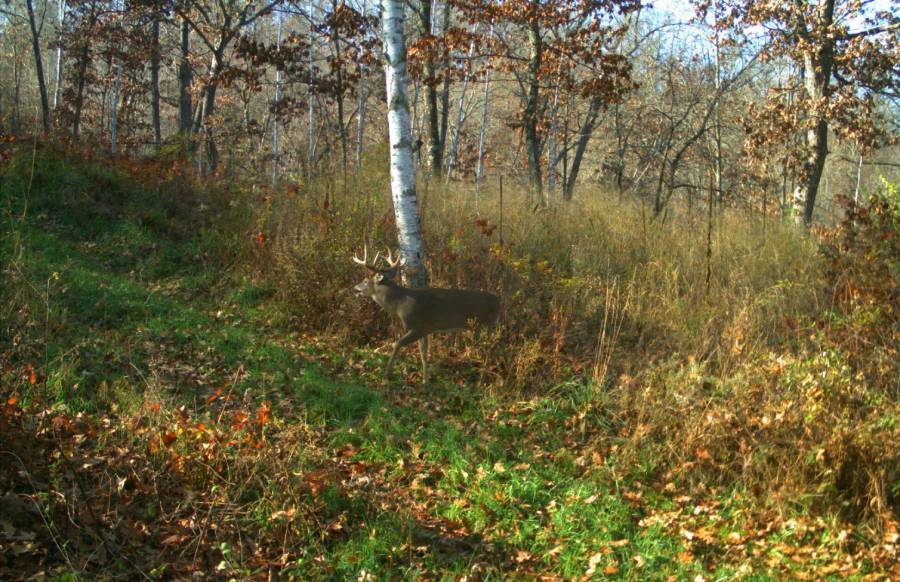
Deer do not consistently prefer north- or south-facing slopes because slope selection changes with season, temperature, sunlight, food availability, cover, and wind. South-facing slopes are generally more attractive during cold conditions because they receive more direct sunlight, while north-facing slopes can become more attractive during warm conditions because they provide cooler, shaded habitat. Neither slope direction should be treated as an absolute rule when locating deer.
Slope aspect matters because it changes the microclimate deer experience on the same ridge or mountain. Greater solar exposure can warm south-facing ground, accelerate snowmelt, and influence available vegetation. Reduced solar exposure can keep north-facing slopes cooler and moister, supporting different vegetation and thermal cover. These differences affect where deer feed, bed, and travel throughout the year.
For hunters, slope direction is most useful when combined with current conditions rather than used by itself. Season, recent weather, bedding cover, food sources, wind direction, hunting pressure, and access can all override a general north-versus-south preference. Understanding how these factors interact makes slope aspect a practical scouting tool for identifying higher-probability deer habitat before choosing where to hunt.
Do Deer Prefer North or South Facing Slopes?
Deer use both north- and south-facing slopes, but south-facing slopes tend to become more attractive in cold conditions, while north-facing slopes tend to become more attractive in hot conditions. The reason is not the compass direction itself. Slope aspect changes sunlight exposure, temperature, moisture, snow conditions, vegetation, and thermal cover, which influence where deer can efficiently bed, feed, and travel.
In the Northern Hemisphere, south-facing slopes receive more direct solar exposure than comparable north-facing slopes. This additional sunlight generally creates warmer and drier conditions. North-facing slopes receive less direct sunlight, helping them remain cooler and retain more moisture. A deer living around the same ridge can therefore encounter two different microclimates within a relatively short distance.
| Factor | North-Facing Slopes | South-Facing Slopes |
|---|---|---|
| Sun exposure | Lower | Higher |
| Temperature | Generally cooler | Generally warmer |
| Moisture | Generally higher | Generally lower |
| Snow retention | Longer | Shorter |
| Summer value | Shade and cooler cover | Hotter and drier |
| Winter value | Cooler conditions | Sun and warmer conditions |
| Deer use | Often attractive during heat | Often attractive during cold |
These differences do not mean every deer switches to a north-facing slope in summer and a south-facing slope in winter. Slope direction is one habitat variable, not a standalone predictor of deer location. A south-facing hillside without security cover or suitable food can hold fewer deer than a north-facing hillside containing quality bedding cover and nearby forage. Hunting pressure can alter the pattern further by pushing deer toward secure terrain regardless of aspect.
Hunters should therefore use slope direction to narrow a search area rather than determine a stand location by itself. Start with the slope that provides favorable conditions for the current season and weather, then verify food, bedding cover, trails, tracks, droppings, rubs, and other deer sign before committing to a hunting location.
Why Do Deer Use South-Facing Slopes?
Deer use south-facing slopes primarily because greater solar exposure can create warmer habitat and improve access to food during cold conditions. This advantage becomes most relevant when low temperatures, frost, or snow increase the energy deer must expend to maintain body temperature and reach forage.
Sunlight is the mechanism behind the difference. A south-facing hillside in the Northern Hemisphere generally receives more direct solar radiation than a north-facing hillside with otherwise similar terrain. The additional solar energy warms the ground and surrounding vegetation. Deer resting or feeding in these locations can take advantage of a warmer microclimate without moving long distances to find it.
Snow conditions can strengthen this preference. Greater solar exposure can cause snow on south-facing terrain to melt sooner or become shallower than snow on shaded slopes. Reduced snow depth can lower the energy cost of movement and expose vegetation that would otherwise remain covered. A hillside that combines sunlight, accessible browse, and security cover therefore offers several useful habitat features at the same location.
Food availability can make south-facing slopes especially important during late winter and early spring. Earlier warming and snowmelt can expose browse and encourage vegetation to become available sooner than on colder aspects. Deer are responding to the resulting food and thermal conditions rather than choosing a compass direction for its own sake.
South-facing slopes can also contain bedding habitat, but sunlight alone does not make a hillside a good bedding area. Deer still need security cover and a location that helps them detect threats. Wind, terrain features, vegetation density, human disturbance, and proximity to feeding areas can determine whether deer actually bed on a particular south-facing slope.
For hunters, the practical value of south-facing terrain increases during cold weather. A south-facing hillside containing thick bedding cover near a winter food source is a stronger scouting candidate than an exposed south-facing hillside with little forage. After snow or a sustained period of cold temperatures, hunters can examine these slopes for concentrated tracks, beds, droppings, browse activity, and travel routes connecting cover with food.
The same principle explains why south-facing slopes should not automatically receive priority throughout the hunting season. During unusually warm weather, their additional solar exposure can make them less favorable for daytime bedding. Under those conditions, deer may shift toward shaded terrain, thicker cover, or cooler aspects nearby. The hunting value of a south-facing slope is highest when its warmer microclimate solves a current need for the deer while the location still provides food, security, or an efficient travel route.
Why Do Deer Use North-Facing Slopes?
Deer use north-facing slopes because these slopes generally provide cooler temperatures, more shade, and higher moisture levels than south-facing slopes. These conditions become especially valuable during warm weather, when deer benefit from bedding and traveling in habitat that reduces direct solar exposure.
North-facing slopes in the Northern Hemisphere receive less direct sunlight than comparable south-facing slopes. Lower solar exposure allows the soil and surrounding vegetation to retain moisture longer and limits daytime heating. The resulting microclimate can make a north-facing hillside noticeably different from another aspect on the same ridge.
Cooler conditions matter most when daytime temperatures rise. Deer generate body heat while feeding and traveling, so shaded cover provides a more favorable place to spend inactive periods. A mature buck, for example, may use dense cover on a north-facing slope as a daytime bedding area and move toward nearby feeding habitat as temperatures decline later in the day.
Moisture also affects the vegetation growing on a slope. North-facing terrain can support denser or different plant communities than warmer, drier terrain, depending on the region, elevation, soil, and precipitation. Dense vegetation can provide both browse and security cover. This combination can make a north-facing slope attractive even when temperature is not the primary reason deer are using it.
North-facing slopes are not automatically deer bedding areas. A cool hillside with sparse cover and frequent human disturbance can be less attractive than a warmer slope that provides secure bedding habitat. Deer evaluate the complete location, including cover, wind, terrain position, food access, and disturbance.
Hunters should give north-facing slopes greater attention during warm periods, particularly where shaded terrain intersects thick cover. Look for beds, concentrated tracks, droppings, trails, and transitions between dense vegetation and feeding areas. These signs confirm actual deer use rather than relying on slope direction alone.
How Does the Season Change Which Slopes Deer Prefer?
Season changes deer slope preference because temperature, sunlight, vegetation, food availability, and cover change throughout the year. A slope that provides favorable habitat in winter can offer less value during summer, so hunters should evaluate slope aspect in the context of current seasonal conditions.
During winter, south-facing slopes can gain importance because increased solar exposure produces warmer daytime conditions and can reduce snow cover. Less snow can make travel easier and expose browse. Deer attempting to conserve energy during cold periods can therefore benefit from south-facing terrain that combines sunlight, food, and protective cover.
Spring creates a different pattern. South-facing terrain generally warms earlier, which can affect snowmelt and the timing of new plant growth. Deer emerging from winter need accessible, nutritious forage, so slopes producing early vegetation can receive increased feeding activity. As vegetation develops elsewhere, that concentration can become less pronounced.
During summer, north-facing slopes can become more attractive because shade and lower solar exposure help create cooler daytime habitat. Dense vegetation on these aspects can also provide security and bedding cover. Hunters scouting summer habitat should therefore pay particular attention to cool slopes located near reliable food and water rather than assuming deer remain in areas they used during colder months.
Fall produces the most complex pattern for hunters because deer behavior is influenced by changing temperatures, shifting food sources, hunting pressure, and the rut. Early in the season, warm conditions can preserve the value of shaded north-facing bedding cover. As temperatures fall later in autumn, sunny slopes can become increasingly attractive under cold conditions.
Food can override the seasonal slope pattern. Deer may use an otherwise less favorable aspect when it contains a concentrated food source. The same applies to security. Hunting pressure can push deer into thick or difficult terrain even when another slope offers better thermal conditions.
Weather changes within a season can also produce short-term shifts. A cold period during fall can increase the value of sunny terrain, while an unusually warm period can increase the value of shaded cover. Hunters should therefore treat season as the starting point for predicting slope use and current weather as the variable that refines that prediction.
A practical scouting sequence is to identify the seasonal needs of deer first, compare north- and south-facing terrain second, and confirm the prediction with fresh deer sign third. This approach uses slope aspect as part of habitat analysis rather than turning compass direction into a fixed hunting rule.
How Does Temperature Affect Which Slopes Deer Use?
Temperature affects which slopes deer use by changing the thermal value of sunny and shaded terrain. Colder conditions increase the value of slopes receiving more solar exposure, while hotter conditions increase the value of shaded slopes that remain cooler during the day. This relationship helps explain why deer can change slope use within the same season.
During cold weather, south-facing slopes can provide a warmer microclimate because they generally receive more direct sunlight in the Northern Hemisphere. This difference becomes more useful when deer need to conserve energy. A hillside that combines solar exposure with bedding cover allows deer to gain thermal benefits without sacrificing security.
Warm weather changes the advantage. North-facing slopes receive less direct solar exposure and generally remain cooler than south-facing terrain with otherwise similar characteristics. Thick vegetation can strengthen this effect by adding shade. Deer may use these areas for daytime bedding before moving toward feeding areas when temperatures decline.
Daily temperature changes also matter. A deer does not experience one temperature throughout a 24-hour period, so the most favorable terrain can change between morning, midday, evening, and night. A sunny slope can provide useful warmth during a cold morning but become less attractive after several hours of direct solar exposure.
Short-term weather patterns can be more useful to hunters than relying only on the calendar. For example, an unusually warm period during fall can increase the relative value of shaded bedding cover even though temperatures normally decline during that season. A sharp temperature drop can reverse the situation by increasing the thermal value of terrain receiving direct sunlight.
Temperature should therefore be combined with security cover, food, wind, and fresh deer sign. A thermal advantage influences deer slope use most strongly when the same location also satisfies another important need, such as bedding security or access to food. Hunters who find both conditions in one area have a stronger reason to scout it than hunters selecting terrain based only on its compass direction.
How Does Sunlight Affect Deer Use of North- and South-Facing Slopes?
Sunlight affects deer slope use by creating different temperatures and habitat conditions on different sides of the same terrain. In the Northern Hemisphere, south-facing slopes generally receive greater direct solar exposure, while north-facing slopes receive less. This difference influences ground temperature, moisture, snow retention, vegetation, and the thermal conditions available to deer.
The basic relationship can be viewed as:
Slope aspect → solar exposure → temperature and moisture → vegetation and snow conditions → deer habitat use.
South-facing terrain receives more solar energy and therefore tends to warm faster. During cold conditions, this can create favorable bedding and feeding opportunities. Sunlight can warm exposed ground and reduce the persistence of snow, potentially making movement and access to vegetation easier.
North-facing terrain receives less direct sunlight and consequently tends to retain cooler conditions. Reduced solar heating also helps the ground retain moisture. During warmer periods, these characteristics can make shaded north-facing cover useful for deer seeking cooler daytime bedding habitat.
Sunlight also changes habitat indirectly through vegetation. Plants respond to differences in light, soil moisture, temperature, and other site conditions, so vegetation communities can differ between slope aspects. Those differences matter to deer because vegetation supplies 2 important resources: food and cover. A slope with favorable thermal conditions becomes substantially more useful when it also contains browse or dense security cover.
The effect of sunlight varies with terrain and surrounding features. Tree canopy can limit direct solar exposure, while steepness, elevation, neighboring ridges, and local topography can change how long a hillside remains illuminated. Hunters should therefore avoid assuming that every south-facing slope is consistently sunny or every north-facing slope remains shaded throughout the day.
A practical way to use sunlight when scouting is to compare slopes rather than evaluate them in isolation. On cold days, identify terrain receiving prolonged sunlight and then look for bedding cover, accessible food, and fresh deer sign. During hot conditions, identify shaded terrain and determine whether it contains secure bedding habitat.
Sunlight explains why slope direction matters, but habitat determines whether deer actually use that slope. Compass direction identifies a potential microclimate. Tracks, beds, droppings, trails, browse, rubs, and other current sign determine whether deer are taking advantage of it.
How Do Food and Vegetation Affect Which Slopes Deer Prefer?
Food and vegetation can outweigh slope direction when deer choose where to spend time. North- and south-facing slopes create different growing conditions, but deer ultimately respond to the resources those conditions produce. A slope with abundant browse, suitable cover, and secure access can attract more deer than a thermally favorable slope with little food or protection.
Slope aspect influences vegetation by changing 3 major growing conditions: sunlight, temperature, and soil moisture. South-facing slopes generally receive more direct sunlight in the Northern Hemisphere, creating warmer and often drier conditions. North-facing slopes generally remain cooler and retain more moisture. These differences can affect the density, composition, and seasonal availability of plants deer use for food and cover.
The relationship is important because deer habitat depends on more than forage quantity. Vegetation can provide food, bedding cover, screening cover, and protected travel routes at the same time. Dense vegetation on a north-facing hillside, for example, may create a secure daytime bedding area during warm weather. A south-facing hillside with accessible browse can become more attractive during colder periods.
Seasonal food availability can also shift deer from one aspect to another. New vegetation may become available earlier on warmer terrain during spring, while other food sources become more important as the growing season progresses. During fall, changes in preferred foods can alter deer movement even when temperature conditions remain similar.
Hunters should therefore identify the food source before assuming deer will use a slope because of its direction. Look for active browsing, fresh tracks, droppings, trails, and nearby bedding cover. These observations show whether the vegetation on a particular slope is currently providing something deer need.
The strongest slope is usually the one where favorable microclimate, food, and security overlap. Slope aspect helps predict where those conditions may occur, but current habitat and deer sign confirm whether the prediction is correct.
How Do Deer Use Slopes for Bedding and Feeding?
Deer use slopes as bedding areas, feeding areas, and travel corridors between the two. The exact use depends on cover, food, terrain position, temperature, wind, and hunting pressure rather than north- or south-facing orientation alone.
Bedding areas require security first. Deer need locations where they can remain relatively concealed while monitoring approaching danger. Thick vegetation, terrain breaks, benches, points, and other terrain features can provide that security. Thermal conditions can then make one suitable bedding location more attractive than another.
Feeding areas follow a different set of priorities. Deer select locations where preferred forage is accessible without requiring excessive movement or exposure. A slope containing productive vegetation can therefore attract feeding activity even when another aspect offers better thermal conditions. The value increases when deer can reach the food through secure cover.
The relationship between bedding and feeding areas creates predictable travel. Deer frequently move through terrain features that provide efficient or protected routes instead of crossing every hillside randomly. Benches, saddles, draws, points, vegetation edges, and changes in terrain can concentrate movement between cover and food.
This distinction matters for hunters because finding deer sign on a slope does not automatically identify how deer are using it. Numerous tracks around browse can indicate feeding activity, while depressions in protected cover can indicate bedding. A defined trail connecting the two may provide a travel corridor rather than either destination.
What Makes a Slope a Good Deer Bedding Area?
A good deer bedding slope combines security cover with favorable wind, terrain, temperature, and access to nearby resources. Slope direction can improve the thermal characteristics of a bedding area, but it does not replace these fundamental requirements.
Security cover reduces the chance that deer will be visually detected and gives them protected locations for daytime use. Dense vegetation, difficult terrain, or low human disturbance can increase this value. Mature bucks in pressured hunting areas can place particularly high value on locations that reduce predictable human access.
Wind adds another layer to bedding selection. Deer rely heavily on scent to detect danger, so a bedding location that allows useful wind exposure can provide information about areas they cannot see. Terrain can modify airflow, meaning two bedding sites on the same slope may provide different wind advantages.
Terrain position also affects security. Benches, points, upper portions of slopes, and changes in contour can create locations where deer can combine cover with awareness of surrounding terrain. The best position varies with local topography, wind, vegetation, and disturbance, so hunters should confirm use through actual beds and fresh sign.
Temperature determines which otherwise suitable bedding area may be more comfortable under current conditions. During cold weather, solar exposure can increase the value of secure south-facing bedding cover. During hot weather, shaded north-facing cover can provide a cooler alternative.
Proximity to food further improves a bedding area’s efficiency. Deer that can move between secure cover and feeding habitat without crossing large exposed areas have less reason to travel through risky terrain. Hunters can use this relationship to identify likely movement routes around the edges of bedding areas.
The most useful bedding slope for hunting is therefore not simply north-facing or south-facing. It is the slope where security, wind, terrain, thermal conditions, and access to food align with current deer needs. Hunters should use aspect to narrow potential bedding habitat and then use beds, tracks, droppings, trails, rubs, and other fresh sign to determine which locations deer actually occupy.
How Does Wind Direction Affect Which Side of a Slope Deer Use?
Wind direction can influence which part of a slope deer use because deer depend on scent to detect danger around bedding and travel areas. A slope with favorable temperature, food, and cover can lose some of its hunting value when the wind does not support the way deer are currently using that terrain.
Wind interacts with terrain rather than moving uniformly across every hillside. Ridges, draws, points, benches, and changes in slope steepness can redirect airflow. This means the prevailing wind direction provides a starting point, but the wind experienced at a specific bedding area or travel corridor can differ from the general forecast.
Bedding deer can use wind together with sight and hearing to monitor their surroundings. A secure bedding location may allow a deer to smell danger approaching from one direction while terrain or vegetation provides visibility and protection in another. This helps explain why two apparently similar locations on the same slope can receive very different levels of deer use.
Thermals add another variable on sloped terrain. Air near the ground changes as a hillside heats and cools. During periods of daytime heating, rising air can move scent uphill. As the ground cools, air can move downhill. Local terrain and weather complicate this pattern, so hunters should verify actual airflow instead of assuming thermals will behave identically on every slope.
Wind can also affect how deer travel between bedding and feeding areas. A deer may use a route that allows it to monitor surrounding cover with its nose rather than following the shortest path between two locations. As a result, trails positioned along benches, sidehills, or terrain transitions can become important when they provide both efficient travel and a scent advantage.
For hunters, wind should be evaluated after identifying likely deer habitat. First locate the bedding cover, food, and travel routes that make a slope attractive. Then determine whether the current wind allows deer to use those locations while also providing a hunting approach that does not carry human scent toward them.
The best slope to hunt is not necessarily the slope with the most deer sign if the wind makes it difficult to approach and hunt without detection. A slightly less active location with reliable wind and clean access can provide a better setup than a heavily used bedding area where hunter scent consistently reaches the deer.
Read more: Do Deer Bed Near Water? What Hunters Should Know
How Can Hunters Find North- and South-Facing Slopes on a Map?
Hunters can identify north- and south-facing slopes by determining the direction the hillside descends from higher ground toward lower ground. A slope that falls toward the south is south-facing, while a slope that falls toward the north is north-facing. The orientation of the ridge itself does not determine the slope aspect.
Topographic contour lines provide the information needed to make this distinction. Closely spaced contours indicate steeper terrain, while wider spacing indicates gentler terrain. By locating ridges, high points, draws, and valleys, hunters can determine which direction each hillside faces.
For example, consider a ridge running from east to west. The terrain dropping from the ridge toward the south forms a south-facing slope. Terrain dropping from the opposite side toward the north forms a north-facing slope. Both aspects can therefore occur on opposite sides of the same ridge.
Digital hunting maps can make this process faster because hunters can combine contour information with aerial imagery. Aerial imagery adds information about timber, openings, vegetation transitions, agricultural areas, access routes, and other habitat features. Contours explain the shape and orientation of the terrain, while imagery helps determine what habitat exists on it.
Hunters should then compare slope aspect with the conditions deer currently need. During cold weather, south-facing terrain with substantial solar exposure, bedding cover, and nearby food deserves attention. During hot weather, shaded north-facing cover near feeding habitat can become a stronger candidate. The map narrows the search before boots-on-the-ground scouting confirms actual use.
Several terrain features deserve additional attention when analyzing either aspect. Benches can provide relatively level bedding or travel locations on otherwise steep hillsides. Points can create distinct wind and visibility conditions. Saddles can funnel movement between terrain features, while draws can provide cover and natural travel corridors.
Map analysis should also include hunting access. A promising bedding slope is difficult to hunt effectively when the only entrance crosses feeding habitat, major trails, or the bedding area itself. Identifying multiple access routes before hunting allows the hunter to choose an approach based on wind direction and expected deer location.
A map identifies where favorable north- or south-facing habitat could exist; fresh deer sign determines whether deer are actually using it. After selecting candidate slopes, hunters should verify them by looking for beds, tracks, droppings, trails, rubs, browsed vegetation, and other recent evidence before deciding where to set up.
Which Slopes Should You Hunt for Deer?
Hunters should target the slope that best combines current weather conditions, food, bedding cover, wind, and low hunting pressure rather than automatically choosing north- or south-facing terrain. South-facing slopes deserve more attention during cold conditions, while north-facing slopes become stronger candidates during warm conditions. Fresh deer sign should ultimately determine which slope receives hunting pressure.
A practical way to select a slope is to evaluate 7 factors in order: season, current weather, slope aspect, food, bedding cover, wind, and hunting pressure. Season establishes the general habitat needs of deer, while current weather identifies short-term thermal conditions. Slope aspect then helps hunters locate terrain capable of providing those conditions. Food and bedding determine whether the habitat can support regular deer use, and wind and hunting pressure determine whether the location can be hunted effectively.
This sequence prevents a common scouting mistake: selecting terrain based only on compass direction. For example, a south-facing slope may look ideal during a cold November period, but it becomes a weak hunting location if it contains little cover, no active food source, and no fresh deer sign. A nearby north-facing slope containing secure bedding and concentrated deer activity may still be the better choice.
Hunters should also separate a good deer location from a good hunting location. A bedding area can hold deer consistently but provide poor access because the prevailing wind carries hunter scent directly into the cover. Another location along the travel route between that bedding area and a feeding area may provide a cleaner approach and a more reliable wind.
Fresh sign should provide the final confirmation. Tracks indicate recent movement, beds identify resting habitat, droppings show repeated use, browsed vegetation reveals feeding activity, and established trails can expose movement patterns. Rubs and scrapes can add information during the appropriate part of the hunting season. Several forms of recent sign concentrated in one area provide stronger evidence than slope aspect alone.
When Should Hunters Focus on South-Facing Slopes?
Hunters should focus on south-facing slopes when cold conditions make sunlight, warmer ground, reduced snow cover, or accessible forage valuable to deer. These conditions are especially useful when the same hillside also contains secure bedding cover or connects bedding habitat with an active food source.
Cold periods are the clearest reason to prioritize south-facing terrain. Greater solar exposure can create a warmer microclimate than nearby shaded slopes. Deer can benefit from this thermal difference while bedding, and exposed vegetation can provide feeding opportunities where snow or frost limits forage elsewhere.
Snow increases the potential difference between aspects. South-facing terrain exposed to sunlight can lose snow sooner than shaded terrain, making movement easier and uncovering vegetation. Hunters scouting after snowfall should compare snow depth, tracks, feeding activity, and bedding sign on opposite aspects instead of assuming deer distribution remains unchanged.
Late-season hunting can make this pattern particularly useful because deer must balance security with energy conservation and food acquisition. A south-facing slope that combines thermal advantage, winter browse, and thick cover can satisfy several needs within a compact area. Such locations deserve closer scouting.
Hunters should not hunt a south-facing slope simply because temperatures are low. Prioritize south-facing terrain when 3 conditions overlap: favorable solar exposure, usable habitat, and fresh deer activity. Without the second and third conditions, slope direction provides only a prediction rather than evidence of deer presence.
When Should Hunters Focus on North-Facing Slopes?
Hunters should focus on north-facing slopes when warm conditions increase the value of shade, cooler temperatures, moisture, and dense bedding cover. These slopes become especially interesting when they provide secure daytime habitat close to active feeding areas.
Warm early-season conditions are one situation where north-facing terrain deserves attention. Reduced solar exposure can keep these hillsides cooler during the day, while moisture can support vegetation that provides cover. Deer may spend daylight hours in this protected habitat before moving toward feeding areas later in the day.
Unexpected warm spells during fall can produce the same logic. Hunters should not assume that a particular month automatically determines slope preference. When temperatures rise substantially, shaded bedding habitat can regain value even during a season normally associated with cooling conditions.
North-facing slopes can also remain attractive when their habitat is simply better. Dense security cover, favorable wind conditions, limited human access, and nearby food can outweigh the thermal benefits available elsewhere. This is particularly important in pressured hunting areas, where avoiding disturbance can become more important than selecting the most comfortable slope.
Hunters evaluating north-facing terrain should look for concentrated bedding sign in thick cover and identify trails connecting that cover with food. The most useful hunting position may be outside the bedding area along one of these travel routes, allowing the hunter to intercept movement without entering the location deer use for daytime security.
The north-versus-south question should therefore end with conditions rather than a fixed compass direction. Hunt south-facing slopes when cold weather makes solar exposure valuable and deer sign confirms use. Hunt north-facing slopes when heat and shade favor cooler cover and deer sign confirms use. When food, security, wind, or hunting pressure contradict the expected pattern, follow the habitat and fresh deer sign rather than the general slope rule.