
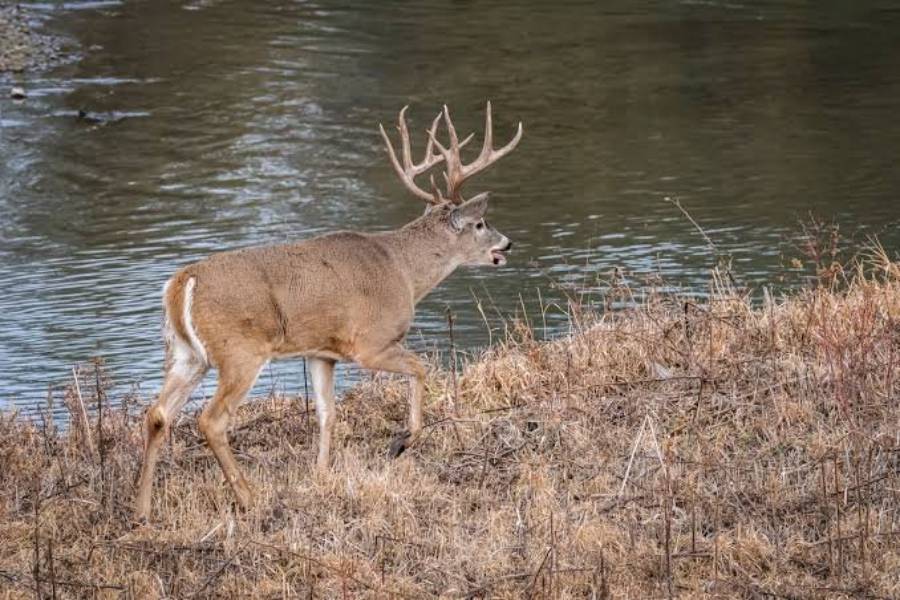
Yes, deer do bed near water, but access to water alone does not determine where they choose to bed. Whitetail deer select bedding areas primarily based on security, cover, terrain, wind conditions, food access, hunting pressure, and seasonal conditions. A creek, pond, river, spring, swamp, or marsh can make an area more useful because deer can reach water without traveling far, but the surrounding habitat still needs to provide a suitable place to rest.
Some deer beds are only a short distance from water, while others are farther away and connected to a water source by established travel routes. This difference matters to hunters because finding water does not automatically mean a bedding area is nearby. A secluded creek surrounded by thick cover, for example, can provide both water and security, while an exposed pond with frequent human activity may offer water without providing suitable bedding habitat.
Understanding how water fits into deer bedding behavior helps hunters narrow down potential bedding areas instead of scouting every available water source. The key is to evaluate water together with security cover, terrain, wind, deer sign, seasonal conditions, and hunting pressure. These factors reveal when deer are likely to bed near water and which locations deserve closer scouting.
Do Deer Bed Near Water?
Deer do bed near water when the surrounding habitat provides enough security, cover, and favorable terrain for resting. Water is an important resource, but its presence does not automatically create a bedding area. A deer is more likely to use a location where it can remain concealed, detect approaching danger, and move between its bed, food, and water without unnecessary exposure.
The distance between a deer bed and water therefore varies with habitat conditions. A creek running through thick cover can have beds close to its banks because the same location provides water and concealment. A pond surrounded by open ground may produce a different pattern. Deer can visit the pond to drink and then travel back to bedding cover farther away. In both cases, the deer uses the water source, but only the first location combines water access with suitable bedding habitat.
Security can outweigh convenience when deer select a bed. This becomes especially important in areas with regular hunting or human activity. A secluded bed farther from water can provide a better survival advantage than an exposed bed directly beside a pond or creek. Hunters should therefore treat water as one component of bedding-site selection rather than assume that the closest cover around every water source holds deer beds.
The most useful scouting question is not simply whether water is present. Hunters should determine whether water, security cover, terrain, and low disturbance occur in the same area. When these attributes overlap, the surrounding habitat becomes a stronger candidate for deer bedding.
Why Do Deer Bed Near Water?
Deer bed near water primarily because some water sources combine convenient drinking access with security cover and favorable habitat. Three factors deserve the most attention: access to water, protective cover around the water source, and environmental conditions that make the surrounding location suitable for resting.
Easy water access reduces the distance deer need to travel between important resources. A deer using a secure bedding area near a creek, pond, spring, or wetland can reach water without making a long movement through exposed habitat. However, this does not mean deer always minimize the distance between their bed and water. A secure bedding location can remain more valuable than a closer but exposed location, so deer may travel from their beds to drink rather than rest immediately beside the water.
Cover can be more important than the water itself. Creeks, marshes, swamps, and pond edges can support thick vegetation that restricts visibility and makes human access difficult. In this situation, a hunter may observe deer bedding near water and assume the water caused the bedding pattern. The stronger explanation may be that the location provides security cover and water at the same time. This distinction matters because another nearby water source without equivalent cover may receive deer visits but contain few or no beds.
Temperature and seasonal water availability can also change the value of water-side habitat. During hot or dry periods, reliable water becomes a more important resource within a deer’s usable range. Shaded creek corridors, wetland vegetation, and similar habitats can also provide environmental conditions different from exposed uplands. Hunters should evaluate these conditions together rather than use temperature alone to predict bedding.
For scouting purposes, water becomes most valuable when it overlaps with other bedding requirements. A creek passing through dense cover, a secluded pond surrounded by vegetation, or elevated dry ground within a wetland deserves more attention than an exposed water source simply because it contains water. The strongest bedding locations near water provide both access to resources and a security advantage.
How Close Do Deer Bed to Water?
There is no fixed distance that deer bed from water because bedding location depends more on security and habitat structure than a specific number of yards from a water source. Deer can bed directly beside water when suitable cover and terrain are present, or they can establish beds farther away and reach water through regular travel routes.
Beds located close to water are most likely where multiple habitat advantages overlap. A creek bordered by dense vegetation, for example, can allow deer to rest close to water while remaining concealed. Marshes and swamps can create a similar pattern when small areas of dry or elevated ground provide secure bedding locations surrounded by difficult-to-cross habitat. In these situations, proximity to water is part of a larger combination of bedding advantages rather than the only reason deer use the location.
Deer can also bed well away from the water they regularly visit. An exposed pond in an agricultural field may provide reliable drinking water but little security during daylight. Deer using that pond can remain in thicker bedding cover and approach the water through a trail or travel corridor when conditions are safer. The physical distance between the bed and water matters less than whether the deer can move between the two locations without excessive exposure.
Hunters should therefore avoid using a fixed radius around creeks, ponds, or wetlands when searching for beds. A more effective method is to start at the water source and identify the nearest areas that provide security cover, favorable terrain, and protected travel access. Deer trails connecting these areas to water can then help narrow the search toward actual bedding habitat.
What Types of Water Sources Do Deer Bed Near?
Deer can bed near 6 common types of water sources: creeks, ponds, rivers, springs, marshes, and swamps. The bedding value of each source depends on its surrounding cover, terrain, reliability, accessibility, and level of human disturbance. The presence of water by itself is not enough to predict where beds will occur.
Creeks can be particularly useful for locating potential bedding habitat because they create edges and terrain changes while often supporting thicker vegetation than the surrounding ground. A creek running through secluded cover can provide water, concealment, and protected movement in the same area. Hunters should examine nearby banks, terrain transitions, thick creek-bottom vegetation, and trails leading away from the creek rather than searching only along the waterline.
Ponds provide concentrated and easily identifiable water sources, but their value for bedding varies substantially with surrounding habitat. A secluded pond enclosed by brush or timber can have bedding cover nearby. An exposed pond surrounded by open ground can function mainly as a drinking destination, with deer bedding elsewhere and approaching it through established travel routes. Tracks around the shoreline confirm deer activity but do not by themselves confirm nearby bedding.
Rivers can influence deer bedding through the habitat corridors associated with them. Riverbanks, floodplains, islands, timber, and dense riverside vegetation can create secure locations, but large rivers also contain extensive areas that deer use primarily for travel or access to other resources. Hunters need to identify the specific cover and terrain features that provide security instead of treating the entire river corridor as bedding habitat.
Springs and seeps can be important because they may provide water within secluded cover. Their hunting value increases when reliable water occurs close to terrain or vegetation that already favors bedding. Small water sources can be easy to overlook during scouting, so trails and concentrated tracks leading into otherwise secure cover can help reveal how deer use them.
Marshes and swamps differ from simple drinking locations because water can contribute directly to the security of the bedding habitat. Difficult access can reduce disturbance, while patches of dry ground, islands, points, or slightly elevated terrain can give deer places to bed within or along wet habitat. A hunter searching these areas should therefore pay particular attention to transitions between wet ground and usable dry bedding surfaces.
The type of water source is less important than the habitat surrounding it. A small creek with secure cover can have greater bedding value than a large pond with no concealment. For hunters, evaluating security, terrain, access, and deer sign around each water source provides more useful information than ranking water sources by size alone.
Do Mature Bucks Bed Near Water?
Mature bucks do bed near water when the location also provides security, favorable wind conditions, and low human disturbance. Water can make a bedding location more efficient by reducing travel to a drinking source, but mature bucks are unlikely to sacrifice security simply to remain close to water. For hunters, this means a secluded water source surrounded by difficult access and secure cover deserves more attention than an exposed pond with obvious deer activity.
Security cover is one of the strongest features to evaluate around potential buck bedding areas. Thick creek bottoms, brush surrounding ponds, marsh edges, swamp interiors, and isolated patches of higher ground can limit human approach while giving a buck protected daytime cover. A water source located beside these features creates several resources within a relatively compact area. In contrast, open shorelines and heavily traveled creek crossings can attract deer without providing the security required for a consistent bedding location.
Wind and terrain further influence which locations near water are useful as beds. A mature buck can select a position that allows it to monitor an approach through scent while terrain and vegetation provide additional protection from other directions. This is why hunters should examine points, benches, creek banks, wetland edges, islands, and transitions between thick and open cover instead of concentrating only on the shortest distance between a bed and water.
Hunting pressure can change this relationship quickly. A convenient water-side location becomes less valuable when hunters repeatedly walk through it, leave scent along access trails, or approach from predictable directions. A buck can respond by using more secure bedding cover farther from the water while continuing to visit the same drinking source. Finding buck sign around water therefore confirms use of the water source, not necessarily the location of the buck’s bed.
Do Does Bed Near Water?
Does also bed near water when the surrounding habitat provides security, cover, and convenient access to other resources. Their bedding patterns should not be reduced to water proximity alone because food availability, habitat structure, disturbance, and seasonal needs can all affect where doe groups spend their resting periods.
A secure area that places bedding cover between food and water can be particularly useful to does. For example, thick vegetation near a creek may provide a protected resting area while allowing deer to reach both water and a nearby feeding area through established trails. In another property, does may bed in cover farther from a pond because that location provides better protection. Both patterns satisfy the same basic requirement: deer maintain access to essential resources without unnecessarily sacrificing security.
Doe bedding can also involve multiple beds within the same general area rather than one isolated bed. Hunters scouting near water should therefore look beyond a single depression on the ground and evaluate clusters of beds, connecting trails, tracks, droppings, surrounding cover, and routes toward feeding areas. Several beds concentrated in secure cover provide stronger evidence of a regularly used bedding area than tracks found only at the water’s edge.
The distinction between doe and mature buck bedding becomes useful when planning a hunt. Both bucks and does can bed near water, but the specific location must be evaluated through security, terrain, cover, deer movement, and hunting pressure. Hunters should identify who is using an area from the complete pattern of beds and supporting sign rather than assuming every isolated bed near water belongs to a buck or every group of beds belongs to does.
When Are Deer More Likely to Bed Near Water?
Deer are more likely to bed near water when reliable water, secure cover, and favorable bedding conditions occur in the same location. Hot weather, drought, the rut, and hunting pressure can change how deer use these areas, but none of these conditions guarantees that deer will move their beds directly to the nearest water source.
Hot weather can increase the importance of convenient water access. During warm periods, a bedding area near a reliable creek, spring, pond, or wetland allows deer to reach water without making a long trip. Shaded creek bottoms and dense vegetation around wet areas can also differ from exposed surrounding habitat. Hunters should look for locations where these conditions overlap with security cover rather than assume every shaded water source contains beds.
Drought can make reliable water sources more influential because temporary pools, small creeks, and other seasonal sources may disappear. When fewer sources remain available, deer movement can become concentrated around the water that is still accessible. This does not necessarily move bedding directly to the shoreline. Deer can continue bedding in secure cover and use established routes to reach the remaining water. Tracks and trails around a drought-resistant source should therefore be followed back toward security cover before a nearby bedding area is assumed.
The rut changes the priorities and movement patterns of bucks. A mature buck may spend more time traveling between doe groups and checking areas used by does instead of following the same movement pattern observed earlier in the season. Water remains a resource, but its relationship with a particular buck bed can become less predictable. Doe bedding near water can still matter to hunters during this period because bucks may travel through or around doe bedding areas while searching for receptive does.
Hunting pressure can have the opposite effect of convenience. A pond, creek crossing, or marsh edge that receives repeated hunter traffic can become risky even when it offers reliable water and good surrounding habitat. Deer can shift toward thicker or less accessible bedding cover while continuing to use the water during periods of lower disturbance. During hunting season, security can outweigh proximity to water when deer select daytime bedding locations.
How Do Wind and Terrain Affect Deer Beds Near Water?
Wind and terrain affect deer beds near water by changing how secure a location is and how deer can detect or avoid approaching danger. Water identifies a resource, while terrain, cover, and air movement help determine whether the surrounding ground is suitable for bedding. Hunters who evaluate all of these features together can narrow a large creek, pond, or wetland system into smaller areas worth scouting.
Wind matters because deer rely heavily on scent to monitor their surroundings. A bedding location that provides useful scent information from likely approaches can offer a security advantage over another location beside the same water source. Hunters should therefore record prevailing wind direction when examining beds rather than viewing the bed independently from its surroundings. The relationship between the bed, nearby cover, open ground, travel routes, and likely approaches provides more information than wind direction alone.
Thermals add another layer in areas with noticeable elevation changes. Air movement can change as slopes warm and cool, particularly around valleys, creek bottoms, ridges, and other terrain features. This makes low areas around water more complicated than simply identifying the prevailing wind. A hunter approaching a creek-bottom bedding area can have favorable wind at one location but encounter changing air movement as elevation and temperature conditions change.
Several terrain features deserve attention around water, including creek banks, benches, points, ridges, marsh islands, and elevated ground within wetlands. A bench above a creek can combine nearby water with a usable resting surface and surrounding cover. A point extending toward a creek bottom can create a defined terrain feature connected to multiple travel options. In marshes and swamps, small patches of elevated dry ground can provide bedding surfaces within habitat that is difficult for people to cross.
Terrain also influences access. A location can appear ideal on a map but become unsuitable for hunting if reaching it requires walking through the bedding cover or crossing the trails deer use between their beds and water. Conversely, difficult terrain or wet ground can contribute to the security that makes an area attractive to deer in the first place.
The best water-related bedding candidates are therefore not simply the closest pieces of ground to water. Hunters should prioritize locations where water access overlaps with security cover, useful terrain, favorable scent conditions, and limited human intrusion. This combination provides a stronger basis for identifying bedding habitat than any single feature.
How Can You Find Deer Bedding Areas Near Water?
To find deer bedding areas near water, start with a reliable water source and work outward toward security cover, favorable terrain, travel routes, physical beds, and supporting deer sign. Water narrows the search area, but a bedding location should be identified from multiple signs rather than from tracks at the shoreline alone.
Start by locating water that deer can access consistently, including creeks, ponds, springs, rivers, marshes, and swamps. Next, identify the nearest secure cover. Thick brush, dense timber, creek-bottom vegetation, marsh edges, isolated cover, and difficult-to-access wet ground are stronger candidates than open shorelines. The objective is to find places where deer can rest with limited exposure while maintaining a practical route to water.
Terrain can narrow the search further. Examine benches above creeks, points extending toward drainage systems, elevated ground along wetland edges, dry islands within marshes, and transitions between thick and open cover. These features can provide usable bedding surfaces while allowing deer to take advantage of surrounding security. Aerial imagery and topographic maps can help identify potential locations before entering an area, but physical scouting is needed to confirm actual bedding use.
Once suitable cover and terrain are identified, look for physical beds. A deer bed typically appears as a flattened or compressed area where vegetation, leaves, grass, or other ground cover has been repeatedly pressed down. One bed confirms that a deer rested at that exact location, but repeated use becomes more convincing when the bed is accompanied by additional evidence such as tracks, droppings, hair, trails, or several beds within the same cover.
Travel routes provide another important clue. Follow established trails from the water toward secure cover rather than assuming the heaviest trail ends at a bed. A heavily used trail can connect water with feeding areas, crossings, or other parts of a deer’s range. Trails that enter thick cover and connect with physical beds provide stronger evidence that the area functions as bedding habitat.
Hunters should also distinguish deer presence from deer bedding. Tracks around a muddy pond edge prove that deer visited the water. Droppings along a creek prove deer were present in the corridor. Rubs indicate buck activity. None of these signs individually proves that deer bed nearby. A confirmed bedding area combines physical beds with suitable security cover and supporting evidence of repeated deer use.
A practical scouting sequence is water source → security cover → terrain → travel route → physical bed → supporting sign. Following this sequence prevents hunters from spending excessive time searching every shoreline and concentrates scouting on locations where water overlaps with the habitat characteristics deer need for bedding.
How Can You Identify a Buck Bed Near Water?
Identify a potential buck bed near water by evaluating an isolated or strategically positioned deer bed together with tracks, rubs, trails, security cover, terrain, and the surrounding bedding pattern. A single large bed or nearby rub is not enough to prove that a mature buck regularly uses the location.
Start with the bed itself and its position within the habitat. A potential buck bed deserves closer attention when it occurs in secure cover with limited human access and provides a practical route toward water without requiring the deer to cross large areas of exposed ground. Beds positioned on terrain features such as points, benches, creek banks, marsh edges, or isolated dry ground can be especially useful scouting clues when the surrounding habitat also provides security.
Next, examine supporting sign. Large tracks, nearby rubs, concentrated droppings, hair in the bed, and a defined trail entering or leaving the location can strengthen the case that a buck uses the area. These signs should be interpreted together. A rub beside an unidentified bed, for example, confirms buck activity in the immediate area but does not establish the age of the buck or prove that the same animal created the bed.
The surrounding bedding pattern also matters. An isolated bed located apart from a cluster of other beds creates a different scouting context from several beds concentrated in one small area. Hunters can use this pattern as one piece of evidence when distinguishing potential buck bedding from group bedding, but the bed’s occupant should not be identified from bed arrangement alone.
Finally, determine how the potential bed connects to water and other resources. Look for trails leaving security cover toward the creek, pond, spring, or wetland and determine whether those trails continue toward feeding areas or additional cover. This reveals how the bedding location fits within a broader movement pattern instead of treating the bed as an isolated point.
The strongest evidence of a buck bedding location comes from multiple clues that agree with one another. Physical beds establish bedding activity, buck sign establishes buck presence, and terrain, cover, trails, and water access explain why the location is useful. Hunters should combine these observations before deciding that a bed near water is a consistent buck bed.
Should You Hunt Near a Deer Bed That Is Close to Water?
You can hunt near a deer bed that is close to water when you can reach and leave your hunting position without entering the bedding area, contaminating major travel routes with scent, or allowing your wind to reach the bed. Finding a bed near a creek, pond, or wetland does not automatically make the location a good place to set up. The quality of the hunting location depends on access, wind, thermals, deer movement, and the risk of disturbing the bedding area.
Start by determining how deer move between the bed and water. A water source can be located between bedding and feeding cover, beside a travel corridor, or in a different direction entirely. Tracks and trails can reveal which routes receive regular use, while repeated scouting observations or trail-camera data can provide additional information about movement timing. The objective is to intercept deer after they leave secure cover rather than force an approach through the cover they are using for safety.
Access is critical because a hunter can disrupt a productive bedding area before the hunt begins. Walking along the same creek bank deer use for travel, crossing a trail between the bed and water, or entering thick cover to reach a stand can leave scent and create noise close to the bed. A better setup allows the hunter to approach from a direction that minimizes contact with both the bedding area and the travel routes deer are expected to use.
Wind must also keep human scent away from the bed and expected deer movement. A stand that appears ideal based on distance can become a poor setup when the wind carries scent directly into security cover. Creek bottoms, valleys, slopes, and wetland edges can make scent management more complicated because terrain and changing thermals influence air movement. Hunters should evaluate actual conditions at the location instead of relying only on a general prevailing-wind direction.
Choosing between the bedding area and the water source depends on where deer movement is most predictable without excessive intrusion. Hunting directly on the edge of a bed can provide access to deer before they move far, but it also creates a higher risk of alerting them. Setting up closer to water can reduce pressure on the bed when deer regularly visit that source during huntable hours. However, a water setup provides little advantage when deer consistently reach it outside legal shooting time or use several alternative water sources.
Avoid hunting directly beside a water-side bedding area when the only available access requires crossing the bedding cover, when wind or thermals repeatedly carry scent toward the bed, or when the setup forces repeated disturbance into a small secure area. In these conditions, moving the hunting position farther toward a travel corridor can preserve the bedding area’s security while still providing an opportunity to encounter deer moving between resources.
The best setup is not necessarily the closest position to either the bed or the water. It is the location that intersects predictable deer movement while allowing the hunter to enter, hunt, and exit without alerting deer in the bedding area.
How Often Do Deer Need Water?
Deer need regular access to water, but they do not need to bed directly beside a water source to meet that need. Deer can obtain moisture from drinking water and from the foods they consume, which means the importance of a specific creek, pond, spring, or wetland changes with diet, temperature, rainfall, habitat, and the availability of alternative water sources.
Water becomes more useful for predicting deer movement when available sources are limited. A property containing numerous creeks, ponds, springs, and wet areas gives deer several drinking options, making any single source less useful as a movement predictor. In dry habitat or during drought, fewer reliable sources can concentrate deer activity around the water that remains. Hunters can use this concentration to identify trails connecting water with nearby bedding and feeding cover.
The availability of water should therefore be evaluated across the entire area rather than at one location. A pond that appears important on an aerial map may receive limited use when a secluded creek or spring provides water closer to secure cover. Conversely, a permanent pond can become more influential when smaller seasonal sources dry up. Fresh tracks, trails, and other sign around each source help establish which water deer are actually using.
For bedding analysis, the important question is not simply how frequently a deer drinks. Hunters need to determine whether access to a particular water source influences the deer’s movement between bedding and other resources. When it does, the water source becomes useful for identifying travel corridors and narrowing the search for secure bedding habitat.
Read more: Do Deer Bed on Ridge Tops? Where to Find Them
Do Deer Visit Water Before or After Feeding?
Deer can visit water either before or after feeding because there is no single bedding-to-water-to-food sequence that applies to every deer or habitat. The order depends on where bedding cover, feeding areas, water sources, and secure travel routes are positioned relative to one another.
A deer leaving its daytime bedding area can encounter water before reaching a feeding area when a creek, pond, or spring lies along its normal travel route. In that layout, the movement sequence may be bedding → water → food. A hunter who identifies a heavily used trail connecting all three resources can use the water source as one point within a larger movement corridor rather than treating it as the final destination.
A different property can produce the opposite pattern. Deer may leave bedding cover, enter a feeding area, and visit water afterward because the water source is located beyond or beside the food. The resulting sequence can be bedding → food → water. Deer can also use different water sources during different movements, making the pattern less predictable where water is abundant.
Security influences both patterns. A direct route from a bed to water may appear efficient on a map, but deer can use a longer route when it keeps them inside cover. Hunting pressure can further alter movement by pushing daylight activity away from exposed ponds, field edges, roads, and frequently accessed creek crossings. For this reason, the shortest line between bedding, food, and water should not automatically be treated as the primary deer trail.
Hunters should map the three resources together: bedding cover, food, and water. Physical trails and fresh sign can then reveal the actual connections between them. This approach provides more useful information than assuming deer must drink at a particular point before or after feeding.
Water is therefore best understood as one node within a broader deer movement system. Its hunting value increases when a specific water source creates a predictable connection between secure bedding cover and feeding areas.
Do Deer Sleep in the Same Place Every Day?
Deer do not necessarily sleep in the exact same place every day because they can use multiple beds and bedding areas within their home range. A deer can return to a productive bedding location repeatedly, but changes in wind, weather, food availability, hunting pressure, human disturbance, and seasonal movement can make another bed more suitable on a particular day.
Repeated bedding use is most likely when a location consistently provides security. Thick cover, limited human access, favorable terrain, and protected travel routes can make the same general bedding area useful over multiple days. If reliable water is also nearby, deer can meet another resource need without making a long or exposed movement. This combination explains why hunters may find several beds or beds showing signs of repeated use around secure creek bottoms, marshes, swamps, and other water-related habitat.
Multiple beds within the same area do not necessarily indicate multiple deer. An individual deer can use alternative beds according to conditions. Wind direction, for example, can change which position provides the best security advantage, while disturbance can cause a deer to temporarily shift away from a frequently used location. Seasonal changes in food and cover can also alter the value of a bedding area even when the nearby water source remains unchanged.
Hunters should therefore distinguish between an individual bed and a bedding area. One physical bed shows that a deer rested at that location. Several beds, established trails, tracks, droppings, and repeated sign within secure cover provide stronger evidence that the broader area functions as regular bedding habitat. This distinction is particularly important when scouting near water because tracks concentrated at a creek or pond can make the area appear more important than the actual bedding evidence supports.
A bed found near water should also be evaluated according to how it connects with alternative beds. Trails may lead from one section of security cover to another while still providing access to the same creek, pond, spring, or wetland. Mapping these connections can help hunters understand the bedding system rather than focusing on one bed as the only location a deer will use.
Deer can reuse productive bedding areas without occupying the exact same bed every day. For hunters, identifying the larger pattern of security cover, alternative beds, water access, travel routes, and current deer sign provides a more reliable picture of bedding behavior than monitoring a single bed alone.