
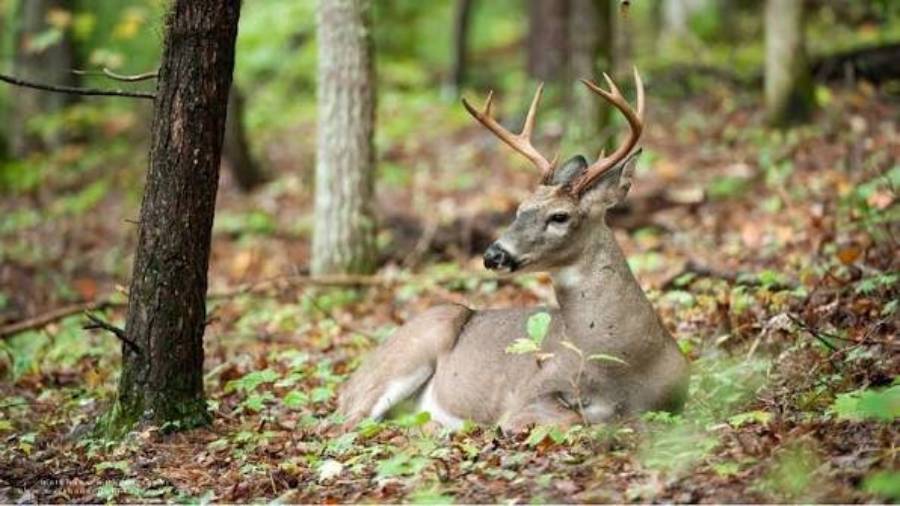
Yes, deer bed on ridge tops, but they do not use every ridge top as a bedding area. Deer select specific locations on and around ridges where terrain, cover, wind, visibility, and escape routes provide security. A deer may bed directly along a ridge top, slightly below the crest, on the upper third of a slope, on a ridge point, or on a bench below the main ridge. The exact position changes with terrain structure and surrounding habitat.
Ridges are useful bedding terrain because elevation can give deer multiple advantages at the same location. Wind moving across a ridge can help deer detect scent from one direction, while their eyes and ears monitor approaching danger from others. Thick vegetation can provide visual concealment, and steep slopes or multiple downhill routes can give a bedded deer fast escape options. Wind and thermal currents also influence which side and elevation of a ridge deer use at different times.
For hunters, finding a ridge is therefore only the starting point. The more important task is identifying where deer actually bed within the ridge system and why they select that location. Understanding ridge points, upper slopes, benches, cover, wind, deer sign, seasonal changes, and hunting pressure makes it easier to distinguish a likely bedding area from terrain deer simply travel through.
Do Deer Bed on Ridge Tops?
Yes, deer bed on ridge tops when the terrain provides enough security, cover, favorable wind, and practical escape routes. A ridge top gives deer an elevated position from which they can use several senses to detect approaching danger. However, finding a high point on a topographic map does not mean hunters have found a bedding area. Deer select specific micro-locations within a ridge system rather than treating the entire ridge top as suitable bedding habitat.
Cover is one factor that separates a productive ridge-top bedding area from an exposed ridge. A ridge covered by brush, young timber, tall grass, mountain laurel, or other dense vegetation gives a bedded deer visual concealment. In contrast, an open ridge with little screening cover may function primarily as a travel route. Hunters should therefore evaluate the vegetation surrounding the ridge together with elevation instead of assuming that the highest ground holds beds.
Terrain structure also determines whether deer bed directly on the crest or shift farther down the slope. A deer can use a subtle terrain change to increase security without moving far from the ridge top. For example, a bed positioned just below the crest can prevent the deer from being easily silhouetted while still allowing it to take advantage of wind moving across the ridge. A nearby steep slope can also provide an immediate escape route if the deer detects danger.
This means “ridge-top bedding” should not be interpreted as deer always lying on the highest contour line. A bedding area associated with a ridge can include beds directly on the crest as well as beds positioned slightly below it. For hunters, identifying these smaller terrain differences is more useful than simply marking an entire ridge as a bedding area.
Where Do Deer Bed on a Ridge?
Deer can bed in 4 primary locations around a ridge system: the ridge top, ridge points, the upper portion of the slope, and benches below the crest. The exact location depends on how each terrain feature interacts with cover, wind, visibility, and escape options. Two ridges with similar elevations can therefore produce very different bedding patterns.
A deer may bed directly on the ridge top where sufficient cover makes the location secure. This is especially worth checking where thick vegetation intersects the crest or where the top widens enough to create protected bedding cover. Hunters scouting these areas should look beyond obvious trails and search for flattened vegetation, depressions, hair, tracks, droppings, and other evidence that deer spend extended periods there rather than simply crossing the ridge.
Ridge points are another potential bedding location because they extend away from the main ridge and create several terrain transitions within a small area. A point can provide visibility toward lower terrain and multiple directions of escape. The end of the point is not automatically the best location. Deer may use the point itself, one side of it, or the transition where the point connects to the main ridge depending on cover and wind conditions.
Benches can also hold beds. A bench is a relatively flat section interrupting an otherwise steeper slope, giving deer a more practical place to rest without requiring them to move all the way to the ridge top. A bench with security cover can be especially important when the crest itself is open or exposed. Hunters who scout only the top of a ridge can therefore walk above bedding areas without realizing deer are using flatter terrain below them.
Do Deer Bed on the Upper Third of a Ridge?
Yes, deer can bed on the upper third of a ridge rather than directly on its crest. This position allows a deer to remain close to the elevation advantages of the ridge while using the slope and vegetation for additional concealment. The distinction matters because a hunter who searches only the ridge top may incorrectly conclude that the ridge contains no bedding.
The upper third should be treated as a terrain zone rather than an exact elevation formula. Hunters need to examine where the slope changes, where thick cover begins, and where points or benches interrupt the main contour. These terrain transitions create more specific bedding opportunities than elevation alone. A small flattening below the crest, for example, may offer a secure resting location even though it appears insignificant on a large-scale map.
Wind further influences which part of the upper slope deer select. The same bedding location will not provide identical scent information under every wind direction, so hunters should evaluate a suspected bed in relation to the surrounding terrain and prevailing wind rather than assuming deer consistently use one side of every ridge. This relationship between wind, thermals, and ridge position becomes particularly important when determining why deer choose one bedding location over another.
Why Do Deer Bed on Ridge Tops?
Deer bed on ridge tops primarily because these locations can provide 4 security advantages: scent detection, visibility, protective cover, and multiple escape routes. Elevation alone does not create a good bedding location. Deer favor portions of a ridge where several of these advantages overlap, which explains why beds can concentrate in one small section while apparently similar terrain nearby receives little bedding use.
Scent detection is one advantage of elevated terrain. Air movement around a ridge carries odors from surrounding areas, allowing a bedded deer to detect potential danger before seeing it. The effectiveness of this advantage depends on wind direction and terrain shape. A ridge point, crest, or upper slope can each interact differently with moving air, so deer bedding patterns should be evaluated at the level of individual terrain features rather than the ridge as a whole.
Visibility provides another layer of security where vegetation permits it. A deer does not need an unobstructed panoramic view to benefit from its bedding position. Openings through vegetation, changes in elevation, and downhill sightlines can allow a deer to monitor specific approach routes while remaining concealed. A location that combines useful sightlines with brush behind or around the bed can provide both detection and concealment.
Protective cover makes these terrain advantages more useful. Dense vegetation, young timber, brush, tall grass, and similar cover reduce the chance that a bedded deer will be visually detected. This explains why a thick section near a ridge crest may contain beds while an exposed section of the same ridge does not. Hunters should look for the intersection of favorable terrain and security cover rather than treating elevation as an independent bedding indicator.
Escape terrain is the fourth major advantage. Deer need a practical way to leave a bed when danger approaches. Ridge points, steep slopes, sidehills, and connected cover can offer several departure routes. A deer positioned near the upper portion of a slope, for example, may be able to move across the ridge, drop downhill, or follow cover along the contour. When scouting a bed, examining these potential escape directions helps explain why the animal selected that exact location.
How Do Wind and Thermals Affect Deer Bedding on Ridges?
Wind and thermal currents affect deer bedding on ridges by changing how scent moves across the terrain. Deer can use this air movement as part of their detection system, which makes wind exposure and terrain position important when evaluating a potential ridge bed. Hunters should therefore consider not only where a bed is located but also what scent information could reach that location.
Prevailing wind can make one side of a ridge more useful than another under a particular set of conditions. The leeward side is the side sheltered from the direct prevailing wind, and bedding discussions commonly focus on this area because airflow interacting with the ridge can create useful scent conditions around the upper slope. However, “deer always bed on the leeward side” is too absolute. Cover, terrain shape, current wind direction, pressure, and available escape routes still influence the final bedding position.
Thermals add another layer because air moves vertically as temperatures change. Thermals generally rise as slopes warm and fall as the ground and surrounding air cool. This movement can carry scent from lower elevations toward upper terrain or in the opposite direction as conditions change. On a ridge system, thermal movement interacts with prevailing wind rather than functioning separately from it.
This interaction matters to hunters because a wind indicator measured at an exposed ridge top may not describe exactly what scent is doing around a bed farther down the slope. Terrain can redirect airflow, while changing temperatures can alter thermal movement. A setup that appears safe based only on the forecasted wind direction can therefore send human scent toward bedding cover under actual terrain conditions.
For scouting, the practical approach is to evaluate the bed, slope, ridge crest, prevailing wind, and expected thermal movement as one system. A bed positioned below a crest or on a ridge point should be examined from the deer’s perspective: determine which approaches can be monitored through scent, which can be monitored visually, and which directions provide an immediate escape route. This provides a stronger explanation for bedding selection than simply labeling a location as a “wind bed.”
For hunting, the same principle determines whether a bedding area is realistically huntable. Knowing the location of a bed is only the first step. A hunter also needs an access route and setup that prevent human scent from entering the bedding area as wind and thermals change. This becomes especially important around mature buck bedding, where security and disturbance can strongly influence how a ridge is used.
Do Bucks and Does Bed in the Same Places on Ridges?
Bucks and does can bed within the same ridge system, but they do not necessarily select the same bedding locations. Both use terrain, cover, wind, and escape routes for security, but the amount of security required and the way deer use surrounding habitat can produce different bedding patterns. Hunters should therefore identify the type of bedding area they are scouting instead of assuming every concentration of deer beds represents mature buck bedding.
Doe bedding areas can contain multiple beds because does may use bedding cover with other deer. Suitable areas can occur on ridge tops, upper slopes, points, or benches where cover provides security and nearby terrain connects the bedding area with feeding and travel areas. Finding several beds close together can therefore indicate repeated group use rather than the preferred bed of one individual deer.
Buck bedding can be more isolated, particularly when security is a major factor. A buck may select a smaller terrain feature that combines cover, favorable air movement, and an efficient escape route. The difference can be subtle. One ridge may contain a larger bedding area used by does while a nearby point, upper slope, or patch of thick cover provides a separate bedding location for a buck.
Hunters should use more than bed size to determine which deer created a bed. Bed dimensions alone do not reliably prove that a mature buck uses the location. Tracks, rubs, nearby trails, repeated observations, trail-camera information where permitted, and the overall terrain context provide stronger evidence when considered together. A large depression without supporting sign should not automatically be classified as a mature buck bed.
Where Do Mature Bucks Bed on Ridges?
Mature bucks can bed on ridge points, upper slopes, ridge tops, and other secure locations where terrain and cover help them detect danger and leave quickly. The most important characteristic is not a single elevation or contour shape but the combination of security features available at the exact bedding location.
A ridge point is worth investigating because it can create several approach and escape directions around one compact terrain feature. An upper-slope bed may provide similar benefits while keeping the buck below an exposed crest. Thick cover can further reduce visual exposure. These features become more meaningful when their position also allows the deer to detect scent carried through the surrounding terrain.
Human access is another important part of the bedding equation. A seemingly ideal ridge can receive little daytime bedding use if hunters, hikers, vehicles, or other disturbances repeatedly pass through it. Conversely, a less obvious point or patch of cover may become valuable because people rarely enter it. For mature bucks, security from human disturbance can be as important as the visible shape of the terrain itself.
This is why mature buck bedding should be evaluated as a complete system: terrain position, cover, wind, escape routes, deer sign, and human pressure. Finding one favorable attribute identifies a place worth investigating. Finding several attributes together, supported by physical sign, provides stronger evidence of an established bedding location.
How Can You Find Deer Beds on Ridge Tops?
Find deer beds on ridge tops by combining topographic terrain analysis with physical deer sign found during ground scouting. Maps help narrow a large ridge system to specific locations, while field evidence confirms whether deer actually bed there. Neither method is as useful when applied alone.
Start by identifying terrain features rather than searching an entire ridge uniformly. On a topographic map, locate the ridge crest, points extending from the main ridge, changes in slope, benches, saddles, and upper-slope transitions. These features create a manageable group of locations to inspect. A ridge point with a small bench and dense cover, for example, deserves more attention than hundreds of yards of featureless open ridge.
Once on the ground, look for the physical shape of a deer bed. A deer bed is typically a flattened or compressed area where a deer has rested, and its appearance changes with the ground surface. Beds in grass or vegetation may leave an obvious flattened oval, while beds on leaves or bare forest floor can be considerably harder to recognize. Repeated use can make a location more apparent than a bed used only occasionally.
Next, look for supporting deer sign. Tracks can identify movement into and out of the area. Droppings can confirm deer presence. Trails can reveal how the bedding location connects with surrounding terrain. Rubs can add evidence of buck activity. Hair in or near a depression can further support identification. No single sign proves the complete bedding pattern, so the strongest interpretation comes from several pieces of evidence occurring around the same terrain feature.
The direction of nearby trails also matters. A bed should not be treated as an isolated spot on the ground. Determine where trails lead after leaving the bedding area and whether they connect with feeding areas, cover, saddles, benches, or other travel terrain. This helps distinguish a functional bedding area from a location where deer happened to rest temporarily.
Hunters should also examine the bed from the deer’s position. Sit or crouch near the location without unnecessarily disturbing the area and evaluate the surrounding terrain. Check what portions of the slope are visible, where thick cover blocks an approach, how many escape directions are available, and how wind moves around the location. The objective is to determine why a deer would choose that bed instead of another location 50 or 100 yards away.
A confirmed ridge bedding area is therefore built from multiple signals rather than one clue. Terrain identifies where to search; beds establish resting use; tracks, trails, droppings, rubs, or hair strengthen the identification; and wind, cover, visibility, and escape terrain explain why the location works. This process gives hunters a more reliable basis for planning around ridge bedding than simply marking the highest point on a map.
How Does Hunting Pressure Change Deer Bedding on Ridges?
Hunting pressure can change where and when deer use ridge bedding areas by making security from human activity a stronger factor in bedding selection. A ridge may contain suitable cover, favorable wind, and useful escape terrain but lose daytime bedding activity when hunters repeatedly enter the area. Deer can respond by shifting toward thicker cover, more difficult terrain, or less accessible portions of the same ridge system.
Human access is particularly important because disturbance does not have to occur directly at a bed. Repeated foot traffic along a ridge top, logging road, saddle, or common access trail can reduce the security value of nearby bedding cover. A deer using that area has several alternatives: move farther along the ridge, drop below the crest, use a more isolated point, or relocate to another bedding area. For hunters, this means a bed discovered during scouting does not guarantee the same level of use throughout hunting season.
Pressure can also make overlooked terrain more important. Hunters naturally concentrate on obvious ridge tops, saddles, field edges, established trails, and convenient access routes. Deer that experience repeated disturbance around these features can favor locations separated from predictable human movement. A thick upper slope or secondary ridge point may provide better security even when it appears less attractive on a topographic map.
Physical sign can help determine whether a bedding area remains active. Fresh tracks, droppings, recently used trails, fresh rubs, and beds showing repeated use provide more useful information than old sign alone. Hunters should distinguish between a location capable of holding deer and a location deer are currently using under existing pressure. The terrain may remain unchanged while deer behavior changes substantially.
Scouting pressure itself must also be considered. Walking directly through every suspected bed can provide information, but it can also leave scent and create disturbance in the exact location a hunter intends to hunt. Detailed ground scouting is often most useful when its timing minimizes interference with the upcoming hunt. Once an active bedding pattern has been identified, observation from a distance, maps, terrain knowledge, and carefully placed monitoring equipment where legal can reduce unnecessary intrusion.
For this reason, hunting pressure should be treated as a variable rather than a permanent terrain characteristic. A ridge that holds deer under low pressure may be used differently after repeated human intrusion. Hunters who continue evaluating fresh sign, access routes, and security cover are better positioned to recognize these shifts than hunters who rely only on bedding locations identified earlier in the year.
Read more: Do Deer Use Ravines as Travel Routes?
Does Deer Bedding on Ridges Change by Season?
Yes, deer bedding on ridges can change by season because cover, food availability, weather, breeding behavior, and hunting pressure change throughout the year. The ridge itself remains in place, but the value of individual bedding locations within that ridge system can increase or decrease as conditions change.
During the early season, vegetation can provide considerably more screening cover than it will later in the year. A ridge top, point, or upper slope surrounded by dense foliage may offer secure bedding during this period. Food availability also affects daily movement, so bedding locations should be considered in relation to the feeding areas deer are using at that time rather than evaluated only by elevation.
Temperature also influences how useful different bedding environments are. Shade, vegetation, slope orientation, and airflow can create different conditions within the same ridge system. Deer can select bedding locations that provide security while also responding to environmental conditions. Hunters scouting early-season bedding should therefore evaluate both terrain structure and the cover that actually exists during that period.
The rut changes the importance of movement, particularly for bucks. A mature buck’s bedding and daytime movement pattern can become less predictable during the breeding period because searching for receptive does increases movement. This does not make bedding areas irrelevant. Doe bedding areas can become especially useful pieces of the terrain puzzle because bucks may travel through or around locations where does spend time.
Hunters should not assume that every buck completely abandons established security cover during the rut. Bedding still serves a resting and security function, while the timing and frequency of use can change. A ridge system containing doe bedding, connecting travel terrain, and secure buck bedding can therefore remain important even when individual deer movement becomes less consistent.
Late-season conditions can shift bedding priorities again. Vegetation may provide less concealment after leaf drop, hunting pressure may have accumulated, and available food can become concentrated in fewer areas. Under these conditions, secure cover and efficient travel between bedding and feeding locations become important factors to evaluate. A bedding area that was difficult to see in early season may also become much easier for hunters to identify once vegetation has changed.
Weather can further modify these seasonal patterns. Wind, temperature, precipitation, and snow conditions can affect how deer use exposed versus protected portions of a ridge. Rather than applying one fixed rule such as “deer always bed on ridge tops in winter,” hunters should evaluate terrain, current cover, food, weather, and pressure together.
The practical result is that a ridge bedding map should not be treated as permanent. A bed found during spring scouting identifies a location deer have used, but it does not establish exactly how that location will function during every part of hunting season. Comparing historical sign with fresh sign and current habitat conditions gives hunters a stronger picture of which ridge bedding areas are active when they plan to hunt them.
How Should You Hunt Deer Bedding on a Ridge?
Hunt deer bedding on a ridge by positioning outside the bedding area, controlling your scent, using terrain to conceal your approach, and setting up along a likely travel route. Finding the bed itself does not determine where a hunter should sit. The hunting location needs to intercept deer movement while keeping the hunter’s scent, sound, and visible movement from reaching the bedding cover.
Start by identifying how the bedding area connects with surrounding terrain. Deer leaving a ridge bed may use a sidehill trail, ridge point, saddle, bench, or another terrain feature as they move toward feeding or staging areas. Tracks and established trails can help identify these connections. A setup positioned along predictable movement gives a hunter an opportunity to encounter deer without entering the center of the bedding area.
The safest setup is not automatically the location closest to the bed. Moving closer can increase the chance of encountering a deer during legal shooting hours, but it also reduces the margin for error. A wind shift, noisy approach, or unexpected thermal can alert a bedded deer before the hunter reaches the setup. The correct distance therefore depends on terrain, cover, wind stability, access, and the deer’s expected movement.
Terrain can provide concealment during both access and the hunt. A ridge crest, slope, drainage, thick vegetation, or other terrain break can prevent deer from seeing a hunter approaching. The same terrain can also reduce the distance that sound travels directly toward a bedding location. Hunters should evaluate an access route from the deer’s position rather than choosing the shortest walking route from a road or parking area.
Timing should match the movement being targeted. When hunting an evening movement from bedding toward food, the hunter needs to reach the setup before deer begin leaving their beds. A setup along a travel route between the two areas can intercept that movement while avoiding unnecessary penetration into bedding cover. Morning strategies require additional caution because deer may already be traveling back toward their bedding areas while the hunter is approaching.
Wind remains a primary constraint throughout the hunt. A setup is compromised when human scent consistently enters the bedding area or crosses the route deer are expected to use before they reach the hunter. Forecasted wind direction provides a starting point, but terrain can alter airflow around ridge points, slopes, benches, and crests. Thermals can create additional scent movement as temperatures change.
This makes access, setup position, and wind direction parts of the same hunting decision. A stand with favorable wind while hunting provides little advantage if the hunter’s access route carries scent through the bedding area beforehand. Likewise, a concealed access route is insufficient if changing thermals later carry scent directly toward the bed.
How Should You Approach a Ridge Bedding Area Without Spooking Deer?
Approach a ridge bedding area from a route that keeps your scent and movement away from the bed and the travel routes deer are likely to use. The best route can be longer than the most direct route because avoiding detection is more important than minimizing walking distance.
Use terrain features to stay concealed whenever possible. Approaching behind a ridge crest can block a deer’s direct view, while traveling below a terrain break may provide similar visual separation. Thick vegetation can also conceal movement, although hunters must balance visual cover against the additional noise created by moving through dense brush.
Avoid walking through the bed or crossing the primary trails leading from it immediately before hunting. Doing so places ground scent and disturbance directly within the area where deer are expected to travel. When a ridge offers several access options, favor the route that approaches from terrain deer are least likely to monitor or use under the current conditions.
Wind should be checked throughout the approach rather than only at the final setup. A favorable wind at the stand does not guarantee a safe entry route. A hunter may approach from a direction that sends scent across the ridge and into bedding cover before reaching a location where the wind becomes favorable. Evaluating scent movement along the entire route reduces this risk.
Thermals deserve the same attention on steep terrain. Rising or falling air can move scent vertically along a slope, creating problems that are not obvious from the general wind forecast. Checking actual air movement at several points during access provides more useful information than assuming the forecasted direction remains identical throughout the ridge system.
Finally, hunters should avoid treating every confirmed bed as a location that must be hunted aggressively. Some bedding areas are difficult to approach without alerting deer because of terrain, wind, limited cover, or the available access routes. In those situations, hunting a travel route farther from the bed can provide a better setup than forcing an approach into an area that cannot be entered cleanly.
The central principle is simple: finding a ridge bed tells you where deer rest, while understanding wind, terrain, access, and travel routes tells you whether that bed can be hunted effectively. A productive ridge-bedding strategy combines all 4 factors instead of using the bed location alone.