
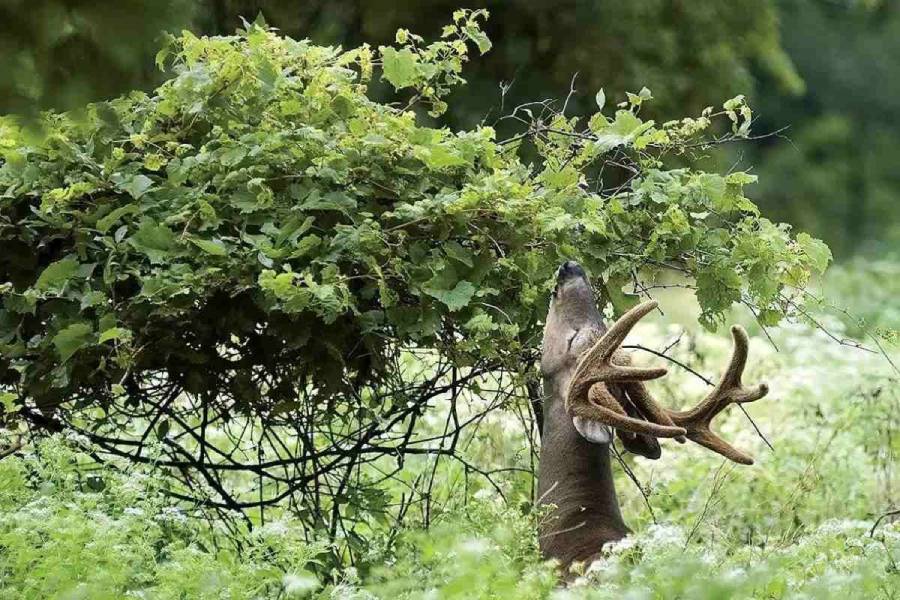
The best shrubs for whitetail deer provide browse, seasonal food, dense cover, or a combination of these three habitat benefits. American plum, elderberry, dogwood, hazelnut, blackberry, raspberry, serviceberry, and sumac are strong options because they can contribute food or woody structure to a whitetail property. The right species depends on whether the primary goal is increasing available browse, producing fruit or berries, creating security cover, or improving several habitat functions in the same planting.
Shrubs are valuable for whitetail habitat because they occupy the vegetation layer between low-growing forage and mature trees. Deer can browse accessible leaves, buds, shoots, and twigs, while fruit-producing species add seasonal food. Dense shrubs and thicket-forming species also create visual obstruction and woody structure that can improve bedding areas, field edges, transition zones, and travel corridors.
Choosing shrubs for hunting land therefore requires more than identifying plants that deer will eat. A useful shrub must match the property’s climate, soil, sunlight, and moisture conditions while tolerating the level of browsing it will receive. This guide compares the best shrubs for whitetail deer based on food, browse, cover, growing requirements, and their practical role in whitetail habitat management.
What Are the Best Shrubs for Whitetail Deer?
The best shrubs for whitetail deer include American plum, elderberry, dogwood, hazelnut, blackberry, raspberry, serviceberry, and sumac. These shrubs serve different purposes in deer habitat. Some primarily provide browse or seasonal fruit, while others form dense woody growth that contributes cover. For hunting properties, the strongest planting strategy is usually to select multiple species rather than expect one shrub to provide food and cover throughout the entire year.
| Shrub | Main Deer Value | Food Type | Cover Value | Best Use |
|---|---|---|---|---|
| American plum | Food + cover | Fruit, browse | High | Edges and thickets |
| Elderberry | Food + browse | Berries, foliage | Medium | Habitat plantings and edges |
| Dogwood | Browse + cover | Leaves, twigs, buds | High | Cover and transition areas |
| Hazelnut | Food + browse | Nuts, foliage | Medium | Woodland and field edges |
| Blackberry | Food + cover | Berries, foliage | High | Thickets and disturbed edges |
| Raspberry | Food + browse | Berries, foliage | Medium | Openings and edges |
| Serviceberry | Food + browse | Fruit, foliage | Medium | Habitat diversity |
| Sumac | Browse + cover | Foliage, fruit | High | Thickets and open edges |
American plum is particularly useful when the objective is to combine seasonal food with dense woody structure. It can form thickets rather than remaining an isolated individual plant, giving the planting greater habitat value than fruit production alone. Whitetails can use the vegetation as browse and consume the fruit, while established plum thickets add horizontal and vertical structure along field edges, woodland openings, and other transitional habitat. For a hunting property where both food and cover are priorities, this combination makes American plum a versatile option.
Elderberry provides two distinct food sources: vegetative growth and berries. Deer can browse its foliage and young growth, while mature plants produce fruit that adds another seasonal food source. Elderberry’s value is therefore broader than that of a shrub planted solely for fruit production. Its growth also adds vegetation at deer height, making it useful for diversifying edges and habitat plantings where the existing vegetation lacks a productive shrub layer.
Dogwood is valuable primarily as a browse and cover shrub. Depending on the dogwood species and region, whitetails can use accessible leaves, buds, and young woody growth. Its branching structure also increases woody density close to ground level. This combination makes dogwood more useful in areas where the management objective includes improving cover or browse availability rather than simply producing a concentrated fruit crop.
Hazelnut combines woody browse with nut production and works particularly well as part of diverse woodland-edge or field-edge habitat. Deer can browse accessible foliage and shoots, while the plant’s nuts provide seasonal food for wildlife. Hazelnut should not be evaluated only by the amount of food it produces for deer, because its greater habitat value comes from adding another food-producing woody species to a diverse planting. Mixing it with fruiting and thicket-forming shrubs creates more varied structure and food availability than planting hazelnut alone.
Blackberry and raspberry provide berries, tender vegetation, and low, dense structure. Blackberry is especially capable of creating thick patches where growing conditions and disturbance favor its spread. These patches can simultaneously provide browse and visual obstruction near ground level. The berries add seasonal food, but the long-term value of brambles on hunting land also comes from the dense vegetation they establish in openings, field margins, logging areas, and other early-successional habitat.
Serviceberry provides fruit and browse while increasing plant diversity within a deer habitat planting. Its fruit gives whitetails and other wildlife a seasonal food source, while accessible foliage can contribute browse. Serviceberry is most useful as one component of a mixed planting rather than as the sole shrub species across a property. Combining it with shrubs that form denser thickets can provide both food diversity and stronger cover.
Sumac is useful where the objective is to establish patches of woody browse and dense early-successional vegetation. Deer can browse its accessible vegetation, and established colonies can create substantial structure in open or disturbed areas. Its clustered growth also makes sumac relevant to cover management because a patch provides a different habitat function from scattered individual shrubs. This makes it particularly useful when converting open areas into more structurally diverse whitetail habitat.
The best shrub mix depends on the habitat function that is missing from the property. American plum, blackberry, and sumac are strong candidates when dense structure is a priority, while elderberry, serviceberry, hazelnut, and other food-producing shrubs can increase the diversity of seasonal forage. Combining shrubs with complementary functions creates a planting that provides more consistent value than selecting every species for the same purpose.
What Makes a Shrub Good for Whitetail Deer?
A good shrub for whitetail deer provides five primary attributes: usable browse, seasonal food, protective structure, extended seasonal value, and the ability to establish under local growing and browsing conditions. The importance of each attribute changes with the management objective. A shrub intended for a bedding-cover project needs different characteristics from one planted primarily to increase food availability.
Browse value depends on whether deer can reach and consume nutritious parts of the plant, including leaves, tender shoots, buds, and young twigs. Accessibility matters because food above the normal browsing zone contributes less direct forage to whitetails. Shrubs naturally place a substantial portion of their vegetative growth within browsing height, which is one reason a productive shrub layer can be important in deer habitat.
Seasonal food production adds another layer of value. Shrubs that produce berries, fruit, or nuts can provide food beyond their vegetative browse, but the timing and duration of production differ among species. A diverse planting can therefore distribute food availability across a longer period instead of producing one short pulse. For example, combining browse-oriented shrubs with fruit-producing shrubs gives deer access to different food types as conditions and seasonal diets change.
Cover value comes primarily from stem density, branching pattern, mature height, spreading behavior, and the ability to form patches or thickets. Dense shrubs can create visual obstruction and woody structure that an isolated fruit tree cannot provide. On hunting land, this structure is relevant around bedding cover, field edges, transition zones, travel corridors, and locations where managers want to reduce large areas of open, exposed ground.
A shrub must also survive long enough to deliver those benefits. Heavy browsing can damage young plants before their root systems and stems become established. Site compatibility is equally important: a species suited to moist soil and partial shade should not be expected to perform identically on a dry, exposed slope. The best shrub is therefore not simply the species whitetails prefer to eat. It is a species that deer use and that can successfully grow, regenerate, and perform its intended habitat function on the specific hunting property.
Which Shrubs Are Best for Feeding Whitetail Deer?
Elderberry, American plum, blackberry, raspberry, serviceberry, hazelnut, dogwood, and sumac are useful food-producing shrubs for whitetail deer because they provide browse, fruit, berries, nuts, or a combination of these food sources. Their value is not identical throughout the year. Browse-oriented shrubs provide accessible leaves, shoots, buds, and twigs, while fruiting shrubs create concentrated seasonal food when their crops become available.
A diverse shrub planting provides more consistent forage than a planting dominated by one food type. Whitetail diets change with seasonal food availability, so a property containing browse, soft fruit, berries, and other natural forage gives deer more feeding options. For example, elderberry and brambles contribute both foliage and berries, while dogwood and sumac add woody browse and American plum adds fruit alongside browse. This diversity is especially useful along habitat edges where deer can move between woody cover and feeding areas without crossing large expanses of open ground.
Food production alone should not determine which shrubs to plant. A shrub that produces desirable fruit but performs poorly in the property’s soil, light, or moisture conditions may contribute less forage than a well-adapted browse species. Managers should therefore evaluate both what the shrub provides to deer and whether the shrub can reliably produce that food at the planting site.
Which Shrubs Provide the Best Browse for Deer?
Dogwood, elderberry, sumac, American plum, hazelnut, blackberry, and raspberry can contribute browse within reach of whitetail deer. Browse consists of woody and semi-woody plant material such as leaves, buds, shoots, and tender twigs. Shrubs are particularly relevant because much of this new growth develops within the vertical zone deer can reach while feeding.
Dogwood and sumac are useful when the management objective includes increasing woody browse rather than relying entirely on fruit production. Their accessible vegetative growth gives deer another natural forage source while the plants add structure to the habitat. American plum and hazelnut can serve a similar dual role because they provide browse while also producing seasonal food. This makes mixed shrub communities more useful than a planting designed around fruit production alone.
Elderberry and brambles such as blackberry and raspberry add a different browse structure. Deer can use tender foliage and young growth, while the same plants later produce berries. Brambles can also respond to disturbance by developing dense new vegetation. On properties containing mature woodland with limited vegetation at deer height, maintaining suitable openings and edges where these shrubs can grow can increase the amount of accessible browse.
Browse pressure must be considered during establishment. The fact that deer readily browse a shrub can become a disadvantage when young plants are unable to replace the vegetation being removed. Newly planted shrubs have smaller root systems and fewer stems than established plants, so repeated browsing can delay growth or prevent establishment. Temporary protection may therefore be necessary even when the ultimate purpose of the planting is to provide deer forage.
Which Shrubs Produce the Best Fruit or Berries for Deer?
American plum, elderberry, blackberry, raspberry, serviceberry, and hazelnut add seasonal food production to a whitetail habitat planting. American plum produces fruit, elderberry produces clusters of berries, blackberry and raspberry produce soft berries, serviceberry produces fruit, and hazelnut produces nuts. These food sources complement the foliage, shoots, and woody browse available from the shrubs themselves.
American plum is especially useful where managers want food production and dense woody structure from the same planting. Once established under suitable conditions, multiple plants can develop into a thicket rather than remaining isolated stems. Deer can use the vegetation as browse and consume available fruit, while the thicket continues to provide habitat structure after the fruiting period ends. This gives American plum a broader function than a plant valued only for its crop.
Elderberry, blackberry, raspberry, and serviceberry contribute soft fruit, but their habitat value extends beyond the berries. Deer can use accessible vegetative portions of these plants, and dense patches of brambles can add low cover. Fruit production is seasonal, whereas the physical structure of an established shrub remains after the fruit has been consumed. Managers should therefore evaluate these plants according to their full annual habitat function rather than the size of a single fruit crop.
Hazelnut provides another type of seasonal food through nut production while contributing foliage and woody structure. Its value increases when it is incorporated into a mixed planting with species that produce different foods at different times. The objective is not to find one shrub that feeds deer during every season, but to establish complementary shrubs that collectively increase the diversity and duration of natural food availability.
Which Shrubs Provide the Best Cover for Whitetail Deer?
American plum, blackberry, sumac, dogwood, and other densely growing shrubs are among the strongest choices when cover is the primary habitat objective. Effective deer cover depends less on whether a plant produces fruit and more on whether its stems, branches, and foliage create enough horizontal and vertical structure to reduce visibility and make an area feel less exposed.
American plum can provide strong cover because it can develop into dense thickets under suitable conditions. A thicket creates substantially more habitat structure than scattered individual shrubs. This structure is useful along woodland openings, field margins, and transition zones where an abrupt boundary between open ground and mature timber would otherwise provide little intermediate cover. Adding shrubs creates a layered edge between those habitat types.
Blackberry can perform a similar function closer to ground level. Dense bramble patches create visual obstruction while also supplying foliage and seasonal berries. This combination is particularly relevant in early-successional areas, including disturbed openings and edges where sunlight reaches the ground. Rather than viewing blackberry solely as a food plant, hunting-property managers can treat established patches as both a forage source and a structural component of cover.
Sumac can form colonies that add woody density to open areas, while dogwood contributes branching structure and browse within the shrub layer. These species are useful where the property lacks vegetation between ground-level plants and the tree canopy. A diverse shrub layer fills that structural gap, providing deer with cover while keeping browse within reach.
Cover should also be evaluated according to its intended function. Bedding cover requires enough density and visual obstruction to make an area secure, while screening cover is used to reduce sight lines between deer and exposed areas such as access routes. Edge cover creates a gradual transition between habitat types, and travel-cover plantings can increase vegetation along existing movement routes. The same shrub can contribute to several of these functions, but its effectiveness depends on planting density, mature form, surrounding vegetation, and location.
Shrubs are therefore most effective when managers plant or encourage them as functional patches rather than isolated landscaping specimens. A single American plum or dogwood may provide browse, but a mixed patch of thicket-forming and food-producing shrubs can simultaneously increase woody structure, seasonal forage, and visual cover. On a hunting property, that combination produces greater habitat value because it addresses both the nutritional and security requirements that influence how whitetails use an area.
Should You Plant Native Shrubs for Whitetail Deer?
Native shrubs are generally the strongest starting point for whitetail habitat plantings because they can provide food and cover while fitting the ecological conditions of the region. Native status alone, however, does not make a shrub suitable for every hunting property. The species must still match the site’s climate, soil, moisture, sunlight, available space, and specific habitat objective.
The main advantage of native shrubs is their role within an existing plant community. A native species adapted to the region can be incorporated into woodland edges, old fields, openings, and transition zones without treating the property like a conventional landscaping project. For whitetail management, the objective is to establish functional vegetation that contributes browse, seasonal food, or woody structure over the long term.
Plant selection should therefore begin with habitat function and regional suitability. For example, a manager trying to increase security cover should prioritize native shrubs capable of producing dense growth at that specific site. A manager with adequate cover but limited natural food can prioritize shrubs that add browse, berries, fruit, or nuts. When both resources are limited, mixing species with different functions creates greater habitat diversity than planting a single shrub across the entire area.
Managers should also distinguish between plants deer use and plants that are appropriate to establish intentionally. Whitetails may browse or use cover created by a plant without that plant being desirable for habitat management. An invasive shrub can provide temporary food or concealment while spreading aggressively and displacing other vegetation. Deer utilization alone is therefore not sufficient justification for planting a species.
A practical approach is to identify shrubs native to the property’s region first and then compare their habitat functions. Select species according to the site’s conditions and the resource that is currently missing, whether that is browse, seasonal food, bedding structure, edge cover, or screening. This keeps shrub selection aligned with whitetail management rather than simply choosing plants because deer have been observed eating them.
How Do You Choose Deer Shrubs for Your Property?
Choose deer shrubs by matching each species to five property conditions: climate, soil, moisture, sunlight, and available growing space. After those requirements are satisfied, compare the species according to the habitat function it needs to perform. A highly attractive shrub planted on an unsuitable site will provide less long-term value than a well-adapted species capable of establishing, spreading, and producing usable food or cover.
Climate is the first constraint because shrubs differ in their tolerance of winter cold, summer heat, and the length of the growing season. USDA hardiness zones provide a useful initial filter for cold tolerance, but they should not be treated as a complete planting prescription. Two properties within the same hardiness zone can still differ substantially in rainfall, soil drainage, exposure, elevation, and local growing conditions.
Soil and moisture further narrow the selection. Some planting sites remain moist for extended periods, while exposed slopes and upland edges may drain rapidly. Match the shrub to the existing conditions rather than repeatedly trying to change a large wildlife planting site to accommodate the shrub. This is particularly important for hunting properties where plantings may cover significantly more ground than a residential landscape and receive less intensive maintenance.
Sunlight determines both where a shrub can survive and how strongly it can perform. Open field edges, logging areas, utility corridors, woodland openings, and mature forest understories receive different amounts of light. A shrub suited to an open, sunny edge should not automatically be expected to produce the same density or food crop beneath a closed tree canopy.
Available space also matters because mature shrubs occupy more area than young nursery plants suggest. Species capable of spreading into colonies or thickets need enough room to perform that function without interfering with roads, trails, stand access, or other management areas. Conversely, planting a thicket-forming species where dense cover is actually desired can turn its spreading behavior into a habitat advantage.
Which Deer Shrubs Grow Best in Your Climate and Soil?
The best deer shrub for a specific climate and soil is a locally suitable species whose hardiness, moisture requirements, and soil tolerance match the planting site. There is no single shrub that performs best across every whitetail range because growing conditions differ substantially between regions and even between locations on the same property.
Start with regional suitability, then evaluate individual planting sites. A low area with greater soil moisture should be treated differently from a dry ridge, exposed field edge, or well-drained woodland opening. The goal is to narrow the candidate list before planting rather than select a preferred deer shrub first and attempt to force it into unsuitable conditions.
Soil drainage deserves particular attention because water availability affects establishment and root health. Observe whether water remains after heavy rain, whether the site dries quickly, and what vegetation already grows successfully nearby. Existing plant communities can provide useful evidence about site conditions before money and labor are committed to a larger shrub planting.
Local suitability also affects how much maintenance the planting requires. A shrub that naturally fits the site is more useful for long-term deer management than a species that requires continuous intervention merely to survive. Once several suitable species have been identified, managers can make the final selection according to browse value, fruit production, cover density, and the season in which the property needs additional habitat resources.
Which Deer Shrubs Grow Best in Sun or Shade?
Sun-loving shrubs belong primarily in open edges, fields, clearings, and other high-light locations, while shade-tolerant shrubs are better candidates for woodland edges and sites receiving limited direct sunlight. Light availability affects vegetative growth, density, flowering, and fruit production, so it should be evaluated before the final planting location is selected.
Open areas are especially useful when the management goal is dense shrub growth. Adequate sunlight can support vigorous lateral growth and help suitable species develop into patches or thickets. Field edges and woodland openings also allow managers to create a gradual transition from low vegetation to shrubs and then mature trees rather than maintaining an abrupt boundary between open ground and timber.
Partial shade can support a different shrub community and may be useful along woodland margins where direct sunlight reaches the ground for only part of the day. These transition areas can combine woody browse with cover while connecting feeding and forest habitat. Species selection should reflect the actual light level instead of assuming that every location classified as an “edge” receives equivalent sunlight.
Dense shade beneath a closed canopy is more restrictive. If insufficient light reaches the shrub layer, simply planting additional shrubs may not produce the desired food or cover. In those situations, the limiting factor is the habitat structure itself rather than the number of shrubs planted. The correct planting location is therefore where the selected species can grow strongly enough to perform its intended function for deer.
Where Should You Plant Shrubs on a Whitetail Hunting Property?
Plant deer shrubs where food, cover, and deer movement already intersect or where one of those habitat components is clearly missing. High-value locations include food plot edges, woodland edges, transitions near bedding cover, existing travel corridors, openings, and selected screening areas. Placement should improve the function of the property rather than distribute shrubs evenly across available acreage.
Food plot edges are useful because shrubs can create a transition between concentrated forage and surrounding woody habitat. Instead of moving directly from mature timber into an exposed plot, deer encounter an intermediate vegetation layer that can provide browse and visual cover. Fruit-producing or browse-oriented shrubs can also add natural food immediately adjacent to the planted forage.
Woodland edges benefit from the same structural principle. An abrupt edge has limited vertical diversity, while a developed edge can contain grasses and forbs at ground level, shrubs in the middle layer, and trees behind them. Shrubs such as American plum, dogwood, elderberry, sumac, hazelnut, or brambles can occupy portions of this middle layer when each species matches the site.
Shrubs can also improve transitions around bedding habitat. The objective is not simply to plant shrubs directly inside every bedding area. Instead, managers can use dense woody vegetation to increase security and create gradual transitions between bedding cover, travel habitat, and feeding areas. Placement should account for existing deer use so that habitat work supports rather than unnecessarily disrupts functional cover.
Existing travel corridors are another potential planting location. Adding shrubs along suitable portions of a corridor can increase visual obstruction and provide browse as deer move between habitat components. The planting should reinforce logical movement through the property rather than attempt to force deer through a route that conflicts with terrain, cover, or existing habitat patterns.
Shrubs can also contribute to hunter-access screening. Dense vegetation positioned between access routes and areas used by deer can reduce direct sight lines once the planting reaches sufficient height and density. Screening is different from simply attracting deer, however. The purpose is to improve concealment and property layout, so species should be selected primarily for dependable structure and site suitability.
The most effective shrub placement connects habitat functions rather than treating each planting as an isolated feature. A mixed shrub edge beside a food plot, for example, can provide browse, seasonal fruit, structural cover, and a transition into adjacent timber. That planting has greater functional value than the same shrubs scattered randomly across the property because its location allows several habitat benefits to operate together.
When Is the Best Time to Plant Shrubs for Whitetail Deer?
The best time to plant shrubs for whitetail deer is generally during spring or fall, when moderate temperatures and available soil moisture can support root establishment without the stress of peak summer heat. The better season depends on the shrub species, local climate, soil conditions, and whether the plants are bare-root, container-grown, or dormant at planting.
Spring planting gives shrubs an entire growing season to develop roots before their first winter. It is particularly useful in regions where severe winter conditions make fall establishment less predictable. Planting should occur after the soil becomes workable but early enough that roots can establish before hot, dry summer conditions increase water stress. Newly planted shrubs may require supplemental watering when natural rainfall is insufficient.
Fall planting allows roots to begin establishing while above-ground growth slows. Cooler temperatures reduce moisture loss, and suitable soil can remain warm enough for root activity after shoot growth declines. Fall planting can work well where shrubs have enough time to establish before the ground freezes, but late planting in colder regions leaves less time for root development.
The planting date should therefore follow local growing conditions rather than a single calendar month. A hunting property in the northern whitetail range faces different temperature and dormancy conditions from one farther south. Choose the planting window that provides adequate soil moisture, workable ground, and the longest practical establishment period before severe heat, drought, or freezing conditions arrive.
Planting is also different from establishment. A shrub may survive its first growing season without yet providing meaningful browse, fruit, or cover. Fruit production can require additional growth and maturity, while dense screening or bedding structure develops only after shrubs produce sufficient stems and lateral growth. Habitat managers should evaluate shrub projects over multiple growing seasons rather than expect the full habitat benefit immediately after planting.
Read more: 5 Best Native Grasses for Deer Bedding Cover
How Do You Protect New Shrubs From Whitetail Deer?
Protect newly planted deer shrubs when browsing pressure is strong enough to prevent establishment, using cages, suitable guards, or other physical barriers that keep deer from repeatedly removing new growth. Protection appears contradictory when the shrubs are intentionally planted for deer, but young plants need enough stems, leaves, and root reserves to survive before they can tolerate regular browsing.
Browsing pressure is most damaging when deer repeatedly remove terminal buds and young shoots from a small plant. This reduces the photosynthetic tissue available for growth and can prevent the shrub from gaining height or developing additional stems. A mature shrub with an established root system can recover from browsing more effectively than a recently planted shrub with limited stored energy.
Wire cages can protect the entire young shrub while allowing sunlight and air movement around the plant. The cage needs enough distance from the stems to prevent deer from reaching the majority of new growth through the openings. Guards and tubes can be appropriate for certain woody plants, but the protection method should match the growth form of the species. A shrub expected to branch and spread near ground level has different requirements from a single-stem tree.
Protection is especially important when establishing small numbers of highly attractive plants in areas with concentrated deer activity. A new planting can become an obvious food source before the shrubs have developed enough biomass to tolerate browsing. Protecting the plants during this vulnerable period allows roots and woody stems to develop first, increasing the probability that the planting will eventually become a renewable browse source.
Weed competition should also be controlled around young shrubs. Grasses and other vegetation compete for moisture, nutrients, sunlight, and growing space, particularly during the first establishment period. Removing excessive competition around the root zone gives the planted shrub better access to the resources needed for growth. Protection from deer will accomplish little if the plant is simultaneously being suppressed by unsuitable site conditions or severe competition.
Remove or expand protection only after the shrub is established enough to withstand the expected level of browsing. There is no universal number of months or years because establishment speed differs by species, plant size, site quality, weather, and deer density. Evaluate root establishment, stem development, plant height, and evidence of browsing before exposing the entire shrub.
The long-term objective is not to keep deer away from the planting permanently. Protection serves as a temporary establishment tool. Once shrubs can regenerate after normal browsing, deer can begin using the vegetation as intended while the plants continue developing food and cover.
Are Shrubs Better Than Food Plots for Whitetail Deer?
Shrubs are not inherently better than food plots for whitetail deer because the two habitat features perform different functions. Food plots primarily create concentrated areas of forage, while shrubs can provide perennial browse, seasonal fruit, woody structure, visual screening, and cover. A hunting property can benefit from both when each is placed according to a specific habitat objective.
Food plots concentrate desirable forage within a defined area. Managers can select the crop, determine the plot size, and manage planting according to seasonal objectives. This makes food plots useful for increasing available forage, but their habitat function remains strongly centered on feeding. Their productivity also depends on factors such as soil preparation, planting success, weather, competition, and ongoing management.
Shrubs operate differently because established woody plants remain part of the habitat from year to year. Deer may browse their leaves, shoots, buds, and twigs, while fruiting species can provide berries, fruit, or nuts during specific seasons. Dense shrubs also retain structural value when they are not producing food. An American plum thicket, for example, can continue providing woody cover after its fruit is gone.
This difference makes shrubs especially valuable in transition zones. Planting or encouraging shrubs between a food plot and mature timber can add browse and visual cover between two distinct habitat types. The result is not simply another food source; it is a more gradual structural transition from low-growing forage through woody shrubs into taller forest vegetation.
Shrubs can also perform functions that food plots cannot efficiently replace. Dense woody vegetation can help develop screening cover, improve selected travel corridors, add structure near bedding habitat, and increase horizontal cover in otherwise open areas. Conversely, shrubs do not provide the same concentrated, manageable forage production that a well-designed food plot can provide.
The stronger whitetail habitat strategy is to use shrubs and food plots as complementary tools rather than substitutes. Food plots can supply concentrated forage, while shrub communities provide perennial browse, seasonal foods, and structural habitat. Connecting these resources with suitable bedding cover, woodland edges, and travel habitat creates a property where food and security are distributed across multiple vegetation layers.
For hunting-land managers, this functional approach also provides a better method for deciding where to invest time and money. A property already containing abundant natural browse and dense woody cover but lacking quality forage may benefit more from additional food plots. A property dominated by open fields and mature timber with little intermediate vegetation may gain more immediate habitat diversity from shrub establishment and early-successional cover.
The best shrubs for whitetail deer should ultimately be selected according to the resource the property lacks. Use American plum, blackberry, sumac, and other dense-growing species when additional woody structure is needed; incorporate elderberry, serviceberry, hazelnut, brambles, and other suitable food-producing shrubs when increasing natural forage diversity is the priority. Match every species to local growing conditions and combine complementary plants where both food and cover need improvement.