
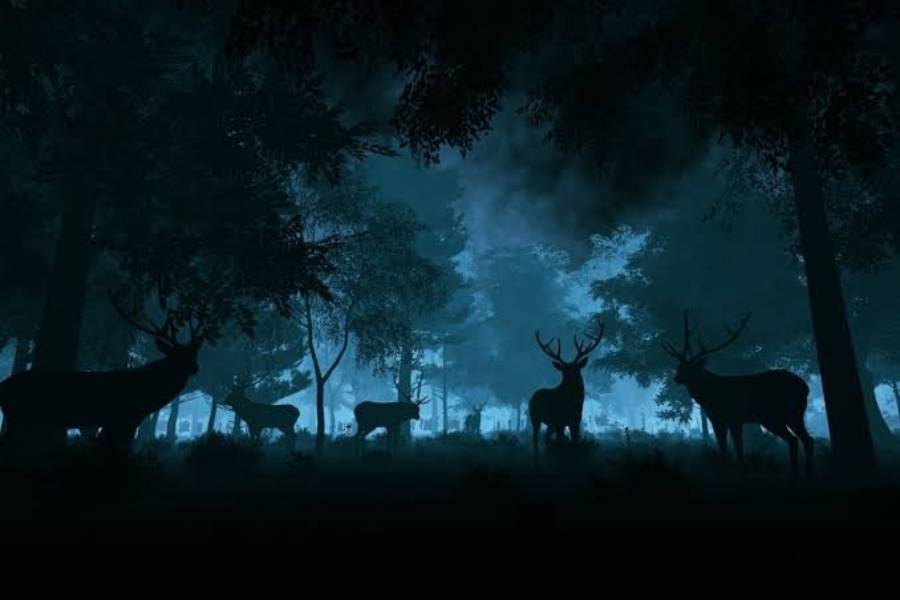
Deer cannot see in complete darkness because their eyes still need light to create a visual image. However, deer can see much better than humans in low-light conditions, which is why they can navigate and detect movement effectively around dawn, dusk, and during many nighttime conditions.
The key distinction is between complete darkness and low light. Complete darkness means there is no usable light available for the eyes to detect. Most outdoor environments at night are not completely dark. Moonlight, starlight, distant artificial light, and other ambient light can provide enough illumination for a deer’s highly light-sensitive eyes. Deer have several adaptations that support this ability, including a retina suited to low-light vision and a reflective structure called the tapetum lucidum that gives incoming light another opportunity to stimulate the retina.
For hunters, this difference matters. A hunter who can barely make out objects in the surrounding terrain should not assume that a deer has the same visual limitation. Deer can use available light to detect movement and contrast under conditions that appear extremely dark to human eyes. Their ability to combine visual information with hearing and smell also means darkness alone does not prevent them from detecting a hunter.
Can Deer See in Complete Darkness?
Deer cannot see in complete darkness because vision requires light to reach the retina. Their eyes are highly adapted for low-light conditions, but those adaptations cannot create an image when no usable light is present. In true darkness, where there are no photons available for the eye to detect, a deer cannot rely on vision to identify trees, terrain, other deer, or a hunter.
Complete darkness is different from what hunters normally describe as a dark night. An outdoor environment can look nearly black to human eyes while still containing small amounts of ambient light. Moonlight, starlight, skyglow, and distant artificial light can illuminate objects even when a hunter struggles to distinguish them. A deer can take greater advantage of this limited illumination because its visual system prioritizes light sensitivity.
This distinction explains why saying that deer “can see in the dark” is only partly accurate. Deer can see exceptionally well in very low light, not in the total absence of light. A windowless enclosed space with no light source represents complete darkness; a forest on a moonless night generally represents low-light conditions rather than guaranteed total darkness.
For hunters, the practical difference is significant. Darkness that severely limits human vision does not necessarily eliminate the visual cues available to deer. A moving hunter, a silhouette that contrasts with the background, or movement across an opening can still provide detectable visual information when sufficient ambient light remains.
How Well Can Deer See in Low-Light Conditions?
Deer can see effectively in low-light conditions because their eyes are adapted to collect and use limited available light. This gives them an advantage over humans around dawn, dusk, and at night when the environment still contains ambient illumination. Their advantage is particularly relevant during the transition periods when human vision becomes progressively less effective.
Deer do not need bright daylight to detect every useful visual cue. Night vision is not simply a question of whether an animal can resolve fine details. Detecting movement, changes in contrast, shapes, and silhouettes can provide useful information even when the visual scene lacks the clarity associated with daylight. For a prey animal, detecting that something has moved can be more immediately useful than identifying fine details on that object.
Moonlight can increase the amount of environmental light available to a deer. Light reflected from the moon illuminates vegetation, openings, terrain, and moving objects, giving the deer more visual information to process. The exact conditions vary with factors such as moon phase, cloud cover, vegetation, and terrain, so “nighttime” does not represent one fixed level of visibility.
A moonless night also should not be treated as complete darkness. Starlight, skyglow, artificial light, and other sources can remain present even when the moon contributes no illumination. Dense forest cover and heavy clouds can further reduce available light, but the biological limitation remains the same: as usable light approaches zero, vision becomes progressively less useful until no visual image can be formed.
This matters when approaching or leaving hunting areas in darkness. A hunter’s own visual experience is not an accurate measurement of what a deer can detect. Even when the hunter cannot clearly identify a deer without optics or artificial light, the deer may still have enough visual information to detect the hunter’s movement or contrast against the surrounding environment.
Why Can Deer See Better Than Humans at Night?
Deer see better than humans under low-light conditions because their eyes prioritize light sensitivity more strongly than fine visual detail. Several parts of the visual system contribute to this advantage, including light-sensitive retinal cells, the tapetum lucidum, and adaptations that allow the eye to make efficient use of limited illumination.
The advantage involves a trade-off. An eye optimized to gather and reuse limited light does not necessarily produce a sharper image in every situation. Deer vision is adapted to the survival requirements of a prey animal, where recognizing movement and detecting potential threats across a broad visual environment can be more valuable than resolving the fine detail that human vision handles well under brighter conditions.
How Do Rod Cells Help Deer See in Low Light?
Rod cells help deer see in low light by detecting small amounts of illumination more effectively than the cone cells responsible for color vision. Rods specialize in light sensitivity and therefore become especially important as illumination decreases.
This retinal adaptation supports useful vision during periods such as dawn and dusk and under nighttime illumination. Instead of requiring enough light to produce a detailed, color-rich scene, a rod-dominated visual system is well suited to extracting information about brightness, contrast, shapes, and movement from a darker environment.
For hunting, the important result is that reduced color and fine detail do not make a hunter visually undetectable. A moving shape can provide meaningful information even when a deer cannot perceive that object with the detail a human would associate with clear daylight vision.
How Does the Tapetum Lucidum Improve Deer Night Vision?
The tapetum lucidum improves deer night vision by reflecting light back through the retina, giving retinal photoreceptors another opportunity to respond to available light. This reflective layer is one of the principal reasons the eyes of deer and several other mammals appear to shine when illuminated at night.
Light normally enters the eye and reaches the retina, where photoreceptors respond to it. Light that passes through the retina without being absorbed can reach the tapetum lucidum and be reflected back toward the retinal cells. Reusing part of the incoming light improves sensitivity when illumination is limited.
This mechanism does not allow deer to see without light. The tapetum lucidum can only reflect light that has already entered the eye. Its advantage therefore becomes relevant in low light rather than true zero-light conditions, reinforcing the distinction between night vision and vision in complete darkness.
Other characteristics of the deer eye also contribute to nighttime performance. The eye is structured to collect available illumination efficiently, while the combination of retinal sensitivity and reflected light allows deer to obtain useful visual information under conditions that severely restrict human vision. Together, these adaptations explain why a hunter and a deer standing in the same dark environment do not necessarily experience the same degree of visual limitation.
Can Deer See Hunters in the Dark?
Deer can see hunters in the dark when enough ambient light remains to reveal movement, contrast, or a recognizable silhouette. They cannot visually detect a hunter in complete darkness, but most nighttime hunting environments contain some usable light. This gives deer an opportunity to detect visual changes that a hunter may struggle to notice with human vision.
Movement is one of the most important visual cues. A hunter does not need to appear as a sharp, detailed image for a deer to detect that something in its surroundings has changed position. Turning the body, raising equipment, moving an arm, or crossing an opening can create movement against a relatively stable background. The more distinct that movement is from the surrounding vegetation or terrain, the easier it becomes to detect when sufficient light is available.
Contrast and silhouette also affect visibility. A hunter positioned against an open sky or another lighter background can create a recognizable outline even when clothing colors and fine details are difficult to distinguish. A darker background, vegetation, and a hunting blind can reduce that contrast, but concealment does not eliminate the effect of movement. Openings in a blind can also expose movement inside when the hunter’s body contrasts with the opening.
The amount of available light changes how useful these visual cues are. Moonlight, starlight, skyglow, and artificial illumination can increase contrast between the hunter and the surrounding environment. Cloud cover, dense vegetation, terrain, and enclosed spaces can reduce it. As illumination decreases, deer receive less visual information, and they eventually lose the ability to see when no usable light remains.
Hunters therefore should not use their own eyesight as the standard for deer visibility. A hunter who sees only vague shapes may still produce enough movement or contrast for a deer’s low-light visual system to detect. Remaining visually concealed in low light depends on controlling movement and silhouette rather than assuming darkness provides complete concealment.
Can Deer See Better Than Hunters at Night?
Deer can see better than hunters in low-light conditions because their visual system is more sensitive to limited light, but this advantage does not mean deer have superior vision in every respect. Deer vision favors low-light sensitivity and environmental awareness, while human vision performs better at resolving fine detail under suitable lighting.
The difference becomes increasingly relevant as daylight fades. Human color and detail perception deteriorate as illumination decreases, while the low-light adaptations of deer allow them to continue extracting useful information from the environment. A deer may therefore detect that an object moved without seeing the same fine details that a human would identify during daylight.
Motion detection strengthens this practical advantage. For a deer, recognizing a change in the visual field can signal a potential threat before the animal needs to determine exactly what caused it. A hunter who shifts position can consequently reveal their presence even when their clothing, face, or equipment is not clearly distinguishable.
Humans retain an advantage in visual detail when enough light is present. A hunter in daylight may identify specific features at a level of detail that is less important to deer vision. At night, however, that advantage becomes less useful as available illumination declines. Deer are better adapted to continue using visual cues under those conditions.
The comparison also has a clear limit. Neither deer nor hunters can see naturally in complete darkness. The deer’s advantage exists while usable light remains. Once no light reaches the eyes, the biological mechanisms that improve low-light vision have no illumination to collect, amplify through sensitivity, or reflect through the tapetum lucidum.
For hunting purposes, “too dark for me to see clearly” and “too dark for a deer to see me” are therefore different conditions. Hunters should assume that movement and silhouette can remain detectable while ambient light is available rather than treating poor human visibility as evidence of complete visual concealment.
Does Artificial Light Affect What Deer Can See at Night?
Artificial light increases the amount of visual information available to deer at night, but how deer perceive that light depends on its brightness, wavelength, direction, and contrast with the surrounding darkness. A flashlight, headlamp, vehicle light, or other artificial source can illuminate objects that would otherwise be difficult for a deer to distinguish under low-light conditions.
A light source does not need to illuminate a deer directly to change what the animal can see. Light falling on a hunter, vegetation, a trail, or nearby terrain can increase contrast and make shapes or movement more noticeable. A moving hunter crossing an illuminated area, for example, creates a stronger visual change than the same movement against a uniformly dark background. This is important because deer vision is adapted to extracting useful information from limited illumination.
Artificial light can also create abrupt changes in the visual environment. Deer eyes adapted to darkness are operating under very different conditions from eyes exposed to a bright light source. The practical hunting implication is that using a light does more than help the hunter navigate; it changes the illumination available to the deer as well.
A flashlight should therefore not be treated as invisible simply because its beam is not aimed directly at a deer. The beam can illuminate surrounding objects, while the light source itself may provide a detectable visual stimulus. Whether a deer responds to that stimulus is a separate question from whether its eyes are capable of detecting it. Visual detection does not automatically predict a specific behavioral reaction.
Can Deer See Red or Green Light at Night?
Deer can detect red and green light, but they do not perceive these wavelengths in the same way humans do. Deer have dichromatic color vision, meaning their color perception differs from the trichromatic system of humans. This distinction matters when hunters evaluate colored hunting lights.
Color perception and light detection are not the same process. Reduced sensitivity to a particular portion of the visible spectrum does not mean that light within that range becomes completely invisible. Brightness, intensity, surrounding contrast, and movement of the light source can still provide visual information. A claim that deer perceive a particular color less effectively therefore should not be interpreted as evidence that hunters can use that color without being detected.
The same principle applies to equipment and clothing. The relevant question is not simply whether deer perceive an object as the same color a human sees. Its brightness, contrast with the background, movement, and the wavelengths reflected from its surface also affect how visually distinct it becomes.
For hunters, colored lights should therefore be viewed as tools that alter visibility rather than as a way to become visually undetectable. Red or green illumination can affect how a nighttime scene appears to a deer, but neither color changes the fundamental rule of deer night vision: deer need usable light to see, and adding artificial illumination introduces additional visual information into the environment.
What Colors Can Deer See at Night?
Deer can distinguish some colors at night, but their ability to use color decreases as available light becomes weaker. Deer have dichromatic vision, so their color perception differs from human trichromatic vision. Their visual system is particularly useful for detecting shorter wavelengths, while longer wavelengths such as red are perceived differently and with less sensitivity than they are by humans.
The distinction between color perception and object detection is important for hunters. A deer does not need to perceive the exact color of a jacket, backpack, bow, or other object to detect it. Brightness, contrast, outline, and movement can reveal the object even when its color is poorly distinguished. A hunter wearing a color that deer perceive less strongly can therefore remain visually detectable against a contrasting background.
Low-light conditions further change the importance of color. As illumination falls, vision becomes increasingly dependent on light-sensitive rod cells rather than the cone cells responsible for color discrimination. Movement, brightness differences, and silhouettes consequently become more useful visual information than precise color identification.
For hunting, clothing color should therefore be considered alongside movement and contrast rather than in isolation. A color that falls within a less-sensitive portion of deer vision does not make a hunter invisible. The complete visual scene—including available light and the relationship between the hunter and the background—determines how much visual information the deer receives.
How Far Can Deer See at Night?
There is no single fixed distance at which deer can see at night because visibility depends on available light, contrast, movement, terrain, vegetation, and the object being viewed. Giving one universal nighttime viewing distance would ignore the environmental conditions that determine whether useful visual information reaches a deer’s eyes.
Available light is one of the primary limitations. An open field under moonlight can provide substantially more visual information than dense woodland beneath heavy cloud cover. A deer looking across an open area may therefore have better conditions for detecting an object than a deer looking through layers of vegetation, even when the straight-line distance is shorter in the second situation.
The characteristics of the object also matter. Large silhouettes and moving objects provide different visual cues from small, stationary objects that blend into the background. For example, a hunter walking across an opening can create repeated changes in position and contrast, while a stationary hunter positioned against vegetation presents fewer obvious visual changes.
Distance should therefore not be treated as the only measure of whether a deer can see a hunter. A relatively distant moving silhouette can provide stronger visual cues than a closer stationary object with low contrast. As distance increases, however, fine visual information becomes harder to resolve, especially when illumination is poor.
For hunters, the useful question is consequently not “How many yards can a deer see at night?” but whether the hunting environment provides enough light, contrast, and movement for the deer to detect a visual change. These variables explain nighttime visibility more accurately than a universal yardage figure.
Read more: Do Deer Sleep With Their Eyes Open? Explained
What Matters More to Deer at Night: Sight, Smell, or Hearing?
Deer use sight, smell, and hearing together at night, so no single sense determines whether a hunter will be detected in every situation. Sight provides information about movement, contrast, and surrounding shapes; smell provides information carried by airborne scent; and hearing provides information from sounds in the environment.
Sight becomes dependent on available illumination. Deer have strong low-light vision, but their visual advantage still disappears in true complete darkness. As light decreases, visual information becomes progressively limited. A deer can compensate for that limitation by continuing to receive information through its other senses.
Smell does not require light. Human scent can therefore remain a detection cue whether the environment is bright, dim, or completely dark. Wind direction and air movement influence where scent travels, which means visual concealment alone does not remove this source of information.
Hearing is similarly independent of visible light. Footsteps, vegetation being disturbed, equipment contacting another object, or other unnatural sounds can reveal activity without providing the deer with a visual image of its source. A deer may consequently detect the presence of something unusual before it can visually identify what caused the sound.
For hunters, these sensory systems explain why darkness should not be treated as complete concealment. Reduced illumination primarily restricts the visual component of detection. It does not simultaneously eliminate the scent and sound cues produced by a person moving through deer habitat.
Does Complete Darkness Prevent Deer From Detecting Hunters?
Complete darkness prevents deer from visually seeing hunters, but it does not prevent them from detecting hunters through smell and hearing. Deer depend on available light for vision just as other sighted mammals do. When no usable light reaches the retina, adaptations such as rod cells and the tapetum lucidum cannot produce visual information. Darkness removes the visual cues a hunter creates, but it does not eliminate non-visual cues.
Scent remains available regardless of how dark the environment becomes. A hunter can be completely hidden visually while still producing human odor that moves through the surrounding air. Wind direction, air currents, and the hunter’s position relative to the deer determine whether that scent reaches the animal. Complete darkness therefore provides no equivalent protection against scent detection.
Sound creates another independent detection pathway. Footsteps, snapping vegetation, clothing movement, equipment noise, or contact with branches can provide information about activity nearby. A deer does not need to see the source of a sound to recognize that something has changed in its surroundings. This becomes especially relevant when visual information is severely restricted.
The three senses also provide different types of information. Vision helps deer detect movement, silhouettes, and contrast when light is available. Hearing can indicate the direction and nature of nearby activity, while smell can reveal the presence of a potential threat without requiring visual contact. Information from one sense can therefore reinforce information received through another.
For hunters, the practical distinction is straightforward: being impossible for a deer to see is not the same as being impossible for a deer to detect. In true complete darkness, visual concealment is effectively provided by the absence of light, but scent and noise can still reveal a hunter’s presence. Under ordinary nighttime conditions, the situation is even less forgiving because ambient light may allow the deer to use vision alongside smell and hearing.
This is why a dark forest should not automatically be treated as complete visual cover. Most outdoor nights contain some level of ambient illumination, and deer are adapted to use limited light more effectively than humans. When usable light is genuinely absent, hunters still need to account for the two detection channels that darkness does not remove: scent and sound.