
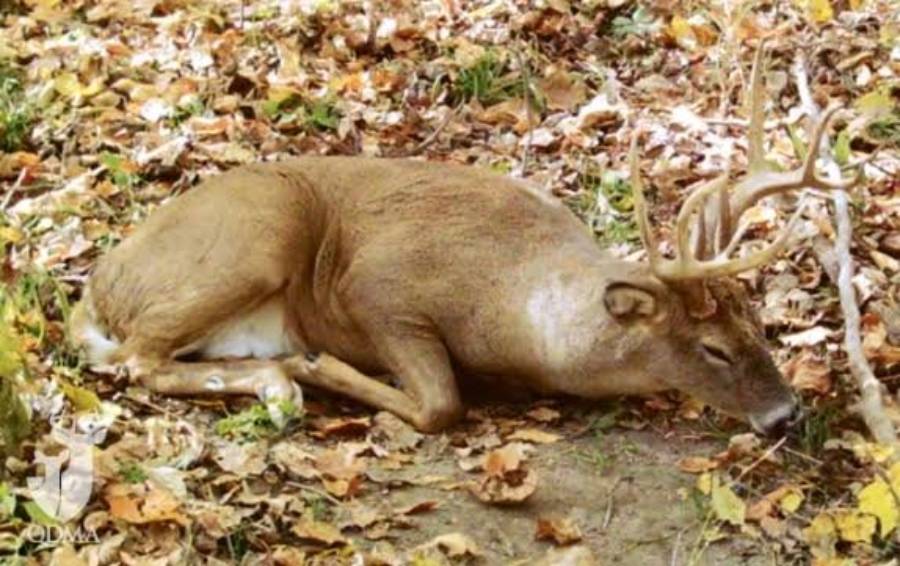
Deer generally close their eyes when they sleep, but they can lie still with their eyes open or partially open while resting and remaining alert. This behavior can make a resting deer look asleep, especially when observed from a distance. As prey animals, deer rely heavily on awareness of their surroundings, so periods of deeper sleep are balanced with lighter rest and frequent responses to sounds, scents, and movement.
For hunters, the distinction between sleeping and resting matters because a bedded deer is not necessarily unaware of what is happening around it. A deer lying in cover may remain attentive even when its body appears relaxed. Its ears can respond to sounds, its nose continues detecting scent, and its eyes may open as its level of alertness changes. This helps explain why approaching a bedded deer without being detected can be difficult.
Understanding how deer sleep therefore requires more than looking at whether their eyes are open or closed. Their body position, head movement, sensory awareness, bedding location, and activity patterns provide additional clues. This article explains how deer sleep, what a sleeping deer looks like, when and where deer bed, and what these behaviors mean for hunters.
Do Deer Sleep With Their Eyes Open?
Deer normally close their eyes during actual sleep, but they may keep their eyes open or partially open while resting. This distinction explains why hunters sometimes see a bedded deer that appears to be asleep even though its eyes remain open. A deer can lower its head, remain motionless, and relax its body without entering a deeper state of sleep.
Sleeping and resting are therefore not interchangeable behaviors. During rest, a deer can remain visually aware of its surroundings and quickly increase its level of alertness when it detects a potential threat. During sleep, its eyes are more likely to be closed and its responsiveness is reduced. Deer alternate between these states rather than remaining deeply asleep for one long, uninterrupted period.
Eye position alone is not enough to determine whether a deer is asleep. A hunter observing a bedded deer should also consider its head position, ear movement, body posture, and responses to the surrounding environment. A deer lying down with open eyes should generally be treated as awake or resting rather than assumed to be asleep.
Why Do Deer Open Their Eyes While Resting?
Deer open their eyes while resting to monitor their surroundings for potential danger. Deer are prey animals, so remaining aware of predators and other disturbances is an important part of their resting behavior. Opening the eyes allows a bedded deer to gather visual information without standing up or leaving its bed.
A resting deer can shift between relaxed and alert states as environmental conditions change. A sound, movement, unfamiliar scent, or other disturbance can cause the animal to raise its head or focus its attention in a particular direction. Once the perceived threat passes, the deer may relax again without leaving the bedding area.
This behavior is especially relevant to hunters because a motionless deer should not be considered unaware simply because it has remained in the same position for an extended period. Open eyes are one indication that the deer may still be monitoring its surroundings, while movement of the ears or head can provide additional evidence that it remains alert.
How Do Deer Sleep While Staying Alert to Danger?
Deer stay alert around sleeping periods by relying on short transitions between sleep, rest, and active vigilance rather than remaining continuously unresponsive. This pattern allows a deer to obtain rest while retaining opportunities to detect approaching danger. Its survival depends on recognizing a threat early enough to stand, orient toward it, and escape when necessary.
Three senses are especially important when a deer is bedded: smell, hearing, and vision. The nose can detect airborne scent from predators or humans, while independently moving ears help the deer locate sounds without requiring large body movements. Vision becomes more important when the deer has its eyes open and is actively checking the area around its bed. Together, these senses make a bedded deer difficult to approach undetected.
Bedding location also contributes to this defensive behavior. Deer can use vegetation, terrain, and surrounding space in ways that provide concealment while still allowing them to monitor potential threats. The exact advantages of a bed depend on habitat and conditions, so bedding behavior should not be reduced to a single rule such as deer always choosing the thickest available cover.
For hunters, this means a bedded deer can remain capable of detecting danger even when it appears relaxed. A deer does not need to be standing or actively feeding to notice a hunter. Sound, scent, visible movement, or a combination of these cues can change a resting animal’s behavior before the hunter sees an obvious reaction.
The practical distinction is therefore between physical inactivity and sensory inactivity. A deer may be physically inactive while lying in its bed but still process information from its surroundings. Recognizing that distinction helps explain both why deer can rest in areas exposed to potential threats and why hunters can have difficulty approaching bedded deer without alerting them.
What Does a Sleeping Deer Look Like?
A sleeping deer typically lies down with a relaxed body, limited head movement, and closed or mostly closed eyes. Its legs are positioned beneath or alongside the body, allowing it to rest without remaining fully upright. However, body posture alone does not prove that a deer is asleep because deer use similar positions while resting and remaining alert.
Head position provides another useful clue. A relaxed deer may lower its head or hold it in a comfortable position for an extended period, while an alert deer is more likely to raise its head and orient toward a sound, scent, or visible disturbance. These changes can happen quickly, so a deer that looks relaxed at one moment may become attentive without standing up.
Ear movement is particularly important when observing a bedded deer. A deer can remain almost motionless while rotating its ears toward different sounds. Frequent ear movement, changes in head position, and open eyes indicate that the animal is still monitoring its environment. Hunters should therefore avoid using lack of body movement as the only sign that a deer has fallen asleep.
How Can You Tell Whether a Deer Is Sleeping or Just Resting?
The clearest difference is that a sleeping deer shows a more complete reduction in visible alertness, while a resting deer continues monitoring its surroundings. No single visual sign provides a perfect test from a distance, so eye position, head position, ear movement, and responses to environmental stimuli should be considered together.
A deer with open eyes, active ears, and occasional head movements is more consistent with an alert resting state. A deer with closed eyes, a relaxed posture, and reduced head and ear activity is more consistent with sleep. Between these states, a deer may briefly close its eyes and then become attentive again, which can make the transition difficult to identify during a short observation.
This distinction matters to hunters because bedded does not mean sleeping. Bedding describes the deer lying in a resting location, whereas sleeping describes its physiological state. A bedded deer may be asleep, resting quietly, grooming, chewing cud, or actively monitoring its surroundings. Treating every bedded deer as asleep can lead a hunter to underestimate how easily the animal can detect an approach.
Where Do Deer Usually Sleep?
Deer usually sleep and rest in bedding areas that provide a combination of security, cover, and opportunities to detect approaching danger. A bedding area is not simply a place where a deer happens to lie down. Its location can help the animal reduce exposure while maintaining access to information about its surroundings.
Cover is one component of a secure bedding location. Vegetation such as brush, tall grass, young trees, or dense woodland can reduce visibility from outside the bed. Terrain can provide similar protection. Depending on the habitat, deer may use slopes, ridges, depressions, field edges, wooded cover, or transitions between different vegetation types as places to bed.
Visibility and escape opportunities can also influence the usefulness of a bedding location. Dense vegetation may provide concealment, while a more open direction can allow a deer to visually monitor part of the surrounding area. Access to an escape route gives the animal a way to leave quickly after detecting danger. These characteristics can occur in different combinations, which is why deer beds are found in more than one type of terrain or vegetation.
Wind and scent are particularly relevant in a hunting context because deer rely strongly on their sense of smell. The value of a specific wind direction depends on terrain, habitat, the position of potential threats, and how the deer is using the location. Hunters should therefore avoid assuming that every deer bed follows one universal wind rule.
Bedding locations can also change as conditions change. Food availability, weather, human disturbance, hunting pressure, vegetation, and seasonal behavior can alter which areas provide the best combination of security and access to resources. A bedding area that receives regular deer use under one set of conditions may receive less use when those conditions change.
For hunters, identifying a likely bedding area is therefore different from simply finding thick cover. The stronger interpretation comes from combining several pieces of evidence, such as actual beds, tracks, trails, droppings, nearby feeding areas, terrain features, and signs of repeated deer movement. These clues provide more context for determining whether an area functions as a regular resting location rather than a place a deer used only once.
Do Deer Return to the Same Bedding Areas?
Deer can return to the same bedding areas when those locations continue to provide security, suitable cover, and access to the surrounding habitat. However, repeated use of a bedding area does not mean an individual deer will occupy exactly the same bed every day. Deer can use multiple beds and shift between them as environmental conditions and perceived risks change.
A bedding area becomes valuable when it supports the deer’s need to rest without sacrificing its ability to detect danger. Cover can reduce visual exposure, terrain can influence how an animal detects approaching threats, and nearby escape routes allow it to leave quickly. When these advantages remain consistent, the same general area may continue to attract deer.
Conditions around the bedding area can change its use. Human disturbance, hunting pressure, changes in available cover, food sources, weather, and seasonal movement can make another location more suitable. A deer that regularly uses one area under low disturbance may alter its bedding behavior after repeated encounters with people.
Hunters should therefore distinguish between a deer bed and a bedding area. A bed is the specific depression or location where a deer has lain down. A bedding area is the broader location containing one or more places suitable for bedding. Finding a single bed confirms that a deer used that spot, but it does not establish how frequently the deer returns or whether the bed belongs to the same animal each time.
Repeated sign provides more useful context. Multiple beds, established trails entering or leaving cover, tracks, droppings, and other evidence of recurring deer activity can indicate that a location receives regular use. Hunters can combine these signs with observations of terrain and nearby movement routes rather than treating one isolated bed as proof of a predictable daily pattern.
This distinction is important when scouting because deer behavior is responsive rather than fixed. A productive bedding area can remain useful over time, but hunters should expect deer to adjust where they rest when security conditions change.
When Do Deer Sleep During the Day and Night?
Deer sleep and rest during both the day and night rather than following one continuous nighttime sleep period like humans. Their daily behavior alternates among feeding, traveling, bedding, resting, and shorter periods of sleep. As a result, seeing a deer bedded during daylight does not mean it has remained asleep throughout the day.
Deer activity is commonly associated with periods around dawn and dusk, but activity patterns should not be interpreted as a rigid schedule. A deer can feed or travel during daylight and can also move during the night. Likewise, it can bed and sleep during either period. Habitat, season, weather, food availability, reproductive behavior, and disturbance can all influence when these activities occur.
A bedded period can contain several different behaviors. A deer may lie quietly, remain alert, chew cud, groom itself, briefly sleep, and return to an alert resting state without leaving the bed. This explains why observations of a bedded deer do not necessarily reveal exactly how much time the animal has spent asleep.
For hunters, the distinction between bedding time and sleeping time is especially important. Daytime bedding does not mean a deer is continuously asleep and easy to approach. Even when it remains in one location for an extended period, it can periodically monitor its surroundings through scent, hearing, and vision.
Hunting pressure can also influence when and where deer feel secure enough to remain active. Repeated disturbance may change deer movement and habitat use, but hunters should not reduce this relationship to a rule that pressured deer simply become completely nocturnal. Deer behavior reflects multiple environmental and biological factors rather than hunting pressure alone.
Understanding these activity changes is more useful than assuming deer follow an exact daily timetable. For scouting purposes, hunters can combine direct observations with tracks, trails, bedding sign, feeding locations, terrain, and known sources of disturbance to understand how deer use a particular property during different parts of the day.
Read more: Do Deer React to Human Footprints? Hunter Guide
How Long Do Deer Sleep Each Day?
Deer do not follow one long, continuous sleep period, so their daily sleep is divided into shorter episodes mixed with resting and alert behavior. This makes it difficult to assign one universal number of sleeping hours to every deer. Age, season, habitat, disturbance, and individual behavior can influence how much time an animal spends sleeping versus simply lying in a bed.
This distinction also explains why the amount of time a deer spends bedded should not be treated as its total sleep duration. A deer can remain in the same bedding area for an extended period while alternating between several activities. It may close its eyes and sleep, wake and scan the surrounding area, chew cud, groom itself, reposition its body, and then return to sleep without standing up.
Shorter sleep episodes provide an important survival advantage for a prey animal. Remaining unresponsive for a long period would reduce opportunities to detect predators and other disturbances. Alternating sleep with alert resting periods allows deer to recover while repeatedly checking their environment.
For hunters, the important point is that a deer that has been bedded for a long time has not necessarily been asleep for that entire period. The animal may become more or less alert several times while remaining in approximately the same location. This is another reason why a bedded deer should never be assumed to be unaware of an approaching hunter.
Exact sleep-duration claims should also be treated carefully. Observing how long a deer remains in its bed is easier than determining precisely how much of that period represents physiological sleep. Without measurements that distinguish sleep from quiet rest, a specific daily sleep total can create more certainty than the observation supports.
What Sleeping and Bedding Behavior Should Hunters Look For?
Hunters should look for multiple signs of repeated bedding activity rather than relying on a single deer bed or assuming that a motionless deer is asleep. Useful evidence includes visible beds, tracks, trails entering and leaving cover, droppings, hair, nearby feeding locations, and repeated observations of deer using the same general area. Combining these signs provides a stronger picture of how deer use a location.
The condition and distribution of beds can provide additional context. Several beds concentrated within suitable cover indicate a different pattern from one isolated depression with no supporting deer sign nearby. Tracks and trails can also show how deer enter and leave the area, while nearby feeding and travel locations help place the bedding site within a broader movement pattern.
Hunters should also pay attention to the behavior of deer they can observe directly. A bedded deer that repeatedly moves its ears, raises its head, looks in different directions, or reacts to sounds is still actively monitoring its surroundings. These behaviors indicate that physical inactivity does not equal a lack of awareness.
Scent is another important consideration because a deer does not need to see a hunter to detect danger. A hunter may remain visually concealed yet still alert a bedded deer when human scent reaches its location. Likewise, unnecessary movement or noise can provide additional warning signals. The deer’s reliance on several senses helps explain why approaching bedding cover can be difficult even when the animal appears inactive.
Bedding sign should be interpreted within its environmental context rather than as an isolated clue. Terrain, vegetation, available food, escape routes, human activity, and hunting pressure can affect how useful a location is to deer. A hunter who understands these relationships can make a more informed assessment of why deer are bedding in a particular area and whether that pattern is likely to continue.
How Should Hunters Interpret a Deer Lying Down With Its Eyes Open?
Hunters should interpret a deer lying down with its eyes open as bedded and potentially alert, not automatically as sleeping. An open-eyed deer can remain physically relaxed while continuing to monitor sounds, scents, and movement around its bedding location.
Watch the ears and head in addition to the eyes. Ear rotation can indicate that the deer is tracking sounds, while a raised or suddenly repositioned head can indicate increased attention. Changes in body tension or orientation can provide further evidence that the animal has detected something unusual.
Distance can make these behaviors difficult to interpret. A deer may appear completely motionless through the naked eye while making subtle ear, eye, or head movements. Binoculars or other lawful observation equipment can make these details easier to see without requiring the hunter to move closer simply to determine whether the deer is alert.
The most useful rule is simple: do not equate bedded with asleep or open eyes with an unusual form of sleep. Deer can remain in a resting position while maintaining substantial awareness of their surroundings. Their eyes are only one part of that system; hearing, smell, posture, bedding location, and reactions to environmental cues provide additional information about their level of alertness.