
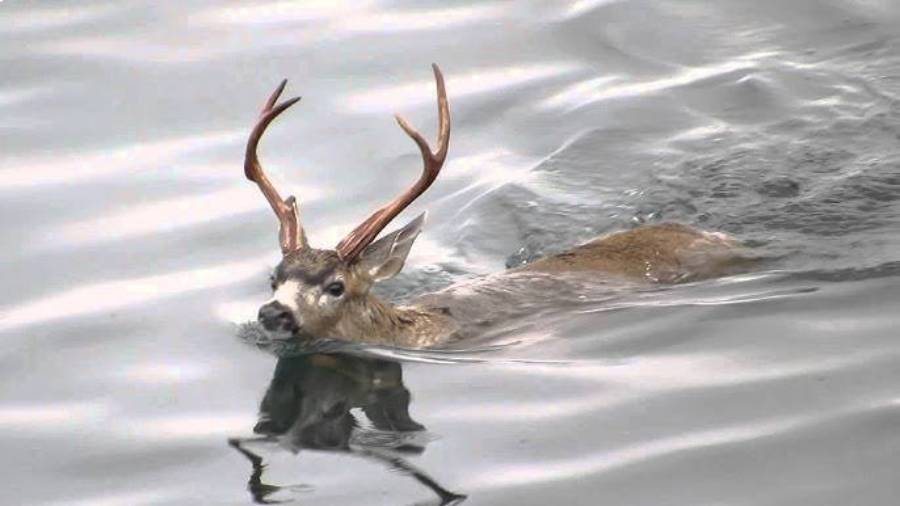
Deer can swim long distances and are strong enough swimmers to cross rivers, lakes, and other bodies of water when necessary. Their exact swimming range is not fixed because endurance depends on the deer’s species, age, physical condition, water temperature, current, waves, and the distance between suitable exit points. A healthy adult deer can therefore handle a water crossing that would represent a significant obstacle to many other land animals.
Deer enter water for several practical reasons, including reaching new habitat, moving between feeding and bedding areas, avoiding predators, and escaping disturbances. Their body structure allows them to keep their head above the surface while their legs provide propulsion, making swimming a functional part of deer movement rather than an unusual behavior. However, being a capable swimmer does not mean a deer can safely cross every river or lake. Strong currents, cold water, exhaustion, and difficult banks can turn a crossing into a serious risk.
For hunters, this ability changes how rivers and lakes should be interpreted when reading terrain. A body of water can influence a deer’s travel route without completely stopping its movement. Understanding how far deer can swim, how they cross water, and why they choose specific crossing points helps hunters evaluate waterways as part of the larger deer movement system.
Can Deer Swim Long Distances?
Deer can swim long distances because they are capable swimmers with enough buoyancy, leg strength, and endurance to cross substantial bodies of water. Swimming is a functional form of movement for deer rather than an ability limited to emergencies. They can enter rivers, lakes, and other waterways when moving through their habitat, reaching another area, or avoiding a threat. A wide stretch of water can slow or redirect a deer, but the presence of water alone does not mean the animal cannot continue its route.
A deer swims by keeping its head and upper neck above the surface while using its legs to generate forward propulsion. This position allows the animal to breathe normally while moving through deep water where its hooves cannot touch the bottom. The same long, powerful legs that allow deer to travel quickly across land also provide repeated strokes in water. As a result, deep water does not automatically stop deer movement simply because the animal can no longer walk along the bottom.
Swimming ability and swimming endurance are not the same, however. A deer being physically capable of a long crossing does not mean every deer can cover the same distance. An adult in good physical condition has a different endurance level from a young, injured, exhausted, or otherwise compromised animal. Environmental conditions also change the effort required. Calm water allows the deer to direct more of its effort toward forward movement, whereas a strong current can push the animal downstream and increase the total distance it must cover before reaching land.
This distinction matters to hunters because waterways should be evaluated as movement features rather than automatic boundaries. A river may discourage deer from crossing at one location while creating a predictable crossing opportunity at another. Bank accessibility, current, nearby cover, and the habitat on the opposite side can all influence whether a deer chooses to enter the water. Hunters who assume deer will never cross substantial water may overlook travel routes that connect two otherwise separated areas of habitat.
How Far Can Deer Swim?
There is no single maximum swimming distance that applies to every deer. The distance a deer can cover depends on the species, age, physical condition, water conditions, and purpose of the crossing. This makes a fixed universal figure misleading: an observed long-distance crossing demonstrates what a particular deer accomplished under particular conditions, not what every deer will routinely do.
The practical difference between maximum swimming ability and normal water-crossing behavior is especially important. Deer do not need to swim their maximum possible distance every time they enter water. A deer crossing a river may only need to remain in deep water for a short period, while movement across a large lake or between land masses can require substantially greater endurance. For hunters, the more useful question is therefore not only “How far can deer swim?” but also “What would make a deer cross this particular stretch of water?”
At least 6 variables can affect the distance of a deer crossing: physical condition, age, species, current, water temperature, and the availability of suitable entry and exit points. Current is particularly important in rivers because the distance traveled through the water can exceed the straight-line width between the banks. A deer entering a fast-moving river may be carried downstream as it swims toward the opposite side. Cold water and prolonged exposure can also increase the physiological demands of a long crossing, while poor physical condition reduces the animal’s available endurance.
Shoreline structure further changes whether a crossing is practical. Reaching the opposite side is not enough if the bank is too steep or otherwise difficult to exit. A usable crossing therefore consists of more than open water: it includes an accessible entry point, a manageable route through the water, and an exit point that allows the deer to return to land. This helps explain why repeated deer movement may become concentrated at specific locations even when a longer section of the same river appears crossable.
For hunting purposes, the width of a river or lake should not be used by itself to decide whether deer can cross it. Hunters should evaluate water conditions together with tracks, established trails, accessible banks, cover, and habitat on both sides. Repeated sign leading into and away from the shoreline provides stronger evidence of an active crossing than simply assuming that a narrow section must be the preferred route. In this way, deer swimming ability becomes part of interpreting the broader movement pattern rather than an isolated fact about the animal.
How Fast Can Deer Swim?
Deer can swim efficiently enough to cross rivers and other bodies of water, but swimming speed varies with the animal and water conditions. A single speed should not be treated as universal for every deer species or every crossing. Current, waves, fatigue, body condition, and the direction of travel can all change how quickly a deer reaches the opposite shore.
Swimming speed also describes only one part of a deer’s ability to cross water. Speed and endurance measure different aspects of swimming performance. A deer may move quickly over a short distance but require substantially more energy to maintain that pace during a long crossing. Conversely, a deer moving at a sustainable pace may remain in the water longer without covering the distance as quickly. This distinction is important when evaluating whether a deer can cross a particular river or lake.
River current further separates swimming speed from actual crossing speed. A deer can continue swimming toward the opposite bank while the current carries its body downstream. In this situation, the animal travels diagonally rather than directly across the river. The resulting route is longer than the river’s width, and the exit point may be considerably downstream from the entry point. Stronger currents increase this displacement and require the deer to expend more energy to complete the crossing.
For hunters, the practical value of swimming speed is therefore limited when considered alone. Entry points, current direction, downstream exit locations, and shoreline cover provide more useful information for interpreting deer movement. A trail entering the water on one side of a river does not necessarily continue directly opposite on the other bank. Checking downstream terrain and suitable exit areas can provide a more complete picture of the crossing route.
Can Deer Swim Across Rivers?
Deer can swim across rivers, including water deep enough that they cannot walk along the bottom. Rivers can influence where deer travel, but they do not automatically create an impassable boundary. Whether a deer crosses depends on the width of the river, current, bank structure, water conditions, the animal’s physical condition, and its motivation for reaching the opposite side.
River width is only one part of crossing difficulty. A relatively wide section with calm water and accessible banks may present a more manageable crossing than a narrower section with a strong current and steep banks. Once the water becomes deep enough for swimming, the deer must maintain forward movement while also compensating for any downstream force produced by the current. The stronger that force becomes, the greater the physical demand of reaching the other bank.
Strong currents make river crossings more difficult because they increase downstream displacement and the total effort required to reach land. A deer entering moving water can be carried away from its original line of travel even while actively swimming toward the opposite bank. The animal may consequently emerge farther downstream than expected. Extremely difficult water conditions also increase the risk of exhaustion before a suitable exit point is reached.
Bank structure affects both the beginning and end of the crossing. Deer need a practical way to enter the water and, more importantly, regain solid ground after swimming. Gradual or accessible banks provide easier exit opportunities than steep, unstable, or obstructed shorelines. Nearby vegetation and security cover can also make one exit area more useful than another because reaching the bank does not complete the animal’s broader movement objective; the deer still needs to move into suitable habitat.
For hunters, a river should be treated as a terrain feature that can redirect and concentrate deer movement rather than as an absolute barrier. Search for repeated tracks, trails approaching the bank, disturbed soil, and corresponding travel routes on the opposite or downstream shore. When these signs occur at accessible entry and exit points, they provide stronger evidence of an established crossing than river width alone. This approach connects water crossings with the larger pattern of deer travel between bedding areas, feeding areas, cover, and other parts of their habitat.
Can Deer Swim Across Lakes?
Deer can swim across lakes when the distance and water conditions are within their physical limits. Unlike rivers, lakes generally do not expose a swimming deer to continuous downstream current, but open-water crossings can still require substantial endurance. Distance, waves, water temperature, wind, physical condition, and the availability of suitable shoreline exits determine how difficult a lake crossing becomes.
The absence of a strong current does not make every lake crossing easy. A deer moving across open water must continue swimming until it reaches suitable land, and the energy requirement increases as the route becomes longer. Waves can make it harder for the animal to maintain its position and keep its head comfortably above the surface. Cold water can add physiological stress during prolonged exposure. A healthy adult deer crossing calm water therefore faces different conditions from an exhausted, injured, or young deer attempting the same route in rough or cold water.
Deer also do not need to cross directly from one side of a lake to the other. The route a deer chooses depends on where it needs to go and which shoreline provides practical access to habitat. An animal may follow the edge of a lake, enter at a narrow section, or use water to reach another area when the destination provides food, cover, or another habitat resource. This distinction matters because swimming ability alone does not predict where a crossing will occur.
For hunters, a lake should therefore be interpreted together with the surrounding terrain. Points, narrow sections, islands, accessible banks, vegetation, and nearby cover can influence how deer move around or across the water. Tracks and established trails near the shoreline provide evidence of actual movement, while the shape of the lake only indicates where crossings might be physically practical.
A lake can consequently function as both an obstacle and a feature that concentrates movement. Deer may avoid unnecessary open-water travel while still being physically capable of swimming when there is a reason to reach the opposite side. Hunters should distinguish between water that affects the route a deer chooses and water that completely prevents deer movement. This distinction becomes especially useful when evaluating hunting areas where feeding cover, bedding cover, or security habitat lies on opposite sides of a body of water.
Why Do Deer Swim Across Rivers and Lakes?
Deer swim across rivers and lakes primarily to continue moving through their habitat, reach resources, or escape threats. Water crossing is therefore connected to broader deer behavior rather than occurring simply because deer are capable of swimming. The reason for entering the water can change with habitat conditions, seasonal movement, disturbance, food availability, security needs, and the location of suitable cover.
Access to habitat is one reason deer cross water. Feeding areas, bedding cover, and other useful habitat features are not always located on the same side of a river or lake. When water separates two areas a deer needs to use, swimming provides a way to maintain movement between them. The value of the destination can influence whether the animal accepts the additional effort of a water crossing. This is why the habitat on both sides of the water is more informative to a hunter than the water feature considered in isolation.
Avoiding danger is another reason a deer may enter water. Deer respond to predators and other disturbances by moving toward routes that increase separation from the perceived threat. Because deer can swim, water remains one possible component of an escape route. A river that restricts movement for a pursuing threat does not necessarily restrict a deer to the same degree. However, the available material does not establish that deer consistently choose water as a preferred response to hunting pressure, so individual crossings should not automatically be interpreted as hunter-avoidance behavior.
Seasonal and routine movement can also bring deer to waterways without an immediate threat being present. Deer move through landscapes to use changing food sources, cover, and other habitat resources. When a river or lake intersects those movements, the animal may travel around the water or cross it depending on the conditions and destination. Repeated use can consequently create identifiable entry and exit areas along the shoreline.
For hunters, the reason behind a crossing matters because a repeated habitat-related crossing provides different information from a single escape event. Tracks and trails repeatedly connecting useful habitat on both sides of a waterway can indicate an established travel pattern. A single set of tracks entering the water after a disturbance provides much less evidence that deer regularly use the same location.
The strongest interpretation therefore combines water-crossing evidence with the surrounding habitat. Hunters should examine where trails originate, what lies across the water, where deer can exit safely, and whether sign indicates repeated use. This turns a river or lake from a simple boundary on a map into part of the larger deer movement system.
Are Deer Naturally Good Swimmers?
Deer are naturally capable swimmers because their body structure allows them to remain afloat while using all four legs for propulsion. Swimming does not require deer to maintain contact with the bottom. Once the water becomes too deep for walking or wading, they can continue forward by paddling while keeping the head and upper neck above the surface.
The legs provide the primary propulsion during swimming. Deer have long, powerful limbs adapted for terrestrial movement, and these limbs can produce repeated strokes in water. The animal maintains a relatively horizontal body position while keeping its nose and mouth clear of the surface. This combination of buoyancy and continuous leg movement allows a deer to cross water considerably deeper than its standing height.
However, being a good swimmer does not make deer aquatic or semi-aquatic animals. Their swimming ability functions as one component of terrestrial movement. Deer still depend on dry land for feeding, bedding, reproduction, and most daily activities. Entering deep water therefore has a different function from swimming behavior in mammals that spend substantial portions of their lives in aquatic environments.
Physical capability also varies between individual deer. An adult in good condition can sustain a demanding crossing more effectively than an animal weakened by injury, exhaustion, or poor condition. Environmental resistance adds another variable. Calm water requires the deer primarily to propel its own body, while current and waves force it to expend additional energy maintaining direction and reaching a usable shoreline.
For hunters, the important point is that deep water should not automatically be considered beyond a deer’s movement capability. The fact that a deer cannot touch the bottom does not mean the route ends there. When tracks or trails lead toward deep water, hunters should consider the possibility of an actual swimming route and examine accessible shoreline areas on the other side before concluding that the trail stops at the water.
Can Whitetail Deer Swim Long Distances?
White-tailed deer can swim and can use water crossings as part of their movement through suitable habitat. However, a precise universal maximum swimming distance for whitetails should not be stated without species-specific evidence. Individual condition and the characteristics of the water crossing affect how demanding a particular route becomes.
Whitetails have the same basic locomotor advantages that allow deer to move through deep water: buoyancy combined with propulsion from the legs. This means a river, creek, lake, or other body of water can influence whitetail movement without necessarily stopping it. A deer can leave one shoreline, swim through water beyond standing depth, and regain land where the opposite bank provides a usable exit.
This distinction is particularly relevant in whitetail hunting because water features can help shape travel routes. A river may restrict the number of convenient crossing locations even when whitetails are physically capable of swimming across it. Current, bank steepness, cover, and habitat distribution can make certain sections more practical than others. Repeated use of those locations can concentrate deer sign around specific approaches and exits.
Hunters should therefore look for physical evidence before identifying a location as a regular whitetail crossing. Tracks entering soft shoreline soil, established trails approaching the water, disturbed mud, and corresponding sign on the opposite or downstream bank provide stronger evidence than the appearance of the waterway itself. Trail-camera observations can provide additional confirmation when cameras can be positioned legally and practically along the approaches.
Species-specific evidence also matters when discussing how far whitetails can swim. Deer species differ in body size, habitat, behavior, and ecology, so an exceptional swimming distance documented for another cervid should not automatically become a maximum-distance claim for white-tailed deer. For the same reason, observations of a single whitetail crossing should be described as evidence of that event rather than proof that all whitetails routinely cover the same distance.
For hunting applications, the most useful conclusion is therefore not a theoretical maximum distance. It is that whitetails are capable of crossing water, so hunters should evaluate waterways in relation to terrain, habitat, and verified deer sign. A water feature that appears to divide two hunting areas on a map may still contain travel connections where deer can enter, cross, and exit efficiently.
Can Fawns Swim?
Fawns can swim, but their swimming endurance should not be assumed to equal that of healthy adult deer. Young deer have smaller bodies and less developed physical capacity, so age and condition become especially important when a water crossing requires sustained effort. The available source material for this article does not establish a reliable universal distance that a fawn can swim, so assigning a specific maximum would create unsupported precision.
A fawn entering deep water uses the same basic swimming mechanism as other deer: it keeps its head above the surface and moves its legs to generate propulsion. The ability to remain afloat means water deeper than the fawn’s standing height is not automatically impassable. However, the ability to swim and the ability to sustain a long, difficult crossing are separate questions. A short crossing through calm water places different demands on a young animal than prolonged exposure to cold water, waves, or current.
Physical development also means hunters should avoid interpreting adult deer swimming capability as a direct measurement of fawn capability. Age, body condition, crossing distance, and water conditions all affect the effort required. A route regularly used by mature deer may therefore present a different level of difficulty for a young animal, particularly when the crossing involves fast-moving water or difficult shoreline access.
For hunting purposes, fawn swimming ability reinforces a broader principle: water does not create the same movement restriction for every deer. Species, age, condition, and environmental circumstances change how an individual animal responds to the same terrain feature. Hunters should rely on actual tracks, trails, observations, and other deer sign when determining whether a particular water crossing is being used.
What Conditions Make Swimming Dangerous for Deer?
Swimming becomes dangerous for deer when environmental conditions or physical limitations increase the energy required to reach land beyond what the animal can sustain. The main risk factors include strong currents, long crossing distances, cold water, rough water, exhaustion, injury, poor physical condition, and difficult exit banks. These factors can also interact, making a crossing substantially harder than any single characteristic suggests.
Strong current is one of the clearest examples. A deer attempting to cross moving water must generate forward propulsion while the current pushes it downstream. This increases the actual distance traveled and can move the animal away from its intended exit point. The deer may then need to remain in the water longer or search for another accessible bank, increasing energy expenditure and the risk of exhaustion.
Long distance increases risk because swimming requires continuous physical effort until the deer reaches a usable exit. A deer crossing calm water over a short distance has a different energy requirement from one making an extended open-water crossing. Waves or rough surface conditions can further increase the effort required to maintain direction and keep the head comfortably above water. The combination of distance and adverse conditions is therefore more informative than distance alone.
Cold water can add another source of physiological stress during prolonged exposure. The importance of temperature increases when the deer remains in the water for longer periods or is already in poor physical condition. The available material does not provide a deer-specific temperature threshold at which a crossing becomes unsafe, so a precise cutoff should not be claimed without stronger evidence.
Injury and exhaustion reduce the animal’s available physical capacity before the crossing even begins. A healthy adult deer and an injured deer confronting the same river do not face an equivalent challenge. Young animals can likewise have different endurance from mature deer. Swimming capability should therefore be evaluated as the interaction between the deer, the distance, and the water conditions rather than as a fixed species-wide limit.
The exit bank is another important part of crossing safety. A deer can successfully swim across the open water yet still encounter difficulty if the shoreline is steep, unstable, obstructed, or otherwise difficult to climb. An accessible exit reduces the amount of time the deer must remain in the water, whereas an unsuitable bank may force it to continue swimming until another exit becomes available.
For hunters, these conditions explain why a deer being able to swim does not mean every section of a waterway is equally crossable. Calm water, accessible banks, manageable distances, and suitable habitat on the opposite side can make one location more practical than another. Strong currents, difficult banks, and unnecessary open-water exposure can discourage movement elsewhere. Identifying this difference helps hunters interpret waterways as variable terrain rather than treating an entire river or lake as either completely passable or completely impassable.
Read more: Do Deer Cross Rivers? What Hunters Should Know
What Does Deer Swimming Behavior Mean for Hunters?
Deer swimming behavior means hunters should treat rivers, lakes, and other waterways as features that influence deer movement rather than boundaries that automatically stop it. Deer can enter deep water and swim when a crossing provides access to useful habitat or another travel route. The practical hunting question is therefore not simply whether deer can cross the water, but where they are most likely to enter and exit it.
Water can concentrate deer movement because not every section of a shoreline provides equally practical crossing conditions. Current, bank structure, crossing distance, nearby cover, and habitat on the opposite side can make one location more suitable than another. For example, a deer traveling toward bedding cover across a river may use an accessible bank instead of entering at a nearby section with a steep shoreline. Repeated decisions of this type can produce recognizable travel routes around water.
Hunters can identify potential deer water crossings by looking for multiple pieces of physical evidence rather than relying on a single sign. Useful evidence includes tracks in mud or sand, established trails approaching the shoreline, disturbed soil at entry and exit locations, and corresponding deer sign on the other side. Trail-camera observations can strengthen the interpretation by showing whether deer repeatedly approach or leave the water at the same location.
The exit side deserves particular attention. A deer crossing moving water may not emerge directly opposite its entry point because the current can carry it downstream. Hunters examining only the corresponding point on the opposite bank could therefore miss the actual exit. Checking downstream for tracks, trails, accessible banks, and security cover provides a more complete assessment of the crossing.
Habitat context determines whether a potential crossing is relevant to a larger movement pattern. A water crossing becomes more meaningful when it connects areas deer have a reason to use, such as feeding habitat, bedding cover, or secure travel terrain. Tracks disappearing into water are evidence that a deer entered at that location, but they do not by themselves establish how frequently the route is used. Repeated sign and evidence on both sides provide a stronger basis for identifying a consistent travel corridor.
Hunters should also distinguish routine movement from movement caused by disturbance. A deer may enter water while escaping a threat, but one event does not establish that the same route is part of its normal travel pattern. This distinction prevents hunters from interpreting every water crossing as a predictable hunting location. Frequency, direction of travel, surrounding habitat, and repeated physical evidence provide the context needed to evaluate its significance.
Should Hunters Treat Rivers and Lakes as Barriers to Deer Movement?
Hunters should not automatically treat rivers and lakes as absolute barriers to deer movement because deer are capable of swimming across water that is too deep to walk through. Water can restrict, redirect, or concentrate movement, but its effect depends on the characteristics of the waterway and the terrain surrounding it.
A useful distinction is between a movement barrier and a movement funnel. A barrier makes travel sufficiently difficult that deer avoid or rarely cross it. A funnel does not prevent travel; instead, it makes certain routes more practical than others and concentrates movement through those locations. A river with difficult banks along most of its length but several accessible crossing areas can function more like a funnel than a complete boundary.
River conditions can change this effect from one location to another. A section with strong current, steep banks, or a long open-water crossing can impose a higher movement cost. Another section of the same river may have calmer water and accessible entry and exit points. Deer capable of swimming can therefore respond to the river by selecting a more manageable crossing rather than avoiding the entire waterway.
Lakes create a similar terrain problem. A lake may redirect deer around its shoreline while still allowing crossings where the route and destination justify entering the water. Hunters should examine points, narrow sections, shoreline trails, accessible banks, and habitat distribution instead of assuming that deer will always travel around the lake. Evidence of repeated use remains more valuable than predicting a crossing from map geometry alone.
Waterways can also create misleading assumptions during digital scouting. A river displayed between two habitat areas on a map can appear to separate them completely, yet deer swimming ability means those areas may remain connected. Conversely, knowing that deer can swim does not justify assuming they will cross at every convenient-looking location. On-the-ground sign or reliable observations are needed to determine how deer actually use the terrain.
The most useful hunting interpretation combines water conditions, terrain, habitat, and deer sign. Identify what lies on both sides of the water, locate practical entry and exit banks, account for current where relevant, and then look for evidence of repeated deer movement. This approach treats swimming as one component of deer behavior and provides a stronger basis for interpreting travel routes than classifying every river or lake as either passable or impassable.